Last updated: June 2026 — written by the Gymnase Tips training team.
Yes, you can build muscle without lifting weights — but only if you train close to failure, progressively overload through harder variations or higher reps, and eat enough protein (0.7 to 1.0 g per pound of bodyweight). Bodyweight training builds significant muscle in beginners and intermediates; advanced lifters chasing maximum size eventually hit a ceiling without external load. Below is the science, the realistic ceiling, and a 4-week template.
The question gets two answers depending on context. For an untrained beginner, the answer is an unequivocal yes — push-ups, pull-ups, squats, and lunges build noticeable muscle in the first 6 to 12 months. For someone with 5+ years of advanced training already, the truthful answer is “to a point.” Let’s get into why.
The science: muscle doesn’t care where the load comes from
Hypertrophy research consistently shows three primary drivers: mechanical tension, metabolic stress, and proximity to failure. Neither barbells nor dumbbells nor body weight are uniquely required — what matters is delivering enough tension at high effort levels often enough across weeks and months. The ACSM position stand on resistance training recognizes bodyweight exercise as a legitimate hypertrophy stimulus when programmed for adequate volume and intensity.
How far can bodyweight training take you?
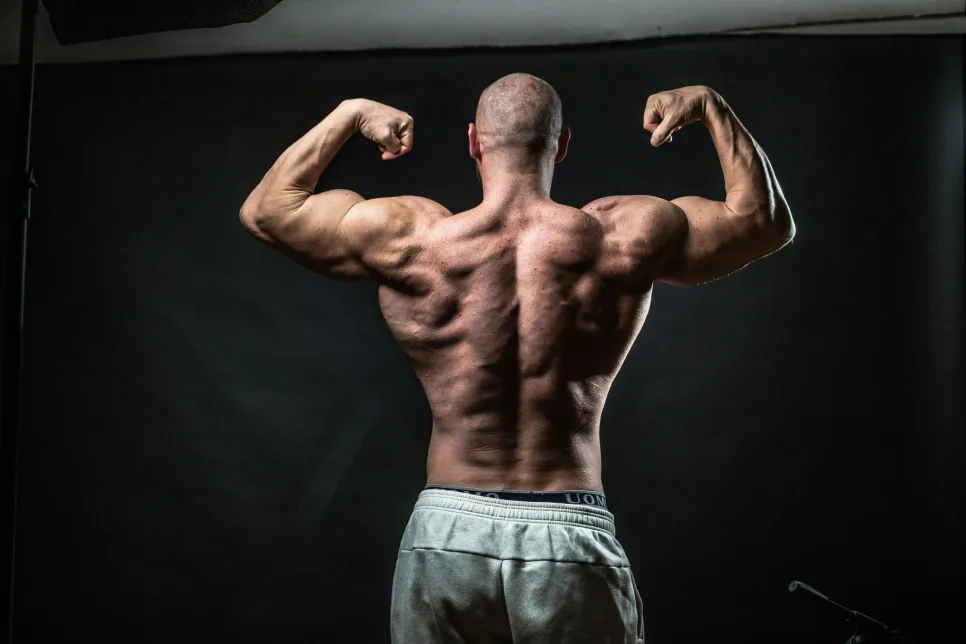
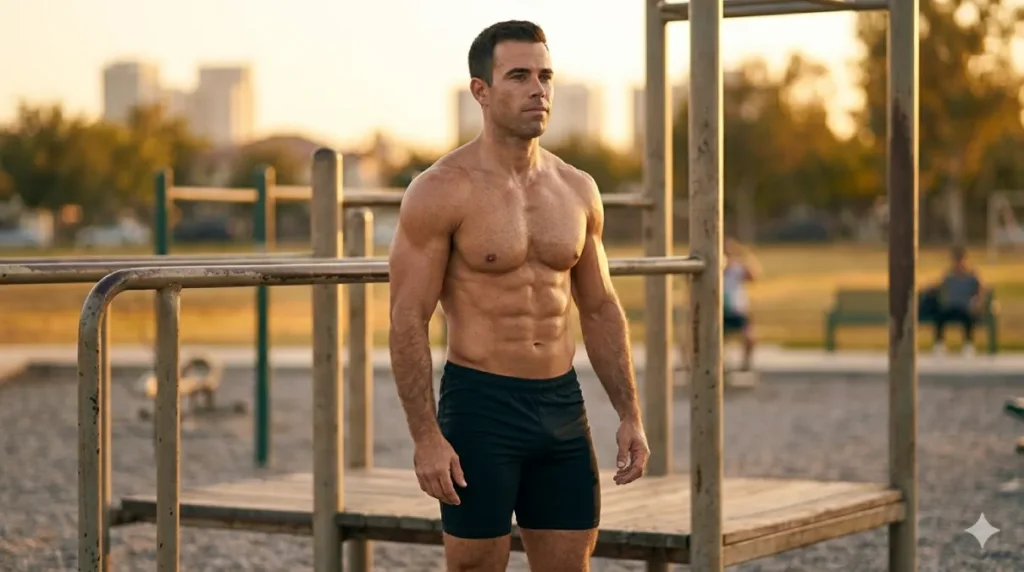
Look at advanced gymnasts and high-level calisthenics athletes — many have never deadlifted in their lives, yet they’re built like bodybuilders through their backs, shoulders, arms, and chests. Front-lever, planche, ring muscle-up, and one-arm pull-up training generates massive mechanical tension on small surface areas of muscle.
That said, two areas plateau earliest with bodyweight only:
- Hamstrings and posterior chain — without RDLs, deadlifts, or heavy hip thrusts, hamstring development lags.
- Maximum quad size — pistol squats and shrimp squats challenge balance more than they challenge raw load tolerance.
Most lifters get ~70 to 80 percent of their potential muscle size from well-programmed bodyweight work alone. The last 20 to 30 percent generally requires external resistance.
The 4 keys to building muscle without weights
1. Train close to failure
Stop sets within 1 to 3 reps of failure on most working sets. If you can do 50 push-ups and stop at 20, you’re not loading the muscle enough.
2. Progress through harder variations
This is the bodyweight equivalent of adding plates. Standard push-up → diamond → archer → one-arm assisted → one-arm. Pull-up → archer pull-up → typewriter → one-arm assisted. Squat → split squat → pistol squat → shrimp squat.
3. Accumulate enough volume
10 to 20 hard sets per muscle group per week is the typical hypertrophy range. With bodyweight that means hitting upper-body push, upper-body pull, and lower-body work 2 to 3 times per week.
4. Eat enough protein
0.7 to 1.0 g of protein per pound of bodyweight per day. Without that, no amount of training builds muscle efficiently. Whether you eat before or after training matters less than total daily intake — see our breakdown of eating before vs. after a workout.
A 4-week bodyweight muscle-building template
Three sessions per week, 45 to 60 minutes each. Rest 60 to 90 seconds between sets. Each set goes within 2 reps of failure.
Day A — Push and core
- Push-up variation (best you can do for 8 to 12 reps) — 4 sets
- Pike push-up or handstand push-up — 4 sets of 6 to 10
- Dips (parallel bars or sturdy chairs) — 3 sets to near failure
- Hollow body hold — 3 sets of 30 to 45 sec
Day B — Pull and legs
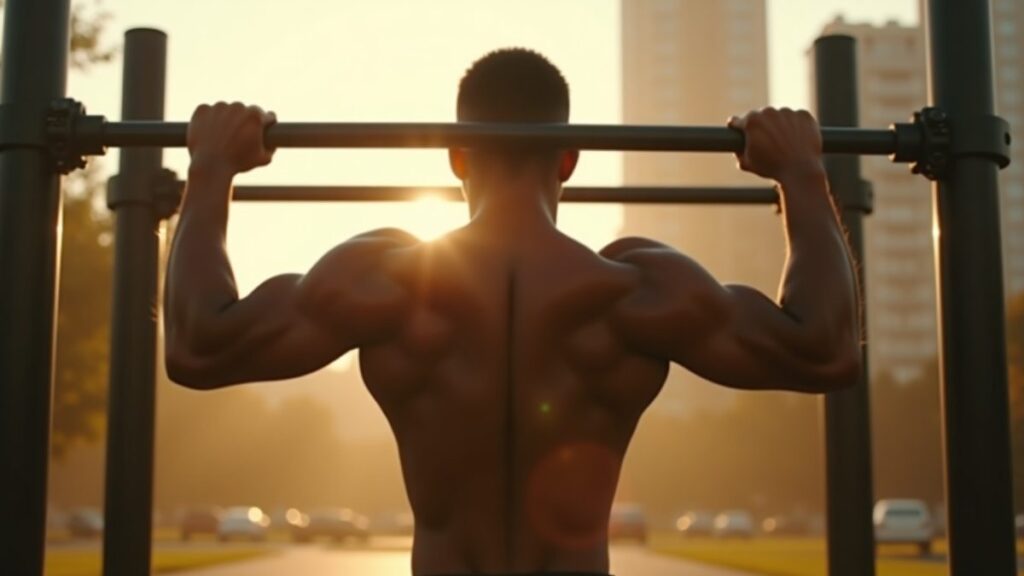
- Pull-up or chin-up variation — 4 sets of 6 to 10
- Inverted row — 4 sets of 10 to 15
- Bulgarian split squat — 4 sets of 12 per leg
- Single-leg glute bridge — 3 sets of 15 per leg
Day C — Full body
- Pistol squat or assisted pistol — 4 sets of 6 to 10 per leg
- Archer push-up — 4 sets of 6 to 8 per side
- Australian rows — 4 sets to near failure
- Hanging leg raise — 3 sets of 10 to 15
- Calf raise — 3 sets of 20
Add one rep per set per week before progressing to a harder variation. For deeper templates, our military calisthenics workout and calisthenics back workout are direct extensions of this approach.
Don’t ignore the diet
Building muscle without weights still requires a slight caloric surplus — roughly 200 to 400 calories above maintenance for natural lifters past the beginner stage. Skip the “lean bulk while ripped” fantasy. If you’re trying to gain mass and lose fat at the same time and you’re not a complete beginner, expect slow progress on both fronts.
When to consider adding weights
Add weights when one of these is true:
- You can do 8+ strict, controlled reps of one-arm push-ups, pistol squats, and one-arm chin-ups (advanced bodyweight ceiling).
- You’re explicitly chasing maximum hamstring or quad size.
- You enjoy lifting and have access to a gym — there’s no penalty for combining methods.
For a head-to-head comparison, our guide on lifting weights vs. bodyweight for mass gain goes deeper into the trade-offs.
FAQ
How long does it take to build noticeable muscle without weights?
For beginners eating well and training 3 days a week, visible upper-body change shows in 8 to 12 weeks. Lower-body change tends to lag slightly because most people start with stronger legs from daily walking.
Can I build a six-pack with bodyweight only?
Yes — six-pack visibility is a body-fat issue, not a training-equipment issue. Bodyweight ab moves like hollow holds, V-ups, leg raises, and dragon flags build serious midline development.
Will high-rep push-ups make me bigger?
To a point. Once 30+ reps becomes easy, the stimulus shifts toward muscular endurance over hypertrophy. That’s when you switch to harder variations (decline, archer, one-arm) instead of more reps.
Do I need protein powder if I’m doing bodyweight only?
Only if you can’t hit your daily protein target with whole foods. Protein powder is convenient, not magical. See our guide on supplements that actually work for context.
Is bodyweight training enough for older adults?
For most older adults, well-programmed bodyweight work plus targeted resistance bands is highly effective — and gentler on joints than maximal lifting. Our leg strengthening exercises for seniors guide is a good starting point.
The bottom line: can you build muscle without lifting weights? Yes — most lifters can build a strong, muscular physique with bodyweight alone, especially in the first several years. Train hard, progress through harder variations, eat enough protein, and the results show. For more on the comparison, our gym vs. calisthenics deep dive helps you choose the path that fits your goals.