


TL;DR — What’s the Right HYROX Training Plan for You?
A HYROX training plan runs 8 to 12 weeks and pairs interval running with race-specific strength work performed under fatigue. Pick the 12-week beginner plan if you can’t run 5K continuously or haven’t strength-trained consistently in three months; pick the 8-week intermediate plan if you already run 10K comfortably and lift twice a week. Both plans build in deload weeks and a race-week taper.
Table of contents
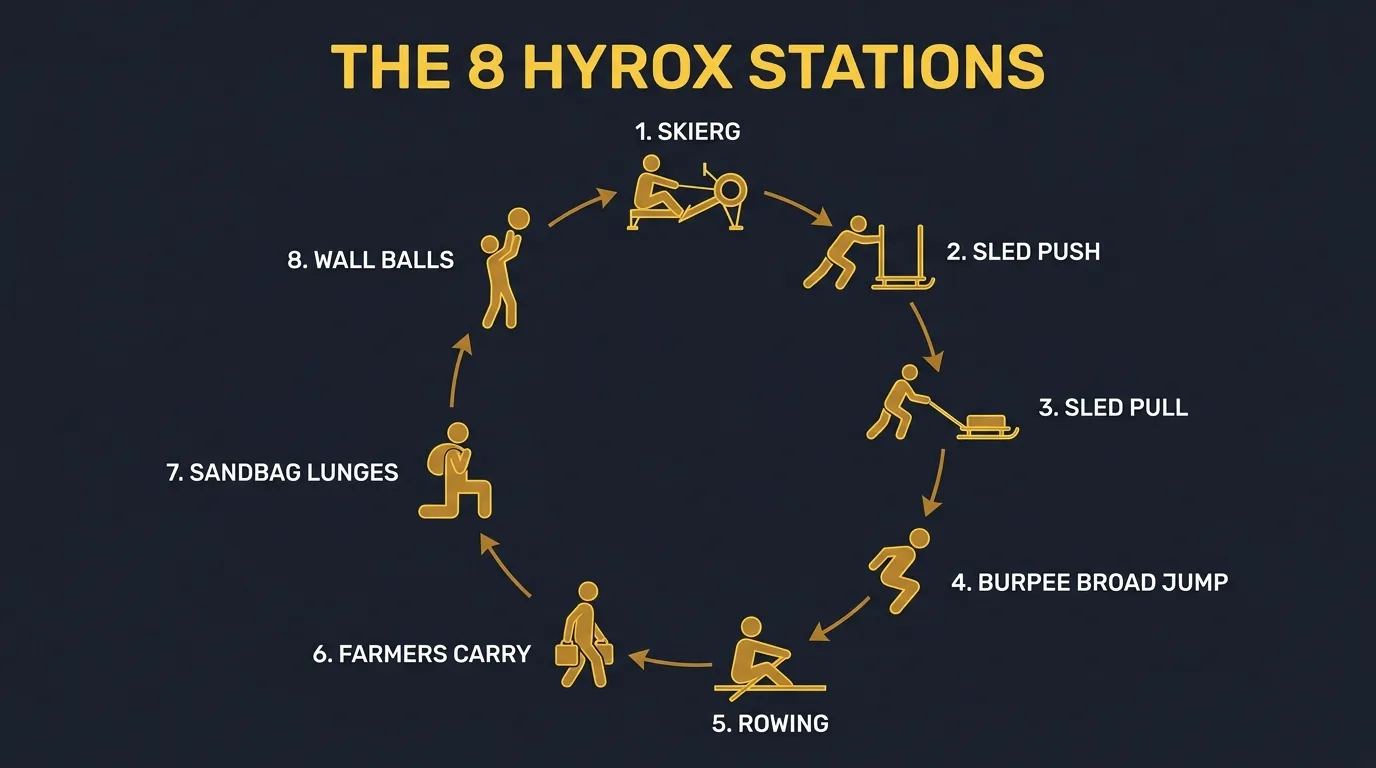
A HYROX training plan has to do two things most running or lifting programs don’t: build a real aerobic engine and keep your legs functional under load. The race is eight 1km runs, each followed immediately by a strength station: SkiErg, sled push, sled pull, burpee broad jumps, rowing, farmers carry, sandbag lunges, and wall balls (Source: HYROX official race format, hyrox.com, 2026). Train running and strength as separate hobbies and you’ll blow up around station five. This guide gives you a full 12-week beginner plan and an 8-week intermediate plan, both built week by week, plus the programming logic behind them.
Training with race-accurate loads? See the full station-by-station weight chart by division in our HYROX weights for men guide.
How Long You Need: 8-Week vs. 12-Week Plan
Pick 12 weeks if you can’t currently run 5K without stopping or you haven’t strength-trained consistently in the last three months. Pick 8 weeks if you can already run 10K comfortably and you squat, deadlift, and carry loaded objects at least twice a week. How much base you need to build before race-specific work sticks is what determines the plan length, not your fitness level on race day.
Two quick checks before you choose:
- Running test: Can you run 5km continuously at a conversational pace? If yes, you can skip the pure base-building phase and start at week 5 of the beginner plan (which is effectively the intermediate plan’s starting point).
- Strength test: Can you back squat and deadlift your bodyweight for reps, and carry two 24kg kettlebells 40 meters without stopping? If not, spend at least 4 weeks on strength fundamentals before adding compromised running.
If you’re short on time entirely, with under 4 weeks to race day, don’t try to compress either plan further. Switch to maintaining current fitness and prioritizing technique on the two stations you’re weakest at instead of chasing volume you can’t recover from.
Beginner HYROX Training Plan (12 Weeks)
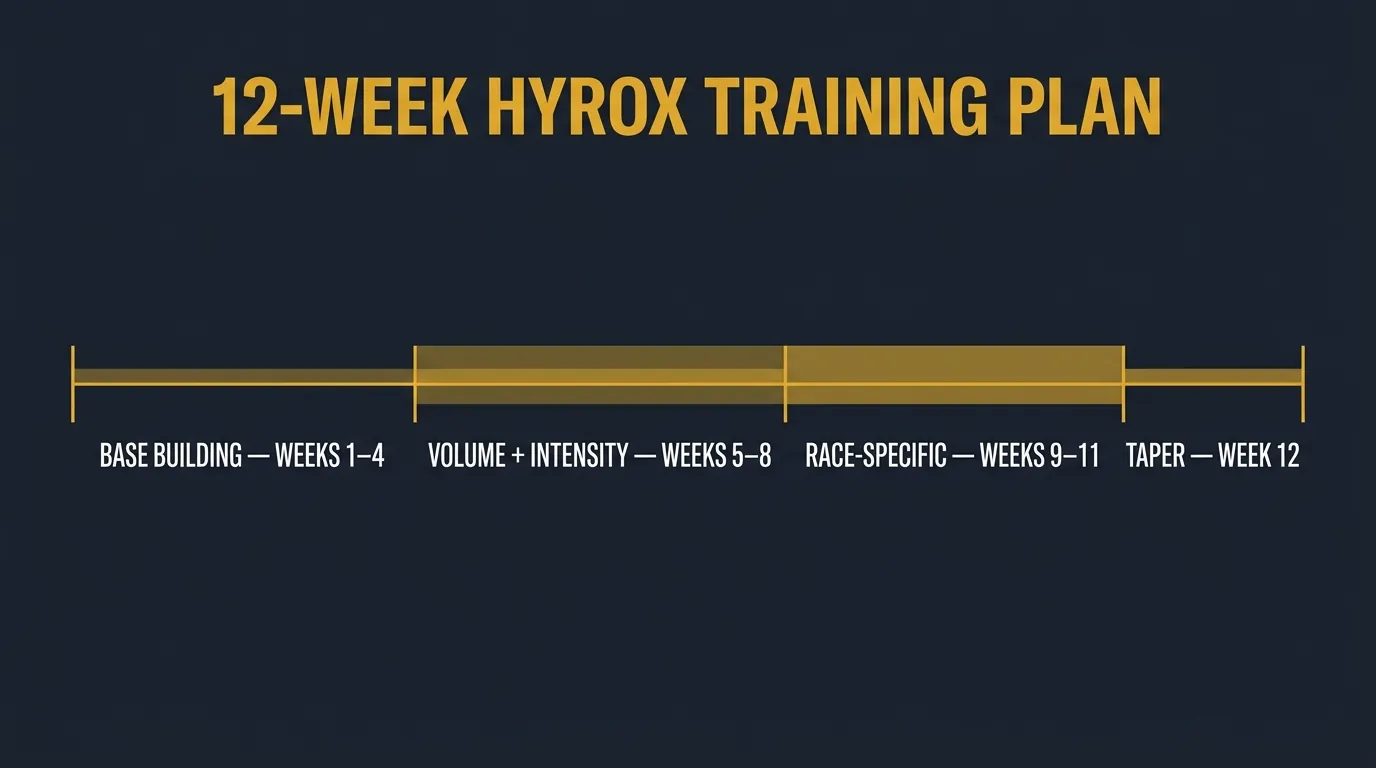
The beginner HYROX training plan runs three 4-week phases plus a taper: base building, volume and intensity, race-specific work, and taper. Every 4th week is a deload week with meaningfully reduced volume — that’s when the previous three weeks of adaptation lock in. Four training days a week is the baseline here; see the split options section below if you need three or five.
Phase 1: Weeks 1–4 — Base Building
| Week | Day 1: Run | Day 2: Strength | Day 3: Run | Day 4: Strength |
|---|---|---|---|---|
| 1 | Zone 2 run, 20 min | Back squat 4×8 @ RPE 6, Romanian deadlift 3×10, sled push drill 4x15m (bodyweight sled) | Zone 2 run, 20 min | Deadlift 4×6 @ RPE 6, overhead press 3×8, sled pull drill 4x15m |
| 2 | Zone 2 run, 25 min | Back squat 4×8 @ RPE 7, RDL 3×10, sled push 4x20m (add light load) | Zone 2 run, 25 min | Deadlift 4×6 @ RPE 7, OHP 3×8, sled pull 4x20m |
| 3 | Zone 2 run, 28 min | Front squat 4×6, RDL 3×10, sled push 4x25m | Zone 2 run, 28 min | Deadlift 4×5 @ RPE 7, OHP 3×8, sled pull 4x25m |
| 4 (deload) | Easy run, 15 min | Back squat 2×8 @ RPE 5, RDL 2×8, sled push 2x15m (light) | Easy run, 15 min | Deadlift 2×6 @ RPE 5, OHP 2×8, mobility 15 min |
Zone 2 means you can hold a full conversation — roughly 60–70% of max heart rate. This isn’t wasted time; 70–80% of your total cardio volume should sit in this zone to build the aerobic base that everything else depends on (Source: Roxzone Training, “Zone 2 Training for HYROX,” 2025).
Phase 2: Weeks 5–8 — Volume + Intensity
| Week | Day 1: Run | Day 2: Strength + HYROX-specific | Day 3: Intervals | Day 4: Strength + HYROX-specific |
|---|---|---|---|---|
| 5 | Zone 2 run, 30 min | Front squat 4×6, farmers carry 4x30m (moderate KBs), walking lunges 3×16 steps | 6x400m @ 5K pace, 90s rest | Deadlift 4×5, wall balls 4×15, sled push 4x25m |
| 6 | Zone 2 run, 32 min | Front squat 4×6, farmers carry 4x40m, walking lunges 3×20 steps | 6x400m, 90s rest (faster than wk5) | Deadlift 4×5, wall balls 4×20, sled push/pull 4x25m each |
| 7 | Zone 2 run, 35 min | Front squat 4×5, farmers carry 4x50m, walking lunges 4×20 steps | 6x600m, 2min rest | Deadlift 4×4, wall balls 4×20, sled push/pull 4x30m each |
| 8 (deload) | Easy run, 20 min | Front squat 2×6 (light), farmers carry 2x30m | 4x400m, easy effort | Deadlift 2×5 (light), wall balls 2×12 |
This is where you introduce the actual HYROX movement patterns — farmers carries, lunges, wall balls — not just general strength. The intervals train your ability to recover heart rate quickly, which matters more on race day than raw top-end speed.
Phase 3: Weeks 9–11 — Race-Specific Training
This phase is built around compromised running: running immediately after a fatiguing station, which is the single hardest skill HYROX demands and the thing pure runners underestimate (Source: Red Bull, “How to Master Compromised Running for HYROX,” 2025).
| Week | Day 1: Compromised Run | Day 2: Strength (technique-focused) | Day 3: Compromised Run | Day 4: Strength (light) |
|---|---|---|---|---|
| 9 | 5x (800m run + 15 burpee broad jumps) | Squat 3×5 @ RPE 6, single-leg RDL 3×8/side, core circuit | Full race simulation: 8x1km run + 8 stations at 80% race effort | Deadlift 3×5, farmers carry technique 4x40m |
| 10 | 5x (1km run + 12 sandbag lunges/side) | Squat 3×5, single-leg RDL 3×8/side, core circuit | 4x (1km run + sled push 20m + 15 wall balls) | Deadlift 3×5, sled push/pull technique |
| 11 | 4x (1km run + 20 wall balls) | Squat 3×4 (light), mobility | Full race simulation #2: full 8x1km + 8 stations at 85–90% race effort | Light full-body circuit, 20 min easy |
Run a full or near-full race simulation roughly every two weeks in this phase, not weekly. It’s too taxing to recover from more often than that, and doing it too close to race day will leave you flat instead of sharp.
Week 12: Taper
| Day | Session |
|---|---|
| Monday | Easy run, 15–20 min, conversational pace |
| Tuesday | Light technique session: mobility, wall ball form drills, sled push at 30% of race load — no new volume |
| Wednesday–Thursday | Rest |
| Friday | Optional 10-minute shakeout jog + light dynamic stretching |
| Saturday–Sunday | Full rest, or race day |
Don’t be tempted to squeeze in “one more” hard session during taper week. The fitness is already built by week 11. Taper week is about arriving with fresh legs, not extra conditioning.
Intermediate HYROX Training Plan (8 Weeks)
If your running and strength base already checks out, skip base-building entirely and start where the beginner plan’s volume phase would be — just with a higher starting load and less ramp-up time. Same structure, same deload logic, compressed into 8 weeks with 3 build weeks, 3 race-specific weeks, one peak week, and one taper week.
| Week | Phase | Key Sessions |
|---|---|---|
| 1 | Build | Zone 2 runs 30–35 min x2, intervals 6x600m, front squat 4×6, farmers carry 4x40m, wall balls 4×20 |
| 2 | Build | Zone 2 runs 35 min x2, intervals 6x800m, front squat 4×5, farmers carry 4x50m, sled push/pull 4x30m each |
| 3 (deload) | Build | Easy runs 20 min x2, light strength at 50% volume, mobility |
| 4 | Race-specific | Compromised run: 5x (1km + 15 burpee broad jumps); strength technique day; 4x (1km + wall balls) |
| 5 | Race-specific | Compromised run: 5x (1km + 20 sandbag lunges/side); half-race simulation (4x1km + 4 stations) at 85% effort |
| 6 | Race-specific | Compromised run: 4x (1km + sled push/pull); light strength; core and mobility |
| 7 (peak) | Simulation | Full race simulation, 8x1km + 8 stations at 90–95% race effort — your best predictor of race pacing |
| 8 | Taper | Easy 15-min runs, light technique work, full rest 2–3 days before race |
The two plans differ in how much time is spent building the aerobic base before race-specific work starts, not in intensity ceiling. Intermediate athletes already have that base, so all 8 weeks go toward sharpening race-specific fitness instead of constructing it from scratch.
Weekly Split Options: 3-Day, 4-Day, 5-Day
Both plans above assume 4 training days a week. Adjust based on your schedule, not the calendar:
- 3 days/week: Combine strength and running into hybrid sessions (e.g., squat + short run, or farmers carry + intervals in the same workout). You’ll progress slower — add 2–3 weeks to either plan if you’re limited to 3 days throughout. If you’re this tight on time long-term, our 28-day military workout is a lower-commitment alternative that still builds a strength-endurance base.
- 4 days/week: The structure used above — 2 dedicated run days, 2 strength/HYROX-specific days. This is the sweet spot for most people balancing a full-time job.
- 5 days/week: Add a 5th easy Zone 2 session (20–30 min) or a mobility/core day. Don’t add a 3rd hard interval or compromised-running session. Extra hard days without extra recovery is how people get hurt in week 9, not week 1.
Race-Week Taper and Simulation Session
The last full race simulation should land 10–14 days before race day, not race week itself — you need time to absorb it. Race week is about volume reduction, not new stimulus: cut total training volume by 60–70%, keep intensity brief and technique-focused, and stop all strength training with meaningful load by 3 days out. Sleep and carbohydrate intake in the final 48 hours matter more than any workout you could still fit in.
If you haven’t run a single full simulation before race day, don’t panic — a well-built 12-week plan gets you there through compromised running blocks even without one perfect full rehearsal. But if you can fit one in, it’s the single best predictor of your actual pacing strategy on the day.

Training the 8 Stations Without Race Weights
You don’t need to train every session at exact competition loads — most weeks should use 60–80% of race weight for volume work, saving full race-weight sets for the simulation sessions in the final phase. What matters more early on is movement competency: can you sled push in a straight line without wasting energy, can you keep your wall ball form together at rep 40, can you switch farmers carry hand position without stopping.
Race weights differ by division (Open vs. Pro) and by sex, and they’re specific enough that we’ve broken them out separately rather than repeating them here — see HYROX weights for men: every station by division in kg and lb for the exact sled, farmers carry, sandbag, and wall ball loads you’ll actually face on race day.
Common Programming Mistakes
- Running too little. HYROX is 8km of running under fatigue, more than most people’s weekly running mileage combined. Treating it as a “gym workout with some cardio” is the single biggest reason first-timers blow up mid-race.
- Skipping compromised running. Training runs when fresh and stations when fresh separately doesn’t prepare you for running on dead legs. If your plan never combines the two, it’s incomplete.
- Ignoring deloads. Skipping the reduced-volume weeks because “you feel fine” is how people show up to race-specific training already fatigued, then get hurt or plateau in exactly the phase that matters most.
- Peaking too early. Running your hardest simulation the week of the race instead of 10–14 days out leaves you tired on the start line instead of sharp.
FAQ
How many days a week should I train for HYROX?
Four days a week is the practical minimum for balanced progress — two running-focused sessions and two strength/HYROX-specific sessions. Three days works with hybrid sessions but takes longer; five days lets you add easy volume or mobility work, not more high-intensity sessions.
How long does it take to train for HYROX (8 vs. 12 weeks)?
Twelve weeks if you can’t yet run 5K continuously or haven’t strength-trained consistently in the last three months. Eight weeks if you already run 10K comfortably and lift twice a week — you can skip straight to race-specific work.
Can I train for HYROX at home or without a HYROX-specific gym?
Yes, for most of the plan. Zone 2 runs, intervals, squats, deadlifts, and lunges need no special equipment. You’ll need access to a sled, SkiErg, or rower for a handful of sessions in the race-specific phase — most commercial gyms or CrossFit boxes have these even without full HYROX branding. If gym access is the real barrier, our military calisthenics workout guide covers a bodyweight-strength alternative you can run alongside the running sessions.
What’s the difference between a beginner and intermediate HYROX plan?
Time spent building the aerobic base. Beginners need 4 dedicated weeks of base training before race-specific work; intermediates already have that fitness, so all 8 weeks go directly into race-specific volume, compromised running, and simulation work.
Do I need to do all 8 stations every training session?
No. Most sessions target 1–2 stations plus running. Save full 8-station simulations for the race-specific phase — running them more than every 2 weeks adds fatigue without added benefit.
Sources and Verification
- HYROX official race format — 8x1km runs, 8 functional stations, fixed order (SkiErg, Sled Push, Sled Pull, Burpee Broad Jump, Rowing, Farmers Carry, Sandbag Lunges, Wall Balls): hyrox.com, 2026
- Zone 2 training volume guidance (70–80% of cardio volume): Roxzone Training, 2025
- Compromised running definition and physiology: Red Bull, 2025
- Race format and run/station sequencing detail: HYRESULT, 2026