
TL;DR — What Is Grip Strength Training?
Grip strength training means deliberately building the crush, support, and pinch grip through targeted exercises like dead hangs, farmer’s carries, and plate pinches, done 2-3x/week with progressive overload. It matters beyond the gym too: weak grip strength is a well-documented biomarker for overall health decline, and stronger grip generally tracks with better long-term outcomes. Test your dead hang time, compare it to the standards below, and follow the protocol to build from there.
Table of contents

What Is Grip Strength Training?
Grip strength training is the deliberate practice of building hand and forearm strength through exercises that isolate how you grab, hold, and squeeze — separate from the grip work your muscles absorb incidentally during deadlifts or pull-ups. Most lifters never train it directly. They assume enough carryover comes from compound lifts and wonder why their deadlift stalls at lockout or their pull-up set ends at rep 6 with their back barely fatigued.
The problem is specificity. General strength training loads your grip inconsistently and rarely to failure, so it lags behind the muscles it’s supporting. Direct grip work fixes that gap.
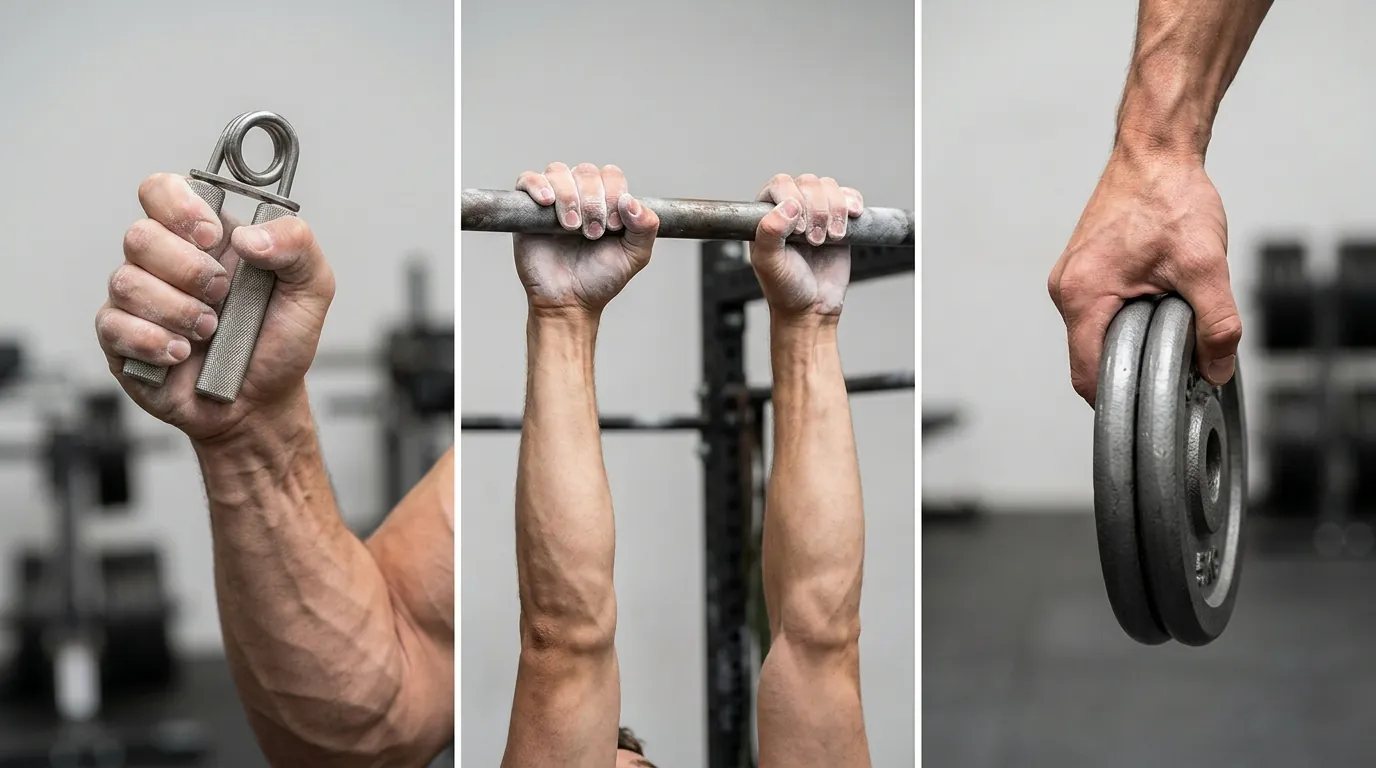
Grip strength isn’t one skill — it’s three. Crush grip closes your hand around an object. Support grip holds a load without your fingers closing further, like gripping a bar. Pinch grip squeezes an object between your thumb and fingers without wrapping around it. Each responds to different exercises and different dosages, covered in detail below.
Why Grip Strength Matters — The Longevity Link
Grip strength is one of the most consistently studied biomarkers of overall health, and the numbers are hard to ignore. In a study of 139,691 adults across 17 countries, every 5kg decline in grip strength was linked to a 16% increase in all-cause mortality risk (HR 1.16) and a 17% increase in cardiovascular mortality risk (HR 1.17), plus more modest upticks in heart attack risk (7%) and stroke risk (9%). Grip strength outpredicted systolic blood pressure as a marker for cardiovascular and all-cause mortality (Source: Leong et al., The Lancet, 2015).
That’s a striking number. It’s also, importantly, not proof that training your grip extends your life.
The PURE study measured an association, not a causal chain. Grip strength correlates with mortality because it functions as a proxy for total muscle mass, frailty, and general physiological reserve — people with more overall muscle and better systemic health tend to have stronger hands, not the other way around. The researchers didn’t test whether grip-specific training changes mortality risk, and no study since has established that it does. Treat this as a reason to value overall strength and muscle mass as a health marker worth tracking, not as a promise that hand grippers add years to your life.
The Three Types of Grip Strength
Crush Grip
Crush grip is the strength of your fingers closing around an object toward your palm, and it’s what most people picture when they hear “grip strength.” A hand gripper (like a Captains of Crush) trains it directly, as does the crushing phase of a heavy farmer’s carry where your fingers fight to keep the handle from rolling out of your palm. Dose it at 2-3 sets of 5-8 reps per hand, 2-3x/week, training close to but not at total failure.
Support Grip
Support grip is your ability to hold a static load for time without your hand closing any further — think holding onto a loaded barbell or hanging from a bar. The dead hang is the cleanest test and trainer for it: arms straight, shoulders slightly engaged rather than fully slack at the joint. Program it for 3 sets to near-failure, 3x/week, and it’s usually the first grip quality to show visible carryover to pull-ups and deadlift lockouts.
Pinch Grip
Pinch grip is squeezing an object between your thumb and fingers without wrapping your hand around it — the weakest of the three for most people, since it isolates the thumb instead of letting the whole hand share the load. A plate pinch hold (two smooth plates pinched face-to-face) is the standard exercise. Start light; even 10-15kg pinched for 20-30 seconds is genuinely hard for most beginners. Train it 2x/week, 3 sets per hand.
How to Increase Grip Strength
You increase grip strength by training all three grip types (crush, support, pinch) with progressive overload — adding hold time, weight, or reps over weeks — at a frequency of 2-3 sessions per week. Below is a rotation covering each grip type; you don’t need to do all six exercises every session, but hit each grip type weekly.
- Dead Hang — 3 sets to near-failure, 3x/week. Hang from a pull-up bar with arms straight, shoulders slightly engaged, not fully dead-hanging on the joint.
- Farmer’s Carry — 3 sets of 30-40m, 2x/week. Carry heavy dumbbells or a trap bar at your sides, walking with a tall posture and a tight core.
- Plate Pinch Hold — 3 sets per hand to near-failure, 2x/week. Pinch two smooth plates together face-to-face and hold; keep your wrist neutral, not flexed.
- Hand Gripper (crush) — 2-3 sets of 5-8 reps per hand, 2-3x/week. Close the gripper fully each rep rather than partial-repping; rest 60-90 seconds between sets.
- Wrist Curls and Extensions — 3 sets of 10-15 reps each direction, 2x/week. Use a light barbell or dumbbell, resting your forearms on a bench to isolate the wrist.
- Towel Pull-Ups (optional) — 2-3 sets of 3-6 reps, 1-2x/week. Drape towels over a pull-up bar and grip those instead of the bar; this combines crush and support demand and is genuinely difficult — add it once the basics feel easy.
Place grip work after your main lifts, not before. Pre-fatiguing your hands before a heavy pull or deadlift session will tank the very lift you’re trying to build (Source: NSCA, “Effective Methods of Grip Strength Development”).
Grip Strength Standards — Dead Hang Time and Estimated Strength by Age
Grip strength is professionally measured with a hand dynamometer, which gives a precise kilogram reading, but almost nobody owns one. A dead hang from a pull-up bar is the practical substitute: it’s free, it takes 30 seconds, and it tracks well enough with support-grip strength to self-assess where you stand.
The table below is not a clinical or peer-reviewed norm table — no single authoritative dataset publishes dead-hang-specific standards by age and sex. These are practical estimates based on commonly cited beginner/intermediate/advanced fitness benchmarks, meant for self-testing and program selection, not diagnosis.
| Age Band | Sex | Dead Hang — Beginner | Dead Hang — Average | Dead Hang — Good | Suggested Training Tier |
|---|---|---|---|---|---|
| 20-29 | M | Under 20s | 30-45s | 60s+ | Tier 1 if under 20s, Tier 2 if 30-45s, Tier 3 if 60s+ |
| 20-29 | F | Under 12s | 20-30s | 40s+ | Tier 1 if under 12s, Tier 2 if 20-30s, Tier 3 if 40s+ |
| 30-39 | M | Under 18s | 25-40s | 55s+ | Tier 1 if under 18s, Tier 2 if 25-40s, Tier 3 if 55s+ |
| 30-39 | F | Under 10s | 18-28s | 35s+ | Tier 1 if under 10s, Tier 2 if 18-28s, Tier 3 if 35s+ |
| 40-49 | M | Under 15s | 20-35s | 45s+ | Tier 1 if under 15s, Tier 2 if 20-35s, Tier 3 if 45s+ |
| 40-49 | F | Under 8s | 15-24s | 30s+ | Tier 1 if under 8s, Tier 2 if 15-24s, Tier 3 if 30s+ |
| 50-59 | M | Under 12s | 15-28s | 35s+ | Tier 1 if under 12s, Tier 2 if 15-28s, Tier 3 if 35s+ |
| 50-59 | F | Under 6s | 12-18s | 24s+ | Tier 1 if under 6s, Tier 2 if 12-18s, Tier 3 if 24s+ |
| 60+ | M | Under 8s | 12-20s | 25s+ | Tier 1 if under 8s, Tier 2 if 12-20s, Tier 3 if 25s+ |
| 60+ | F | Under 5s | 8-14s | 18s+ | Tier 1 if under 5s, Tier 2 if 8-14s, Tier 3 if 18s+ |
Tier 1 (beginner) means build the base with the full 3x/week protocol above at lighter loads. Tier 2 (intermediate) means the same frequency with heavier loads and longer holds. Tier 3 (advanced) means dropping to 2 harder sessions per week with a deload every 4-6 weeks, per the protocol in the next section.
How Often Should You Train Grip Strength? The Progressive Overload Protocol
Train grip strength 2-3x/week, adding small increments in hold time, weight, or reps each week, and deload every 4-6 weeks. This frequency is sustainable because grip recovers faster than large muscle groups, but the tendons connecting your forearm muscles to your fingers adapt slower than the muscle itself — that mismatch is where most grip injuries come from (Source: NSCA, “Effective Methods of Grip Strength Development”).
Two dedicated sessions per week is the reliable baseline for most lifters. A third session, if you add one, should stay lighter and focus on pinch or wrist work rather than another max-effort crush or hang session.
Progression is simple: if your dead hang held for 30 seconds this week, aim for 32-35 next week. If your farmer’s carry felt manageable at a given weight, add 5-10% before adding distance. Every 4-6 weeks, cut volume by roughly half for a week — this isn’t optional if you’re training grip 3x/week alongside heavy pulling and deadlifting, since that’s a lot of cumulative tendon stress.
Watch for elbow or wrist pain that lingers between sessions rather than fading within a day. That’s the signal to deload immediately, not wait for the scheduled one.
Does Grip Strength Decline With Age?
Yes. Grip strength typically peaks around age 30, holds relatively flat through the late 30s, and then declines at an accelerating rate, with the drop becoming more pronounced after roughly age 50 as part of the broader muscle-loss process known as sarcopenia (Source: MDPI, Journal of Clinical Medicine, 2025).
The rate of decline varies enough by individual, activity level, and measurement method that no single percentage-per-decade figure is reliable across studies. What is consistent: people who stay resistance-trained lose grip strength more slowly than sedentary peers of the same age. Longitudinal data from people in their mid-80s show measurable multi-kilogram declines even over a 5-year window, which underscores that this isn’t a slow, negligible process once it starts (Source: Newcastle 85+ Study, PMC, 2016).
Grip Training for Pull-Ups and Deadlifts
Grip is the most common limiting factor in both max pull-up sets and deadlift lockouts — your back and legs are often ready for more reps or more weight before your hands are. Training grip directly closes that gap faster than hoping for incidental carryover.
Sequence it deliberately: do grip work after your pulling or deadlift session, never before. A pre-fatigued grip on a heavy deadlift day turns a leg-and-back-limited lift into a hands-limited one, which caps the load you can move and reduces the training stimulus for the muscles you actually came to train.
If your pull-up ceiling is grip-limited specifically, work through progressions that build support grip under time and load before adding volume — see our guide to pull-up grip variations for a breakdown by hand position, and assisted pull-up progression if you’re still building toward your first strict rep. Once grip stops being the bottleneck, pull-up and deadlift numbers tend to move faster than expected.
FAQ
What is grip strength and why does it matter?
Grip strength is your hand and forearm’s ability to crush, hold, and pinch objects. It matters for direct performance reasons (pull-ups, deadlifts, carrying loads) and because it’s a widely studied biomarker correlated with overall muscle mass and long-term health outcomes.
What health issues are associated with weak grip strength?
In a 139,691-person study, every 5kg decline in grip strength was linked to a 16% higher all-cause mortality risk and 17% higher cardiovascular mortality risk (Source: Leong et al., The Lancet, 2015). This is a correlation — grip strength acts as a proxy for muscle mass and frailty — not proof that grip training itself changes mortality risk.
How can you improve grip strength?
Train all three grip types (crush, support, pinch) 2-3x/week using exercises like dead hangs, farmer’s carries, plate pinches, and hand grippers, adding small weekly increases in hold time, weight, or reps, with a deload every 4-6 weeks.
How is grip strength measured?
The clinical standard is a hand dynamometer, which gives a precise kilogram reading. Without one, a dead hang from a pull-up bar is a practical, equipment-free way to self-test support grip strength.
What is a good dead hang time for my age?
It depends on age and sex — for example, a good target is 60+ seconds for men in their 20s and roughly 40+ seconds for women in their 20s, dropping to around 25+ seconds for men and 18+ seconds for women at 60+. Full breakdown by age band is in the standards table above.
How often should you train grip strength?
2-3x/week, with progressive overload on hold time, weight, or reps, and a deload every 4-6 weeks to let tendons catch up with muscle adaptation.
Does grip strength decline with age, and how much?
Yes — it generally peaks around 30, stays roughly flat through the late 30s, then declines at an accelerating rate after about 50 as part of normal sarcopenia. There’s no single reliable percentage-per-decade figure, since the rate varies by individual and activity level, but staying resistance-trained slows the decline.
Sources
- Leong DP, Teo KK, Rangarajan S, et al. “Prognostic value of grip strength: findings from the Prospective Urban Rural Epidemiology (PURE) study.” The Lancet, 2015;386:266-273. ScienceDirect
- NSCA. “Effective Methods of Grip Strength Development.” NSCA PDF
- “Progressive Loss of Muscle Strength: The Effects of Ageing and Sarcopenia on Muscle Function in Older Females.” Journal of Clinical Medicine (MDPI), 2025. MDPI
- “Grip Strength Decline and Its Determinants in the Very Old: Longitudinal Findings from the Newcastle 85+ Study.” PMC, 2016. PMC