Last updated: May 2026 — written by James Nolan, Gymnase Tips senior trainer. For intermediate trainees with prior bodyweight and gymnastic strength experience.
A solid CrossFit ab workout combines high-skill gymnastic core moves (toes-to-bar, hollow holds, V-ups) with grinding bodyweight finishers (GHD sit-ups, weighted sit-ups, plank holds). The format is typically a 6 to 12 minute AMRAP or a short EMOM of 8 to 10 minutes, hit 2 to 3 times per week. Below are 6 staple movements, two complete WOD templates, scaling options for every level, and the warm-up that makes GHD work safe rather than disastrous.
CrossFit core training is different from typical ab routines because every movement involves global core bracing — even back squats, cleans, and wall balls hammer the midline. The dedicated ab work below sharpens what the lifts are already building.
Readiness Check Before You Start
This is intermediate programming. If any of these are no, run our calisthenics core workout first.
- 6+ months of consistent strength or CrossFit-style training
- 5+ strict pull-ups (or 8+ strict hanging knee raises)
- 60-second plank
- 30-second hollow body hold
- No current low-back pain or unresolved spinal issues
Why CrossFit-Style Ab Work Builds Strong Abs
Three reasons: high training density (lots of work in short windows), heavy compound carryover (cleans, snatches, overhead lifts demand massive bracing), and gymnastic skill development (T2B, L-sits, hollow rocks build deep flexion strength).
Honest framing on visible abs: training builds the muscle; visibility requires lower body fat than most marketing claims suggest. Clear definition typically needs roughly 10 to 12% body fat for men or 16 to 20% for women, with faint outlines appearing higher. Diet drives the deficit; training builds the muscle that becomes visible underneath. For the fat-loss side, see our how to get lean fast guide and our fat loss exercises at home.
5-Minute Core Warm-Up (Non-Negotiable)
GHD sit-ups in particular are one of the most-injured movements in CrossFit when done cold. Warm up properly every time:
- 30 seconds jumping jacks or jump rope
- 10 cat-cow stretches (spinal mobility)
- 10 dead bugs (deep core activation)
- 20-second hollow hold
- 10 hanging scapular pulls (only if T2B is in the workout)
- 5 partial-range sit-ups before any GHD work
The 6 Staple CrossFit Ab Movements
| Movement | Primary emphasis | Difficulty | Scaling option |
|---|---|---|---|
| Toes-to-bar | Lats, deep flexors, grip | Advanced | Hanging knee raise |
| GHD sit-up | Rectus abdominis, hip flexors | Advanced | AbMat sit-up |
| Hollow body hold/rock | Anterior chain, full core | Intermediate | Tuck hollow |
| V-up | Upper and lower abs | Intermediate | Tuck-up |
| Plank w/ shoulder tap | Anti-rotation, obliques | Beginner+ | Standard plank |
| Russian twist (loaded) | Obliques, rotational | Beginner+ | Bodyweight twist |
1. Toes-to-bar (T2B)
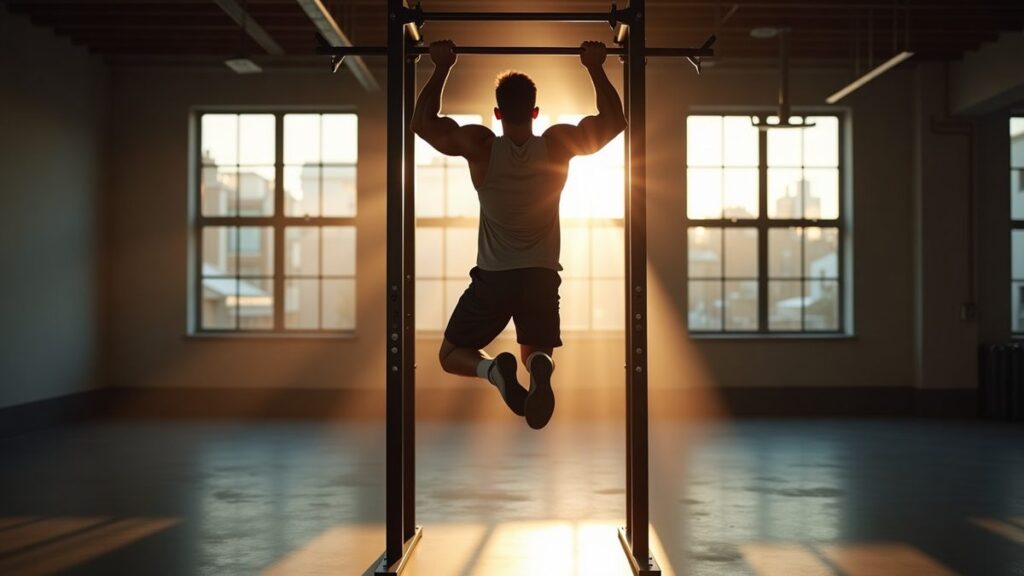
Hang from a pull-up bar and bring your toes to touch the bar by hinging at the hips and engaging the lats. Develops everything from grip to deep core. Scale to knees-to-elbows, knee raises, or hanging leg raises if you can’t string T2B yet.
2. GHD sit-up
Performed on a glute-ham developer with feet anchored. Allows full hip flexion and extension for a much greater range than a floor sit-up. Critical safety note: build very gradually. Start with 5 to 10 reps in your first session and add 2 to 3 reps per week. GHD sit-up rhabdomyolysis is a real and documented risk for trainees who do 50+ reps unconditioned.
3. Hollow body hold and rock
The foundational gymnastic core position. Lower back pressed flat into the floor, legs straight and feet just off the ground, arms overhead. Holds of 20 to 60 seconds, or rocking back and forth like a banana for 10 to 30 reps.
4. V-up
Lying flat, simultaneously raise legs and torso to meet in a V, hands reaching to feet. Hits both upper and lower abs in one move.
5. Plank with shoulder tap
Standard plank, alternately tapping each shoulder while keeping hips square to the floor. The anti-rotation work hammers the obliques.
6. Russian twist with plate
Seated, feet elevated or on the floor, holding a plate or dumbbell. Rotate side to side, tapping the weight on each hip. Standard load is 10 to 20 kg (men) or 5 to 12 kg (women).
WOD #1 — “Midline Mayhem” (12-minute AMRAP)
- 10 toes-to-bar
- 15 V-ups
- 20 Russian twists (10 each side)
- 30-second hollow body hold
Repeat as many rounds as possible in 12 minutes. Score is total rounds + reps. Scaling: beginners scale T2B to knee raises, V-ups to tuck-ups, and trim the hold to 20 seconds.
WOD #2 — “Hollow Out” (8-minute EMOM)
Every minute on the minute for 8 minutes, alternating:
- Min 1, 3, 5, 7 — 12 GHD sit-ups (or weighted sit-ups if no GHD)
- Min 2, 4, 6, 8 — 30-second hollow body hold
Short rest between movements is the leftover time in each minute. The faster you finish, the more rest you earn. Beginner cap: if you’ve done fewer than 5 sessions of GHD work total, cap reps at 6 to 8 per round and add a week before progressing.
How Often to Train Abs in a CrossFit Program
Two or three dedicated ab sessions per week, 8 to 15 minutes each, are plenty when you’re already running standard CrossFit programming. Indirect core work from squats, deadlifts, cleans, presses, and Olympic lifts is significant — overdoing direct ab volume cuts into recovery without adding much.
The American College of Sports Medicine‘s general guidance also recommends training core stability 2 to 3 times per week as part of a balanced program — well-aligned with what most CrossFit boxes program organically.
Famous Benchmark WODs That Hammer the Midline
If you want established benchmark WODs (with documented community scores you can compare yourself against), these three are core-killers from the official CrossFit programming library:
- “Annie” — 50-40-30-20-10 reps of double-unders and sit-ups. Most people finish in 8 to 18 minutes; sub-7 is competitive. Sit-up volume alone (150 reps) destroys the rectus abdominis.
- “Mary” — 20-min AMRAP of 5 handstand push-ups, 10 pistol squats, 15 pull-ups. The HSPU and pistols stress core stability under fatigue more than direct ab work does.
- “Cindy” with T2B substitution — 20-min AMRAP of 5 pull-ups, 10 push-ups, 15 air squats. Swap pull-ups for toes-to-bar and you’ve got a brutal core variant that doubles as conditioning. Aim for 12+ rounds in 20 minutes.
Use these benchmarks every 4 to 6 weeks as fitness tests, not weekly. The CrossFit Games leaderboard has decades of community data for comparison.
Scaling for Every Level
- T2B → knees-to-elbows → hanging knee raise → lying leg raise
- GHD sit-up → AbMat sit-up → standard sit-up
- Hollow hold → tuck hold (knees pulled in)
- V-up → tuck-up (tuck the knees to chest instead of straight legs)
- Russian twist with weight → bodyweight Russian twist → seated alternating toe touches
If you’re newer to bodyweight training broadly, our calisthenics for weight loss and beginner calisthenics routine introduce foundational holds and pulls that translate directly to CrossFit gymnastic skills.
Safety Notes Specific to CrossFit Ab Work
- GHD sit-up rhabdomyolysis is documented. Build very gradually. 5 to 10 reps in session one. Never do 50+ reps unconditioned.
- Lower back pain during sit-ups usually means hip flexors are doing the work, not abs. Drop to AbMat sit-ups or hollow rocks until the pattern resets.
- If form breaks down under fatigue in any AMRAP or EMOM, the set is over. Quality reps in quality positions beat junk reps in broken positions every time.
- Pregnant or postpartum trainees should not start GHD work or high-volume sit-ups without guidance from a healthcare provider or postnatal fitness specialist.
CrossFit Ab Workout FAQ
Will a CrossFit ab workout give me visible abs?
It will build them. Whether you see them depends on body fat percentage — typically below 10 to 12% for men and 16 to 20% for women for clear definition, with faint outlines appearing higher. The training reveals what the diet uncovers.
Are GHD sit-ups dangerous?
Not when introduced gradually. Start with 5 to 10 reps in your first session and work up over weeks. Most issues come from doing 50 in a row before your tissues are conditioned for the range of motion. GHD-related rhabdomyolysis is documented in the medical literature and isn’t worth the risk.
Can I do this ab workout at home without equipment?
Mostly. Swap T2B for hanging knee raises (any sturdy bar) or lying leg raises if no bar exists, and skip GHD sit-ups in favor of weighted sit-ups with a backpack or dumbbell. The hollow holds, V-ups, planks, and twists travel anywhere.
How long until I can string toes-to-bar?
For most beginners, 6 to 12 weeks of consistent practice — 2 to 3 sessions per week working on hollow holds, hanging knee raises, and strict T2B singles — produces the first chained reps. Kipping technique adds another month or two of skill work on top.
Should I add weight to my ab work?
Yes, for movements like sit-ups, V-ups, and twists where progressive overload drives growth. Bodyweight gymnastic moves like T2B and hollow holds progress through harder positions and longer holds rather than added load.
The bottom line: a strong CrossFit ab workout uses high-skill gymnastic moves, brutal short AMRAPs, and consistent frequency — with a warm-up that respects the demands. Combine these WODs with smart eating and you’ll build a midline that handles every lift. For the strength side, our calisthenics back workout rounds out the upper-body chain that supports every gymnastic movement above.