

Military Calisthenics: Complete 2026 Guide + Free 4-Week Plan
By James Nolan, strength & conditioning writer, Gymnase Tips
TL;DR — What Is Military Calisthenics and What Does the Free Plan Cover?
Military calisthenics is a high-volume bodyweight system the U.S. armed forces use to build muscular endurance and combat-ready work capacity. This free 4-week military calisthenics workout plan runs the eight core moves — push-up, pull-up, sit-up, air squat, burpee, lunge, mountain climber, flutter kick — in timed circuits you can do at home with one pull-up bar. Below, each move maps to the new Army Fitness Test (AFT).
Table of Contents
- What Is Military Calisthenics?
- Why It Works
- How Long Until Military Calisthenics Shows Results?
- Is Military Calisthenics Effective? (The Research)
- The 8 Core Exercises
- How the 8 Moves Map to the New Army Fitness Test (AFT)
- Military vs Regular Calisthenics: What’s the Difference?
- The 4-Week Workout Plan
- Weekly Schedule
- Common Mistakes
- How to Progress Past 4 Weeks
- Free Printable PDF
- More Resources
- Military Calisthenics FAQ
What Is Military Calisthenics?
Military calisthenics is a bodyweight strength-and-conditioning method used across U.S. military Physical Readiness Training to build muscular endurance, work capacity, and combat-functional fitness. It runs high-rep compound movements in timed circuits with short rest, no machines required. This is the military bodyweight workout in its rawest form.
Full breakdown, history, and how it differs from gym training: What Is Military Calisthenics?
Why It Works
Short answer: it trains the exact qualities combat demands — pushing, pulling, squatting, and sprinting under fatigue — using the cheapest tools available, your own bodyweight and gravity. High reps and brief rest periods keep your heart rate elevated, so you build strength-endurance and aerobic base in the same session. The whole system is codified in U.S. Army Field Manual 7-22, the doctrine that governs how soldiers actually train (Source: army.mil / FM 7-22).
How Long Until Military Calisthenics Shows Results?
Expect strength and work-capacity gains in 4 to 8 weeks, and visibly more muscle in 3 to 6 months. The early jump is mostly your nervous system getting better at recruiting muscle you already have, not new tissue. Honest caveat: where you start, how often you train, and whether you eat enough protein move those windows around a lot.
Here’s the mechanism. In the first few weeks of any resistance program, strength climbs fast while muscle fiber size barely changes, because the gains come from improved neural function rather than growth (Source: NSCA, “Neural Contributions to Muscle Growth”). Hypertrophy shows up later, once your nervous system can drive enough stimulus to force the tissue to adapt. The 2026 ACSM resistance-training position stand, built from 137 systematic reviews and over 30,000 participants, points to roughly 10 weekly sets per muscle group as the volume that reliably grows size over months, not weeks (Source: ACSM, 2026). A complete beginner training four to six days a week and eating adequate protein will feel the strength change first and see the mirror change second. Skip the food or the frequency, and both stretch out.
Is Military Calisthenics Effective? (The Research)
Yes. The same protocols that drive measurable conditioning gains across the roughly 10-week Army Basic Combat Training cycle work for civilians, and the adaptation science backs it up. Untrained adults commonly add 15 to 30 reps to their push-up max and cut two to four minutes off a 2-mile run inside the first 12 weeks. The early strength surge is neural, the later size change is hypertrophic (Source: NSCA), and the volume that grows muscle long-term sits around 10 sets per muscle weekly (Source: ACSM, 2026). The doctrine itself lives in FM 7-22.
Full evidence write-up with the basic-training data: Does Military Calisthenics Work?
The 8 Core Exercises
Eight movements carry the entire system. Master these and you can run any military-style circuit. The table below is the quick reference; full scaling, beginner-to-advanced progressions, and video-grade form notes live in the dedicated guide.
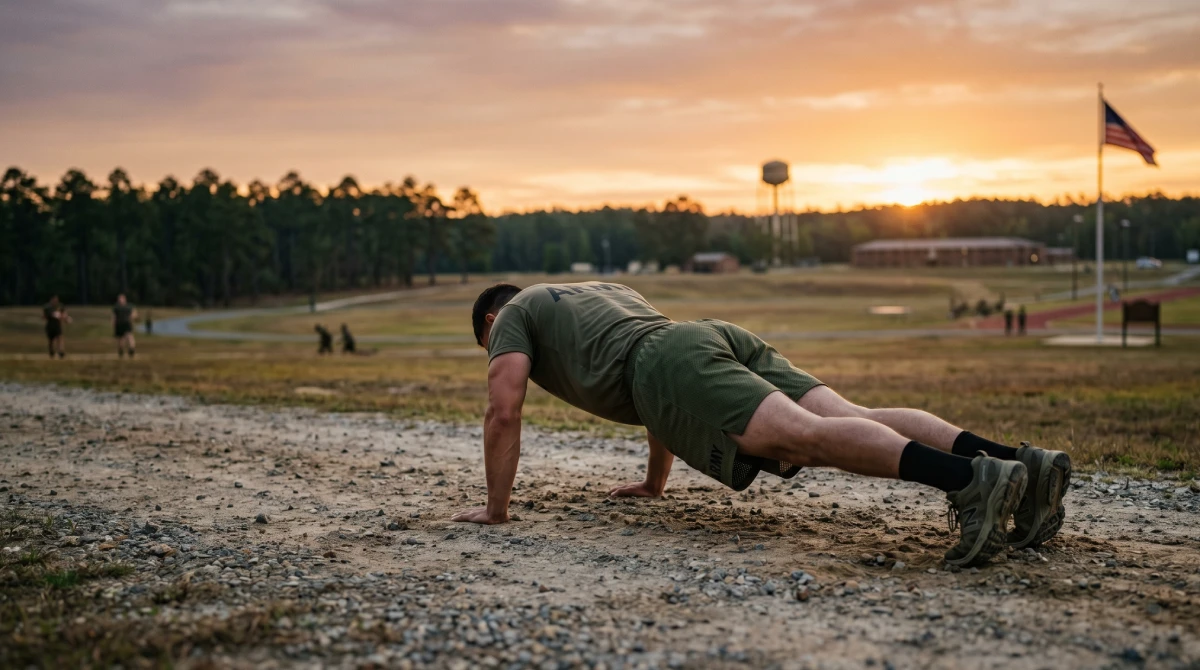
| Move | Primary target | One-line form cue |
|---|---|---|
| Push-Up | Chest, shoulders, triceps | Hands just wider than shoulders, rigid plank, chest to a fist off the floor, full lockout. |
| Pull-Up (dead hang) | Lats, biceps, grip | Full extension at the bottom, chin over the bar, no kipping. |
| Sit-Up | Hip flexors, abs | Feet anchored, elbows to knees at the top, shoulder blades touch down at the bottom. |
| Air Squat | Quads, glutes | Hip crease below the knee, full stand at the top, knees tracking over toes. |
| Burpee | Full body, conditioning | A push-up plus a squat-jump in one fluid motion. |
| Lunge | Quads, glutes, balance | Front knee over ankle, back knee to the floor, chest tall. |
| Mountain Climber | Core, conditioning | Plank position, drive knees to chest alternately at speed. |
| Flutter Kick | Lower abs, hip flexors | Back flat, heels six inches up, scissor the legs. |
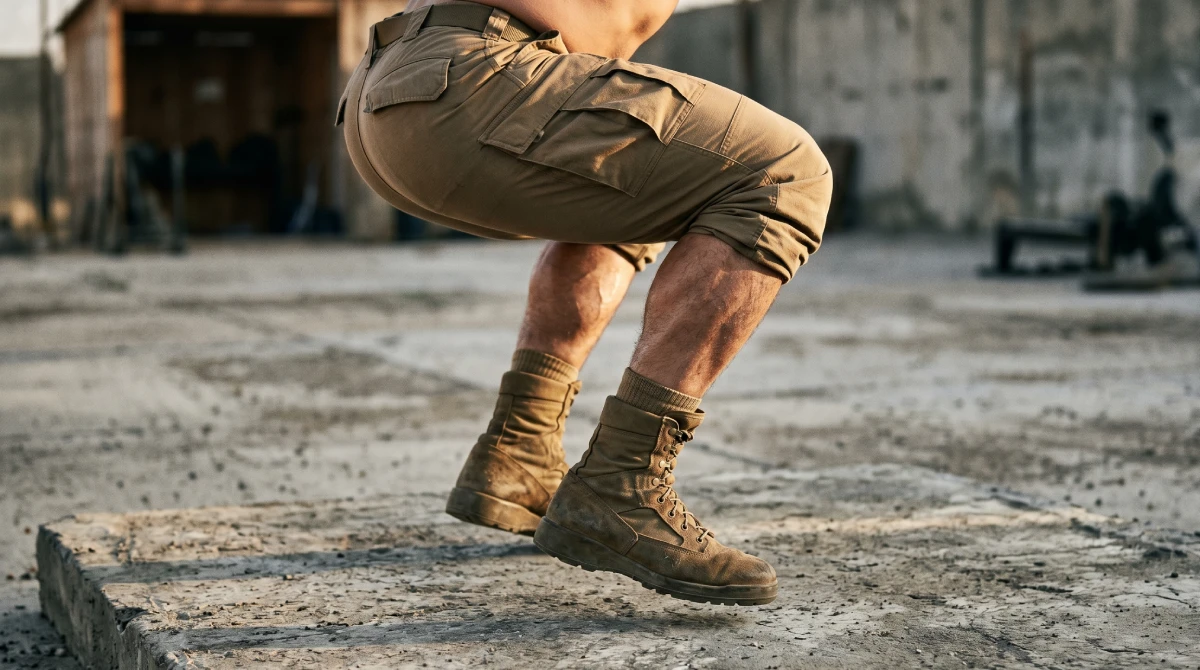
Full form guide with scaling: List of Military Calisthenics Exercises
How the 8 Moves Map to the New Army Fitness Test (AFT)
The Army replaced the ACFT with the Army Fitness Test (AFT) on June 1, 2025. The AFT has five events: Maximum Deadlift (MDL), Hand-Release Push-Up (HRP), Sprint-Drag-Carry (SDC), Plank (PLK), and the 2-Mile Run (2MR). The Standing Power Throw and Leg Tuck are gone; the plank replaced the leg tuck, cutting six events to five (Source: army.mil; army.mil release). New sex-neutral standards for 21 combat MOSs take effect January 1, 2026 for the Active component and June 1, 2026 for the Reserve and National Guard (Source: army.mil, 2025).
These eight bodyweight moves train every AFT event except the deadlift’s top-end load. Benchmarks below are for the age 22–26 band. The plank standard is sex-neutral and age-normed, so it reads the same for men and women. Passing is 60 points per event (Source: army.mil AFT scoring scales, eff. 1 Jun 2025; cross-checked against Army Apex AFT chart and AFT Calculator).
| Calisthenics move | Maps to AFT event(s) | What it trains for that event | 100-pt (M, 22–26) | 100-pt (F, 22–26) | Passing 60-pt (M / F, 22–26) |
|---|---|---|---|---|---|
| Push-Up | Hand-Release Push-Up (HRP) | Pressing endurance over a 2-min max set | 61 reps | 50 reps | 14 / 11 reps |
| Pull-Up | (no AFT event) | Pulling strength carryover, posture, shoulder balance | — pulling carryover | — pulling carryover | — pulling carryover |
| Sit-Up | Plank (PLK) | Trunk endurance that holds the plank line | 3:35 | 3:35 (sex-neutral) | 1:25 / 1:25 |
| Air Squat | Maximum Deadlift (MDL) | Lower-body strength base under the bar | 350 lb | 230 lb | 150 / 120 lb |
| Burpee | Sprint-Drag-Carry (SDC); 2-Mile Run | Anaerobic capacity and repeated power | SDC 1:30 | SDC 1:55 | SDC 2:31 / 3:15 |
| Lunge | Sprint-Drag-Carry (SDC) | Single-leg drive for the drag and carry lanes | SDC 1:30 | SDC 1:55 | SDC 2:31 / 3:15 |
| Mountain Climber | 2-Mile Run; SDC | Conditioning / core carryover (no single AFT cell) | conditioning carryover | conditioning carryover | conditioning carryover |
| Flutter Kick | Plank (PLK) | Core endurance carryover for the plank hold | core carryover | core carryover | core carryover |
2-Mile Run reference for the same band: 13:25 (M, 100-pt) and 15:30 (F, 100-pt); passing is 19:45 (M) and 22:45 (F) (Source: AFT Calculator; Army Apex). The deadlift is the one event you can’t fully cover with bodyweight alone — air squats build the base, but you’ll want a barbell or loaded carries to chase the top scores.
Full point-by-point standards: AFT Score Chart
Military vs Regular Calisthenics: What’s the Difference?
Military calisthenics chases work capacity and combat readiness through high-rep compound circuits. Regular (street or skill) calisthenics chases skill mastery — muscle-ups, levers, planches, handstands. Different goals, different training, different bodies at the finish line. Can you get ripped on the military version? You’ll get lean, dense, and conditioned. For deep aesthetic muscle, you eventually add load.
| Dimension | Military | Regular / skill |
|---|---|---|
| Goal | Work capacity, endurance, combat fitness | Skill mastery, control, aesthetics |
| Structure | Timed high-rep circuits, short rest | Low-rep skill practice, long rest |
| Equipment | Pull-up bar, floor space | Bars, rings, parallettes |
| Physique outcome | Lean, dense, conditioned | Defined, often more visibly muscular over time |
The honest version: military calisthenics will strip fat and build a hard, capable physique fast, and it scales gently for beginners. If your single goal is maximum size, you’ll plateau on bodyweight alone and need a vest, bands, or a barbell. For most people wanting to look fit and perform, the military route gets you there quicker.
The 4-Week Workout Plan
This is the full military calisthenics workout — four weeks, four phases, built on Army PRT logic. Run it at home with a single doorway pull-up bar. Beginners, start at the rep floor and substitute inverted rows — or a set of assisted pull-up bands — for pull-ups until you own bodyweight pulls.
Week 1 at a Glance: Day-by-Day
| Day | Focus | Exercises (sets × reps/time) | Est. time |
|---|---|---|---|
| Day 1 (Mon) | Full-body circuit | 4 rounds: 20 push-ups, 10 pull-ups, 25 air squats, 15 sit-ups, 10 burpees | 30–40 min |
| Day 2 (Tue) | Run + core | 20-min easy run; 3 × 30s flutter kicks | 25–30 min |
| Day 3 (Wed) | Full-body circuit | 4 rounds: 20 push-ups, 10 pull-ups, 25 air squats, 15 sit-ups, 10 burpees | 30–40 min |
| Day 4 (Thu) | Run + core | 20-min easy run; 3 × 30s flutter kicks | 25–30 min |
| Day 5 (Fri) | Full-body circuit | 4 rounds: 20 push-ups, 10 pull-ups, 25 air squats, 15 sit-ups, 10 burpees | 30–40 min |
| Day 6 (Sat) | Long run + ladder | 3-mile run; 5 × 10 push-up ladder | 35–45 min |
| Day 7 (Sun) | Rest | Full recovery — walk, stretch, or mobility only | — |
Weeks 2–4 progress through the phases below (more rounds, tighter rest, longer runs). The full printable 28-day grid lives in the free PDF.
Week 1 — Baseline. Strength-Endurance Circuit (Mon/Wed/Fri): 4 rounds, 60 seconds rest.
- 20 push-ups
- 10 pull-ups (sub inverted rows if needed)
- 25 air squats
- 15 sit-ups
- 10 burpees
Conditioning (Tue/Thu): 20-minute run at conversational pace + 3 × 30-second flutter kicks. Saturday: 3-mile run + 5 × 10 push-up ladder.
Week 2 — Volume. Same circuit, add a round (5 total). Drop rest to 45 seconds. Tue/Thu runs go to 25 minutes.
Week 3 — Density. Back to 4 rounds, cut rest to 30 seconds. Saturday run extends to 4 miles. Add 20 lunges per leg to the circuit.
EMOM Density Option (Week 3)
Swap one density session for this EMOM — every minute on the minute, start the prescribed reps; whatever’s left of the minute is your rest. Run it for 20 minutes (four times through the five-minute block). It forces the short-rest density the military trains for, and it’s brutal on conditioning.
- Minute 1: 12 push-ups
- Minute 2: 6 pull-ups (or 10 inverted rows)
- Minute 3: 18 air squats
- Minute 4: 8 burpees
- Minute 5: 30 seconds mountain climbers + 15 flutter kicks
If you can’t finish a minute’s reps before the next starts, cut that movement’s count by 2–3 reps and hold the pace. Finishing every minute clean beats redlining and stalling.
Week 4 — Test Week.
- Mon: 2-min max push-ups, 2-min max sit-ups, max pull-ups, 2-mile timed run.
- Tue/Thu: active recovery — walking, mobility, light stretching.
- Wed/Fri: Week 1 circuit at 3 rounds (deload).
- Sat: rest or 30-minute walk.
Weekly Schedule
Here’s the military calisthenics schedule in one table — the same six-on, one-off rhythm used across basic training, scaled for a home setting.
| Day | Session | Focus | Duration |
|---|---|---|---|
| Monday | Strength-Endurance Circuit | Full body | 40 min |
| Tuesday | Run + Core | Aerobic base | 30 min |
| Wednesday | Strength-Endurance Circuit | Full body | 40 min |
| Thursday | Run + Core | Aerobic base | 30 min |
| Friday | Strength-Endurance Circuit | Full body | 40 min |
| Saturday | Long Run + Push-Up Ladder | Aerobic + chest | 60 min |
| Sunday | Rest | Recovery | — |
Common Mistakes
Four mistakes kill more results than any programming flaw.
- Going to failure every session. Build capacity across weeks, not in one workout. Leave one or two reps in the tank.
- Neglecting pull work. Match your pressing volume with pulling or your shoulders pay for it. This is why the pull-up stays in the rotation even though the AFT dropped a dedicated pull event.
- Skipping the run. Aerobic base isn’t optional. Every branch tests a timed run, and the AFT’s 2-mile is no exception.
- Sloppy form at rep 20. End the set the moment form breaks. A clean 18 beats an ugly 25.
How to Progress Past 4 Weeks
Three levers. Pull one at a time, never all three at once.
- Add reps: +2 push-ups and +1 pull-up per session each week.
- Cut rest: shrink between-round rest from 30 seconds to 20, then 15.
- Add a round: 4 rounds to 5, then 6.
Once you’ve squeezed those, move to a structured eight-week block with built-in deloads — see the 8-week progression plan. After about 12 weeks, layer in loaded carries (water jugs or a workout sandbag), an adjustable weighted vest, and single-limb variants to keep forcing adaptation.
Free Printable PDF
The whole 4-week program prints clean on US Letter — circuits, schedule, and test-week protocol on a few pages, no signup.
Download the printable military calisthenics PDF (4-week starter) · 9 pages · US Letter · No signup
Want the longer build? Grab the free 8-week military calisthenics PDF plan or the day-by-day 28-day military workout.
More Resources
Related guides in the military calisthenics series:
Military Calisthenics FAQ
What is military calisthenics?
Military calisthenics is a bodyweight strength-and-conditioning system used by the U.S. armed forces to build muscular endurance and combat-functional fitness. It runs high-rep compound moves — push-ups, pull-ups, sit-ups, squats, lunges, burpees, mountain climbers, flutter kicks — in timed circuits with short rest. The method is codified in U.S. Army Field Manual 7-22.
How often should I do military calisthenics?
Six days a week is the standard military rotation: three strength-endurance days, two conditioning days, one long day, one rest. If you’re new, start at four days a week and add a session every two weeks until you reach six. Recovery quality decides how fast you can climb.
How long until I see results from military calisthenics?
Strength and work-capacity gains show in 4 to 8 weeks; visibly more muscle takes 3 to 6 months. The early change is mostly neural, not new tissue. Your starting point, training frequency, and protein intake all shift those windows, so treat them as ranges, not promises.
How do I use military calisthenics to prep for the Army Fitness Test (AFT)?
The AFT replaced the ACFT on June 1, 2025 and has five events: deadlift, hand-release push-up, sprint-drag-carry, plank, and 2-mile run (u003ca href=’https://www.army.mil/article/285501/army_introduces_new_fitness_test_for_2025’u003eSource: army.milu003c/au003e). Train push-ups for the HRP, sit-ups and flutter kicks for the plank, squats for the deadlift base, and burpees plus the timed run for the sprint-drag-carry and 2-mile. Add a barbell for top-end deadlift scores.
Military calisthenics vs CrossFit vs the gym — which builds more?
For raw muscle size, the gym wins — progressive barbell loading beats bodyweight long-term. CrossFit builds the broadest mix of strength and conditioning but needs equipment and coaching. Military calisthenics builds the most usable work capacity per dollar with almost no gear. Pick by goal: size, all-round fitness, or portable conditioning.
Can you start military calisthenics as a beginner over 50?
Yes, with scaling. Begin at roughly half the prescribed volume, swap burpees for step-ups, and extend the warm-up since tendons adapt slower with age. Get medical clearance first if you have cardiovascular or joint conditions. See the u003ca href=’https://www.gymnasetips.com/military-calisthenics-for-men-over-50/’u003eover-50 planu003c/au003e for the full modified protocol.
Can military calisthenics build muscle?
Yes, within limits. Expect visible muscle in your chest, shoulders, arms, and legs within 3 to 6 months, especially starting untrained. Past that, growth slows unless you add load with a weighted vest or single-limb progressions. Bodyweight alone caps your top-end size.
What equipment do I need for military calisthenics?
One pull-up bar. Everything else — push-ups, squats, lunges, burpees, sit-ups — needs only floor space. A weighted vest earns its place around month three for continued progression. See the u003ca href=’https://www.gymnasetips.com/calisthenics-workout-equipment/’u003eequipment guideu003c/au003e for what to buy first and what to skip.
Is military calisthenics good for women?
Yes. The same exercise library and circuit structure works, with adjusted starting reps and a longer pull-up progression since most women begin without bodyweight pulling strength. See the dedicated u003ca href=’https://www.gymnasetips.com/military-calisthenics-women/’u003emilitary calisthenics for womenu003c/au003e plan for the full female-specific schedule.
Is military calisthenics effective for civilians?
Yes. The same protocols that drive conditioning gains across Army Basic Combat Training work for civilians. Untrained adults typically add 15 to 30 push-ups to their max and cut two to four minutes off a 2-mile run inside 12 weeks, with strength rising before visible size.
What’s the difference between military and street calisthenics?
Street calisthenics prioritizes skill moves — muscle-ups, flags, levers. Military calisthenics prioritizes high-rep compound work for raw capacity. Military training is faster to learn and scales more gracefully for beginners; street work takes longer but builds eye-catching skill.
Is military calisthenics good for weight loss?
Yes. A 40-minute circuit burns roughly 300 to 500 calories depending on bodyweight and intensity. Pair it with a 300 to 500-calorie daily deficit and most people lose 1 to 2 pounds of fat a week without losing strength.
Where can I download a free printable military calisthenics plan?
The 4-week plan here is built to screenshot-print straight from the page. For a formatted file, grab the u003ca href=’https://www.gymnasetips.com/wp-content/uploads/2026/05/military-calisthenics-4-week-plan.pdf’u003eprintable military calisthenics PDF (4-week starter)u003c/au003e or the longer u003ca href=’https://www.gymnasetips.com/8-week-military-calisthenics-plan-pdf/’u003e8-week plan PDFu003c/au003e.
Is military calisthenics a real thing?
Yes. Military calisthenics is genuine doctrine, not a marketing label. The U.S. Army’s u003ca href=’https://www.army.mil/aft/’u003ephysical readiness programu003c/au003e (FM 7-22) has used bodyweight drills like push-ups, the plank, and timed runs for decades to build soldiers. Most commercial “military” workouts borrow the name, but the underlying movements trace straight back to official PT manuals.
What are the five military calisthenics exercises?
The five foundational military calisthenics exercises are the push-up, sit-up, air squat, pull-up, and run — the core movements behind almost every armed-forces fitness standard. This guide layers on three more (plank, burpee, and flutter kick) to round out core and conditioning, but those first five carry the program.
How do I start military calisthenics?
Start with three full-body circuit sessions in week 1 — Monday, Wednesday, Friday — plus two easy run-and-core days. Your first session is four rounds of push-ups, pull-ups, air squats, sit-ups, and burpees. Scale reps down or use assisted/knee variations until form holds, then build from the 4-week plan above.
Gymnase Tips is reader-supported. Some links may be Amazon affiliate links; if you buy through them we may earn a small commission at no extra cost to you.
Looking for a circuit-based format? Try our boot camp workout — a 4-week plan that uses military PRT drills in timed rounds.



Pingback: Military Calisthenics for Women: 4-Week Plan (2026)
Pingback: Can I Gain Muscle With Calisthenics? (The Honest Answer)
Pingback: Complete Calisthenics Workout Plan for All Fitness Levels
Pingback: Navy SEAL Calisthenics Workout: The Real BUD/S Training Plan
Pingback: Special Forces Calisthenics: SFAS & Ranger Selection Training (2026)
Pingback: Why Does Pre-Workout Make You Poop? The Real Science (2026)
Pingback: Best Pre-Workout Energy Drinks 2026: Top 8 Picks Ranked
Pingback: Best Calisthenics App 2026: 7 Workout Apps Ranked & Reviewed
Pingback: 28-Day Military Workout: Free Day-by-Day Bodyweight Plan
Pingback: List of Military Calisthenics Exercises: 25+ Moves (2026)
Let’s go
Pingback: Military Workout PDF: Free 4-Week Printable Plan (2026)
Pingback: Calisthenics Mobility Exercises: 10 Drills + Daily Routine
Pingback: Military Calisthenics at Home: No-Equipment 6-Day Plan
Pingback: What Is Military Calisthenics? Definition + 8 Core Exercises
Pingback: Assisted Pull-Ups: 8-Week Beginner Progression to First Rep (2026)
Pingback: Advanced Calisthenics Workout: 8-Week Skill-Strength Plan (2026)
Pingback: How Many Push-Ups Should I Do a Day? Goal-Based Answers (2026)