
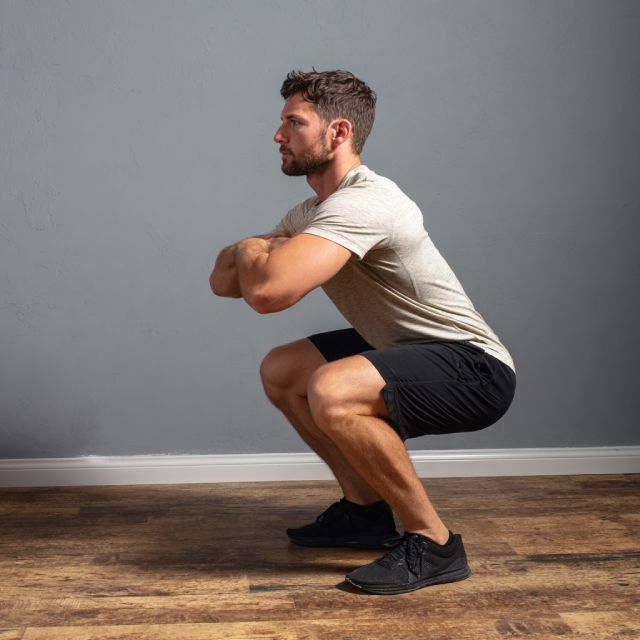
The Complete Calisthenics Workout Plan: Beginner, Intermediate & Advanced (Free PDF + Tracker)
By James Nolan, NSCA-CPT · Last updated June 2026
Table of contents
TL;DR: Your Calisthenics Workout Plan at a Glance
This calisthenics workout plan takes you from your first wall push-up to a muscle-up across three tiers: a beginner full-body block (weeks 1–8, 3 days a week), an intermediate push/pull/legs build (weeks 9–24, 3–4 days), and an advanced 12-week skill block (4–5 days). Pick your tier with the self-test below, follow the sets/reps tables, and grab the free PDF plus auto-calculating Google Sheet tracker.
Most people who quit calisthenics quit because they picked the wrong starting point — too hard and they stall, too easy and they get bored. Start where the self-assessment puts you, not where your ego does. Want the plan to log itself? Track your plan with a calisthenics app.
How This Plan Works (Pick Your Tier)
There are three tiers, and you choose by what you can already do, not by how long you’ve trained. If you can’t yet do 5 clean full push-ups and 1 strict pull-up, start Beginner. If you can hit roughly 15 push-ups, 5 pull-ups, and 20 bodyweight squats, start Intermediate. If you own those numbers with room to spare and want skills like the muscle-up, start Advanced.
The whole plan runs on progressive overload — the same principle that drives a barbell program, just applied to leverage and reps instead of plates. You make a movement harder over time by adding reps, slowing the tempo, shortening rest, or switching to a tougher variation. When a tier’s “graduation” numbers feel routine, you move up. No calendar rushes you.
Here’s the structure at a glance:
| Tier | Weeks | Days/week | Split | Graduate when you can… |
|---|---|---|---|---|
| Beginner | 1–8 | 3 | Full-body A/B circuits | 15 push-ups · 5 pull-ups · 20 squats, all strict |
| Intermediate | 9–24 | 3–4 | Push / Pull / Legs | 25 push-ups · 10 pull-ups · 10 pistol-squat negatives |
| Advanced | 12-week block | 4–5 | Skill + strength split | Train specific skills (muscle-up, lever, OAP) |
A quick self-test before you commit: do as many strict push-ups, dead-hang pull-ups, and full-depth bodyweight squats as you can in three separate maximal sets, resting fully between. Match the lowest of the three results to the table above. Your weakest lift sets your tier — don’t run an advanced pulling block on a beginner’s pull strength.
The free PDF and the Google Sheet tracker carry every table below in a fillable format. The Sheet auto-calculates your weekly target reps as you log sessions, so you’re not doing arithmetic mid-workout. Download links are in the tracker section near the end.
Beginner Calisthenics Workout Plan (Weeks 1–8)
The beginner plan is three full-body sessions a week (think Monday / Wednesday / Friday) built from two alternating circuits, A and B, with at least one rest day between sessions. You progress by adding one rep per set each week until you hit the top of the rep range, then you make the exercise harder. Eight weeks gets most people from regressed movements to clean, full-range reps.
Full-body beats a split here for one reason: when you’re new, frequency drives skill more than volume does. Hitting a push pattern three times a week teaches the movement faster than blasting it once. You also recover fine, because the loads are low relative to a trained lifter.
If you can’t do the standard version yet, use the regression in the table — there’s no shame in incline push-ups or band-assisted pull-ups. They build the exact same strength curve, just shifted to a leverage you can control.
Beginner Sets and Reps Table
| Exercise | Sets | Reps | Tempo | Regression if too hard |
|---|---|---|---|---|
| Push-up | 3 | 8–12 | 2-0-1 | Incline (hands on bench) → knee push-up |
| Inverted row (or band-assisted pull-up) | 3 | 8–12 | 2-0-1 | Raise the bar / shorten the body angle |
| Bodyweight squat | 3 | 12–20 | 2-0-2 | Box squat to a chair |
| Walking lunge | 2 | 10 each leg | controlled | Static split squat, hold support |
| Plank | 3 | 20–40 sec | hold | Knees down |
| Glute bridge | 3 | 15 | 2-1-2 | — |
Tempo is written as eccentric-pause-concentric in seconds. A 2-0-1 push-up means two seconds down, no pause, one second up. Slowing the lowering phase adds time under tension without needing a harder variation, which is your first progression lever before you ever change the movement.
Run circuit A on day one, circuit B on day three, alternate. Both pull from the table above; vary the lower-body and core picks between them so nothing gets stale.
Weekly Schedule: 3-Day Full-Body
| Day | Session |
|---|---|
| Monday | Circuit A (push-up, inverted row, squat, plank) |
| Tuesday | Rest or 20-min walk |
| Wednesday | Circuit B (incline/knee push-up variant, band pull-up, lunge, glute bridge) |
| Thursday | Rest |
| Friday | Circuit A |
| Sat / Sun | Rest, mobility, or light cardio |
Rest 60–90 seconds between sets. Two to three sessions a week is the right beginner dose — training frequency drives strength gains with diminishing returns past a point, so there’s no prize for adding a fourth day this early (Source: Pelland et al., SportRxiv preprint, 2024). For dedicated midsection work between sessions, add this calisthenics core workout.
Intermediate Calisthenics Workout Plan (Weeks 9–24)
The intermediate plan shifts to a push/pull/legs (PPL) split run three to four days a week for sixteen weeks, and you graduate into it once you can do 15 strict push-ups, 5 pull-ups, and 20 full squats. PPL lets you train each pattern harder because you’re not fatiguing your push muscles before your pull work in the same session. You add volume and start chasing the first harder variations: diamond push-ups, chin-ups, Bulgarian split squats.
Don’t jump here from week one of beginner just because the program looks more interesting. The PPL split assumes you’ve built the base strength to handle heavier per-session loading on each muscle group. If your pull-ups are still band-assisted, finish the beginner block first.
Push / Pull / Legs Split Explained
A PPL split groups exercises by movement pattern. Push day covers everything that extends the arms and presses away from you — push-ups, dips, pike push-ups. Pull day covers everything that draws toward you: pull-ups, chin-ups, rows. Legs day covers squats, lunges, and single-leg work. On a 4-day week you run Push / Pull / Legs / Upper, repeating the push and pull patterns once more for added frequency.
The advantage over full-body at this stage: you can do 12–15 hard sets for a muscle group in a focused session and recover before you hit it again. That higher per-muscle volume is what pushes hypertrophy once the beginner newbie gains slow down.
Intermediate Sets and Reps Table
| Day | Exercise | Sets | Reps |
|---|---|---|---|
| Push | Push-up (feet elevated) | 4 | 10–15 |
| Push | Parallel-bar dip | 3 | 6–12 |
| Push | Pike push-up | 3 | 8–12 |
| Pull | Pull-up | 4 | 5–10 |
| Pull | Chin-up | 3 | 6–10 |
| Pull | Inverted row (feet elevated) | 3 | 10–15 |
| Legs | Bulgarian split squat | 4 | 8–12 each |
| Legs | Pistol-squat negative | 3 | 3–5 each |
| Legs | Nordic curl (assisted) | 3 | 5–8 |
Aim for roughly 10–15 hard sets per muscle group across the week. That range sits in the evidence-backed zone where most trained lifters keep gaining without wrecking recovery (Source: Pelland et al., SportRxiv preprint, 2024). Push the last set of each exercise to within 1–2 reps of failure — that’s an RIR (reps in reserve) of 1–2, the intensity that reliably drives growth without burning you out. To bring up pressing strength and lockout, slot in this calisthenics shoulder workout on push days.
Advanced Calisthenics Workout Plan: The 12-Week Block
The advanced plan is a 12-week block running four to five days a week, splitting skill practice (done fresh, early in the session) from strength volume (done after). It’s for people who already own 25+ push-ups, 10+ pull-ups, and solid pistol-squat negatives, and who now want specific skills: the muscle-up, front lever, one-arm pull-up, and full pistol squat. You periodize across three 4-week phases — accumulation (build volume), intensification (build difficulty), and realization (test the skill).
This is the tier where calisthenics stops being “bodyweight exercise” and becomes gymnastics-adjacent strength training. Skills are practiced when you’re freshest, because grinding a front-lever attempt while fatigued teaches your body sloppy mechanics. Strength assistance work comes after.
Skill work is neurological as much as muscular early on. You’ll often see a skill “click” in a single session after weeks of nothing — that’s your nervous system, not new muscle. Keep skill sets short, crisp, and far from failure.
Advanced Skill Progressions (with Regressions)
Each of these skills is a destination, not a starting exercise. Work the regression that lets you hit clean reps, then climb. Here’s the inline ladder for the four flagship skills — no need to leave this page to find your next step.
Muscle-up. Regression ladder: high pull-ups (pull chest to bar) → explosive pull-ups → band-assisted muscle-ups → slow negative muscle-ups → straight-bar muscle-up. The transition over the bar is the sticking point, not the pull; drill the negative until the rotation feels automatic.
One-arm pull-up (OAP). Regression ladder: weighted two-arm pull-ups → archer pull-ups → one-arm assisted (towel/band on the working side) → one-arm negatives → full OAP. Build to a weighted pull-up with roughly half your bodyweight added before expecting the one-arm to come.
Front lever. Regression ladder: tuck front lever → advanced tuck → single-leg (straddle) lever → full front lever. Hold each progression for 10+ controlled seconds before extending the body further. Brace the core like you’re about to be punched — the lever is a straight-body hold, not a hang.
Pistol squat. Regression ladder: box pistol (sit to a high surface) → assisted pistol (hold a post) → pistol negatives → full free pistol. Ankle mobility is the silent blocker here; if your heel lifts, fix the ankle before adding range.
Use the site’s dedicated progression guides as supplements when you want a deeper drill set for a single skill — they expand on these ladders rep by rep.
Advanced Sets and Reps Table
| Phase (4 wks each) | Skill block (fresh) | Strength block (after) | Frequency |
|---|---|---|---|
| 1 — Accumulation | Skill regressions, 4–6 short sets, RIR 4+ | High-volume dips, weighted pull-ups, pistols: 4×8–12 | 4 days |
| 2 — Intensification | Harder regression, 5–6 sets, RIR 2–3 | Heavier load, lower reps: 5×4–6 | 4–5 days |
| 3 — Realization | Test the full skill, low reps, full rest | Maintenance volume: 3×6–8 | 4 days |
Deload in week 8 if joints feel beat up — cut sets by half for that week and keep skill practice light. Advanced calisthenics is more elbow- and shoulder-tendon-limited than muscle-limited, so the smart move is to protect connective tissue, not chase soreness. If you want a structured conditioning challenge alongside the skill block, our 8-week military calisthenics plan runs the volume side hard.
Stuck? The Calisthenics Plateau Decision Tree
The single most common reason calisthenics progress stalls is repeating the same reps at the same difficulty week after week — your body adapted, and nothing changed to force a new adaptation. The first fix is almost never “train harder.” It’s to change one variable: tempo, then volume, then variation, in that order. Here’s the decision tree for the three lifts everything else is built on.
Push-up plateau
- Stuck below ~10 reps? Add tempo first — 3 seconds down on every rep for two weeks. If reps still don’t climb, drop to a slightly easier variation (incline) and rebuild volume.
- Stuck at 15–25 reps? Stop chasing reps. Switch to a harder variation: feet-elevated, then archer, then pseudo-planche push-ups. Endless high-rep push-ups build endurance, not strength.
- Stuck above 25 reps but no harder variation works yet? Add load — a backpack with books — and treat it like a weighted set of 6–10.
Pull-up plateau
- Can’t add reps past 3–5? Use negatives: jump to the top, lower for 5 seconds, 3–4 sets. Negatives build the eccentric strength that raw reps don’t, and they’re the fastest fix for a low-rep pull-up stall.
- Stuck at 8–12 reps? Add weight (5–10 lb) and work in the 5–8 rep range, or switch to a harder variation like archer or commando pull-ups.
- Grip failing before your back? That’s a grip plateau, not a back plateau — add dead hangs and farmer-style holds twice a week, and the pull-up reps follow.
Squat plateau
- Bodyweight squats feel easy past 25 reps? Stop counting reps and move to single-leg work — split squats, then pistol progressions. Two-leg bodyweight squats stop overloading the legs fast.
- Stuck on pistol-squat negatives? The blocker is usually ankle mobility or balance, not strength. Elevate the heel slightly or hold a support, drill negatives, then remove the assistance.
- Strong but no pistol yet? Build with box pistols to a progressively lower surface — the box removes the balance demand so you can train the strength in isolation.
The pattern across all three: when reps stall, change tempo or variation before you add volume, and add load only once a movement has no harder bodyweight version left in your tank. Log every session so you can actually see the stall instead of guessing — that’s what the tracker is for.
What Should You Eat? Sample Nutrition Day by Tier
To build muscle on calisthenics you need a small calorie surplus and enough protein — roughly 1.4 to 2.0 grams of protein per kilogram of bodyweight per day, which covers most people training for hypertrophy (Source: International Society of Sports Nutrition Position Stand: Protein and Exercise, Journal of the ISSN, 2017). To lose fat while keeping strength, hold protein at the top of that range and run a modest deficit. The sample days below scale protein and calories to each tier’s training load.
For a 75 kg (165 lb) trainee, that’s about 105–150 g of protein daily. You don’t need to be precise to the gram — hit the range, eat mostly whole foods, and adjust based on the scale and the mirror over a few weeks.
| Tier | Daily calorie aim | Protein target | Sample day |
|---|---|---|---|
| Beginner (recomp / slight surplus) | Maintenance to +150 | ~1.4 g/kg | Oats + eggs · chicken rice bowl · Greek yogurt + berries · salmon, potatoes, greens |
| Intermediate (lean build) | +200–300 | ~1.6 g/kg | 3-egg omelet + toast · turkey wrap + fruit · cottage cheese + nuts · beef stir-fry + rice |
| Advanced (skill phase) | +300–400 | ~1.8–2.0 g/kg | Protein oats + whey · chicken pasta · tuna sandwich · steak, sweet potato, broccoli · casein before bed |
If you’re in a fat-loss phase instead, the higher end of the protein range (around 2.0+ g/kg) protects muscle while you’re eating less — the same position stand notes intakes of 2.3–3.1 g/kg help retain lean mass during a calorie deficit (Source: ISSN Position Stand, Journal of the ISSN, 2017). Spread protein across three to four meals rather than dumping it all at dinner.
Does Calisthenics Build Muscle? (The 2024–2025 Evidence)
Yes — bodyweight training builds real muscle, and the gap between calisthenics and weights is far smaller than gym lore suggests. In a randomized trial, men doing push-ups adjusted to roughly 40% of their bench-press 1RM gained muscle thickness and strength comparable to a group doing low-load bench press over eight weeks (Source: Kikuchi & Nakazato, Journal of Exercise Science & Fitness, 2017). The driver of growth isn’t the equipment — it’s training close enough to failure with enough weekly volume.
That volume principle is where the recent science sharpens the picture. A 2024 dose-response meta-regression pooling 67 studies and 2,058 participants found muscle growth keeps rising with more weekly hard sets, with diminishing returns rather than a hard ceiling (Source: Pelland et al., SportRxiv preprint, 2024). For calisthenics that translates cleanly: as a movement gets easy, you add sets, slow the tempo, or move to a harder variation to keep accumulating effective volume close to failure.
The honest limit: once you can do 25+ reps of a bodyweight movement, you need a harder variation or added load to keep it a hypertrophy stimulus rather than endurance work. That’s exactly why the advanced tier leans on skill progressions and weighted variations. The Cleveland Clinic makes the same point from the clinical side — calisthenics builds muscle and endurance over time and scales from beginner to athlete (Source: Cleveland Clinic, 2023).
For a deeper head-to-head on loading, recovery, and which goal each method wins, see our calisthenics vs weights comparison.
Track Your Progress: Free PDF + Google Sheet
The free download pack gives you every table on this page in two formats — a printable PDF of all three tiers and an auto-calculating tracker that logs your reps and flags when a lift has stalled long enough to trigger the plateau tree. No competitor program on this topic ships a live tracker, only static printouts.
Tracker note: the .xlsx opens directly in Excel, or upload it to Google Drive and “Open with Google Sheets” to get the live auto-calculating version described above.
Want the plan to nag you instead of a spreadsheet? A workout app handles the logging and reminders automatically. See our pick of the best calisthenics apps for following a structured bodyweight plan.
Minimal gear that actually helps: a doorway or freestanding pull-up bar, a set of resistance bands for assisted pull-ups and front-lever work, and a pair of parallettes for dips and L-sits. That’s the whole kit — you can run the entire beginner and most of the intermediate block with just a pull-up bar.
Frequently Asked Questions
How many days a week should I do calisthenics?
It depends on your tier: two to three days for beginners, three to four for intermediates, and four to five for advanced trainees. Beginners need recovery between full-body sessions; advanced lifters split work across more days to manage volume and skill practice.
How long does it take to see results from calisthenics?
You’ll feel and see changes on a predictable timeline if you train consistently and eat enough protein. Strength comes first, then visible muscle: 2–4 weeks for noticeable strength and rep increases (mostly neural), 6–8 weeks for visible muscle definition (especially arms and core), 10–12 weeks for a clear physique change, and 3–6 months for a major transformation in skills, leanness, and strength. These ranges are coaching guidance based on typical beginner-to-intermediate progress, not a guarantee.
Can you build muscle with calisthenics alone?
Yes. A randomized trial found push-ups adjusted to a comparable load produced muscle and strength gains similar to low-load bench press over eight weeks (Source: Kikuchi & Nakazato, Journal of Exercise Science & Fitness, 2017). The key is training close to failure and adding difficulty as movements get easy.
Is calisthenics good for beginners?
Yes — it’s one of the best entry points to training. The movements scale to any starting strength through regressions (incline push-ups, band-assisted pull-ups), need almost no equipment, and carry a low injury risk while you learn (Source: Cleveland Clinic, 2023).
What is the best calisthenics workout split?
There isn’t one best split — there’s a best split for your level. Full-body 3x a week wins for beginners (frequency builds skill fast). Push/pull/legs wins for intermediates (more per-muscle volume). A skill-plus-strength split wins for advanced trainees who are chasing specific moves.
How do I progress from beginner to advanced?
Progress by hitting each tier’s graduation numbers before moving up, and by changing one variable when you stall. Run the beginner block until you can do 15 push-ups, 5 pull-ups, and 20 squats strict. Move to intermediate PPL and build to 25 push-ups, 10 pull-ups, and pistol negatives. Then start advanced skill work. When any lift stalls, change tempo first, then variation, then add load. Log every session so you can see the stall instead of guessing.
Can you do calisthenics every day?
You can train daily only if you split the work so each muscle group still gets recovery — for example, skill practice and light mobility on “off” days, hard sets on others. Training the same patterns hard every single day invites overuse injuries, especially in the elbows and shoulders. Most people get better results from 3–5 quality sessions with real rest days.
How long should a calisthenics workout be?
Most sessions should run 30–45 minutes. Beginners can finish a full-body circuit in 30–35 minutes; intermediate PPL days run 40–45 with added volume; advanced sessions stretch toward 45–60 only because skill practice needs long rests between attempts. Past an hour, quality usually drops faster than the extra volume helps.
Sources
- Kikuchi, N. & Nakazato, K. (2017). Low-load bench press and push-up induce similar muscle hypertrophy and strength gain. Journal of Exercise Science & Fitness, 15(1), 37–42. sciencedirect.com
- Pelland, J., Remmert, J., Robinson, Z., Hinson, S. & Zourdos, M. (2024). The Resistance Training Dose-Response: Meta-Regressions Exploring the Effects of Weekly Volume and Frequency on Muscle Hypertrophy and Strength Gain. SportRxiv preprint. sportrxiv.org
- International Society of Sports Nutrition Position Stand: Protein and Exercise (2017). Journal of the International Society of Sports Nutrition. ncbi.nlm.nih.gov
- Cleveland Clinic (2023). Calisthenics: What It Is and Its Benefits. health.clevelandclinic.org
For a boot camp-style conditioning session that complements this plan, see the boot camp workout — timed circuits with military-style drills scaled across three tiers.
Looking for circuit-style conditioning to complement your calisthenics plan? Our bodyweight circuit training guide covers 7 no-equipment circuits with timed work/rest formats.


A really good blog and me back again.
Pingback: Military Calisthenics: 2026 Guide + Free 4-Week Plan
Pingback: Calisthenics Leg Workout: 10 Exercises + 4-Week Routine
Pingback: NLP for Permanent Weight Loss: Rewire Your Brain, Ditch Diets Forever
Pingback: Yoga for Focus: 5 Poses to Improve Concentration
Pingback: Calisthenics Chest Workout: 9 Exercises for Bigger Pecs
Pingback: 25 Push-Up Variations Ranked Easiest to Hardest (2026 Guide) - gymnasetips.com
Pingback: Dumbbell + Bodyweight Workout: 5-Day Hybrid Plan for Muscle & Strength - gymnasetips.com
Pingback: Fat Loss Exercises at Home: 15 Moves That Actually Work (Ranked) - gymnasetips.com
Pingback: Calisthenics vs Weights: Which Builds More Muscle? (Honest Comparison) - gymnasetips.com
Pingback: Calisthenics Shoulder Workout: 8 Exercises for Capped Delts
Pingback: Hybrid Training: Mixing Dumbbells with Calisthenics for Faster Gains - gymnasetips.com
Pingback: How to Build Muscle Without Weights
Pingback: Calisthenics Core Workout: 10 Exercises for a Stronger Midsection
Pingback: Calisthenics Upper Body Workout: 4-Week Push-Pull Split
Pingback: Calisthenics Exercises Chart: 50+ Moves Sorted by Muscle Group
Pingback: Calisthenics Mobility Exercises: 10 Essentials for Beginners
Pingback: Calisthenics Workout Equipment: 8 Items That Actually Matter
Pingback: Daily Calisthenics Routine: 7-Day Schedule
Pingback: Bodyweight Leg Workouts: 12 Exercises Ranked
Pingback: Can You Gain Muscle With Calisthenics? Honest Answer