
By James Nolan, NSCA-CPT — Senior Trainer, Gymnase Tips. Last reviewed: June 2026.
TL;DR — Calisthenics Core Workout
This calisthenics core workout trains the core through its real job — resisting motion — using an anti-extension, anti-rotation, and anti-lateral-flexion framework. Ten ranked bodyweight exercises build from the hollow hold to the dragon flag and L-sit, with a 4-week routine, progression ladders, and form cues. No equipment required beyond a pull-up bar.
What is the best calisthenics core exercise?
The best calisthenics core exercise depends on the pattern trained: the hollow hold builds foundational anti-extension strength, the hanging leg raise loads dynamic hip flexion against gravity, the L-sit develops isometric compression with shoulder depression, and the dragon flag is the gold-standard advanced anti-extension move. Most lifters need all four.
How the Core Actually Works (Anatomy)
The “core” is not the six-pack. It is a cylinder of muscle that controls the distance between your ribs and pelvis under load.

- Rectus abdominis — the visible “six-pack” sheet. Flexes the spine and, more importantly, resists extension when the ribs want to flare.
- External and internal obliques — diagonal fibers on the sides. They produce rotation and lateral flexion, and they resist both.
- Transverse abdominis (TVA) — the deepest layer, wrapping around like a weight belt. Its job is intra-abdominal pressure: brace, don’t suck in.
- Spinal erectors and multifidus — the back side of the cylinder. Without them, no plank holds.
- Diaphragm and pelvic floor — the top and bottom caps. Breathing into a braced cylinder is what actually keeps the spine stiff under load.
Train the cylinder, not the mirror. Definition follows function and a lean enough body fat — it does not lead it. For the muscle-gain side, see our guide to building muscle with calisthenics.
The Anti-Movement Framework
The core’s primary job in real movement is to prevent motion at the spine while the hips and shoulders do work. Stuart McGill’s three decades of spinal biomechanics research showed that bracing — stiffening the cylinder — protects the spine better than hollowing or repeated flexion (Source: Squat University / McGill, 2018). Bret Contreras codified this into three training categories that organize every core exercise worth doing (Source: Bret Contreras, Bodyweight Strength Training Anatomy, Human Kinetics).

1. Anti-extension. Resisting the lower back’s tendency to arch when load pulls the ribs up or the legs down. Examples: hollow hold, dead bug, plank, hollow rock, L-sit, dragon flag.
2. Anti-rotation. Resisting twist at the spine when force comes from one side. Examples: bird dog, standing Pallof-style band hold, suitcase carry analog.
3. Anti-lateral-flexion. Resisting side-bend when load hangs from one side. Examples: side plank, one-arm hang, single-side farmer carry.
Why crunches alone fail: 100 crunches train one pattern (spinal flexion under low load) and leave the other two untrained while irritating the lumbar discs through repeated bending. The framework fixes that by covering all three resistances with bodyweight tools.
3-Minute Core Warm-Up
Do this before every session. It wakes the deep core so the heavy work loads the right tissue.
- 10 cat-cow stretches — spinal mobility, rib-to-pelvis awareness
- 10 slow dead bugs — deep core activation, opposite arm and leg
- 10 bird dogs — anti-rotation primer on hands and knees
- 20-second hollow hold — neural prep for the working pattern
- 10 hanging scapular pulls (only if hanging work is in the session)
No bouncing. The warm-up sets the brace pattern you will hold for the next 30 minutes.
10 Calisthenics Core Exercises Ranked
Ranked from foundation to elite. Each one carries an anti-movement tag and a difficulty badge: B beginner, I intermediate, A advanced.

1. Hollow Hold — [Anti-Extension] [B]
Lie supine, lower back pressed to the floor, ribs down, legs straight, arms overhead. Hold the shape.
- Cues: Exhale fully before locking the brace. If the lower back lifts, raise the legs higher.
- Regression: Tuck knees, arms by sides.
- Progression: Lengthen lever, add hollow rocks.
2. Dead Bug — [Anti-Extension] [B]
Supine, arms toward ceiling, hips and knees at 90. Lower opposite arm and leg slowly without losing rib-to-pelvis contact. See our full dead bug exercise guide for the complete progression ladder and back-pain protocol.
- Cues: Lower back stays glued. Move at the pace of your exhale.
- Regression: Heels stay on floor, only arms move.
- Progression: Hold a small weight or extend tempo to 5 seconds down.
3. RKC Plank — [Anti-Extension] [B]
Forearm plank with deliberate full-body tension — quads squeezed, glutes locked, lats pulling elbows toward toes.
- Cues: Twenty hard seconds beats two soft minutes.
- Regression: Knees down.
- Progression: Long-lever plank (elbows forward of shoulders).
4. Side Plank — [Anti-Lateral-Flexion] [B/I]
Stack feet, drive the hip up, line ear-shoulder-hip-ankle.
- Cues: Top glute on. Do not let the bottom hip sag — that is the exercise.
- Regression: Bottom knee down.
- Progression: Top leg raised, or star plank.
5. Bird Dog — [Anti-Rotation] [B]
Quadruped. Extend opposite arm and leg without rotating the torso.
- Cues: Put a water bottle on your lower back. If it falls, you rotated.
- Regression: Extend arm only, then leg only.
- Progression: Tap elbow to knee under the torso between reps.
6. Hollow Rock — [Anti-Extension, Dynamic] [I]
From the hollow position, rock head-to-toe like a banana that has been frozen solid.
- Cues: Initiate from the shoulders, not the legs. No piking.
- Regression: Static hollow hold.
- Progression: Hollow-to-arch rolls.
7. Hanging Knee Raise — [Hip Flexion + Anti-Extension] [I]
Dead hang. Raise knees to chest without swinging.
- Cues: Posterior pelvic tilt at the top — that’s where the abs actually work.
- Regression: Captain’s chair with elbow support.
- Progression: Slow eccentric, 3-second lower.
8. Hanging Leg Raise — [Hip Flexion + Anti-Extension] [I/A]
Straight legs, controlled lift to parallel or above. Schoenfeld’s 2014 EMG comparison showed the hanging leg raise activates the lower rectus abdominis significantly more than standard crunches (Source: Journal of Strength and Conditioning Research, 2014).
- Cues: Squeeze armpits, no momentum. Finish with PPT.
- Regression: Straddle leg raise or windshield wiper alternative.
- Progression: Toes-to-bar, then L-sit pull-ups. See our pull-up variations guide for hang strength.
9. L-Sit — [Anti-Extension, Isometric Compression] [A]
On parallettes or dip bars: shoulders depressed, legs straight and parallel to the floor.
- Cues: Push the floor away. The shoulders, not the legs, fail first.
- Regression: Tuck L-sit on the floor.
- Progression: V-sit, then manna progressions.
The L-sit is what taught me that “core” without scapular depression is just leg-holding. I held a tuck L for 30 seconds on the floor for months before I touched parallettes — and on parallettes I dropped to 5 seconds because the shoulder demand changed everything. See shoulder calisthenics work for the prerequisite scap strength.
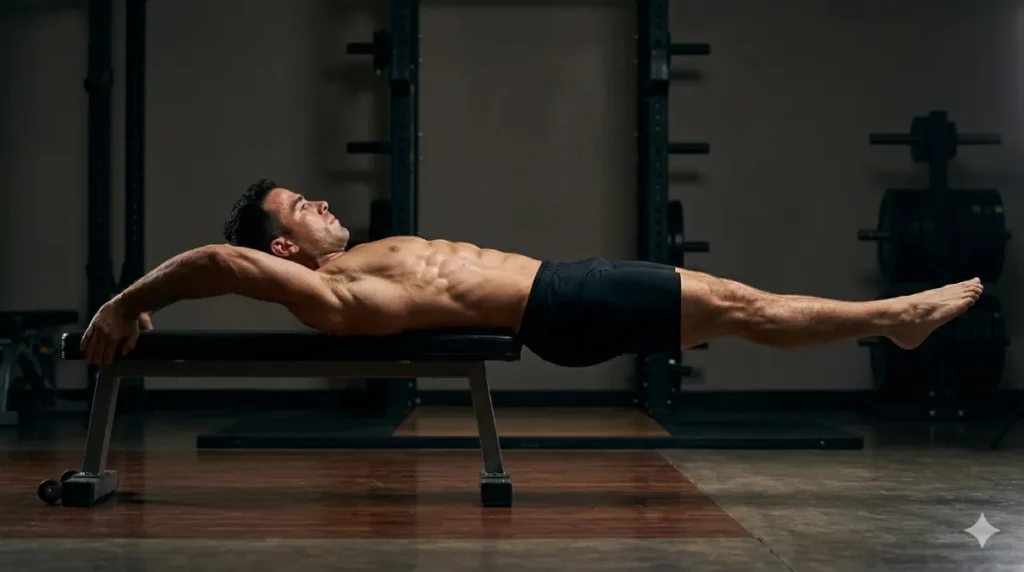
10. Dragon Flag — [Anti-Extension, Maximal] [A]
Lying on a bench (or floor with a sturdy anchor), grip behind the head. Drive feet toward the ceiling, then lower the body as one rigid plank, only the upper back touching down.
- Cues: Squeeze glutes harder than abs. The hips piking is the failure mode — fix it with PPT before lowering.
- Regression: Tuck dragon flag.
- Progression: Add a slow 5-second negative, then full reps.
See the dedicated ladder below. Pairs well with calisthenics back workout days.
Hollow Body Standards
The hollow hold is the gatekeeper. If you cannot hold a clean 45 seconds, harder anti-extension work will leak through the lower back.
| Level | Hold Time | Cue to focus on |
|---|---|---|
| Beginner | 20 seconds, tuck or knees bent | Lower back pinned, exhale before brace |
| Intermediate | 45 seconds, straddle or one-leg straight | Ribs down, arms biceps-by-ears |
| Advanced | 60+ seconds, full hollow | Quads locked, toes pointed, no shake |
The ACSM’s 2026 resistance training guidelines support training major muscle groups at least twice weekly on non-consecutive days, with progressive overload — exactly how this ladder works (Source: ACSM, 2026).
L-Sit Progression Ladder
The shortest path from “cannot lift my legs” to a 20-second straight L. Hold each stage until you hit the time target on three consecutive sessions before moving up.

- Foot-supported knee L (floor): push the floor away, hover the hips. Target: 20 sec.
- Tuck L-sit: knees fully off the floor, shins parallel. Target: 20 sec.
- One-leg L-sit: one leg straight, one tucked. Alternate sides. Target: 15 sec each.
- Straddle L-sit: legs straight and wide. Target: 15 sec.
- Straight L-sit: legs together, parallel to floor. Target: 10 sec, then build to 20.
Train this twice a week, 3–5 short holds with full rest. Quality decays fast on L-sits — stop a set the moment the legs drop.
Dragon Flag Progression
The dragon flag is the most honest anti-extension test in calisthenics. There is nowhere to hide a weak rib cage. Schoenfeld’s research on long-ROM, eccentric-loaded work explains why it produces such a strong hypertrophy stimulus on the rectus abdominis — the lower fibers see eccentric tension at full length, which is exactly the loading pattern the rectus responds to (Source: Schoenfeld et al., 2018).

- Tuck dragon flag: knees tucked, body rigid from shoulders to hips. Target: 5 clean reps with 2-sec lower.
- Straddle dragon flag: legs straight and wide. Target: 5 reps with 3-sec lower.
- One-leg dragon flag: one leg straight, one tucked. Target: 5 each side.
- Full dragon flag: body rigid, slow eccentric, then a slow concentric. Target: 3–5 reps.
I spent six weeks stuck at the straddle stage. The fix was not more reps — it was cueing a hard posterior pelvic tilt at the top before I began lowering. Glutes set the brace; the abs only hold it. Coach yourself out of the pike.
Safety cue: if the lower back arches during the descent, end the set. That is the rep where lumbar discs take the load instead of the rectus.
Anti-Rotation Bodyweight Work
This is the category most calisthenics core articles skip — and the one that transfers most directly to sport. Anti-rotation strength is what keeps a sprinter’s hips driving forward instead of leaking sideways and what keeps a grappler’s spine stacked under torque.
You do not need a cable stack. You need a band, a doorway, or a weighted bag.
- Band Pallof press: anchor a band at chest height, press it out from the sternum, hold 5 seconds. The hands want to drift toward the anchor — your job is not to let them. 3 x 8 each side.
- Partner Pallof: partner pushes the back of your wrist randomly while you hold the press. 30 seconds each side. Brutal and quiet.
- Standing rotation hold: half-kneeling, band overhead, resist the diagonal pull. 20 seconds each side.
- Suitcase-carry analog: carry a water jug or backpack in one hand, walk 20 meters without letting the shoulder dip. Switch sides.
Pair these with grip-heavy days. The carries also build forearm strength — see our calisthenics arm workout for direct work.
4-Week Calisthenics Core Routine (Sessions A / B / C)
Run three core sessions per week on non-consecutive days. Rotate A → B → C. Progress only when you hit the top of the rep range with clean form on two sessions in a row.
| Session | Focus | Exercises (sets x reps — rest) |
|---|---|---|
| A | Anti-Extension | Hollow hold 3 x max time (60s rest); Hanging leg raise 4 x 8 (90s); Tuck/full dragon flag 3 x 5 (2 min); RKC plank 2 x 30s (45s) |
| B | Anti-Rotation / Anti-Lateral-Flexion | Side plank 3 x 30–45s each side (45s); Band Pallof press 3 x 8 each side (60s); Bird dog 3 x 10 each side, slow (45s); Suitcase carry 3 x 20 m each side (60s) |
| C | Dynamic + Compression | Hollow rocks 3 x 20 (45s); L-sit progression 5 x target time (90s); Hanging knee or leg raise 3 x 10 (60s); Dead bug 2 x 10 each side (30s) |
Weeks 1–2: stay at the lower end of rep ranges, prioritize form. Weeks 3–4: push to top of range, drop one rest interval by 15 seconds per session.
Fitting Core Into Your Week
Two to three sessions weekly is the sweet spot. Stack them after pulling days — the hanging work doubles as grip practice, and a fatigued back is not a problem for hollow holds.
- Mon: calisthenics chest workout + Session A
- Wed: calisthenics back workout + Session B
- Fri: Legs / skills + Session C
Skip core on days you train heavy deadlifts or weighted pull-ups — the spinal erectors are already cooked.
Common Mistakes
- Losing posterior pelvic tilt. The lower back arches on leg raises and dragon flags. Fix: exhale, tuck, then move.
- Neck strain on hollow holds. Tuck the chin slightly, eyes on the knees, do not crane.
- Swinging on hanging work. Momentum is the cheat. If you swing, regress to knee raises and slow the tempo. See push-up progression for parallel skill scaling.
- Ignoring breathing. Brace, then breathe shallow into the brace. Holding your breath for 30 seconds is not a core exercise; it is a stunt.
- Training to flop, not to form. The last ugly rep teaches you the wrong pattern. End sets one clean rep before failure.
FAQ
Sources
- ACSM — Resistance Training Guidelines Update 2026. acsm.org
- Schoenfeld et al. (2014). EMG comparison of abdominal exercises. Journal of Strength and Conditioning Research. Summary
- Schoenfeld, B. (2018). Eccentric tension and long-ROM hypertrophy. JSCR.
- McGill, S. — Core stability research, University of Waterloo. Overview
- Contreras, B. Bodyweight Strength Training Anatomy (Human Kinetics). Framework reference

Pingback: CrossFit Ab Workout: 6 Moves and 2 Brutal WODs
Pingback: Can You Do Calisthenics Every Day? Honest Answer
Pingback: Upper Body Gym Machine Workout: Complete Plan