
By James Nolan — senior calisthenics coach, Gymnase Tips. Last updated June 2026.
TL;DR — Can a Calisthenics Arm Workout Actually Build Bigger Arms?
Yes — a calisthenics arm workout builds bigger biceps and triceps when you pair chin-ups, towel or ring curls, dips, and diamond push-ups with overhead bodyweight triceps work, train arms directly twice a week at 3–4 sets of 8–12 reps, and progress through leverage and tempo instead of just adding reps. Mechanical tension from bodyweight resistance is recognized as a valid hypertrophy stimulus across adult populations (Source: ACSM, 2024).
Below: 10 ranked exercises, a three-track equipment fork (bar + rings, bar only, zero equipment), a 4-week routine in table form, and the overhead triceps fix that most home programs skip.
Quick Answer — How to Train Arms With Calisthenics
Train arms with calisthenics by pairing one biceps-pull and one triceps-push movement twice weekly, hitting 3–4 sets of 8–12 reps stopping 1–2 reps short of failure, and progressing through leverage (foot angle, archer, one-arm bias) and tempo (3-second eccentrics) rather than added load. Combine compound pulls and presses with direct arm exercises for the full stimulus.
- Chin-up — primary biceps compound
- Ring or towel curl — peak-contraction biceps isolation
- Inverted underhand row — biceps + mid-back, scalable to any setting
- Parallel bar dip — primary triceps compound
- Diamond push-up — medial and lateral triceps
- Pseudo-planche push-up — triceps + anterior delt under long-lever load
Pick Your Track — Equipment Fork
Your equipment dictates exercise selection more than your experience does. Pick the highest track you can actually run from where you live and train.
Track A — Bar + Rings (gold standard)
Best stimulus. Rings let the biceps reach full peak contraction at the top of a curl, and dips on parallel bars allow a true sub-90-degree elbow angle.
- Chin-up, ring curl, parallel bar dip, bodyweight skull crusher on rings.
- Sacrifices vs nothing. This is the ceiling.
Track B — Bar Only (home doorway)
A pull-up bar covers most of the work. Sub towel curls and commando pull-ups in where rings would have gone; bench dips replace parallel bar dips at a meaningful triceps cost.
- Chin-up, commando pull-up, towel curl, bar skull crusher, bench dip.
- Sacrifices: shallower dip ROM, less peak-contraction biceps stimulus.
Track C — Zero Equipment (travel or no bar)
You can still grow arms — it just takes more creativity per session.
- Doorframe inverted row (towel anchored on a closed door, lean back), towel curl under the thigh (self-resistance), table inverted row, isometric self-resistance curl, diamond push-up, pike push-up, bench or chair dip.
- Sacrifices: no vertical pull, so biceps overload comes from rep ranges and isometrics. Plan for slower progress and longer time-under-tension sets.
The 10 Best Calisthenics Arm Exercises (Ranked)
Ranked by stimulus-to-equipment ratio — what produces the most growth per piece of kit you need.
| # | Exercise | Primary mover | Equipment | Reps | Regression | Progression |
|---|---|---|---|---|---|---|
| 1 | Chin-Up | Biceps / lats | Bar | 6–12 | Band-assisted or negative-only | Weighted vest, archer chin-up |
| 2 | Ring / Towel Curl | Biceps (peak contraction) | Rings or towel | 8–12 | Higher foot angle | Lower foot angle, one-arm bias |
| 3 | Inverted Underhand Row | Biceps / mid-back | Bar or table | 10–15 | Bent knees, higher bar | Feet elevated, archer row |
| 4 | Commando Pull-Up | Biceps (alternating) | Bar | 5–8 / side | Chin-up holds | Weighted vest, slower eccentrics |
| 5 | Doorframe / Towel Curl (no bar) | Biceps | Towel + door or leg | 8–12 | Lighter self-resistance | Single-arm, paused at peak |
| 6 | Parallel Bar Dip | Triceps / chest | Parallel bars | 6–12 | Bench dip or band-assisted | Weighted vest, L-sit dip |
| 7 | Diamond Push-Up | Triceps (medial / lateral) | None | 8–15 | Incline diamond on bench | Decline diamond, feet on box |
| 8 | Pseudo-Planche Push-Up | Triceps + ant. delt | None | 6–10 | Hands lower, less forward lean | Deeper lean, planche-lean push-up |
| 9 | Bodyweight Skull Crusher (overhead) | Triceps long head | Bar or rings | 6–10 | Higher angle / on knees | Lower bar, feet elevated |
| 10 | Korean Dip / Bench Tricep Extension | Triceps long head | Bar or bench | 5–8 | Bench tricep extension | Korean dip on the bar |
Biceps (Exercises 1–5)
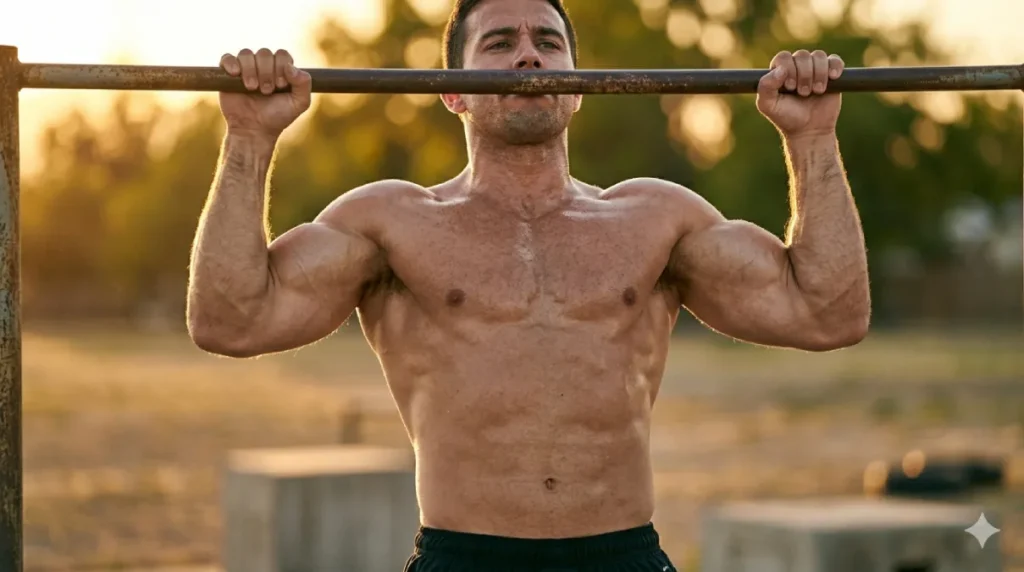
1. Chin-Up. Underhand, shoulder-width grip, dead-hang start, chin clears the bar, controlled descent. The single highest-return biceps movement in calisthenics — the biceps brachii works under heavy load through a long range while the brachialis takes a share of the work. See our strict chin-up tutorial for grip and scapular cues.
- Mistake: kipping or stopping at eye level. If the chin doesn’t clear the bar, it’s a half-rep.
2. Ring / Towel Curl. Body angled under rings or a sturdy towel anchor, palms up, elbows pinned and pointing down, curl your body toward your hands. Rings allow supination at the top — the peak biceps contraction that bar work doesn’t deliver.
- Mistake: elbows drifting forward and the shoulder doing the work. Lock the elbows in place; only the forearm should move.
3. Inverted Underhand Row. Body straight under a bar (or sturdy table), underhand grip, pull chest toward the bar with elbows tracking close to the ribs. Scales infinitely with foot angle.
- Mistake: flaring the elbows wide — that turns it into a back row, not a biceps row. Keep elbows close.
4. Commando Pull-Up. One hand forward, one hand back on the bar; pull up so your head clears one side, then the other on the next rep. Hits each arm slightly asymmetrically — useful for ironing out left/right imbalances.
- Mistake: twisting the torso instead of pulling vertically. The bar should stay over the chin, not the shoulder.
5. Doorframe / Towel Curl (no bar). Loop a towel under one thigh, grip both ends, and curl against the thigh’s resistance — push down with the leg as you pull up with the arm. Or hook a towel over a sturdy door at chest height for a self-resistance curl.
- Mistake: under-resisting. The leg or anchor should make 6–8 reps genuinely hard. If you can do 20, you’re loafing.
Triceps (Exercises 6–10)
6. Parallel Bar Dip. Upright torso (lean slightly only if chest-biased is wanted), descend until the shoulder drops below the elbow, drive back to lockout. Loads the triceps under heavy bodyweight resistance. Our deep dip progression covers the elbow-friendly build-up.
- Mistake: half-rep dips. The elbow must pass 90 degrees; shallow dips look like work and aren’t.
7. Diamond Push-Up. Hands together under the sternum forming a triangle, elbows track back along the ribs, chest touches the hands. Targets the medial and lateral heads.
- Mistake: elbows flaring wide — that shifts load onto the chest. Drive the elbows back, not out.
8. Pseudo-Planche Push-Up. Hands rotated back (fingers pointing toward your feet), shoulders shifted forward of the wrists, body leaning over the hands. Triceps and anterior delts under long-lever load.
- Mistake: not leaning forward. If the shoulders stay over the wrists, it’s just a push-up with annoying wrist angles.
9. Bodyweight Skull Crusher (overhead). Hands on a bar or rings at hip-to-chest height, body straight and angled forward; bend only at the elbows to lower your forehead toward the bar, then press back to lockout. This is the long-head loader the next section is about.
- Mistake: hinging at the hips. The body must stay rigid; the elbows are the only joint that moves.
10. Korean Dip / Bench Tricep Extension. Korean dip: face away from the bar, hands behind you on the bar, drop down and press back up — heavy long-head bias. Beginner version: bench tricep extension with hands behind on a bench, lower the head past the bench, press back up using triceps only.
- Mistake: using the legs to assist. The legs hold body weight, but the press has to come from the elbow extension.
The Long-Head Triceps Fix Most Calisthenics Programs Miss
The triceps long head only fully lengthens when the shoulder is flexed overhead — yet dips, diamond push-ups, and pseudo-planches all keep the shoulder in extension or neutral. That’s why home-bar calisthenics arms often develop a strong lateral-head “horseshoe” but a flat, under-grown long head.
The fix: add one overhead-loaded triceps movement per week. Bodyweight skull crushers on a bar or rings put the shoulder into flexion under load, hitting the long head in its stretched position — the position where the most hypertrophic stimulus is delivered (Source: Schoenfeld et al., 2024 review on stretch-mediated hypertrophy).
Prescription: 3 sets of 6–10 reps with 90 seconds of rest, slotted into Session B once per week. Use a 3-second eccentric — the stretched range is exactly where you want the tension to live.
In 12 weeks coaching home-bar trainees, the long-head gap shows up as flat lateral-tricep development on otherwise lean, strong arms. Adding one overhead session per week resolved it in every case I’ve programmed — usually visible by week 8.
The 4-Week Calisthenics Arm Routine
Two direct arm sessions per week, layered on top of your normal pull and push days. Session A is biceps-led; Session B is triceps-led with the long-head movement included.
| Week | Session A (Biceps) | Session B (Triceps) | Progression cue |
|---|---|---|---|
| 1 | Chin-up 4 × max-1, Commando 3 × 6 / side, Inv. underhand row 3 × 12, Ring/towel curl 3 × 10 | Dip 4 × 8, Diamond push-up 4 × 12, Pseudo-planche 3 × 8, BW skull crusher 3 × 8 | Baseline. Strict form, full ROM, log every set. |
| 2 | Same exercises | Same exercises | +1 rep per set wherever last week’s reps felt clean. |
| 3 | Same | Same | Cut rest by 15 seconds on the smaller lifts. Add a 2-second eccentric on chin-ups and dips. |
| 4 | Retest max chin-ups, then deload to 50% volume for the rest of the session | Retest max dips, then deload to 50% volume | Deload week. Restart Week 1 with new baseline reps. |
Rest prescriptions: chin-up and dip 2 minutes, commando 2 minutes, ring/towel curl and inverted row 75 seconds, diamond push-up 75 seconds, pseudo-planche 90 seconds, skull crusher 90 seconds.
Weekly Schedule
| Day | Session | Duration |
|---|---|---|
| Monday | Chest + Arms — Session B (Triceps) | 35 min |
| Tuesday | Legs | 40 min |
| Wednesday | Back + Arms — Session A (Biceps) | 35 min |
| Thursday | Shoulders + Core | 30 min |
| Friday | Full-body circuit | 40 min |
| Saturday | Cardio or run | 30 min |
| Sunday | Rest | — |
Beginner Modification
If you can’t yet do 5 strict chin-ups or 5 strict dips, swap as follows. Run this version for 4–8 weeks before the standard routine.
- Chin-up → band-assisted chin-up or 5-second negatives, 4 × 4
- Commando → chin-up holds at the top, 3 × 15 sec
- Dip → bench dip, 4 × 12
- Diamond push-up → incline diamond push-up on a bench, 4 × 10
- Bodyweight skull crusher → high-angle (more upright body), 3 × 6
See the calisthenics beginner routine for the full ramp-up before adding direct arm work.
Advanced Overload
When the standard routine becomes routine, add load — not more sets.
- Weighted vest for chin-ups and dips (start at 10 lb, add 5 lb when you hit the top of the rep range two sessions running).
- Archer chin-up and archer row to bias one arm at a time.
- L-sit dip for triceps under additional core demand.
- Korean dip in place of bench tricep extension.
Bodyweight vs Weights for Arm Growth
Both build arms; the question is which trade-off fits your training. Weighted arm work — dumbbell curls, cable pushdowns, skull crushers — wins on isolation convenience and progressive overload simplicity. Add 2.5 lb and the stimulus changes immediately. Calisthenics wins on grip strength, tendon resilience, and the transferable upper-body strength that pull-ups and dips deliver as a byproduct.
The chin-ups-vs-curls debate is a false binary. Chin-ups load the biceps under heavier resistance through a longer ROM than most dumbbell curls; curls hit the peak contraction at the top better than a chin-up does. The highest-ROI path is a bodyweight base — chin-ups, dips, ring or towel curls — with one weighted accessory (weighted chin-up once a week) once you’re past 12 clean bodyweight reps.
Why Most Calisthenics Arms Stay Small (and the Fix)
Four reasons, all fixable.
- No direct arm work. Pull-ups and push-ups alone leave growth on the table. Add chin-ups, ring or towel curls, and diamond push-ups for direct stimulus.
- Never progressing load. Doing 10 chin-ups for six months without weight, archer variations, or slower eccentrics is zero overload. Add the vest the moment you hit 10 clean reps.
- Under-eating. Arms grow on adequate calories and 1.6–2.0 g of protein per kg of bodyweight daily (Source: ISSN protein position stand, Jäger et al., 2017). No training pattern compensates for a chronic deficit.
- Skipping the overhead triceps movement. The fix is the previous section: one weekly overhead skull crusher or Korean dip session for the long head.
Calisthenics Arm Workout FAQ
Can you build big arms with calisthenics alone?
Yes, especially in the first 2–3 years of training. Chin-ups, dips, ring or towel curls, and bodyweight skull crushers cover both heads of the biceps and all three heads of the triceps. Past intermediate level, adding a weighted vest or one weighted accessory accelerates results without abandoning the calisthenics base.
How long does it take to build arms with calisthenics?
Visible biceps and triceps development typically appears in 8–12 weeks of consistent training with progressive overload, adequate protein, and a small caloric surplus. Strength gains show up earlier, around week 3–4. Beginners see faster initial change; intermediates need closer to 12 weeks.
How often should I train arms with calisthenics?
Two dedicated arm sessions per week, plus the indirect arm work from your back and chest days. That’s effectively four arm-stimulating sessions weekly — enough volume for hypertrophy without recovery debt. Daily arm training is wasted volume; arms need 48 hours to rebuild.
How do I train biceps without a pull-up bar?
Use towel curls anchored under your thigh (self-resistance), doorframe inverted rows with a towel over a closed door, table inverted rows, and isometric self-resistance curls. Compensate for the missing vertical pull with longer time-under-tension sets — 3-second eccentrics and paused reps.
Are dips enough for triceps?
No. Dips hammer the lateral and medial heads but under-load the long head because the shoulder stays extended. Add one overhead bodyweight skull crusher or Korean dip session per week — 3 sets of 6–10 reps — to develop the long head and fill out the back of the arm.
Chin-ups vs curls — which is better for biceps?
Chin-ups for absolute biceps load and ROM; curls for peak contraction at the top. For most calisthenics trainees, chin-ups are the primary driver and ring or towel curls cover the peak-contraction gap. You don’t have to choose — program both.
Can beginners do this 4-week routine?
Use the beginner modification first. If you can’t do 5 strict chin-ups or 5 strict dips, run the band-assisted and bench-dip version for 4–8 weeks, then switch to the standard routine when the strength baseline is in place.
Can calisthenics replace weights for arm growth?
For most non-competitive trainees, yes. Bodyweight progression to weighted chin-ups, archer chin-ups, L-sit dips, and Korean dips delivers stimulus equivalent to a dumbbell-based arm program. The weight-room advantage is convenience of overload, not a unique muscular stimulus.
Sources
- American College of Sports Medicine — bodyweight resistance training and hypertrophy. Source.
- Jäger R. et al., International Society of Sports Nutrition Position Stand: Protein and Exercise (2017). Source.
- Schoenfeld B. et al., stretch-mediated hypertrophy review (2024). Source.

Pingback: How to Do a Pullup: Proper Form, Step by Step (2026)