
By James Nolan — Gymnase Tips senior trainer. Updated June 2026. Tier rankings calibrated against gymnastics and military PT progression standards (a max score on the 2026 USMC PFT still requires 20+ strict pull-ups — Source: military.com, 2026).
TL;DR — What Are the 18 Pull-Up Variations Ranked by Difficulty?
The 18 most useful pull-up variations form a 4-tier difficulty progression — from band-assisted pull-ups (Foundation) to the one-arm pull-up (Advanced, a 2–5 year goal). Each tier graduates on a strict-rep benchmark. Pick the variation just above your current level, train it 3–4x weekly, rotate grips, and progress by hitting the rep target.
In eight years of coaching pull-ups, the single biggest predictor of progress isn’t grit — it’s picking the right variation for your current strength and graduating on reps, not on the calendar. Train above your tier and the shoulders complain by week three. Train below it and the lats never grow.
Types of Pull-Ups at a Glance
Pull-up variations sort into four difficulty tiers based on the strict reps required to enter them. Foundation: dead hang, active hang, scapular pull, band-assisted pull-up. Beginner: negative pull-up, standard pull-up, chin-up, neutral-grip pull-up, wide-grip pull-up. Intermediate: L-sit, archer, towel, clapping, weighted pull-up. Advanced: muscle-up, typewriter, one-arm-assisted, one-arm pull-up.
- Tier 1 — Foundation: 1. Dead hang · 2. Active hang · 3. Scapular pull-up · 4. Band-assisted pull-up
- Tier 2 — Beginner: 5. Negative pull-up · 6. Standard pull-up · 7. Chin-up · 8. Neutral-grip pull-up · 9. Wide-grip pull-up
- Tier 3 — Intermediate: 10. L-sit pull-up · 11. Archer pull-up · 12. Towel pull-up · 13. Clapping pull-up · 14. Weighted pull-up
- Tier 4 — Advanced/Elite: 15. Muscle-up · 16. Typewriter pull-up · 17. One-arm-assisted pull-up · 18. One-arm pull-up
Master Comparison Table — All 18 Pull-Up Variations
The single most useful reference in this article. Find your current variation, see what gates the next one, and note the most common mistake before you load your first set.
| # | Variation | Tier | Grip | Prereq strict reps | Primary muscle | Common mistake |
|---|---|---|---|---|---|---|
| 1 | Dead hang | Foundation | Pronated, shoulder-width | None | Grip, shoulder stabilisers | Shrugged shoulders, clenched grip |
| 2 | Active hang | Foundation | Pronated | 30 sec dead hang | Lower traps, lats | Bending the elbows |
| 3 | Scapular pull-up | Foundation | Pronated | 30 sec active hang | Lower traps, lats | Rolling shoulders forward at the bottom |
| 4 | Band-assisted pull-up | Foundation | Pronated | 3×10 scap pulls | Lats, biceps | Bouncing out of the bottom |
| 5 | Negative pull-up | Beginner | Pronated | 8 reps lightest band | Lats (eccentric) | Dropping the last 6 inches |
| 6 | Standard pull-up | Beginner | Pronated, shoulder-width | 5 controlled negatives | Lats, biceps | Chin-craning to clear the bar |
| 7 | Chin-up | Beginner | Supinated | 3 strict standard | Biceps, lower lats | Half-rep ROM at the top |
| 8 | Neutral-grip pull-up | Beginner | Neutral (parallel) | 5 strict standard | Lats, brachialis | Flared elbows |
| 9 | Wide-grip pull-up | Beginner | Pronated, 1.5x shoulder | 8 strict standard | Upper lats | Grip too wide → impingement |
| 10 | L-sit pull-up | Intermediate | Pronated | 10 strict + 20 sec L-sit | Lats, core | Legs dropping below 90° |
| 11 | Archer pull-up | Intermediate | Pronated, wide | 12 strict standard | Lats (unilateral) | Pulling to centre, not toward one hand |
| 12 | Towel pull-up | Intermediate | Towel | 10 strict + 45 sec hang | Grip, forearms | Death-gripping early, gassing in 2 reps |
| 13 | Clapping pull-up | Intermediate | Pronated | 12 strict standard | Lats (power) | Kipping forward instead of pulling up |
| 14 | Weighted pull-up | Intermediate | Pronated | 10 strict | Lats, biceps | Adding weight before full ROM |
| 15 | Muscle-up | Advanced | False / pronated | 15 strict + 10 dips + 5 high pull-ups | Lats, triceps, chest | Chicken-winging the transition |
| 16 | Typewriter pull-up | Advanced | Pronated, wide | 5 archers/side | Lats (lateral) | Chin dropping below bar mid-traverse |
| 17 | One-arm assisted | Advanced | Pronated / towel assist | 5 archers + 3 typewriters/side | Lats (single-side) | Assist hand doing the primary work |
| 18 | One-arm pull-up | Advanced | Pronated | 3 OA-assisted + 8 weighted @ +bodyweight | Lats, biceps (single-side) | Explosive kip — disqualifies the rep |
How to Read the Tier System (Prerequisite Rep Benchmarks)
A tier graduates on reps, not weeks. Time-based progressions ignore the only variable that matters — whether the tissue is actually ready for the next load. A trainee hitting 5 sloppy negatives at week four is not ready for a strict pull-up; a trainee hitting 5 clean negatives at week two is.
Two rules govern the system. First, the prereq rep is “strict” — full range of motion, controlled descent, no kip. If the rep wouldn’t count in a calisthenics certification test, it doesn’t count here. Second, hit the prereq target across two non-consecutive sessions before graduating. One lucky set is variance, not capacity. Trainees who follow this rule typically hit their first strict pull-up in 6–10 weeks of band-and-negative work; trainees who chase the calendar instead often stall for months at the negative stage.
Tier 1 — Foundation Pull-Up Variations (Moves 1–4)
The Foundation tier is for anyone with fewer than one strict pull-up. Skipping it to “save time” is the single most common cause of front-of-shoulder pain in week-three trainees — the scapulae aren’t yet doing the work the joint capsule then has to absorb.
1. Dead Hang
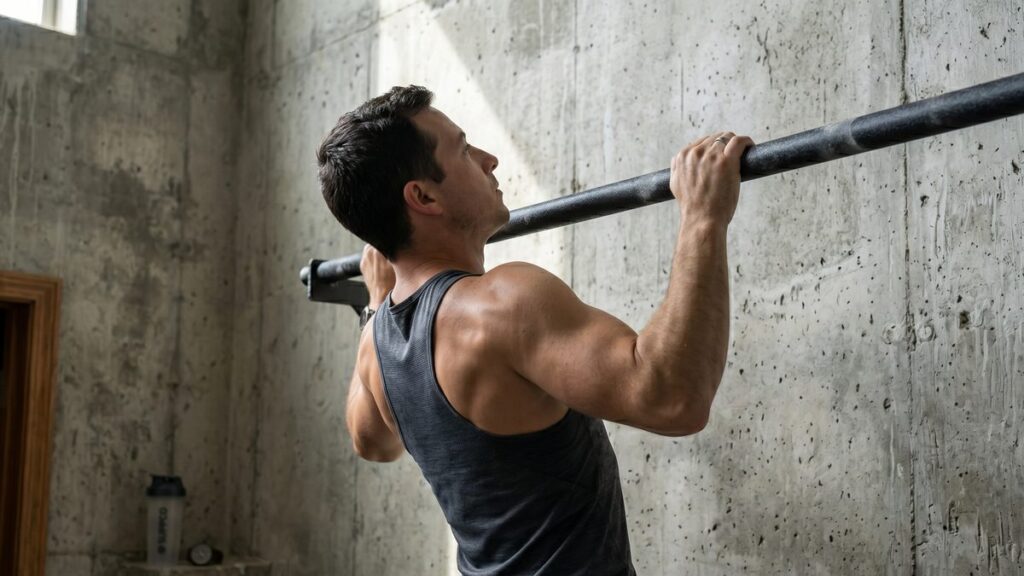
The dead hang is a passive hang from the bar with arms straight, body relaxed, and grip closed. It builds the grip endurance and shoulder integrity that everything above depends on. Prereq: none. Target: 60 seconds unbroken.
Treat it as deliberate practice, not filler. Set a timer, hang, breathe through the nose, and resist the urge to clench the jaw and crush the bar — that’s wasted tension. Two sets, three times a week, builds a 60-second hang inside a month for most adults.
Common mistake: shrugged-up shoulders combined with a clenched grip. The traps lock, the forearms gas in 15 seconds, and the trainee thinks their grip is the problem. Let the shoulders sit “loaded but long” — heavy in the sockets, not pinned to the ears.
2. Active Hang
The active hang depresses the scapulae from a dead-hang position without bending the elbows. The shoulder blades pull down and back; the body floats up an inch or two without arm work. Prereq: 30 second dead hang. Target: 30 second hold.
This is the position every pull-up should start from. If a trainee can’t find it on the ground, they won’t find it under load.
Common mistake: confusing the active hang with a scapular pull-up. There is no elbow bend on an active hang. The motion happens entirely at the shoulder blade.
3. Scapular Pull-Up
From an active hang, retract and depress the scapulae in a small, controlled rep — still no elbow bend. The body rises 2–4 inches. Prereq: 30 second active hang. Target: 3×10–12.
Scap pulls train the muscles that initiate every real pull-up (lower traps, rhomboids, lats in their stabiliser role). Skip them and the upper traps end up doing a job they’re not built for.
Common mistake: bending the elbows mid-rep, or letting the shoulders roll forward at the bottom. The bottom of each rep should still be an active hang, not a dead one.
4. Band-Assisted Pull-Up
Loop a resistance band over the bar, put one foot in the loop, and perform a strict pull-up. The band offloads the most assistance at the bottom (where you’re weakest) and the least at the top. Prereq: 3×10 scap pulls. Target: 8 reps with the lightest band you own.
Use the lightest band that still lets you complete a clean rep. Heavier bands fling people through the bottom and teach them nothing about the actual pattern.
Common mistake: bouncing out of the bottom on band tension. Pause for half a second at the dead-hang position on every rep. If the band catapults you upward, drop to a thinner band.
Tier 2 — Beginner Pull-Up Variations (Moves 5–9)
This is where most committed trainees live for their first 6–18 months. Grip rotation is the differentiator: months of pronated-only pull-ups produce imbalanced lat development and stalling biceps. The Beginner tier is built around rotating between five grip positions so no single tissue gets overloaded.
5. Negative Pull-Up
Jump or step to the top of the bar with chin clear, then lower over 4–5 seconds under control. Prereq: 8 reps lightest band assist. Target: 3×5 with a 4-second descent.
The eccentric phase of a pull-up builds more strength per rep than the concentric, which is why negatives bridge the gap to a first strict rep faster than any other tool. Five clean negatives is the most reliable predictor of a first strict pull-up I’ve seen across hundreds of clients.
Common mistake: controlling the first three-quarters of the descent then dropping the last 6 inches. That bottom range is precisely where the strict pull-up is born — and where rotator-cuff strain enters if you drop into it.
6. Standard Pull-Up
Pronated grip, shoulder-width, full hang to chin-over-bar. Prereq: 5 controlled negatives. Target: 10 strict.
The standard pull-up is the calibration point for every strength chart that exists. The 2026 USMC PFT awards a max score at 20+ strict reps (Source: military.com, 2026) — useful context for what “strong” actually looks like in this lift.
Common mistake: chin-craning — the neck stretches forward to clear the bar while the chest never gets close. Reps that don’t bring the upper chest toward the bar aren’t full reps; they’re cervical-spine creativity.
7. Chin-Up
Supinated (palms-toward-you) grip, shoulder-width or slightly narrower. Prereq: 3 strict standard pull-ups. Target: 12 strict.
Chin-ups recruit the biceps and pec major more than pronated pull-ups do. In the canonical EMG study of pull-up variations, biceps brachii activation hit 96% MVIC during chin-ups versus 78% during standard pull-ups, and pec major activation was significantly higher on the chin-up as well (Source: Youdas et al., JSCR, 2010). That’s why most lifters complete more chin-ups than pull-ups at the same bodyweight.
Common mistake: half-rep ROM at the top. The biceps shorten and the lifter stops at forehead-to-bar. Bring the collarbone toward the bar or the rep doesn’t count.
8. Neutral-Grip Pull-Up
Palms facing each other on parallel handles. Prereq: 5 strict standard. Target: 10 strict.
The most joint-friendly pull-up variation. The humerus stays in a neutral rotation, which sidesteps the impingement risk that haunts wide-grip work. If your gym only has one set of parallel handles, this is the variation to run on every high-volume day.
Common mistake: flared elbows. Cue: drive the elbows down toward the back pockets, not out toward the walls.
9. Wide-Grip Pull-Up
Pronated grip set roughly 1.5x shoulder-width — no wider. Prereq: 8 strict standard pull-ups. Target: 8 strict.
Wider grip biases the upper lat fibres and reduces biceps contribution, which is why competitive bodybuilders favour it for lat-width work. The trade-off is real. Going wider than 1.5x shoulder-width while internally rotating the humerus reduces the subacromial space and raises impingement risk — wide and reverse pull-up positions both show kinematics linked with elevated impingement risk in shoulder-kinematics research (Source: Prinold & Bull, PMC, 2015).
Common mistake — shoulder-safety flag: setting the grip too wide. If you can’t see your knuckles in your peripheral vision at the top of the rep, you’re past the safe envelope. Cap the grip at 1.5x shoulder-width and keep the chest proud throughout.
Tier 3 — Intermediate Pull-Up Variations (Moves 10–14)
Tier 3 unlocks at 10+ strict standard pull-ups. Each variation here trains a quality the standard pull-up alone can’t reach: deep core under load (L-sit), unilateral strength bridge (archer), grip-specific endurance (towel), explosive power (clapping), and pure maximal strength (weighted).
10. L-Sit Pull-Up
Hold the legs at 90° in front of the body throughout a full pull-up. Prereq: 10 strict pull-ups + 20-second L-sit hold. Target: 5 strict reps.
The L-sit position roughly doubles the abdominal demand of a normal pull-up. It also makes the lats work harder by removing the trunk-arch trick that lifters use to clear the bar.
Common mistake: legs dropping below 90° as fatigue accumulates. Once the heels sink, the rep becomes a sloppy standard pull-up — terminate the set the moment leg position breaks.
11. Archer Pull-Up
Wide grip; pull explicitly toward one hand while the other arm stays extended along the bar. Prereq: 12 strict standard pull-ups. Target: 5/side.
The archer is the unambiguous bridge to one-arm work. Half the body is now responsible for nearly all the load. Train both sides every session.
Common mistake: pulling to the centre of the bar instead of toward one hand. The chin should arrive next to the working wrist, not under the middle of the bar.
12. Towel Pull-Up
Drape a sturdy towel (or two) over the bar and grip the ends. Prereq: 10 strict pull-ups + 45 second dead hang. Target: 5 strict reps.
Towel work multiplies grip demand on every rep and is the cheapest forearm builder in calisthenics. EMG analysis comparing traditional, suspension, and towel pull-ups shows the towel variant recruits the lats and biceps similarly to a standard pull-up while substantially raising forearm demand (Source: PMC, 2017).
Common mistake: death-gripping the towel at the bottom of rep one and gassing the forearms in two reps. Hold the towel firmly, not maximally, and breathe through the set.
13. Clapping Pull-Up
A standard pull-up driven explosively enough at the top that both hands leave the bar long enough to clap before re-gripping. Prereq: 12 strict standard pull-ups. Target: 3 reps.
Plyometric pull-up work recruits high-threshold motor units the same way heavy weighted reps do, which makes the clapping pull-up a useful crossover tool for athletes who don’t have access to load.
Common mistake: kipping the body forward to generate momentum, then catching the bar with bent wrists. Generate the impulse from the lats and arms, not the hip swing.
14. Weighted Pull-Up
Standard pull-up plus added load via dip belt or weight vest. Prereq: 10 strict pull-ups. Target: +20 kg (44 lb) × 5.
Of all the Tier 3 variations, weighted work is the fastest-progressing route to raw pulling strength. Most trainees add weight in 1.25–2.5 kg jumps weekly for the first several months.
Common mistake: adding load before owning bodyweight at full ROM. If your strict pull-up stops at forehead-to-bar, weighted pull-ups will entrench that pattern — they don’t fix it.
Tier 4 — Advanced / Elite Pull-Up Variations (Moves 15–18)
Tier 4 takes years, not months. The one-arm pull-up alone is typically a 2–5 year project for someone who arrives at this tier with 12–15 strict reps. Lifestyle, bodyweight, and prior pulling history shift these timelines significantly.
15. Muscle-Up
A strict pull-up that transitions over the bar into a dip. The pull terminates with the sternum (not the chin) at bar height; the transition rolls the shoulders forward; the dip presses the body up to straight arms. Prereq: 15 strict pull-ups + 10 strict dips + 5 high pull-ups to sternum. Target: 3 strict reps.
The transition is the bottleneck, not the strength. Most trainees who can pull to the sternum and dip 10 reps need 4–10 sessions of false-grip practice to nail their first clean transition.
Common mistake: chicken-winging — one elbow flips over the bar first, then the other. The transition should be symmetric. Train the high pull and the bar dip separately first.
16. Typewriter Pull-Up
Pull to the top of a wide pull-up, then shift the body laterally so the chin travels along the bar from one hand to the other, staying above the bar throughout. Prereq: 5 archer pull-ups/side. Target: 3 reps/side.
The typewriter is a sustained-tension single-side exercise. The traversing arm is in a near-isometric one-arm hold at the top while the supporting arm extends.
Common mistake: chin dipping below the bar mid-traverse. If the chin sinks, the rep restarts. Train the top-hold static first — 5–10 second one-arm holds at the top — before adding the traverse.
17. One-Arm Assisted Pull-Up
Primary hand on the bar; assist hand grips the working forearm, a towel, or a thin band, contributing as little as the rep requires. Prereq: 5 archer pull-ups/side + 3 typewriter pull-ups/side. Target: 3 reps/side.
The assisted one-arm is the final bridge to the full one-arm pull-up. Progress by reducing the assist hand’s grip position — forearm, then wrist, then thumb, then fingertip on a thin band.
Common mistake: using the assist hand for primary force. The rule: the working arm pulls; the assist hand only stabilises or unweights the smallest fraction needed to complete the rep. If the rep won’t go without significant assist, drop to archer + typewriter volume for another 8 weeks.
18. One-Arm Pull-Up
Full one-arm rep, chin clears the bar, no kipping, no leg swing. Prereq: 3 one-arm-assisted reps/side + 8 weighted pull-ups at bodyweight (i.e., +your bodyweight on the belt). Target: 1 strict rep/side.
The weighted prereq matters. Pulling your bodyweight one-handed is, mechanically, roughly the same demand as pulling double bodyweight two-handed. Without that base, the connective tissue at the elbow and shoulder isn’t ready.
Common mistake: explosive kip to generate momentum. A kipped one-arm is not a one-arm pull-up — it disqualifies the rep on any strict calisthenics standard.
Shoulder Safety — Kipping, Wide-Grip, and Scapular Prep
Most chronic pull-up injuries trace back to three preventable patterns. Each has a research-backed fix.
Why Kipping Pull-Ups Raise Injury Risk
Forces at the shoulder peak at the bottom of a kipping pull-up swing, and athletes without the capacity for 3–5 strict pull-ups lack the eccentric strength to buffer those forces safely (Source: BarBend sports medicine review, 2024). Treat kipping as a conditioning tool layered on top of strict capacity, not a workaround for missing strict capacity. A pragmatic rule: never kip a pull-up volume you can’t first cover strict.
Wide-Grip Impingement Risk
Subacromial space narrows as the arm elevates overhead, and wide pull-up positions show scapular kinematics patterns associated with elevated impingement risk versus narrower grips (Source: Prinold & Bull, PMC, 2015). The trainees who report front-of-shoulder pinching almost universally have a grip wider than 1.5x shoulder-width combined with internal humeral rotation at the top of the rep. Cap the grip at 1.5x and externally rotate the hands slightly (“rip the bar apart”) to keep the head of the humerus centred.
Scapular Prep Before Every Session
Two sets of 10 scapular pull-ups plus a 30-second active hang at the start of every pulling session is the non-negotiable warm-up. It primes the lower traps and serratus to do the scapular control work that the rotator cuff otherwise has to absorb. Five minutes of this routine has eliminated more chronic front-of-shoulder complaints in the trainees I program for than any single intervention I’ve used.
Grip Width Comparison — What Each Builds
Grip choice changes which tissues do the most work and what the joint cost is. Rotate weekly from Tier 2 onward.
- Wide grip (1.5x shoulder-width pronated): maximum upper-lat width emphasis, minimum biceps contribution. Hardest variation per rep. Highest shoulder demand — cap the width, don’t chase a wider grip.
- Shoulder-width pronated grip (standard): balanced lat and biceps loading. The default for general development and the calibration point for every strength standard, including the USMC PFT.
- Close grip / chin-up (supinated): heavy biceps and lower-lat emphasis. The chin-up tested as the highest-bicep-activation variation in the Youdas EMG study (96% MVIC, Source: Youdas et al., JSCR, 2010). Easiest grip for most lifters.
- Neutral grip (palms facing): balanced lat and brachialis loading, joint-friendly humeral rotation. Often allows the most reps. The best choice for high-volume days and trainees with shoulder history.
For a deeper breakdown, see our pull-up grip variations compared guide.
How to Program Pull-Up Variations (Weekly Structure)
Pull-ups respond well to high frequency because the lats recover quickly relative to the leg compound lifts. Three sessions per week is the sweet spot for most trainees; four works for committed intermediate lifters who have de-loaded their legs in the same week.
The 3-Day Weekly Template
| Day | Focus | Prescription |
|---|---|---|
| Day 1 | Strength | One hard variation (weighted, archer, or L-sit pull-up). 4–5 × 3–5. Rest 2–3 min. |
| Day 2 | Volume | Standard pull-ups. 4 × 8–12 strict. Rest 90 sec. Rotate grip weekly (pronated → neutral → close). |
| Day 3 | Skill & Grip | Negatives, towel pull-ups, scap work + active-hang block. 3 × 5–8 per movement. Rest 90 sec. |
Climbing the Tiers
- Add weight (on weighted pull-ups) by 1.25–2.5 kg per week until rep targets stall, then deload weight 20% and rebuild.
- Rotate to the next variation the session after you hit the prereq target across two non-consecutive sessions — not before, not after.
- Deload every 5th week. Drop sets by one and reps by 30%. Strength supercompensates; chronic overreach grinds tendon health and progress simultaneously.
Realistic Timelines
- Foundation tier: 1–3 months from a cold start.
- Beginner tier: 6–18 months (this is where the body composition changes happen).
- Intermediate tier: 1–3 years.
- Advanced tier: 3+ years to start; the one-arm pull-up can take 5+ years for trainees who started heavy.
For an 8-week protocol that adds 5–10 strict reps to most trainees’ max, see our how to get better at pull-ups guide.
Common Pull-Up Mistakes That Stall Progression
Per-variation mistakes live in the master table. These are the programming mistakes that quietly cost months across every variation.
- Skipping the Foundation tier. Trainees who jump straight to negatives report front-of-shoulder pain in week three. The scap pulls and active hangs are the prep; without them the joint absorbs work the muscles should have done.
- Single-grip rut. Six months of pronated-only pull-ups produces an imbalanced back and an undertrained biceps. Rotate pronated, supinated, neutral, and wide-grip across the week.
- Ignoring the eccentric. Pulling fast and dropping fast trains half the rep. Hold every descent to 2 seconds minimum on volume days.
- Ego-loading weighted pull-ups. Adding 10 kg before owning bodyweight at full ROM entrenches a half-rep. Weighted work magnifies whatever pattern you already have.
- Skipping the archer before chasing the one-arm. The archer and assisted one-arm are not optional. Skipping them adds 6–12 months to the one-arm timeline and frequently produces elbow tendinopathy along the way.
- Chasing variations before mastering basics. 5 sloppy archers don’t beat 10 strict standard pull-ups. Hit the rep target at clean form before climbing.
Pull-Up Variations FAQ
What is the hardest pull-up variation?
The one-arm pull-up. Even strong calisthenics athletes typically need 2–5 years of dedicated training to land a clean rep, because pulling one-handed is mechanically equivalent to a roughly double-bodyweight two-handed pull-up. Heavy weighted reps and clapping pull-ups are the next-hardest accessible variations.
Which pull-up variation is best for lats?
Wide-grip and weighted pull-ups in the 5–8 rep range build the most upper-lat mass; the archer pull-up adds unilateral lat development that bilateral work can’t match. For pure bodyweight programming, alternate wide-grip volume days with archer strength days.
How many pull-up variations are there?
This guide covers the 18 that span the full progression from dead hang to one-arm. Broader catalogs list 25+ variations, but most of those are grip or body-position permutations (commando, mixed grip, behind-the-neck) that don’t add a distinct training stimulus or progression step.
Are chin-ups easier than pull-ups?
Yes for most lifters. The supinated grip recruits the biceps and pec major more directly — biceps activation hit 96% MVIC on chin-ups versus 78% on pull-ups in EMG testing (Youdas et al., JSCR, 2010). The recruited muscle mass per rep is higher, so the available force is higher.
What’s the easiest pull-up variation for beginners?
The band-assisted pull-up, but only after building a 60-second dead hang, a 30-second active hang, and 3×10 scapular pull-ups. Skipping that foundation makes the band-assisted pull-up a shoulder injury waiting to happen.
How do I progress from assisted to a full pull-up?
Run the sequence: lightest-band assisted pull-up (8 reps) → 4-second negatives (3×5) → first strict rep. Most trainees take 4–12 weeks across that sequence depending on starting bodyweight and training age. Once you have one strict rep, two non-consecutive volume sessions per week build it into 5 within another month.
Are kipping pull-ups bad for your shoulders?
Risky without a strict base. Shoulder forces peak at the bottom of the kipping swing, and athletes lacking 3–5 strict pull-ups don’t have the eccentric capacity to buffer those forces safely (BarBend sports medicine review, 2024). Build strict capacity first, then layer kipping for conditioning if your sport demands it.
How long does each tier take?
Rough averages for a trainee starting from zero strict reps: Foundation (1–3 months), Beginner (6–18 months), Intermediate (1–3 years), Advanced (3+ years; the one-arm pull-up can take 5+ years from a heavy starting bodyweight). Lifestyle, sleep, and prior pulling history shift timelines significantly.
The Bottom Line
Pull-up variations form a 4-tier progression gated by strict-rep benchmarks, not the calendar. Pick the variation just above your current capacity, train it 3–4 times a week with grip rotation, warm up the scapulae before every session, and graduate using the rep targets in the master table. Skip the Foundation tier and the shoulders complain; chase elite variations before mastering the basics and the progression stalls for months. For supplementary back work, see our 9 pull exercises for a wider back.
Sources
- Youdas JW et al. Surface EMG activation patterns during pull-up, chin-up, or perfect-pullup. JSCR, 2010. Source.
- Doma K et al. EMG Comparison of Traditional, Suspension Device, and Towel Pull-Up. IJES, 2017. Source.
- Prinold JAI, Bull AMJ. Scapula kinematics of pull-up techniques. 2015. Source.
- BarBend — Kipping Pull-Up Injuries. Source.
- Military.com — USMC PFT standards, 2026. Source.

Pingback: How to Do a Proper Pull-Up: Form Guide
Pingback: 28 Day Calisthenics Challenge (Free): Full Day-by-Day Plan
Pingback: Calisthenics Core Workout: 10 Exercises + 4-Week Plan
Pingback: Street Workout: Beginner's Guide to Bar Calisthenics