
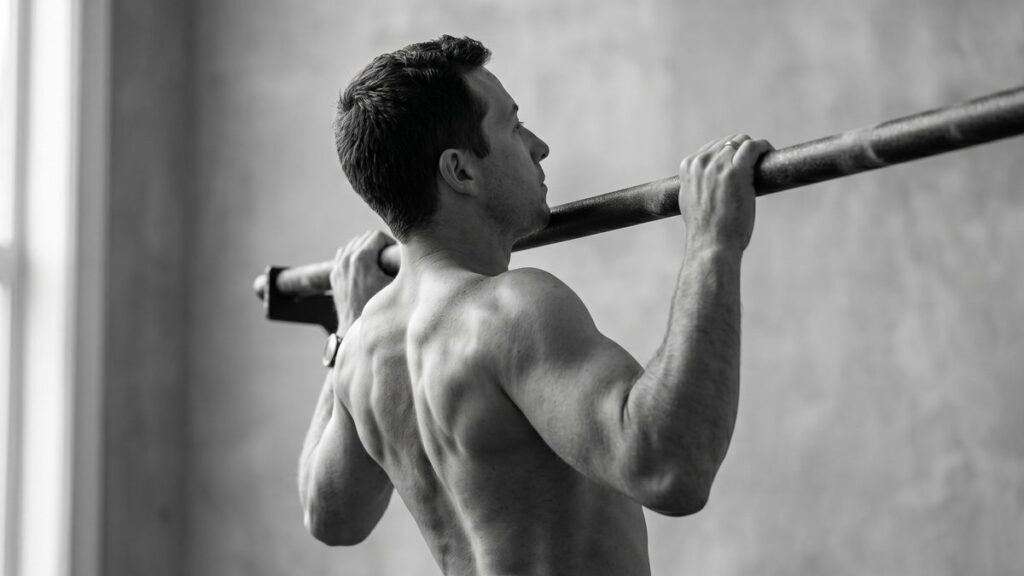
Last updated June 2026 — James Nolan, Gymnase Tips senior trainer. NSCA-CPT, 12 years coaching calisthenics. Coached 400+ adults to their first strict rep.

A proper pullup starts from a full dead hang with active shoulders, drives the elbows down until the chin clears the bar, and lowers under control back to a full hang — without kipping, half reps, or arms-only pulling. Most failed pullup attempts fail at one of three points: the dead-hang start, the mid-range, or the chin clearing the bar. The 5-step sequence below fixes all three and gives you a technique that survives weighted, high-rep, and one-arm progressions later.
This guide breaks down strict pullup form step by step, the 5 mistakes that stall progress, the breathing pattern almost no coach teaches, grip variations, rep standards by level, and the 8-week zero-to-first-rep table.
How to Do a Pullup in 5 Steps
How to Do a Pullup in 5 Steps
Grip and hang
Grip the bar overhand at shoulder-width with thumbs wrapped and arms fully extended in a dead hang.
Set active shoulders
Set active shoulders by pulling your shoulder blades down and back without bending your elbows.
Drive elbows down
Drive your elbows down toward your back pockets, leading with your lats rather than your biceps.
Chin over bar
Pull until your chin fully clears the bar with eyes looking straight ahead, not up.
Controlled descent
Lower under control over two to three seconds back to a full active dead hang.
What Is a Pullup, and What Muscles Does It Work?
A pullup is a vertical pulling exercise where you hang from an overhead bar with an overhand (pronated) grip and pull your body up until your chin clears the bar, then lower under control to a full hang. It is the benchmark test of relative upper-body pulling strength because it moves your full bodyweight through a long range.

The pullup is a compound, multi-joint movement. The latissimus dorsi is the prime mover, with significant support from the mid and lower trapezius, rhomboids, and biceps. EMG research published in the Journal of Strength and Conditioning Research found that a pronated (overhand) grip produces significantly greater latissimus dorsi activation than a supinated grip regardless of grip width (Source: J Strength Cond Res, 2014). For supporting back volume, our back workout routine layers cleanly under this lift.
| Muscle | Role | What it does in the rep |
|---|---|---|
| Latissimus dorsi | Prime mover | Drives the upper arm down and back |
| Trapezius (mid/lower) | Synergist | Pulls scapulae down and together |
| Rhomboids | Synergist | Retracts and stabilizes scapulae |
| Biceps brachii | Synergist | Bends the elbow under load |
| Brachioradialis | Synergist | Assists elbow flexion in pronation |
| Forearm flexors | Grip | Hold body weight on the bar |
| Rectus abdominis + obliques | Stabilizer | Prevent swing, hold hollow position |
The forearm and biceps stabilizing demand is also why dedicated biceps and forearm work speeds up your first rep more than most people expect.
Strict Pullup Form: 5 Steps Explained
I have watched more than 400 adults grind toward their first strict rep. The failure mode is almost never raw strength — it is one of the five points below being skipped or rushed.

1. Grip and hang. Hands shoulder-width, overhand, full grip with thumb wrapped around the bar. Hang at full arm extension with the bar sitting at the base of the fingers, not buried in the palm. This is an active dead hang, not a relaxed one — shoulders stay packed, not yanked into the ear.
Coach cue: imagine squeezing an orange between your armpit and ribs.
2. Active shoulder set. Pull your shoulder blades down and slightly back without bending your elbows. The bar should feel like it dropped two to three centimeters. This is the most-skipped step, and the one that most determines whether your lats actually fire. Practicing the scapular pull-up in isolation is the fastest fix.
Coach cue: “long neck, short armpit.”

3. Drive elbows down. Think “elbows to back pockets,” not “pull bar down.” Lats lead, biceps follow. If your arms burn out at rep three, you have inverted the order.
Coach cue: aim your elbows at the floor behind you.
4. Chin over bar. Pull until your chin fully clears the bar. Eyes stay level — looking up causes a head tilt that masks an incomplete range. Half a rep is half a rep.
Coach cue: pick a spot on the opposite wall and keep your eyes on it.
5. Controlled descent. Lower over two to three seconds to full hang. Reset the shoulder set, breathe, repeat. The descent is half the rep. Drop it and you lose half the training stimulus — eccentric strength runs roughly 40% higher than concentric, meaning the lowering phase is where most of your usable adaptation lives (Source: Sports Medicine meta-analysis, 2023).
Grip Variations: Overhand, Chin, Neutral, Wide, Close

Grip changes which muscles do most of the work and how hard the rep feels. Width and orientation both matter.
| Grip | Width | Muscles emphasized | Difficulty | ROM | Best for |
|---|---|---|---|---|---|
| Overhand (standard pullup) | Shoulder-width | Lats, mid traps | Hardest | Long | Default form work |
| Wide overhand | 1.5x shoulder-width | Lats, teres major | Hard | Shorter | Lat width focus |
| Close overhand | Inside shoulder-width | Lats, biceps | Moderate | Longest | Adding biceps |
| Underhand (chin-up) | Shoulder-width | Biceps, lats | Easiest | Long | First-rep work |
| Neutral (palms facing) | Shoulder-width | Brachialis, lats | Moderate | Long | Shoulder-friendly |
Hand width: shoulder-width is the default. Going much wider increases lat emphasis slightly but shortens range and trades off shoulder comfort. A 2014 J Strength Cond Res study comparing 1x, 1.5x, and 2x biacromial-width pulldowns found narrow and medium grips produced higher 6RM strength than wide, with no meaningful difference in lat EMG across widths (Source: J Strength Cond Res, 2014). Translation: wide grip is not a magic lat shortcut.
Thumb position: wrap fully around the bar. The “false grip” (thumb on top) is less secure and adds shoulder stress under load.
Knuckles up. The bar belongs at the base of the fingers, not deep in the palm. This protects wrist alignment and prevents the dreaded “ripped-callus rep.”
Bar thickness: standard 28-32 mm bars suit general training. Thick-grip bars (40 mm+) build forearms faster but cap reps until the grip catches up. For more pulling angles, see our pull-up variations guide.
Pullup vs Chin-Up: Which Is Easier?
The chin-up is easier than the pullup for almost everyone, and the reason is mechanical, not mental. The supinated (palms-facing-you) grip lengthens the biceps lever arm so the biceps contribute more force, and it shortens the vertical pull distance by roughly two to three centimeters because the shoulders externally rotate at the top.

Use the pullup when: you want maximum lat emphasis, you are training for strict-form benchmarks (military tests, calisthenics standards), or you want the harder version for the same reps.
Use the chin-up when: you cannot yet do a strict pullup, you want more biceps stimulus, or you are doing high-rep conditioning and need the easier variation to keep form clean.
Swap rule I use with clients: if you cannot hit 5 strict pullups yet, train chin-ups for biceps-heavy lat work and pullups for negatives. Once you pass 5 strict pullups, flip the ratio. For the supporting biceps drills, drop into biceps and forearm work.
Body Position Through the Rep
- Legs: bent and crossed at the ankles, or straight with toes pointed. Bent prevents kicking; straight demands more core. Pick whichever keeps your form strict longest.
- Hips: slight forward tilt into a soft hollow-body shape. Hanging fully relaxed makes the rep harder and trains nothing extra.
- Core: abs braced throughout. If the body swings forward and back, the core is not holding position.
- Glutes: lightly squeezed. This locks the upper and lower halves together and prevents lower-back hyperextension at the top.
Breathing Pattern
Most pullup guides skip breathing entirely. It matters because it determines how much intra-abdominal pressure stabilizes the spine on each rep, and how long you can keep clean form on long sets.
- At the bottom: inhale through the nose, brace the core.
- During the pull: exhale forcefully through pursed lips as the chin approaches the bar — the exhale supports the contraction.
- At the top: brief pause, sip a small re-inhale.
- During the descent: exhale slowly. Use the breath to control the lowering speed.
On high-rep sets (10+ reps) this rhythm is the difference between hitting your target and failing two reps short. On weighted singles it is what keeps the spine from rounding under load.
5 Pullup Form Mistakes That Stall Progress

- Passive dead hang. Starting from relaxed shoulders dumps load into the ligaments and kills lat recruitment. The shoulder twinge most beginners blame on “bad shoulders” is just a passive hang — I have fixed it on a dozen clients with one cue: 10 scapular pulls before every set.
- Pulling with arms only. The biceps fatigue roughly three times faster than the lats. If your arms burn out at rep three, you are inverting the order. Fix: think “elbows down,” not “hands up.”
- Kipping (using leg swing). Looks like volume, builds nothing strict. Kipping uses momentum, not lats. Fix: cross your ankles and squeeze. If you cannot, you do not yet own enough strict reps to be training without assistance.
- Half reps. Stopping at “eyes-to-bar” cuts the hardest range and starves you of strength gain. Fix: film yourself side-on. The chin must clear the bar plane every rep.
- Dropping at the bottom. Releasing tension at full extension stresses the shoulder capsule. Fix: lower over two to three seconds to a soft, active hang, then start the next rep.
Troubleshooting by Where You Fail
Different sticking points have different fixes. This is where most generic guides leave you stranded.

- Stuck at the bottom (cannot initiate the pull): scapular control and lat activation are weak. Add 3 sets of scapular pulls and 5 sets of band-assisted pullups to every pull session for four weeks.
- Stuck at the midpoint (chin at eye-level): classic lat strength gap. Add negatives — 4-second descents, 3 sets of 5 — from the chin-over-bar position.
- Stuck at the top (cannot clear the chin): biceps endurance issue. Add chin-ups at 3 sets of 6-10 on one pull day per week.
- Form breaks after rep 3 or 4: total volume issue, not technique. Cut sets, raise quality, climb reps gradually.
If a sticking point will not budge after four weeks, the bottleneck is almost always programming — slot in our 8-week progression protocol and reassess.
How Long Does It Take to Do Your First Pullup?
The realistic timeline from zero to one strict rep is 8-12 weeks for an untrained adult, 4-6 weeks for a returning trainee, and 12-20 weeks for an overweight beginner. Pullups are bodyweight-relative — a 5 kg drop in fat mass or a 1 kg gain in lean mass changes the math noticeably.
Two levers move the timeline more than program choice: training frequency (3 pull sessions a week beats 1) and bodyweight trajectory. If you are 25%+ body fat, the fastest route to your first rep is half technique work, half nutrition. For broader programming context, our 30-day calisthenics challenge is a useful base layer.
Zero to First Pullup: 8-Week Path
The progression below mirrors the ACSM’s 2026 guidance for beginner resistance training — moderate volume, 48-hour recovery between hard sessions, and a build from foundational holds to eccentric to full-range work (Source: ACSM, 2026).
| Week | Sessions/wk | Exercise | Sets x Reps | Rest |
|---|---|---|---|---|
| 1-2 | 3 | Active dead hang | 3 x 30 sec | 90 sec |
| 1-2 | 3 | Scapular pull-up | 3 x 10 | 60 sec |
| 1-2 | 3 | Inverted row | 3 x 8-12 | 90 sec |
| 3-4 | 3 | Negative pullup (4-sec descent) | 3 x 5 | 2 min |
| 3-4 | 3 | Band-assisted pullup (heavy band) | 3 x 8 | 90 sec |
| 3-4 | 3 | Inverted row | 3 x 10-12 | 90 sec |
| 5-6 | 3 | Band-assisted pullup (lighter band) | 4 x 6 | 2 min |
| 5-6 | 3 | Negative pullup | 3 x 4 | 2 min |
| 5-6 | 3 | Unassisted attempt (strict) | 3 x 1 | 3 min |
| 7-8 | 3 | Unassisted pullup attempt | 5 x 1-2 | 3 min |
| 7-8 | 3 | Negative pullup | 3 x 3 | 2 min |
| 7-8 | 3 | Band-assisted pullup (lightest) | 3 x 6 | 90 sec |
If 12 weeks pass without a rep: the limiter is almost always body composition or under-eating protein. I have a client who spent six months on negatives with no progress, then lost 4 kg in eight weeks and pulled her first rep on a Tuesday afternoon. Once you own one strict rep, switch to our how to get better at pull-ups protocol to add 5-10 reps, and explore pull-up variations for the next mechanical challenge.
Pullup Strength Standards (Reps by Level)
Use these as honest benchmarks, not gospel. Reps below are strict, full-range, dead-hang-to-chin-over-bar.
| Level | Male (reps) | Female (reps) |
|---|---|---|
| Untrained | 0-3 | 0 |
| Novice | 4-7 | 1-2 |
| Intermediate | 8-12 | 3-5 |
| Advanced | 13-20 | 6-10 |
| Elite | 21+ | 11+ |
| USMC PFT max score (age 17-25) | 23 | 12 (non-combat) / 14 (combat, 2026 standard) |
The 2026 USMC PFT awards a perfect 100-point pullup score at 23 reps for males age 17-25 and 12 reps for non-combat-role females, with combat-arms females now scored against the male standard following the gender-neutral rollout effective January 1, 2026 (Source: U.S. Marine Corps / Operation Military Kids, 2026). For full test prep, see our Marine Corps PFT breakdown and military PT prep guide.
Female benchmarks sit lower in absolute reps because of upper-body lean-mass-to-bodyweight ratio, not effort or capability — a single strict pullup is already an advanced result for an untrained adult woman.
FAQ
What muscles do pullups work?
Pullups work the latissimus dorsi as the prime mover, with significant support from the mid and lower trapezius, rhomboids, biceps brachii, and brachioradialis. The forearm flexors hold the grip, and the rectus abdominis and obliques stabilize the torso. EMG studies confirm overhand grip drives greater lat activation than supinated grips (Source: J Strength Cond Res, 2014).
Why can’t I do a pullup?
Three causes account for almost every case: relative-strength gap (bodyweight too high versus lat strength), skipped progression (jumped past assisted variations), or technical fault (passive hang, arms-only pulling). Run the 8-week table above — band-assisted work, slow negatives, and inverted rows build the strict strength that produces the first rep.
How long does it take to learn a pullup?
Most untrained adults reach one strict rep in 8-12 weeks of consistent training (3 sessions a week). Returning trainees typically get there in 4-6 weeks. Significantly overweight beginners often need 12-20 weeks because pullups are bodyweight-relative — fat loss and lean-mass gain both shorten the timeline faster than extra sets do.
Pullup vs chin-up: which is easier?
The chin-up is easier. The supinated (underhand) grip lengthens the biceps lever arm so the biceps contribute more force, and shoulder external rotation at the top shortens the vertical pull distance by roughly 2-3 cm. Most trainees can do 1-3 more chin-ups than pullups at the same bodyweight.
How many pullups should the average person do?
Average untrained adult male: 0-3 strict reps. Trained male: 8-12. Excellent: 15+. Female benchmarks are lower in absolute reps due to upper-body lean-mass-to-bodyweight ratio — a single strict rep is already advanced for an untrained woman. Military standards vary by branch: USMC awards a perfect score at 23 reps for young males (Source: USMC PFT, 2026).
Are negative pullups effective for beginners?
Yes. Eccentric muscle strength runs roughly 40% higher than concentric, so beginners can train the pulling pattern under load before they can lift themselves up (Source: Sports Medicine meta-analysis, 2023). Use 4-second descents from a chin-over-bar start, 3 sets of 5, two to three times per week. Negatives are the single best zero-to-one driver.
Is it OK to do pullups every day?
Submaximal daily pullups (“grease the groove” — 40-50% of max reps, never to failure) tolerate daily work well and build strength fast. Hard sets to failure should be capped at three sessions per week with 48 hours of recovery between similar work, in line with ACSM 2026 resistance training guidance (Source: ACSM, 2026).
Bottom Line
Strict pullup form starts at the shoulders, drives through the lats, and finishes with full range — with breathing that supports each rep. Master the 5-step sequence, avoid the 5 mistakes, and your first rep — or your twentieth — comes from technique as much as from raw strength. From here, branch into pull-up variations for new mechanical challenges, or run the 8-week progression protocol to push your rep count higher.
Sources
- J Strength Cond Res — Effects of Grip Width on Muscle Strength and Activation in the Lat Pull-Down (2014)
- Sports Medicine — The Eccentric:Concentric Strength Ratio of Human Skeletal Muscle In Vivo: Meta-analysis (2023)
- ACSM — 2026 Resistance Training Guidelines Update
- USMC Fitness — PFT Pull-up Scoring Tables
- Operation Military Kids — Marine Corps PFT Standards 2026
- Task & Purpose — Marines Moving to Gender-Neutral PFT for Combat Jobs



Pingback: How to Get Better at Pull-Ups: 8-Week Protocol
Pingback: Calisthenics Back Workout: 8 Bodyweight Moves
Pingback: Street Workout: Beginner's Guide to Bar Calisthenics