
Last updated: May 2026 — written by James Nolan, Gymnase Tips senior trainer. For beginner-to-intermediate trainees building pec development.
A calisthenics chest workout can build a thick, defined chest without ever touching a dumbbell — provided you progress past standard push-ups into variations that overload the pecs the way a bench press does: weighted dips, archer push-ups, deficit push-ups, and eventually one-arm push-up progressions. The pectoralis major responds to mechanical tension and progressive overload. The source of that tension is secondary.
This guide covers 9 of the best bodyweight chest exercises with rest prescriptions, a 4-week routine, the warm-up that protects the shoulders, and the progression pattern that moves you past the classic “3 sets of push-ups forever” plateau.
Quick Answer — Calisthenics Chest Workout
- 9 best exercises (easy to hard): Incline, standard, diamond, wide, decline push-ups, dips, archer, deficit, one-arm push-ups.
- Frequency: 2 chest sessions per week, minimum 48 hrs between sessions.
- Volume target: 80 to 150 chest-specific reps per week.
- Must-have for mass: Dips load the chest at roughly 100% bodyweight — they’re the “bench press” of calisthenics.
- Visible pec growth: 6 to 8 weeks with progressive overload and adequate protein.
- Equipment: Floor space + dip station or parallel bars (chairs work).
Can You Build a Big Chest With Calisthenics?
Yes. The pectoralis major responds to two inputs: mechanical tension and progressive overload. A weighted dip or archer push-up delivers both — at bodyweight loads that exceed what many lifters bench press.
A well-trained calisthenics athlete can develop pec mass comparable to intermediate barbell lifters. The ceiling shows up at elite powerlifter-level size — for that, you likely need weights eventually. For athletes, physique lifters, and general fitness goals, bodyweight chest training is enough.
3-Minute Chest and Shoulder Warm-Up
- 30 seconds jumping jacks
- 10 arm circles forward, 10 backward
- 10 wrist circles each direction
- 10 scapular push-ups (plank position, push shoulder blades apart, then squeeze together)
- 10 incline push-ups as a pressing primer
The 9 Best Calisthenics Chest Exercises
Ordered from easiest to hardest.
1. Incline Push-Up
Hands elevated on a bench or countertop. Reduces load to roughly 50 to 60 percent bodyweight. Starting point for beginners. 12 to 20 reps. [60 sec rest]
2. Standard Push-Up
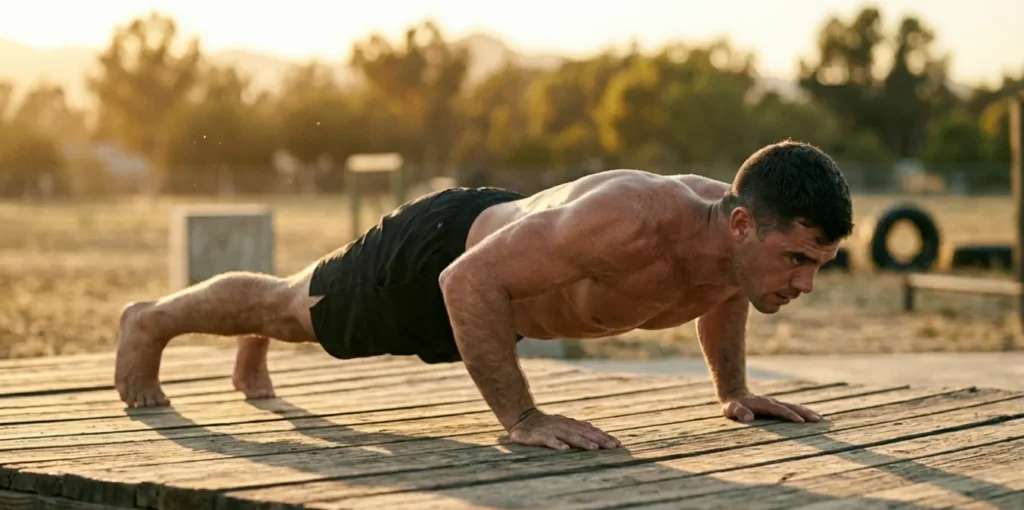
Hands shoulder-width, body rigid from head to heels, chest kisses the floor. 10 to 25 reps. [90 sec rest]
3. Diamond Push-Up
Hands together forming a diamond under the sternum. Shifts load toward the triceps and inner chest. 8 to 15 reps. [75 sec rest]
4. Wide Push-Up
Hands 1.5 times shoulder width. Emphasizes the outer chest. 10 to 20 reps. [75 sec rest]
5. Decline Push-Up
Feet elevated on a bench. Increases load to roughly 70 percent bodyweight and targets upper chest fibers. 10 to 15 reps. [90 sec rest]
6. Dip
Parallel bars or two sturdy chairs. Lean slightly forward to bias the chest over the triceps. 6 to 12 reps. [2 min rest]
7. Archer Push-Up
One arm does most of the work while the other stays extended to the side. Bridge toward the one-arm push-up. 5 to 8 reps per side. [90 sec between sides]
8. Deficit Push-Up
Hands on low parallettes or books, chest drops below hand level. Deeper stretch, greater pec recruitment. 8 to 12 reps. [90 sec rest]
9. One-Arm Push-Up
Feet wide for stability, one arm behind the back, strict form. Takes 3 to 6 months of progression to master. 3 to 5 reps per side. [2 to 3 min between sides]
The 4-Week Calisthenics Chest Routine
Train chest twice per week. Minimum 48 hours between sessions.
Session A — Volume Focus
- Standard push-up — 4 sets of max reps (stop 2 reps short of failure) [90 sec rest]
- Decline push-up — 4 sets of 10 [90 sec rest]
- Dip — 3 sets of 8 [2 min rest]
- Diamond push-up — 3 sets of 10 [75 sec rest]
Session B — Intensity Focus
- Archer push-up — 4 sets of 6 per side [90 sec between sides]
- Deficit push-up — 4 sets of 10 [90 sec rest]
- Wide push-up — 3 sets of 12 [75 sec rest]
- Close-grip push-up to failure — 2 sets [90 sec rest]
Progression:
- Week 1: Use rep targets as written. Focus on strict form and full range.
- Week 2: Add 1 rep per set where possible.
- Week 3: Shorten rest by 15 seconds on the lighter exercises (not on dips).
- Week 4: Retest max push-ups and compare to week 1, then deload one week before restarting.
Calisthenics Chest Workout Weekly Schedule
| Day | Session | Duration |
|---|---|---|
| Monday | Chest — Session A (Volume) | 30 min |
| Tuesday | Legs or Cardio | 30 min |
| Wednesday | Back + Biceps | 30 min |
| Thursday | Chest — Session B (Intensity) | 30 min |
| Friday | Legs or Core | 30 min |
| Saturday | Full-body circuit | 45 min |
| Sunday | Rest | — |
The Push-Up Progression Ladder
The roadmap from beginner to one-arm push-up. Most people take 6 to 18 months end-to-end.
- Knee push-up — 3 sets of 10
- Incline push-up — 3 sets of 15
- Standard push-up — 3 sets of 15
- Decline push-up — 3 sets of 12
- Archer push-up — 3 sets of 6 per side
- Assisted one-arm push-up (hand on elevated surface) — 3 sets of 5 per side
- One-arm push-up — 3 sets of 3 per side
Spend 3 to 6 weeks at each stage before progressing. For the full 7-step progression with stuck diagnostics, see our push-up progression guide.
Common Calisthenics Chest Mistakes
- Only doing push-ups. Same exercise, same reps, forever — zero progression. Your chest adapts in 4 weeks and stops growing. Rotate variations aggressively.
- Flaring elbows 90 degrees. Shoulder injury waiting to happen. Keep elbows at roughly 45 degrees to the torso.
- Half-range reps. Chest to floor or do not count the rep. A push-up stopped 6 inches short is a push-up wasted.
- Ignoring dips. Parallel-bar dips are the bench press of calisthenics chest training. If you have access to a dip station, use it.
For a broader upper-body template, see our complete calisthenics progression plan.
Calisthenics Chest Workout FAQ
How many push-ups should I do per day to build chest?
Per week is the better question. Aim for 80 to 150 total chest-specific reps per week, split across 2 sessions. Daily push-up challenges work for conditioning but underperform for chest hypertrophy — muscles grow during recovery, not during the daily grind.
Can push-ups alone build a big chest?
Standard push-ups alone plateau by week 4 for most people. You need variations — decline, archer, deficit, one-arm — that progressively increase load. Push-ups are the foundation; variations are the growth stimulus.
Are dips better than push-ups for chest?
Dips load the chest with more weight (essentially 100 percent bodyweight minus a small leverage offset). Push-ups are roughly 65 to 70 percent bodyweight. For mass-building, dips edge out push-ups, but both belong in a complete program.
How long until I see chest growth?
Visible pec development in 6 to 8 weeks assuming adequate protein (1.6 to 2.0 g per kg of bodyweight daily) and progressive overload.
Do I need a pull-up bar for chest training?
No. Chest training only needs floor space and ideally a chair or parallel bars for dips. A pull-up bar helps for pulling exercises to balance your posture.
What’s the fastest way to go from 10 to 50 push-ups?
Use the grease-the-groove method: 5 to 8 submaximal sets throughout the day, 6 days per week, each set at 50 to 60 percent of your current max. Most people add 30 push-ups to their max in 8 to 12 weeks on this protocol.

Pingback: Push-Up Progression: Zero to One-Arm Push-Up in 12 Months - gymnasetips.com
Pingback: Diamond vs Wide vs Decline Push-Ups
Pingback: 25 Push-Up Variations: Easiest to Hardest (2026)
Pingback: Calisthenics Chest Exercises: 10 Best Bodyweight Moves