
Last updated: May 2026 — written by James Nolan, Gymnase Tips senior trainer. For intermediate trainees with foundational push-up and pull-up strength.
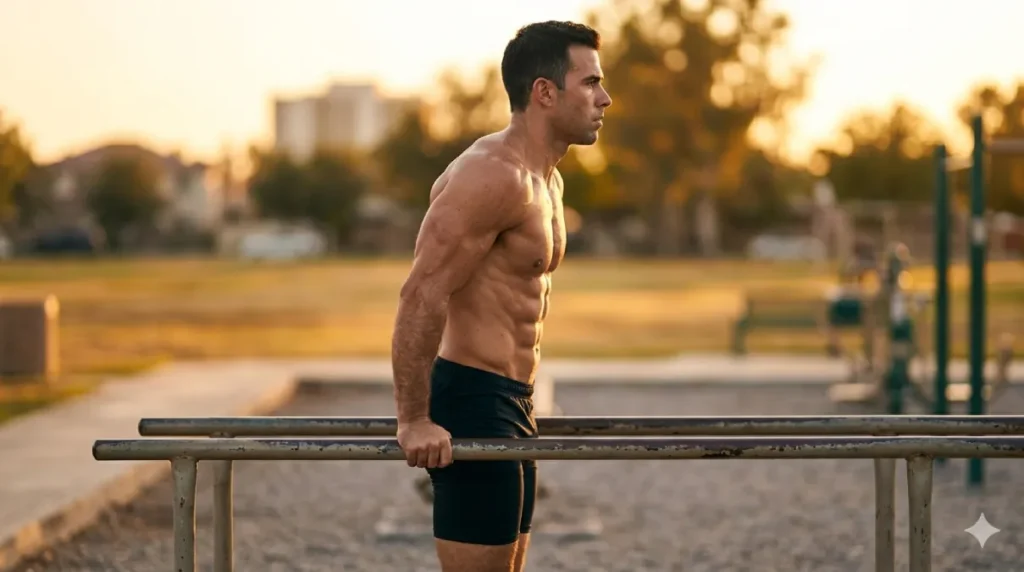
A calisthenics upper body workout covers chest, back, shoulders, and arms through compound bodyweight pushing and pulling movements, structured around a 1:1 push-pull balance and trained twice per week per movement pattern. Done properly, it builds the full V-taper physique — wide lats, capped shoulders, developed chest, thick arms — without touching a barbell.
This guide gives you the push-pull programming framework that actually works, a 4-week upper body split with rest prescriptions, the warm-up that protects the shoulders and elbows, and the 12 movements that form the backbone of every serious calisthenics athlete’s training.
How to Structure a Calisthenics Upper Body Workout
Two principles drive effective upper body programming.
Balance push and pull volume 1:1. Every set of push-ups or dips needs a matched set of pull-ups or inverted rows. This is not a style choice — it is the only way to prevent the rounded-shoulder, forward-neck posture that push-heavy programming creates inside 6 months.
Train each movement pattern twice per week. Resistance training research suggests that twice-weekly training produces more hypertrophy than once-weekly training at matched volume. That means two push sessions and two pull sessions per week. The American College of Sports Medicine supports this frequency range for general strength and hypertrophy.
5-Minute Upper Body Warm-Up
- 30 seconds jumping jacks or jogging in place
- 10 arm circles forward, 10 backward
- 10 wrist circles each direction
- 10 scapular push-ups (plank position, push shoulder blades apart, then squeeze together)
- 5 scapular pulls from a dead hang (pull days only)
- 10 incline push-ups as a pressing primer (push days only)
The 12 Core Upper Body Movements
Three categories, four movements each.
Horizontal Push (Chest + Triceps + Shoulders)
- Push-up — the foundational movement
- Decline push-up — bias toward upper chest and shoulders
- Archer push-up — progression toward one-arm work
- Dip — heaviest chest and triceps loading
Vertical Push (Shoulders + Triceps)
- Pike push-up — intro to overhead pressing
- Elevated pike push-up — advanced overhead loading
- Wall handstand push-up — the bodyweight overhead press
- Pseudo-planche push-up — anterior delt emphasis
Horizontal and Vertical Pull (Back + Biceps + Rear Delts)
- Inverted row — horizontal pull foundation
- Pull-up — vertical pull foundation
- Chin-up — bias toward biceps and lower lats
- Wide-grip pull-up — bias toward lat width
Master these 12 and you have the complete calisthenics upper body library.
The 4-Week Calisthenics Upper Body Split
Four sessions per week: two push, two pull. Each session 40 to 50 minutes including the warm-up.
Push Session A — Horizontal Emphasis
- Push-up — 4 sets of 12 [90 sec rest]
- Dip — 4 sets of 8 [2 min rest]
- Archer push-up — 3 sets of 6 per side [90 sec between sides]
- Pike push-up — 3 sets of 10 [90 sec rest]
- Pseudo-planche push-up — 3 sets of 8 [90 sec rest]
Pull Session A — Vertical Emphasis
- Pull-up — 5 sets of max (stop 1 rep short of failure) [2 to 3 min rest]
- Wide-grip pull-up — 3 sets of 6 [2 min rest]
- Inverted row — 4 sets of 12 [90 sec rest]
- Chin-up — 3 sets of 8 [90 sec rest]
- Dead hang — 3 sets of 45 seconds [60 sec rest]
Push Session B — Vertical Emphasis
- Elevated pike push-up — 4 sets of 8 [90 sec rest]
- Wall handstand hold — 4 sets of 30 seconds [60 sec rest]
- Decline push-up — 3 sets of 12 [90 sec rest]
- Dip — 3 sets of 10 [90 sec rest]
- Diamond push-up — 3 sets of 12 [75 sec rest]
Pull Session B — Horizontal Emphasis
- Inverted row (wide) — 4 sets of 12 [90 sec rest]
- Inverted row (underhand) — 3 sets of 10 [75 sec rest]
- Pull-up — 3 sets of max [2 to 3 min rest]
- Commando pull-up — 3 sets of 6 per side [2 min rest]
- Scapular pull-up — 3 sets of 10 [60 sec rest]
Weekly progression:
- Week 1: Use rep targets as written. Focus on strict form.
- Week 2: Add 1 rep per set on anything that felt manageable.
- Week 3: Shorten rest between sets by 15 seconds.
- Week 4: Retest max push-ups and pull-ups, then deload one week before starting again.
Calisthenics Upper Body Workout Weekly Schedule
| Day | Session | Focus | Duration |
|---|---|---|---|
| Monday | Push Session A | Horizontal push | 45 min |
| Tuesday | Legs | Lower body | 40 min |
| Wednesday | Pull Session A | Vertical pull | 45 min |
| Thursday | Rest or mobility | Recovery | 20 min |
| Friday | Push Session B | Vertical push | 45 min |
| Saturday | Pull Session B | Horizontal pull | 45 min |
| Sunday | Rest | Recovery | — |
How Upper Body Programming Fails Most People
- Too much push, not enough pull. The default home lifter’s routine is push-ups and more push-ups. Six months in, the posture is wrecked. Rule: if you do 100 push-ups this week, do 100 rows or pull-ups this week.
- Skipping vertical pressing. Without pike push-ups and handstand work, the shoulders never receive dedicated overhead stimulus. Shoulders lag and the physique looks incomplete.
- No progressive overload. Same reps, same movements, same intensity — forever. Progress means more reps, shorter rest, or harder variations. Move one lever every week.
- Training upper body every day. Daily pushing and pulling prevents the muscles from rebuilding. Four focused sessions per week beats seven mediocre ones for hypertrophy.
For a full-body context, see our complete calisthenics progression plan.
Calisthenics Upper Body Workout FAQ
How often should I train upper body with calisthenics?
Four sessions per week — two push, two pull — hits the optimal frequency for hypertrophy for most natural lifters. Beginners can start with three total sessions and build up.
Can I build a complete physique with only calisthenics?
Yes, up to intermediate/advanced levels. Elite hypertrophy in the very heavy lean ranges typically benefits from adding weighted work, but a calisthenics-only program can build an impressive, athletic physique comparable to most gym lifters’ results.
What is the minimum equipment I need?
A pull-up bar is essential. Parallel bars or a dip station significantly expand your options. A weighted vest becomes useful around month three. Our equipment guide ranks every piece by priority.
How long until I see upper body growth?
Visible chest, back, and arm development in 6 to 10 weeks with progressive overload and adequate protein (1.6 to 2.0 g per kg bodyweight daily).
Should I do push and pull on the same day or separate?
Separate days allow higher quality per session. Combined “upper body” days save time but reduce the volume you can give each movement pattern. For hypertrophy, separate push and pull days win.
Are there calisthenics exercises for lateral delts?
Pure lateral-raise equivalents are rare in bodyweight training. Wide-grip pull-ups, handstand variations, and inverted rows with a wide grip recruit the lateral delts more than standard movements. For complete lateral delt development, resistance bands or light dumbbells fill the gap.


Pingback: Calisthenics Workout Plan: Beginner to Advanced (2026)