
Last updated: May 17, 2026 — written by James Nolan, Gymnase Tips senior trainer.
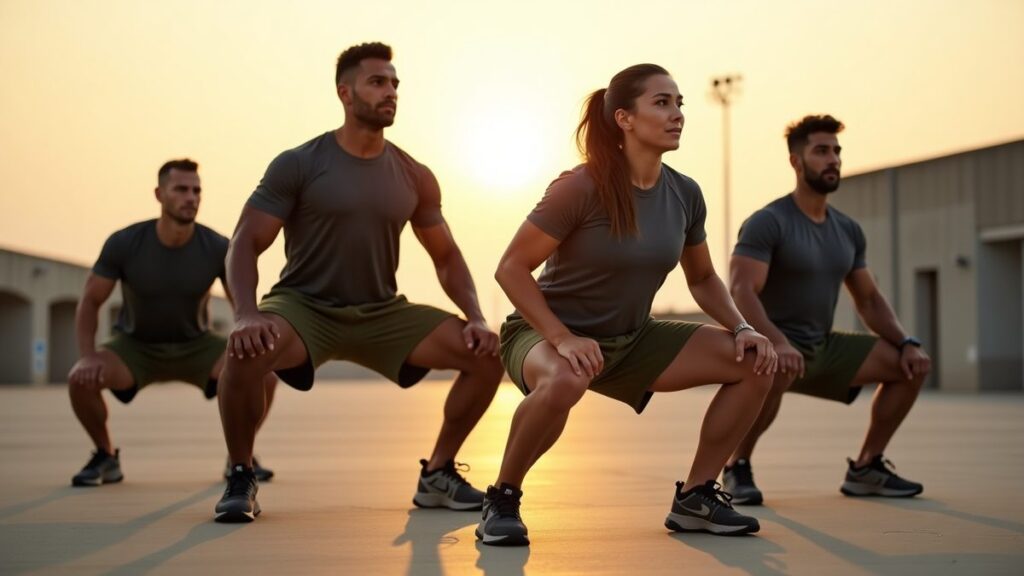
Military calisthenics is a bodyweight strength and conditioning system used by the U.S. Army, Marines, Navy, Air Force, and Coast Guard to build muscular endurance, work capacity, and combat-functional fitness. It consists of high-repetition compound movements — primarily push-ups, pull-ups, sit-ups, squats, lunges, burpees, mountain climbers, and flutter kicks — performed in timed circuits with short rest periods. The system is codified in U.S. Army Field Manual 7-22 (Holistic Health and Fitness, or H2F) and forms the foundation of every U.S. military Physical Readiness Training (PRT) program. It has been the basis of military conditioning since 1907 and has scaled to millions of recruits with measurably consistent outcomes.
This guide covers the precise definition, the history from 1907 to today’s H2F program, what makes military calisthenics structurally different from civilian or street calisthenics, the eight foundational exercises every program builds on, and where to go next if you want to start training.
Table of contents
What Is Military Calisthenics? The Exact Definition
Military calisthenics (n.): A structured bodyweight training system used by armed forces — most commonly U.S. Army, Marines, Navy, Air Force, and Coast Guard — to build muscular endurance, cardiovascular conditioning, and functional fitness for combat readiness. The system uses compound bodyweight movements (push-ups, pull-ups, sit-ups, air squats, lunges, burpees, mountain climbers, flutter kicks) performed in timed high-repetition circuits with brief rest periods. Programming emphasizes work capacity over maximal strength, scalability across all fitness levels, and minimal equipment requirements (typically only a pull-up bar).
In one sentence: Military calisthenics is high-volume, time-tested bodyweight training designed to build the muscular endurance and work capacity required for combat readiness, using only push-ups, pull-ups, squats, sit-ups, burpees, and lunges.
Military Calisthenics History: 1907 to 2026
- 1907: The U.S. Army formally adopts a bodyweight calisthenics regimen as part of recruit training, codified in early field manuals.
- 1942: The Army establishes the first standardized Physical Training (PT) test during World War II — push-ups, sit-ups, pull-ups, and a timed run remain the core measurements.
- 1980: Introduction of the Army Physical Fitness Test (APFT): 2 minutes max push-ups, 2 minutes max sit-ups, 2-mile run. Becomes the standard for 4 decades.
- 1997: The Marine Corps Physical Fitness Test (PFT) standardizes pull-ups (men), flexed-arm hang (women), abdominal crunches, and 3-mile run.
- 2010: Army Physical Readiness Training (PRT) program (TC 3-22.20, later FM 7-22) modernizes the calisthenics protocols with periodization principles.
- 2020: The Army Combat Fitness Test (ACFT) replaces APFT — adds deadlift, sprint-drag-carry, and standing power throw, but keeps hand-release push-ups and a 2-mile run.
- 2022: Army Holistic Health and Fitness (H2F) program launches, integrating calisthenics with mental, spiritual, sleep, and nutrition pillars in current FM 7-22.
Through every modernization, the core exercise library has stayed the same: push-ups, pull-ups, sit-ups, squats, lunges, and burpees. That consistency is the strongest evidence the system works.
How military calisthenics differs from civilian and street calisthenics
| Dimension | Military calisthenics | Street calisthenics | Civilian fitness calisthenics |
|---|---|---|---|
| Primary goal | Work capacity, combat readiness | Skill mastery, advanced moves | General fitness, body composition |
| Volume | Very high (100+ reps per session) | Low to moderate | Moderate |
| Skill focus | Compound movements only | Muscle-ups, levers, planches, flags | Push-ups, pull-ups, squats variations |
| Programming | Time-based circuits, periodized | Skill-progression based | Rep-and-set based |
| Equipment | Minimal (pull-up bar) | Bars, rings, parallettes | Often equipment-free |
| Test format | Standardized (APFT, ACFT, PFT) | Visual/competition | Self-tracked |
The biggest practical difference: military programming prioritizes repeatable performance under fatigue over peak skill demonstration. A street athlete trains to do one perfect muscle-up; a soldier trains to do 60 push-ups when already exhausted from a 5-mile ruck.
The 8 foundational exercises
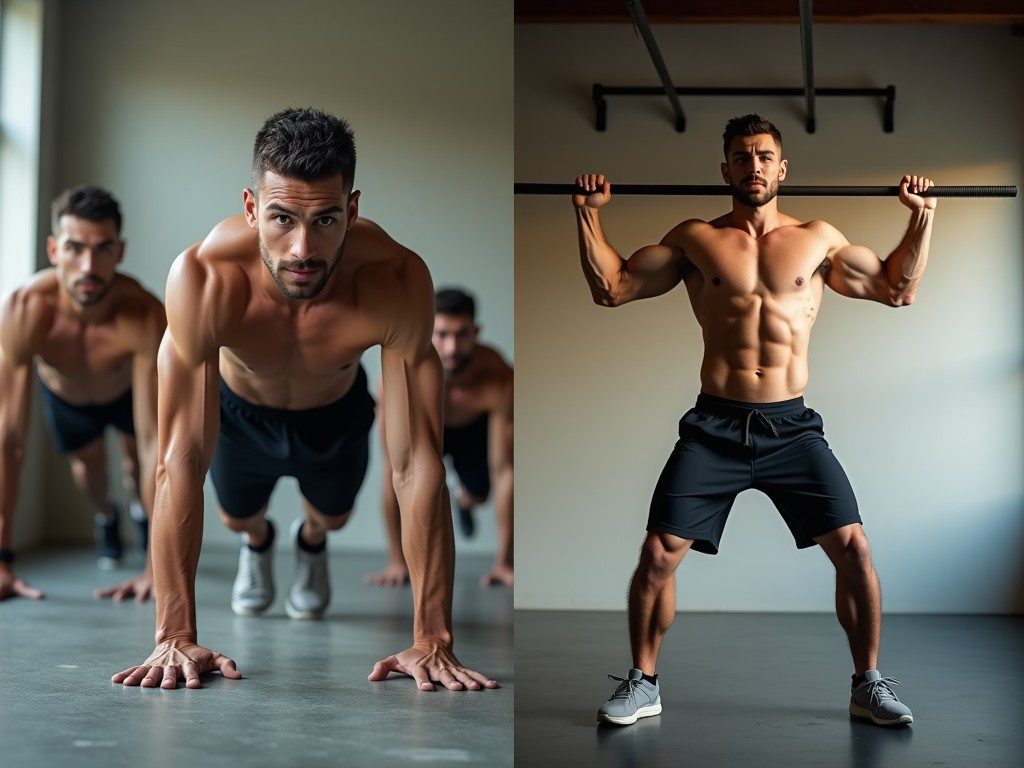
Every U.S. military PT program is built on some combination of these eight movements:
- Push-up — The cornerstone. Standard form, hand-release variant for ACFT.
- Pull-up (dead-hang) — Marine Corps PFT staple. Builds lats, biceps, grip.
- Sit-up — Anchored feet, elbows-to-knees. Replaced by plank in current ACFT.
- Air squat — Hip crease below knee at bottom, full extension at top.
- Burpee — Push-up + squat + jump in one fluid motion. Highest conditioning ROI.
- Lunge — Forward or reverse. Single-leg work that exposes imbalances.
- Mountain climber — Plank position, alternating knees-to-chest at speed.
- Flutter kick — Supine, legs 6 inches off floor, scissor kick. Hip flexors and lower abs.

For the complete reference list with form cues, see our complete list of military calisthenics exercises.
Why the system works at scale
- It scales from zero to elite. The same exercise library works for an out-of-shape recruit and a Force Recon operator. Only the volume, density, and load change.
- It builds work capacity, not just strength. The high-rep circuits develop the ability to produce force repeatedly under fatigue — the actual demand of combat operations.
- It hardens connective tissue. High-rep bodyweight work conditions tendons and ligaments alongside muscle, reducing injury rates compared with equivalent-volume barbell training.
- It requires almost no equipment. A pull-up bar is the only purchase. Everything else needs floor space.
- It produces measurable, repeatable outcomes. Across 10-week U.S. Army Basic Combat Training cycles, recruits typically improve 2-mile run by 2-4 minutes, push-up max by 15-30 reps, and sit-up max by 20-40 reps. The data is consistent across decades and millions of trainees.
Military Calisthenics vs Weight Training: What the Research Shows
Military calisthenics wins on muscular endurance, injury tolerance, cost, and training a hundred recruits at once; barbells win on maximal strength and heavy load-carriage preparation. That split is exactly why the U.S. Army’s current fitness test, the AFT (rolled out June 1, 2025), mixes both worlds: hand-release push-ups and a plank next to a 3-repetition-max deadlift (Source: U.S. Army, 2025). The service that runs more push-ups than anyone still tests a barbell lift. That tells you something.
What about muscle and strength? Closer than most lifters expect. In an 8-week trial, Kikuchi and Nakazato had one group bench press at 40% of their max and another do push-ups matched to the same load; both groups gained similar muscle thickness and strength, with no meaningful difference between them (Source: Journal of Exercise Science & Fitness, 2017). In the moderate-load, high-effort zone where military PT lives, bodyweight work holds its own. Where it falls behind is the top end: nothing in a standard calisthenics session replicates pulling 340 pounds off the ground, which is why soldiers chasing a max AFT deadlift score add barbell work rather than more push-ups.
| Dimension | Military calisthenics | Weight training |
|---|---|---|
| Muscular endurance | Excellent — high-rep push-ups, pull-ups, and squats mirror test demands directly | Moderate — needs deliberate high-rep programming |
| Max strength | Plateaus once bodyweight reps get easy; harder to overload | Superior — progressive barbell loading is the proven path |
| Hypertrophy | Comparable at matched effort levels (Kikuchi & Nakazato, 2017) | Comparable, with easier load progression over years |
| Injury rate | Low per-session joint load; most military training injuries trace to running and foot marching, not bodyweight strength work | Low when coached; heavy maximal lifts demand technique supervision |
| Equipment / cost | Near zero — a pull-up bar covers it | Racks, bars, plates, floor space, maintenance |
| Scalability to groups | An entire company trains simultaneously with one instructor | Bottlenecked by equipment count and spotting needs |
| Test transfer (AFT / PFT / PST) | Direct — push-ups, pull-ups, planks, and runs are the test events | Strong for the AFT deadlift and sprint-drag-carry; indirect for rep-based events |
Notice the injury row. The big musculoskeletal problems in uniform come mostly from running mileage and loaded foot marches, which reviews of military injury data consistently flag as leading causes, not from either style of strength work (Source: U.S. Army Public Health Command / DTIC). So the calisthenics-versus-weights injury debate matters less in practice than managing your run volume and ruck load.
Test transfer settles most real decisions here. The Navy PST scores push-ups, curl-ups, pull-ups, a swim, and a run; the Marine PFT scores pull-ups, a plank, and a 3-mile run. Every one of those is a calisthenics or cardio event. Train the test movements first.
My recommendation: build your base with military calisthenics four or five days a week, and add one or two short barbell sessions only if your test includes a max-strength event like the AFT deadlift, or if your job involves heavy lifting and carrying. Skip the bench press entirely; push-up variations already cover that pattern for scored events. And if you’re a civilian weighing these options for general fitness rather than a PT test, the trade-offs shift, so read our full gym vs calisthenics comparison instead — this section assumes you have a scorecard to beat.
Who uses military calisthenics today
- Active U.S. military: daily PT sessions in all five service branches, codified in branch-specific manuals.
- Selection candidates: people preparing for SFAS, BUD/S, RASP, MARSOC, and similar special operations selection courses.
- Recruits in pre-basic training: civilians 6-12 months out from shipping to basic, building base conditioning.
- Civilian tactical athletes: firefighters, police, EMTs, and outdoor professionals who need work-capacity fitness for unpredictable demands.
- General fitness enthusiasts: people who like the structure, simplicity, and minimal equipment of military-style programming.
Where to start
If you want to begin a military calisthenics program right now:
- For the complete 4-week starter plan: our military calisthenics complete guide + free 4-week plan is the hub.
- For a printable PDF format: see our military workout PDF and 8-week printable PDF.
- For women: our military calisthenics for women plan uses the same library with female-specific scaling.
- For men over 50: see military calisthenics for men over 50 for joint-friendly modifications.
- For branch-specific prep: Navy SEAL plan, Marine PFT prep, Army ACFT prep.
FAQ
Is military calisthenics the same as bootcamp workouts?
Closely related. “Bootcamp workouts” in the civilian fitness world are typically simplified versions of military calisthenics circuits — the same compound exercises in timed-round formats. Actual military PT is more structured and periodized than most civilian bootcamp classes.
Can I do military calisthenics without joining the military?
Yes — the protocols are public domain (codified in publicly accessible field manuals). Civilians use the same programming with consistent results. The plans on Gymnase Tips are based on the same source material the military uses.
How many days per week is military calisthenics?
Standard military rotation is 6 days per week — three strength-endurance days, two conditioning days, one long day, one rest day. Civilians often start at 4 days per week and ramp to 6 over the first 4-6 weeks.
What’s the minimum equipment needed?
One pull-up bar (door-frame or wall-mounted, $30-80). Everything else — push-ups, squats, lunges, burpees, sit-ups — needs only floor space. A weighted vest becomes useful around month three for continued progression.
Is military calisthenics safe for beginners?
Yes, with appropriate scaling. Beginners should start at 50-60% of the prescribed volume, focus on form over reps, and add one session per week rather than starting at six. The exercise library scales gracefully — knee push-ups, inverted rows, and box squats are all valid entry points.
Can military calisthenics replace lifting weights?
For general fitness and conditioning, yes — completely. For maximum hypertrophy and absolute strength gains, eventually no. The system has a ceiling around month 6-12 for most people; past that, weighted variations or barbell work add new stimulus. But for the first 12 months of structured training, calisthenics produces strength and muscle gains comparable to weight training.
Where is military calisthenics codified?
The U.S. Army’s program is codified in Field Manual 7-22 (Holistic Health and Fitness). The Marine Corps uses the Physical Fitness Test (PFT) and Combat Fitness Test (CFT). The Air Force uses the Physical Fitness Assessment (PFA). Each branch has slightly different test standards but uses essentially the same core exercise library.
The bottom line: military calisthenics is bodyweight training designed to build muscular endurance and work capacity for combat readiness, using compound exercises in high-rep timed circuits. It’s been the foundation of U.S. military conditioning since 1907. It scales from zero to elite, requires almost no equipment, and produces measurably consistent outcomes across millions of trainees. To start training, see our complete guide + free 4-week plan, effectiveness research, and complete exercise reference.



Pingback: Military Calisthenics: Free 4-Week Plan + Printable PDF (2026)