
Last updated: April 2026 — written by James Nolan, Gymnase Tips senior trainer.
The Army Combat Fitness Test (ACFT) is the U.S. Army’s official physical fitness assessment, replacing the Army Physical Fitness Test (APFT) in 2022 — and the calisthenics-friendly events (hand-release push-up, leg tuck/plank, 2-mile run) account for 3 of the 6 graded events. Candidates need a minimum score of 60 points per event to pass, with each event scaled by gender and age. This guide breaks down the ACFT calisthenics events, the official scoring tables, and the 12-week bodyweight training plan that gets a recruit from baseline to passing scores.
The ACFT was designed to test combat-relevant fitness over the APFT’s narrower focus. Calisthenics — done right — covers the strength-endurance, core, and aerobic base the test demands.
Table of Contents
- What Is the ACFT?
- The 6 ACFT Events Explained
- ACFT Scoring Standards
- Calisthenics-Specific Prep Plan
- Weekly Schedule
- Common Mistakes
- FAQ
What Is the ACFT?
The Army Combat Fitness Test (ACFT) is the U.S. Army’s gender-neutral, age-adjusted physical fitness test that replaced the APFT in October 2022. It consists of six events designed to assess muscular strength, endurance, power, agility, and aerobic capacity. The Army codifies the ACFT in Field Manual 7-22 (Holistic Health and Fitness).
The test takes approximately 70 minutes to complete and is administered twice per year for active-duty soldiers. Soldiers must score a minimum of 60 points on each event to pass; combat MOSs require higher minimums.
The 6 ACFT Events Explained
1. Three-Repetition Maximum Deadlift (MDL)
Lift a hexagonal trap bar three times at maximum weight. Tests muscular strength. Range: 140-340 pounds depending on score.
2. Standing Power Throw (SPT)
Throw a 10-pound medicine ball backward over the head as far as possible. Tests explosive power. Distance range: 4.5 to 13.5 meters.
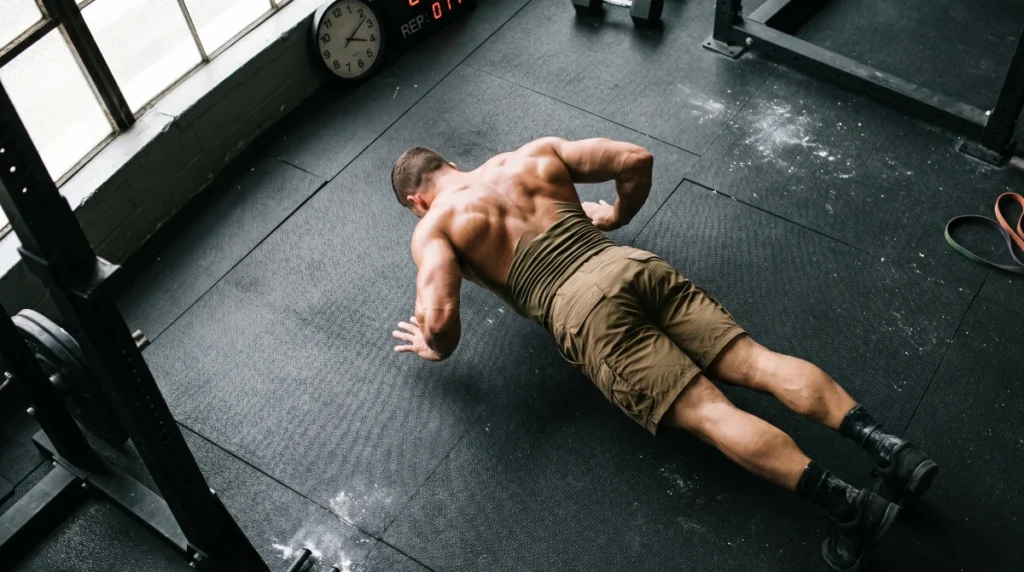
3. Hand-Release Push-Up (HRP)
Standard push-up where chest fully contacts the ground and hands lift off momentarily. Tests upper-body strength endurance. Range: 10-60 reps in 2 minutes.
4. Sprint-Drag-Carry (SDC)
50m sprint, 50m sled drag, 50m lateral, 50m kettlebell carry, 50m sprint. Tests anaerobic power and agility. Range: 1:33 to 3:35.
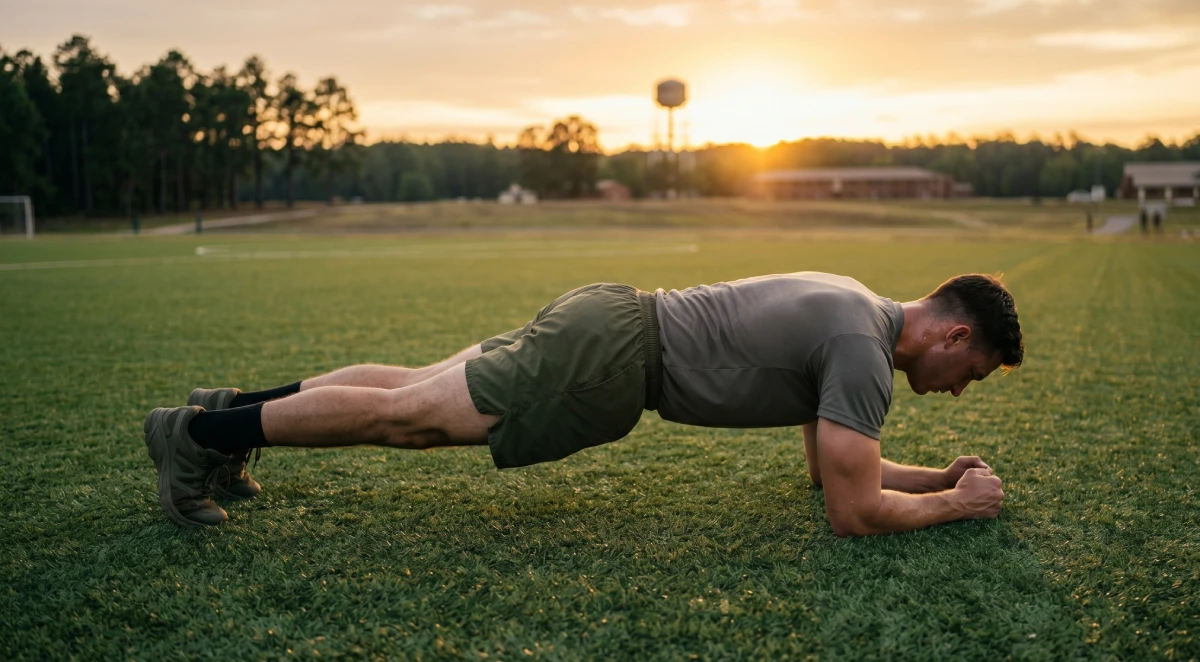
5. Plank (PLK)
Forearm plank, body rigid head to heels. Replaced the leg tuck in 2022. Range: 1:20 to 4:20.
6. Two-Mile Run (2MR)
Standard 2-mile timed run. Tests aerobic capacity. Range: 13:30 to 22:00 depending on score.
ACFT Scoring Standards (Pass = 60 points per event)
Below are minimum (60-point) and high (90-point) thresholds for the calisthenics-relevant events. Full age and gender tables are available in DA Pamphlet 350-50.
| Event | Pass (60 pts) | High (90 pts) |
|---|---|---|
| Hand-Release Push-Up | 10 reps | 40+ reps |
| Plank | 1:20 | 3:35 |
| Two-Mile Run | 22:00 | 15:00 |
| Three-Rep Deadlift | 140 lbs | 270 lbs |
| Sprint-Drag-Carry | 2:28 | 1:50 |
| Standing Power Throw | 4.5 m | 10 m |
Combat MOS soldiers need 70+ on every event. Aim higher than the minimum.
12-Week ACFT Calisthenics Prep Plan
Five days per week. This plan focuses on the calisthenics events (HRP, plank, 2MR) while supporting the other three with bodyweight progressions that transfer.
Phase 1: Weeks 1-4 (Base)
- Mon: Push-ups (4 × 15 HRP form), planks (3 × 60s), 2-mile run conversational pace
- Tue: Bulgarian split squats (4 × 10 per leg), hollow holds (3 × 30s), reverse lunges (3 × 15)
- Wed: Hand-release push-up ladder: 5/10/15/10/5
- Thu: Plank circuit (front/side/front, 60-45-60s) + 1.5-mile run
- Fri: Full-body bodyweight circuit, 4 rounds
- Sat/Sun: Rest or light mobility
Phase 2: Weeks 5-8 (Volume)
Add 30% volume to all sessions. Add 1 day per week of sled-drag simulation (heavy carries) and broad-jump work for the SDC and SPT events.
Phase 3: Weeks 9-12 (Peak)
- Mock ACFT every 10 days with full event sequencing
- Cut HRP volume but increase intensity (max sets to failure)
- Plank work shifts to 4:00+ holds
- 2-mile run trains at 7:30-8:00/mile pace
ACFT Calisthenics Prep Weekly Schedule
| Day | Focus | Duration |
|---|---|---|
| Monday | HRP + Plank + 2-Mile Run | 50 min |
| Tuesday | Lower Body + Core | 40 min |
| Wednesday | HRP Ladder + Mobility | 40 min |
| Thursday | Plank Circuit + 1.5-Mile Run | 40 min |
| Friday | Full-Body Circuit | 50 min |
| Sat/Sun | Rest / Mobility | 20 min |
Common ACFT Calisthenics Prep Mistakes
Training standard push-ups instead of HRP form. The hand-release version is significantly harder. Train the actual test movement from day one.
Neglecting the plank. A 4-minute plank is harder than most people think. Build it up across all 12 weeks, don’t expect to test cold.
Running at conversational pace only. Sub-15-minute 2-mile runs require interval training. Add one tempo or interval session per week starting in Phase 2.
Skipping the sprint-drag-carry training. SDC is the event most people fail. Substitute heavy farmer carries and broad jumps if you cannot access a sled.
ACFT Calisthenics Prep FAQ
What is the ACFT pass score?
60 points per event is the minimum to pass for non-combat MOSs. Combat MOSs require 70+ on every event. Total minimum passing score is 360 points across all 6 events.
How many hand-release push-ups do you need to pass the ACFT?
10 reps in 2 minutes scores 60 points (passing). 30 reps scores around 80 points. 40+ reps scores 90+ points. The HRP standard is identical regardless of age or gender as of the 2022 update.
What replaced the leg tuck in the ACFT?
The plank replaced the leg tuck in October 2022. Soldiers hold a forearm plank with body rigid; pass standard is 1:20, high score is 3:35.
Can I train for the ACFT with calisthenics only?
For 4 of the 6 events (HRP, plank, 2MR, and partially SDC), yes. The deadlift and standing power throw require equipment access. For the deadlift specifically, train pistol squats, single-leg deadlifts, and weighted backpack squats as bodyweight transfer exercises.
How long should I train for the ACFT?
12 weeks of structured training takes most untrained adults from baseline to passing scores. Already-fit candidates can hit competitive scores in 6 to 8 weeks. For full optimization across all 6 events, 16 to 24 weeks is realistic.
Is the ACFT harder than the APFT?
Yes, by most measurements. The ACFT tests more dimensions of fitness (strength, power, agility) than the APFT did, requires equipment (deadlift, sled), and adds the sprint-drag-carry — an event no other military fitness test includes. Pass rates dropped 10-15% during the transition period.
For broader military bodyweight conditioning, see our military calisthenics workout guide.
Related Gymnase Tips guides
- 25 Push-Up Variations Ranked Easiest to Hardest
- How Many Push-Ups Should You Be Able to Do? (By Age & Sex)
- Bodyweight Leg Workouts: 12 Exercises Ranked by Difficulty
- Bodyweight Leg Day: Full Routine for Strength + Hypertrophy
- Diamond vs Wide vs Decline Push-Ups
- How to Build Muscle Without Weights: 6-Month Bodyweight Plan

Pingback: Military Calisthenics: Free 4-Week Plan + Printable PDF (2026)
Pingback: Military Workouts at Home: 4 Branch-Specific Routines
Pingback: What Is Military Calisthenics? Definition + 8 Core Exercises