
Last updated: May 2026 — written by James Nolan, Gymnase Tips senior trainer.
The complete list of military calisthenics exercises spans 25+ movements organized into five categories: pushing (push-ups, dips), pulling (pull-ups, rows), legs (squats, lunges), core (sit-ups, planks, flutter kicks), and conditioning (burpees, mountain climbers). Every U.S. military Physical Readiness Training (PRT) program uses some combination of these — the same exercise library has been the foundation of military fitness since 1907. This page is a complete reference: every movement with form cues, a scaling table from beginner to advanced variations, and the prerequisite progressions.
This guide covers all 25+ exercises grouped by movement category, beginner-to-advanced scaling for each, the 8 “core” exercises every program is built on, the printable reference card, and which exercises map to which military fitness tests. For programmed plans using these exercises see our military calisthenics complete guide.
The 5 categories
- Pushing (chest, shoulders, triceps): push-ups, dips, pike push-ups, handstand push-ups
- Pulling (back, biceps, grip): pull-ups, chin-ups, inverted rows, dead hangs
- Legs (quads, glutes, hamstrings): air squats, lunges, jump squats, step-ups, glute bridges, hip thrusts
- Core (abs, obliques, deep stabilizers): sit-ups, planks, flutter kicks, mountain climbers, dead bugs, bird dogs
- Conditioning (full-body, cardio): burpees, jumping jacks, mountain climbers, high knees, bear crawls
Pushing exercises
Push-up
Hands shoulder-width or slightly wider, body rigid head-to-heels, lower until chest is fist-height from floor, push back to lockout. The cornerstone movement of every military PT program.
Hand-release push-up
Standard push-up plus full hand release at the bottom (lift both palms briefly off the floor before pressing back up). The current ACFT standard. Eliminates bouncing momentum.
Diamond push-up
Hands close together under chest, thumbs and index fingers forming a diamond. Shifts emphasis to triceps and inner chest.
Wide push-up
Hands wider than shoulders. Shifts emphasis to outer chest and front deltoids.
Decline push-up
Feet elevated on a bench or chair. Shifts emphasis to upper chest and front delts.
Pike push-up
Hips raised in inverted V position, head between hands. Trains shoulder pressing strength. Progression toward handstand push-ups.
Dip (parallel bars or chair)
Body suspended between parallel bars (or chair edges), lower until elbows hit 90 degrees, push back to lockout. Hits chest, triceps, and front delts.
Pulling exercises
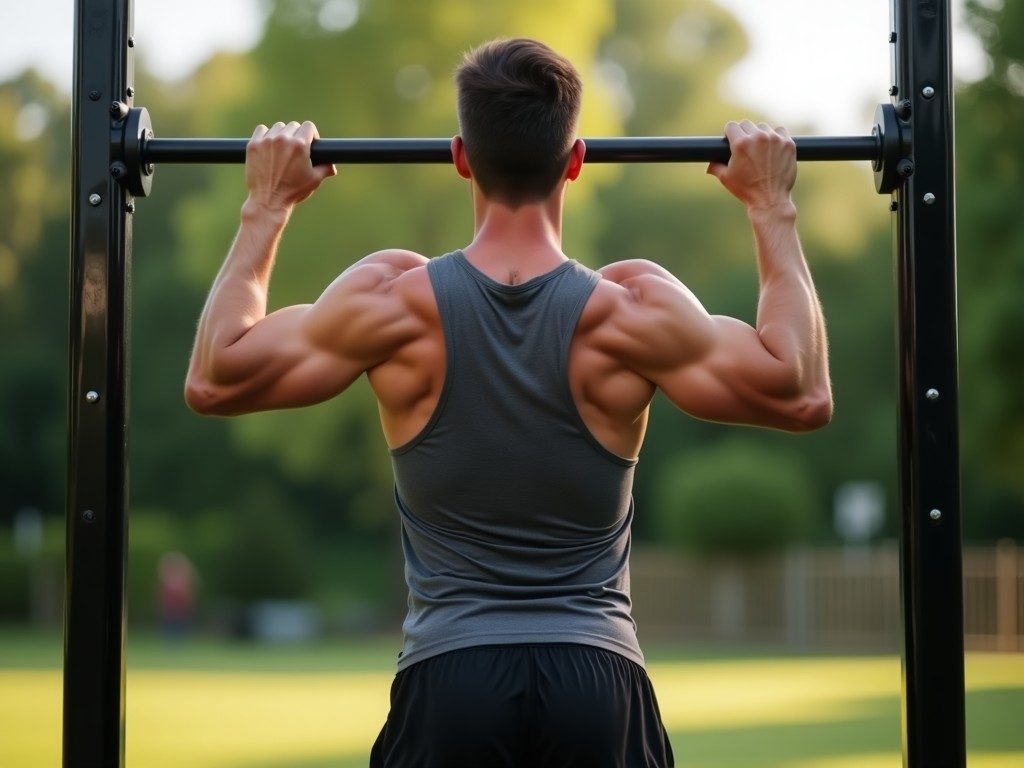
Pull-up (overhand grip)
Dead hang at bottom, chin over the bar, no kipping. The Marine Corps PFT standard. Trains lats, biceps, grip.
Chin-up (underhand grip)
Same movement, palms facing you. Slightly easier than pull-up for most lifters because biceps contribute more.
Inverted row
Bar at hip height, body straight at angle, pull chest to bar. The standard pull-up regression for those without bodyweight pulling strength.
Dead hang
Hang from bar with straight arms. Builds grip endurance. The prerequisite hold for any pull-up training.
Negative pull-up
Jump or step up to chin-over-bar position, lower yourself for 5+ seconds. The bridge between inverted rows and strict pull-ups.
Leg exercises
Air squat (bodyweight squat)
Feet shoulder-width, hip crease below knee at bottom, full extension at top. The cornerstone leg exercise.
Forward lunge
Step forward into lunge, front knee over ankle, back knee almost touches floor, drive back to standing. Alternate legs.
Reverse lunge
Step backward into lunge. Gentler on knees than forward lunges.
Jump squat
Bodyweight squat plus explosive jump at the top. Builds power. Skip if joint-sensitive.
Step-up
Sturdy bench or chair (12-18 inch height). Step up with one leg, drive through heel to stand fully, lower under control. Alternate legs.
Glute bridge
Lying on back, knees bent, drive hips to ceiling, squeeze glutes hard at top. Foundation glute exercise.
Hip thrust (single-leg or weighted)
Upper back on bench/chair, drive hips up. Heavier glute loading than glute bridge.
Core exercises
Sit-up (anchored)
Feet hooked under furniture or held by partner. Elbows touch knees at top. Traditional Army APFT standard.
Plank (forearm)
Forearms on floor, body rigid head-to-heels, hold position. The current ACFT standard core test (replaced sit-ups).
Side plank
Forearm plank rotated to one side, body straight, hips lifted. Hits obliques.
Flutter kick
Lying on back, legs 6 inches off floor, alternating scissor kick. Hits hip flexors and lower abs.
Mountain climber
Plank position, drive knees alternately to chest at speed. Combines core stability with cardio.
Dead bug
Lying on back, arms extended toward ceiling, knees bent at 90 degrees. Slowly lower opposite arm and leg toward floor while keeping lower back pressed down. Trains deep core stability without spine flexion. See our full dead bug exercise guide for progressions and programming.
Bird dog
On hands and knees, extend opposite arm and leg, hold briefly, return. Builds core stability and balance.
Conditioning exercises
Burpee
Push-up + squat + jump in one fluid motion. The single most efficient conditioning exercise. Skip if joint-sensitive.
Jumping jack
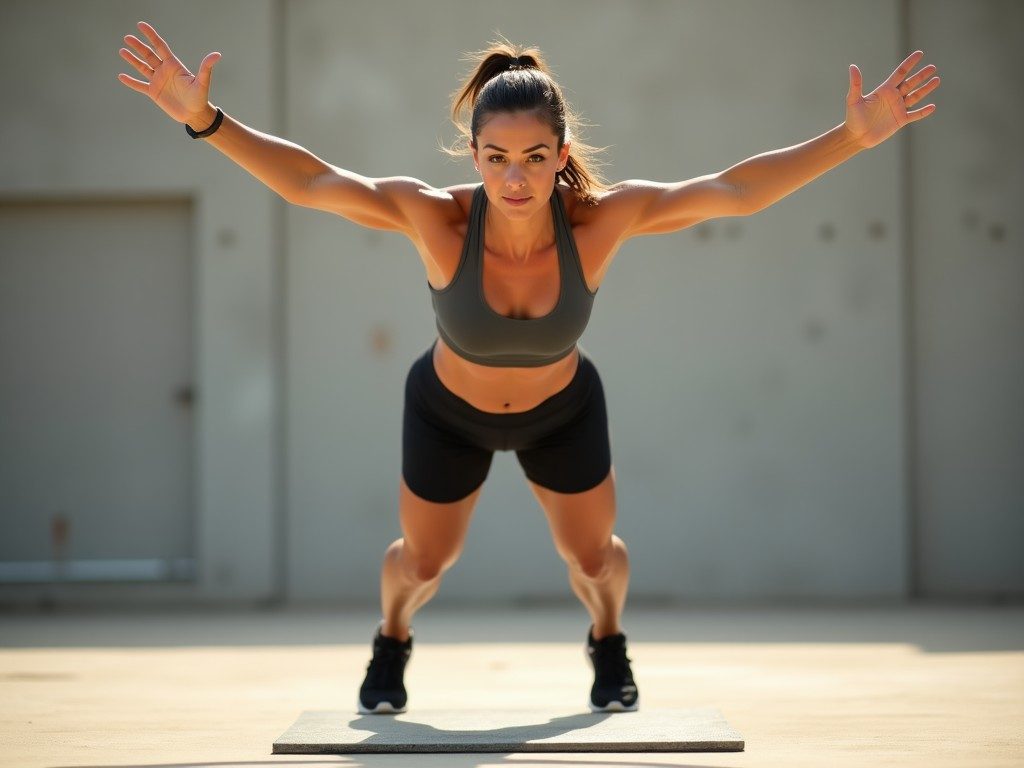
Standing, jump to wide-legged position with arms overhead, jump back. Foundational warm-up and conditioning movement.
High knees
Running in place, driving knees alternately to chest level. Cardio + hip flexor activation.
Bear crawl
On hands and feet (knees off floor), crawl forward maintaining flat back. Hits shoulders, core, conditioning.
Scaling reference (beginner to advanced)
| Exercise | Beginner | Intermediate | Advanced |
|---|---|---|---|
| Push-up | Knee push-up | Standard push-up | Decline / archer / one-arm progression |
| Pull-up | Inverted row | Strict pull-up | Weighted / one-arm progression |
| Squat | Box squat (sit to chair) | Bodyweight squat | Pistol squat / weighted vest |
| Lunge | Reverse lunge | Walking lunge | Jump lunge / weighted lunge |
| Plank | 30s forearm plank | 60s forearm plank | 90s plank + arm/leg lift |
| Burpee | Step-back burpee (no jump) | Standard burpee | Burpee + pull-up |
Which exercises map to which fitness tests
| Test | Exercises tested |
|---|---|
| Army ACFT | Hand-release push-ups, plank, 2-mile run + (deadlift, sprint-drag-carry, standing power throw) |
| Army APFT (legacy) | Push-ups, sit-ups, 2-mile run |
| Marine PFT | Pull-ups, plank, 3-mile run |
| Marine CFT | Movement under fire, ammo can lift, 880-yard run |
| Air Force PFA | Push-ups, sit-ups, 1.5-mile run |
| Navy PRT | Push-ups, plank, 1.5-mile run |
| Coast Guard PFT | Push-ups, sit-ups, 1.5-mile run |
Printable reference card
Screenshot the category lists and the scaling table. Print on a single page. Tape to your gym wall as a quick reference of which exercises to rotate through.
Military Calisthenics Exercise List FAQ
What are the 8 core military calisthenics exercises?
Push-up, pull-up, sit-up, air squat, lunge, burpee, mountain climber, flutter kick. Every U.S. military PT program is built on some combination of these eight movements.
Are there military calisthenics exercises with weights?
Calisthenics by definition is bodyweight only. Once weights enter the picture (weighted vest, ruck march), it becomes “loaded calisthenics” or “tactical strength training.” Many military PT programs include both — pure calisthenics for skill and conditioning, weighted variations for progressive overload.
Which exercises are most important for the ACFT?
Hand-release push-ups, plank, and the 2-mile run. The other ACFT events (deadlift, sprint-drag-carry, standing power throw) require equipment beyond bodyweight. See our ACFT calisthenics prep for the complete training plan.
What’s the difference between calisthenics and gymnastics?
Gymnastics emphasizes acrobatic skills, performance aesthetics, and apparatus work (rings, parallel bars, pommel horse). Calisthenics is bodyweight strength training without the apparatus or performance focus. There’s overlap — many calisthenics skills (planche, lever, muscle-up) come from gymnastics — but military calisthenics specifically focuses on high-rep compound movements rather than skill progressions.
Can I do all these exercises without a pull-up bar?
Most yes — all pushing, leg, core, and conditioning exercises need only floor space. Pulling exercises (pull-ups, chin-ups) require a bar. Inverted rows under a sturdy table are the substitute when no bar is available.
The bottom line: the complete list of military calisthenics exercises spans 25+ movements across pushing, pulling, legs, core, and conditioning categories. The 8 core exercises (push-up, pull-up, sit-up, squat, lunge, burpee, mountain climber, flutter kick) form the foundation of every U.S. military PT program. Use this page as a reference card and pair it with a structured plan: military calisthenics complete guide, 8-week printable PDF, or 28-day starter cycle.

Pingback: What Is Military Calisthenics? Definition + 8 Core Exercises
Pingback: Military Calisthenics: Free 4-Week Plan + Printable PDF (2026)
Pingback: 14 Best Weighted Vest Workouts + 3 Full Routines