
By James Nolan, Gymnase Tips senior trainer
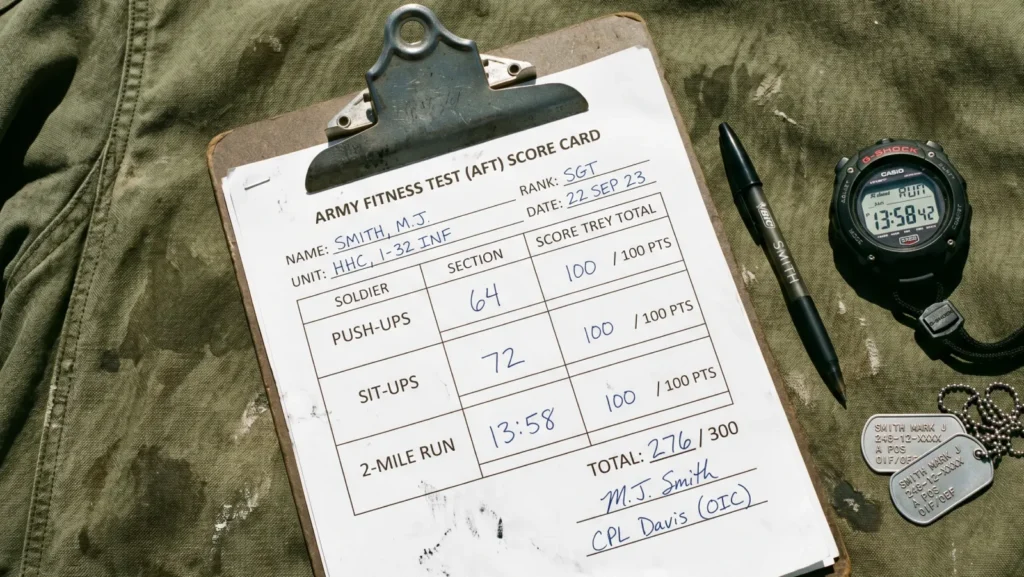
The 2026 Army Fitness Test (AFT) scores five events from 0 to 100 points each. You need at least 60 points per event to pass, and the raw numbers you have to hit shift with your age bracket and sex. Below are the full point tables — deadlift, push-ups, sprint-drag-carry, plank, and the two-mile run — pulled straight from the Army’s official scoring scales, plus what changed when the AFT replaced the ACFT and when the new combat standard kicks in.
TL;DR — What’s the 2026 AFT score chart?
The AFT score chart sets the raw performance you must hit on each of the Army’s five fitness events to earn 60, 80, or 100 points. Every event is scored 0–100, and 60 in each is the floor to pass. The General Standard is normed by age and sex; the Combat Standard is sex-neutral (women in combat jobs meet the same numbers as men) but still age-normed. The active-component combat standard takes effect January 1, 2026. (Source: Army.mil, 2025.)
Want your exact score? Use the AFT calculator to convert your reps and times into points. Secondary reference: the Army’s official AFT Scoring Scales PDF.
Minimum points to pass the AFT (quick reference)
To pass the AFT you need at least 60 points in each of the five events, for a minimum total of 300. Score below 60 on any single event and you fail the whole test, no matter how high your total. Soldiers in the 21 designated combat MOSs face a higher bar: 60 per event still, but a 350 overall minimum under the sex-neutral Combat Standard (Source: Army.mil, 2025).
| Event | Minimum passing score | Notes |
|---|---|---|
| 3-Rep Max Deadlift | 60 points | Raw weight (lbs) varies by age/sex |
| Hand-Release Push-Up | 60 points | Reps in 2 minutes |
| Sprint-Drag-Carry | 60 points | Time, lower is better |
| Plank | 60 points | Hold time, longer is better |
| Two-Mile Run | 60 points | Time, lower is better |
| Overall | 300 (General) / 350 (Combat) | Plus 60 in every event |
How AFT scoring works
Each AFT event is worth 0 to 100 points, for a 500-point maximum, and you must score 60 or higher on all five to pass. The Army converts your raw performance — pounds lifted, reps completed, time run — into points using fixed scoring scales. Those scales are normed by age band and sex under the General Standard, so a 19-year-old and a 50-year-old hitting the same point value lift or run different raw numbers.
There are ten age bands, starting at 17–21 and climbing in five-year steps to 62 and over. The older the band, the more forgiving the raw requirement. Sex matters too under the General Standard: the female scales sit below the male scales at every point value.
The one exception is the Combat Standard, covered next.
General Standard vs Combat (sex-neutral) Standard
The General Standard applies to most soldiers and norms scoring by both age and sex; the Combat Standard applies only to soldiers in 21 designated combat MOSs and is sex-neutral — women meet the same raw numbers as men — while staying age-normed. On the official scale, the male column and the combat column are identical, which is why combat-coded women train to the men’s figures.
| Dimension | General Standard | Combat Standard |
|---|---|---|
| Applies to | Most soldiers (combat-enabling and support roles) | Soldiers in 21 designated combat MOSs (infantry, armor, cavalry, field artillery, combat engineers, Special Forces and more) |
| Age-normed? | Yes | Yes |
| Sex-normed? | Yes | No — sex-neutral (women meet the male numbers) |
| Per-event minimum | 60 points | 60 points |
| Overall minimum | 300 | 350 |
| Active-component effective date | In force (phased from June 1, 2025) | January 1, 2026 |
AFT score chart by event (full point tables)
To read any table below: find your age band down the left, then read across to your sex column at the 60-, 80-, or 100-point threshold. The “Male” columns double as the Combat (sex-neutral) standard — a combat-MOS soldier of any sex uses the Male figure. The tables show the three anchor scores most recruits target: 60 (pass), 80 (competitive), and 100 (max). For every intermediate point value, see the Army’s official scale, which lists all rows from 0 to 100.
A few units to keep straight before you read: deadlift is in pounds, push-ups are reps in two minutes, and the sprint-drag-carry, plank, and two-mile run are all times in minutes:seconds. For the timed lift-and-carry and the run, lower is better; for the plank, longer is better.
3-Repetition Maximum Deadlift score chart
| Age band | Male 60 | Male 80 | Male 100 | Female 60 | Female 80 | Female 100 |
|---|---|---|---|---|---|---|
| 17–21 | 150 | 250 | 340 | 120 | 150 | 220 |
| 22–26 | 150 | 250 | 350 | 120 | 150 | 230 |
| 27–31 | 150 | 250 | 350 | 120 | 150 | 240 |
| 32–36 | 140 | 240 | 350 | 120 | 150 | 230 |
| 37–41 | 140 | 240 | 350 | 120 | 150 | 220 |
| 42–46 | 140 | 240 | 350 | 120 | 150 | 210 |
| 47–51 | 140 | 240 | 340 | 120 | 140 | 200 |
| 52–56 | 140 | 230 | 330 | 120 | 140 | 190 |
| 57–61 | 140 | 140 | 250 | 120 | 140 | 170 |
| 62+ | 140 | 140 | 230 | 120 | 140 | 170 |
On the 80-point figures: the Army’s official deadlift scale does not print a discrete weight on the 80-point line for every age band — the published rows step in fixed weight increments, so the 80-point values shown here are interpolated to the nearest published weight within each band. Use them as a target, not an exact certified cutoff. Source: U.S. Army AFT Scoring Scales, approved 15 May 2025, effective 1 June 2025.
Hand-Release Push-Up score chart
| Age band | Male 60 | Male 80 | Male 100 | Female 60 | Female 80 | Female 100 |
|---|---|---|---|---|---|---|
| 17–21 | 15 | 37 | 58 | 11 | 23 | 53 |
| 22–26 | 14 | 37 | 61 | 11 | 23 | 50 |
| 27–31 | 14 | 37 | 62 | 11 | 23 | 48 |
| 32–36 | 13 | 36 | 60 | 11 | 23 | 47 |
| 37–41 | 12 | 35 | 59 | 10 | 22 | 43 |
| 42–46 | 11 | 34 | 57 | 10 | 21 | 40 |
| 47–51 | 11 | 32 | 55 | 10 | 20 | 38 |
| 52–56 | 10 | 30 | 51 | 10 | 19 | 36 |
| 57–61 | 10 | 18 | 46 | 10 | 15 | 24 |
| 62+ | 10 | 17 | 43 | 10 | 15 | 24 |
For the 57–61 and Over-62 female bands, the official push-up scale prints no discrete repetition on the 80-point line; the value shown is the nearest published rep that reaches the 80-point range and is an interpolated target, not a certified cutoff. Source: U.S. Army AFT Scoring Scales, eff. 1 June 2025.
Sprint-Drag-Carry score chart
| Age band | Male 60 | Male 80 | Male 100 | Female 60 | Female 80 | Female 100 |
|---|---|---|---|---|---|---|
| 17–21 | 2:28 | 1:53 | 1:29 | 3:15 | 2:28 | 1:55 |
| 22–26 | 2:31 | 1:53 | 1:30 | 3:15 | 2:29 | 1:55 |
| 27–31 | 2:32 | 1:55 | 1:30 | 3:15 | 2:29 | 1:55 |
| 32–36 | 2:36 | 1:58 | 1:33 | 3:22 | 2:34 | 1:59 |
| 37–41 | 2:41 | 2:02 | 1:36 | 3:27 | 2:38 | 2:02 |
| 42–46 | 2:45 | 2:07 | 1:40 | 3:42 | 2:44 | 2:09 |
| 47–51 | 2:53 | 2:14 | 1:45 | 3:51 | 2:50 | 2:11 |
| 52–56 | 3:00 | 2:23 | 1:52 | 4:03 | 2:58 | 2:18 |
| 57–61 | 3:12 | 2:29 | 1:58 | 4:48 | 3:07 | 2:26 |
| 62+ | 3:16 | 2:32 | 2:09 | 4:48 | 3:07 | 2:26 |
Plank score chart
| Age band | Male 60 | Male 80 | Male 100 | Female 60 | Female 80 | Female 100 |
|---|---|---|---|---|---|---|
| 17–21 | 1:30 | 2:35 | 3:40 | 1:30 | 2:35 | 3:40 |
| 22–26 | 1:25 | 2:30 | 3:35 | 1:25 | 2:30 | 3:35 |
| 27–31 | 1:20 | 2:25 | 3:30 | 1:20 | 2:25 | 3:30 |
| 32–36 | 1:15 | 2:20 | 3:25 | 1:15 | 2:20 | 3:25 |
| 37–41 | 1:10 | 2:15 | 3:20 | 1:10 | 2:15 | 3:20 |
| 42–46 | 1:10 | 2:15 | 3:20 | 1:10 | 2:15 | 3:20 |
| 47–51 | 1:10 | 2:15 | 3:20 | 1:10 | 2:15 | 3:20 |
| 52–56 | 1:10 | 2:15 | 3:20 | 1:10 | 2:15 | 3:20 |
| 57–61 | 1:10 | 2:15 | 3:20 | 1:10 | 2:15 | 3:20 |
| 62+ | 1:10 | 2:15 | 3:20 | 1:10 | 2:15 | 3:20 |
Two-Mile Run score chart
| Age band | Male 60 | Male 80 | Male 100 | Female 60 | Female 80 | Female 100 |
|---|---|---|---|---|---|---|
| 17–21 | 19:57 | 17:13 | 13:22 | 22:55 | 19:30 | 16:00 |
| 22–26 | 19:45 | 17:18 | 13:25 | 22:45 | 19:25 | 15:30 |
| 27–31 | 19:45 | 17:21 | 13:25 | 22:45 | 19:45 | 15:30 |
| 32–36 | 20:44 | 17:16 | 13:42 | 22:50 | 19:53 | 15:48 |
| 37–41 | 20:44 | 17:33 | 13:42 | 22:59 | 19:57 | 15:51 |
| 42–46 | 22:04 | 17:47 | 14:05 | 23:15 | 20:10 | 16:00 |
| 47–51 | 22:04 | 18:12 | 14:30 | 23:30 | 20:34 | 16:30 |
| 52–56 | 24:00 | 19:00 | 15:09 | 24:00 | 21:19 | 16:59 |
| 57–61 | 23:36 | 19:45 | 15:28 | 24:48 | 21:51 | 17:18 |
| 62+ | 23:36 | 19:45 | 15:28 | 25:00 | 21:59 | 17:18 |
Alternate aerobic event scoring (row, bike, swim, walk)
Soldiers on a permanent medical profile that bars running can substitute one of four alternate aerobic events for the two-mile run: a 5,000m row, a 12km stationary bike, a 1,000m swim, or a 2.5-mile walk. These are scored go/no-go, not on a 0–100 point scale — you either finish inside the time cap or you don’t, and there’s no way to earn above-minimum points on them. A profile from your provider is required to qualify (Source: Army.mil AFT Scoring Scales, 2025).
Because the alternates are pass/fail rather than point-scored, they replace the run for the purpose of completing the test, but a soldier relying on them cannot post a maxed total. The time caps below are age- and sex-banded.
| Age band | 2.5-mi Walk (M / F) | 12km Bike (M / F) | 1km Swim (M / F) | 5km Row (M / F) |
|---|---|---|---|---|
| 17–21 | 31:00 / 34:00 | 26:25 / 28:58 | 30:48 / 33:48 | 30:48 / 33:48 |
| 22–26 | 30:45 / 33:30 | 26:12 / 28:31 | 30:30 / 33:18 | 30:30 / 33:18 |
| 27–31 | 30:30 / 33:00 | 26:00 / 28:07 | 30:20 / 32:48 | 30:20 / 32:48 |
| 32–36 | 30:45 / 33:30 | 26:12 / 28:31 | 30:30 / 33:18 | 30:30 / 33:18 |
| 37–41 | 31:00 / 34:00 | 26:25 / 28:58 | 30:48 / 33:48 | 30:48 / 33:48 |
| 42–46 | 31:00 / 34:00 | 26:25 / 28:58 | 30:48 / 33:48 | 30:48 / 33:48 |
| 47–51 | 32:00 / 35:00 | 27:16 / 29:50 | 31:48 / 34:48 | 31:48 / 34:48 |
| 52–56 | 32:00 / 35:00 | 27:16 / 29:50 | 31:48 / 34:48 | 31:48 / 34:48 |
| 57–61 | 33:00 / 36:00 | 28:07 / 30:41 | 32:50 / 35:48 | 32:50 / 35:48 |
| 62+ | 33:00 / 36:00 | 28:07 / 30:41 | 32:50 / 35:48 | 32:50 / 35:48 |
AFT vs ACFT: what changed and when
The Army Fitness Test (AFT) replaced the Army Combat Fitness Test (ACFT) as the test of record, with phased implementation that began June 1, 2025 and the sex-neutral combat standard taking effect January 1, 2026 for the active component. The headline changes: a new name, a trimmed event list, and a separate combat scoring track. The two-mile run, plank, deadlift, push-up, and sprint-drag-carry all carry over; the standing power throw (the “ball toss”) was cut (Source: Army.mil, 2025).
If you trained for the old ACFT, your prep mostly transfers. The big practical shift is the combat track and the dropped power-throw event, not a wholesale rewrite of standards.
| Aspect | ACFT (former) | AFT (2026) |
|---|---|---|
| Test name | Army Combat Fitness Test | Army Fitness Test |
| Number of events | 6 | 5 |
| Events removed | — | Standing power throw cut |
| Plank | Scored event | Retained as scored event |
| Scoring scale | 0–100 per event, 600 max | 0–100 per event, 500 max |
| Combat standard | None | Sex-neutral, 350 overall minimum |
| Active-component effective date | Replaced | Jan 1, 2026 (combat standard) |
| Reserve/Guard effective date | Replaced | Jun 1, 2026 (combat standard) |
| Who’s affected | All soldiers | All soldiers; 21 combat MOSs hit the sex-neutral track |
How to improve your AFT score
Train the deadlift first — most recruits under-prepare it, then panic when 140 to 150 pounds for three reps feels heavy on test day. It’s the one event where raw strength is non-negotiable and there’s no cardio workaround. Build it with a basic linear program: heavy trap-bar or conventional pulls twice a week, working up in 5-pound jumps.
For the hand-release push-up, the failure point is usually the chest-to-deck reset, not your max set. Practice the strict form to muscular fatigue, not sloppy half-reps that won’t count.
The sprint-drag-carry punishes weak grip and conditioning together. Run the actual event — sled drag, kettlebell carry, sprints — rather than substituting generic cardio, because the transitions are what blow up your time.
For the plank, train holds slightly past your target time so the test feels short. And for the two-mile run, mix one interval session and one tempo run per week; junk-mileage jogging won’t move a sub-20-minute goal.
Frequently asked questions
What is a passing AFT score?
A passing AFT score is at least 60 points in every one of the five events, totaling a minimum of 300 points under the General Standard. Combat-MOS soldiers need 60 per event and a 350 overall minimum. Falling below 60 on any single event fails the test regardless of total.
What is the maximum AFT score?
The maximum AFT score is 500 points — a perfect 100 on each of the five events. Reaching 100 requires hitting the top raw figure in your age and sex band, such as a 340-pound deadlift or a sub-13:22 two-mile run for men aged 17–21.
Is the AFT scored by age and gender?
Yes, under the General Standard the AFT is normed by both age and sex, so the raw performance needed for a given point value drops in older age bands and is lower on the female scales. The Combat Standard is age-normed but sex-neutral — women in combat MOSs meet the same numbers as men.
When does the AFT take effect?
Phased AFT implementation began June 1, 2025. The sex-neutral Combat Standard takes effect January 1, 2026 for the active component and June 1, 2026 for the Army Reserve and National Guard.
Is the AFT the same as the ACFT?
No. The AFT replaced the Army Combat Fitness Test (ACFT) as the test of record. It dropped the standing power throw (down to five events from six), kept the plank, and added a separate sex-neutral scoring track for 21 combat MOSs.
What is the minimum two-mile run time to pass?
The minimum two-mile run for 60 points depends on your age and sex. For men aged 17–21 it’s 19:57, and for women in that band it’s 22:55; older age bands get more time. See the Two-Mile Run table for every band.
Can I substitute the two-mile run?
Yes, if you have a permanent medical profile that prevents running. You may substitute a 5,000m row, 12km bike, 1,000m swim, or 2.5-mile walk, scored go/no-go against a time cap rather than for points — so a substitute cannot earn an above-minimum score.
Sources
- Army.mil — AFT Scoring Scales PDF (effective 1 June 2025)
- Army.mil — Army establishes new fitness test of record (2025)
- GoArmy — Fitness requirements
- Standards last verified against official Army sources on June 20, 2026.


Pingback: Special Forces Training Program: SFAS & Green Beret Selection Guide
Pingback: Navy SEAL Physical Requirements & PST Standards (2026 Guide)