
Last updated: May 2026 — written by the Gymnase Tips training team.
Assisted pull-ups are pull-up variations that reduce the bodyweight load through external support — most commonly a resistance band looped over the bar, an assisted pull-up machine that counterweights you, or a chair/box under your feet to push from. The point of assisted pull-ups is not to “do pull-ups easier” forever; it is to build the specific upper-back strength, scapular control, and grip endurance needed for your first strict, dead-hang rep. Used correctly — fixed assistance level, strict form, 3 sessions per week — most untrained adults can progress from zero pull-ups to one bodyweight pull-up in 6 to 10 weeks.
Most beginners get stuck on assisted pull-ups for one of three reasons: they pick the wrong method (heavy band on the elbows, no scapular engagement), they kip and swing instead of pulling, or they never progressively reduce assistance. This guide fixes all three.
Table of Contents
- What Are Assisted Pull-Ups?
- Are Assisted Pull-Ups Effective?
- The 5 Assisted Pull-Up Methods Compared
- 8-Week Beginner Progression Program
- Form Fundamentals
- 5 Common Mistakes
- Transitioning to Your First Strict Pull-Up
- FAQ
What Are Assisted Pull-Ups?
Assisted pull-ups are pull-up variations that reduce the load you have to lift below bodyweight. The mechanics — initiating with the lats, retracting the shoulder blades, pulling the chest toward the bar — stay identical to a strict pull-up. Only the load changes.
That distinction matters. Assisted pull-ups are a load progression, not a different exercise. Lat pulldowns, inverted rows, and seated rows train similar muscles but in different planes and with different stabilizer demands — they build a foundation, but they do not replicate the pull-up pattern. Only assisted pull-ups train the actual movement at a sub-bodyweight load, which is why they transfer directly to strict reps in a way pulldown variations do not.
The U.S. Army’s Field Manual 7-22 (Holistic Health and Fitness) uses banded pull-ups specifically as the primary regression for soldiers who cannot yet meet the ACFT pull-up standard, citing the same logic: same movement, less load.
Are Assisted Pull-Ups Effective?
Yes — when programmed with progressively decreasing assistance. A 2019 study in the Journal of Strength and Conditioning Research found that participants doing 3 banded pull-up sessions per week with weekly band reduction added an average of 4–5 strict pull-up reps over 10 weeks, compared to 1–2 reps in a lat-pulldown-only group. The effect size was not subtle.
Practically, expect this kind of progression for an untrained adult of average bodyweight starting from zero pull-ups:
| Week | Assistance | Sets × Reps | Approximate Load Reduction |
|---|---|---|---|
| 1–2 | Heavy band (40–80 lbs) | 4 × 6–8 | ~50% bodyweight |
| 3–4 | Medium band (30–50 lbs) | 4 × 6 | ~30% bodyweight |
| 5–6 | Light band (20–35 lbs) | 4 × 5 | ~20% bodyweight |
| 7 | Mini band + negatives | 3 × 4 + 3 × 5s holds | ~10% bodyweight |
| 8 | Test for first strict rep | 1+ rep | 0% |
The principle is simple: each band drop is the equivalent of adding weight to a barbell exercise. You progress when reps with the current band become too easy, and you stop the assistance entirely once you can hold the top position for 5 strict seconds and complete a 5-second eccentric (lowering phase).
The 5 Assisted Pull-Up Methods Compared
1. Band-Assisted Pull-Up
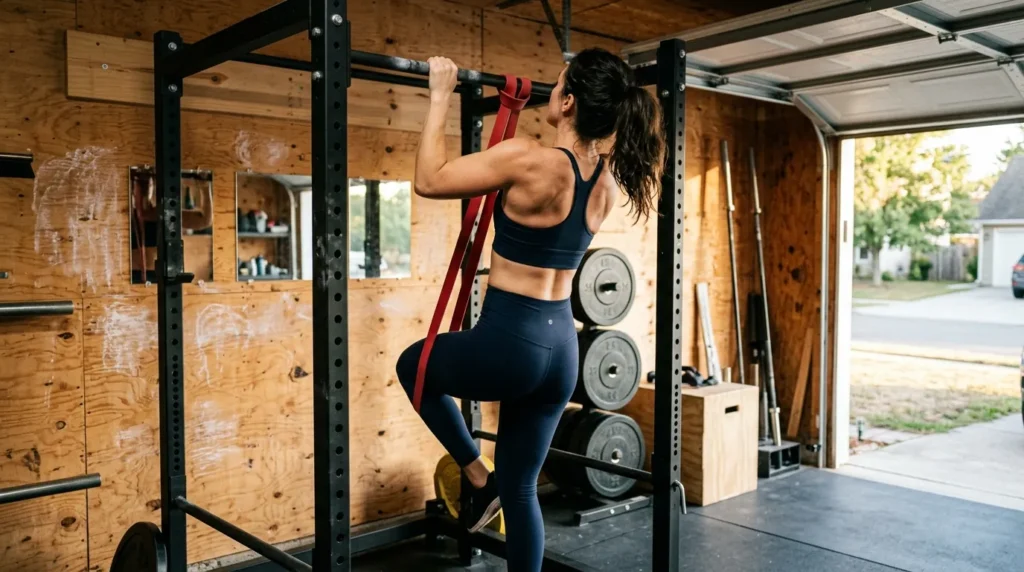
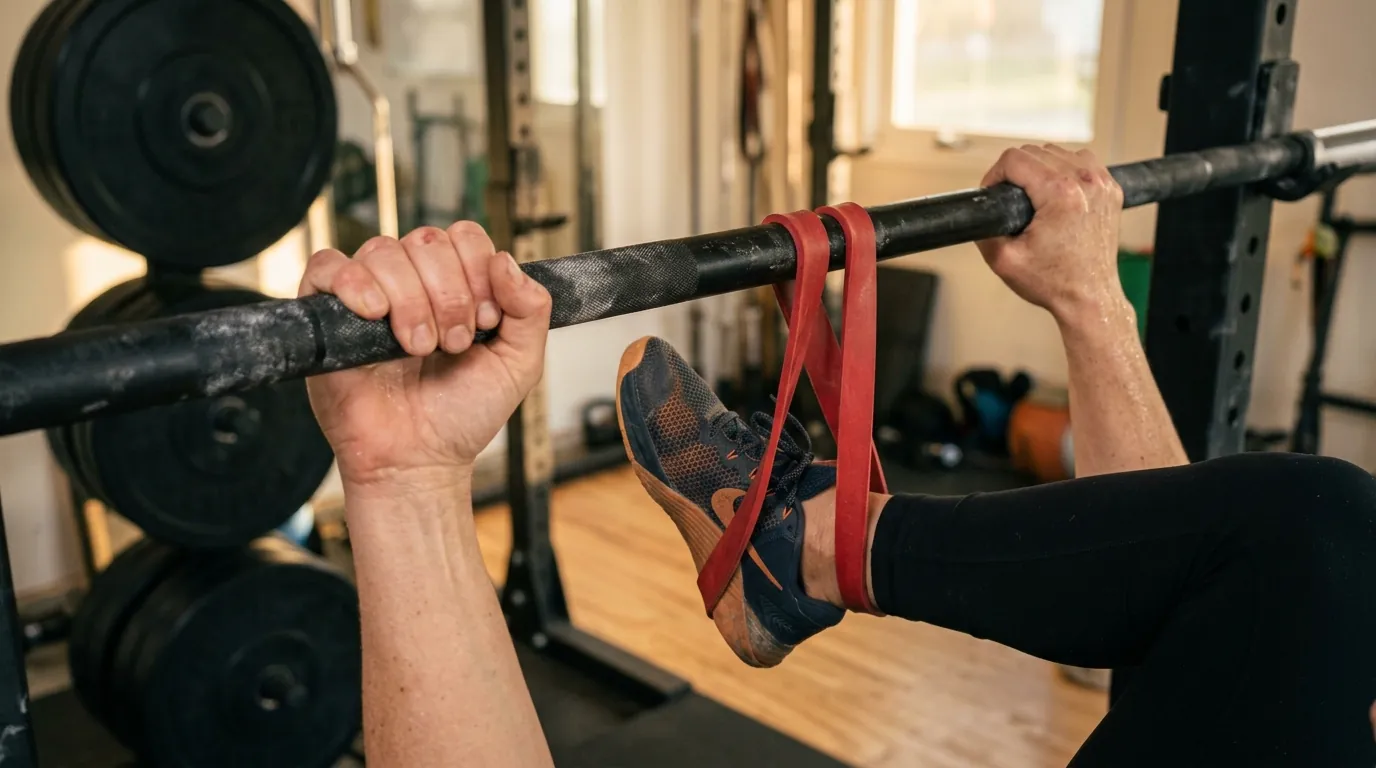
The standard for at-home and gym training. A loop resistance band is anchored over the pull-up bar; you place one foot or knee in the band’s bottom loop, and the elastic recoil unloads part of your bodyweight at the bottom of the rep, where you are weakest. Variable resistance is actually the strength of this method — you get more help where you need it most, and less at the top, which mimics how strict pull-ups feel.
Recommended bands: 0.5″ mini (10–35 lb assist), 1″ light (25–80 lb assist), 1.5″ medium (50–125 lb assist). Most adults start with a 1″ or 1.5″ band for week 1, then drop one band per 2 weeks.
2. Assisted Pull-Up Machine
A counterweight machine with a kneeling platform: you select an assistance weight, and the machine subtracts that load from your bodyweight. Found in most commercial gyms. Cleaner load progression than bands (you can drop in 5 lb increments) but it locks you into a fixed motor pattern, removing some of the stabilizer demand of a free-hanging pull-up.
Best for: very deconditioned beginners who can’t safely control a band, and rehab populations. Weakness: the machine assists you maximally at the top, which is the opposite of how a real pull-up feels — so transfer to strict reps is slightly worse than band-assisted work.
3. Eccentric (Negative) Pull-Ups
Jump or step to the top of the pull-up (chin over bar), then lower yourself as slowly as possible — aim for 5 seconds in week 1, building to 8–10 seconds. No band, no machine. The eccentric (lowering) phase of any lift can handle roughly 1.5× the load of the concentric, which is why a beginner who cannot do a single concentric pull-up can usually do 5-second negatives from day one.
This method has the highest transfer to strict pull-ups of any technique on this list, but is the most fatiguing. Most plans mix negatives with banded work rather than using them alone.
4. Jump-Up Pull-Up
Start with a box or bench under the bar; jump explosively to the top, hold for 1–2 seconds, lower yourself with control, repeat. The jump unloads the hardest portion (bottom-third pull) and lets you train the top of the rep volume that you couldn’t otherwise reach.
This is essentially the bodyweight equivalent of an “ascending strength curve” lift. Use it as the first or second exercise of a session, before fatigue compromises your jump.
5. Foot-on-Chair / Partner-Assisted Pull-Up
One foot on a low chair or box behind you (so the leg is mostly straight) gives you a controllable amount of assistance — push less to make it harder, more to make it easier. Or have a training partner support your feet/hips from behind. Both versions let you self-regulate assistance within a single set.
Best when you are between band sizes and want a more granular load drop, or when no band/machine is available. Form discipline is critical — it’s tempting to push hard with the leg and turn the rep into a partial-effort movement.
8-Week Assisted Pull-Up Beginner Program
This is the program we use with clients who start at zero strict pull-ups. Train pull-up patterns three times per week (e.g., Monday/Wednesday/Friday) on non-consecutive days. The bar work is best done fresh — at the start of a workout, not at the end of back day.
Phase 1: Volume Foundation (Weeks 1–3)
- Banded pull-ups (1″ or 1.5″ band): 4 sets × 6–8 reps
- Inverted rows under a bar/TRX: 3 sets × 8–10
- Hollow-body holds: 3 × 30 seconds
- Dead hangs: 3 × max time (target 30 s by end of phase)
The goal of weeks 1–3 is volume: 18–24 banded pulls per session, three times per week, total ~70 reps per week. You are buying scapular control, grip endurance, and movement coordination.
Phase 2: Strength Build (Weeks 4–6)
- Banded pull-ups (drop one band size): 4 sets × 5–6 reps
- Eccentric (negative) pull-ups: 3 sets × 3 reps, 5-second lowers
- Inverted rows (feet elevated): 3 × 8
- Dead hang to scapular pull: 3 × 6
Phase 2 introduces eccentrics — the highest-transfer technique for hitting your first strict rep. The combination of reduced band size + negatives is what produces the biggest week-over-week strength jumps. Expect to feel surprisingly sore in the lats and biceps the first time.
Phase 3: First-Rep Push (Weeks 7–8)
- Mini-band pull-ups: 3 sets × 4 reps
- Negatives with 8-second lowers: 4 sets × 3
- Strict rep attempts (every other session): 3–5 attempts, fresh, fully recovered
- Inverted rows: 3 × 8
The first strict rep usually arrives somewhere between weeks 6 and 9 for an average untrained adult who has been consistent. When you get it, do not test for max reps that session — protect the new neural pattern and do one rep, walk away. The next session, test again. Volume comes after the pattern is locked in.
Assisted Pull-Up Form Fundamentals
- Grip: overhand (pronated) grip, hands slightly wider than shoulder-width. Avoid going too wide — wider grip reduces ROM and overweights the shoulder.
- Setup: hang from the bar with arms fully extended, then pack the shoulders down and back (“scapular pull-up”) before initiating the rep. This is the single most-skipped element in beginner pull-ups.
- Pull: drive elbows down and back toward your hips. Think of pulling the bar to your chest, not pulling your chin over the bar.
- Top position: chin clears the bar, chest stays lifted, no piking forward. Brief pause if you can manage it.
- Lower: control the descent. A 2–3 second negative on every rep doubles the strength stimulus from each set.
- Body line: hollow-body — ribs tucked, abs braced, glutes tight, legs together. No swinging, no kipping.
5 Common Assisted Pull-Up Mistakes
1. Band Too Heavy, Forever
The most common mistake. A 1.5″ band gives roughly 50–125 lbs of assistance — enough to make pull-ups feel achievable but too much to drive strength gains long-term. If you can hit 10+ reps with a band, drop a band size. The band is a load tool, not a comfort tool.
2. Kipping and Swinging
The band creates kinetic energy at the bottom of the rep — beginners often unconsciously bounce out of the bottom and use the rebound to muscle through. This trains a different movement and won’t transfer to strict reps. Pause briefly at the bottom of every rep with no swing before pulling.
3. Skipping the Scapular Pull
Pulling with arms-only (biceps + brachialis) and never engaging the lats is the pattern most beginners default to. Before every rep, perform a “scapular pull-up” first: from a dead hang, depress and retract the shoulder blades without bending the arms. Only then begin the bicep pull. This single cue is worth multiple weeks of progress.
4. Half Reps
Not pulling chin all the way over the bar, or not lowering to a full dead hang. Strict pull-ups demand full ROM — half-rep training won’t transfer. If you can’t reach the top of the bar with the current band, the band is too small.
5. Training Pull-Ups Fatigued
Tacking pull-ups onto the end of a back day, after rows and pulldowns have already cooked your lats and biceps, is the slowest way to progress. Train pull-ups first in the workout. The sister piece on this — including frequency strategy and grease-the-groove protocols — is laid out in our how to get better at pull-ups guide.
Transitioning From Assisted to Strict Pull-Ups
Two reliable signals tell you that you are within 1–2 weeks of your first strict rep:
- You can hold the top position of a pull-up (chin over bar, chest up) for 5+ seconds with no assistance.
- You can lower yourself from the top with control over a full 5–8 seconds.
Once both are true, attempt strict reps at the start of every other session. Three attempts maximum, fully rested between (90+ seconds). Stop attempting the moment a rep fails. Continue assisted work in the same session to maintain volume.
Your first strict rep will not be pretty — that’s normal. The second through fifth reps come fast (typically within 2–4 weeks of the first), then progression slows. By that stage, the program shifts to volume-frequency work, which is covered in our broader pull-up guide and in the bodyweight strength chapter of our military calisthenics workout guide.
Assisted Pull-Up FAQ
How long does it take to do a strict pull-up from zero?
For an untrained adult of average bodyweight training pull-up patterns 3 times per week, expect 6–10 weeks to your first strict rep. People carrying significant excess bodyweight typically need 12–16 weeks, sometimes paired with a small calorie deficit, since each pound of bodyweight reduction directly improves the rep.
Are bands or machines better for assisted pull-ups?
Bands transfer better to strict reps because the variable resistance pattern matches the strict pull-up’s strength curve (more help at the bottom, less at the top). Machines progress more cleanly in 5 lb increments. Use bands as your primary tool; treat the machine as a useful complement when bands are not available.
How often should I train assisted pull-ups per week?
Three times per week, on non-consecutive days. Daily training is overkill for someone unable to do bodyweight reps — the recovery cost outweighs the volume benefit. Stick to 3 sessions, train them fresh, and progress assistance load over time.
Should women use assisted pull-ups specifically?
Yes. The exact same protocol works for women — the only adjustment is starting band selection (often a 1.5″ medium band rather than 1″ light, based on average upper-body strength relative to bodyweight). For women’s-specific calisthenics programming see our military calisthenics workout guide.
Can I do assisted pull-ups at home?
Yes — a doorway pull-up bar (rated for at least 250 lb), one or two resistance bands, and a chair for jump-ups or foot-assisted reps cover the entire 8-week program. Total equipment cost is roughly $40–60.
Are assisted pull-ups good for the Navy SEAL PST?
As a starting point, yes — but only as a starting point. The PST tests strict, dead-hang reps with no kip and no assist. Use assisted work to build to your first 5 strict reps, then transition to strict-only volume. See our full breakdown in Navy SEAL physical requirements & PST standards.
Is one band heavy enough, or do I need a set?
For the full 8-week program you’ll want at least two bands (e.g., 1″ + mini, or 1.5″ + 1″), so you can drop band size mid-program. A 4-band set covers the entire progression including future weighted pull-up work, and is usually only $10–15 more than buying single bands.
Can assisted pull-ups replace lat pulldowns?
For pull-up strength specifically, yes. Lat pulldowns build similar muscles but in a different motor pattern (seated, vertical-pull-while-stable) and won’t transfer 1-to-1. If your goal is strict pull-ups, prioritize assisted pull-ups; use lat pulldowns as accessory work, not the main lift.
The Bottom Line
Assisted pull-ups work when you treat them like a load progression, not a coping mechanism. Pick a method (bands are the highest-transfer for most people), train the movement 3 times per week with strict full-ROM reps, drop assistance every 2 weeks, and add 5-second eccentrics from week 4 onward. Most untrained adults reach their first strict rep in 6–10 weeks. The two non-negotiables: full range of motion on every rep, and decreasing assistance over time. Cling to the heavy band for 8 weeks and you’ll progress nowhere; force yourself onto smaller bands and the strict rep arrives.
For programming context once you have your first rep, see our how to get better at pull-ups: 6-week program. For the broader military-fitness picture, our military calisthenics workout guide, Navy SEAL calisthenics workout, Army PRT drills, 28-day military workout, and 8-week military calisthenics plan all build on the bodyweight foundation that begins with your first pull-up.



Pingback: Pull Up Bar Workout: Full Upper-Body Program (Any Level, 2026)