TL;DR
The hand-release push-up (HRP) is the upper-body push event on the Army Fitness Test (AFT), which replaced the ACFT as the test of record on June 1, 2025 (Source: Army.mil). You get two minutes to bank as many reps as possible, and each rep requires your hands to fully leave the ground and your arms to extend out to the sides before the next rep starts. Minimum score is 60 points per event; scoring bands run by age and sex (Source: GoArmy.com).
Table of contents

What Is a Hand-Release Push-Up?
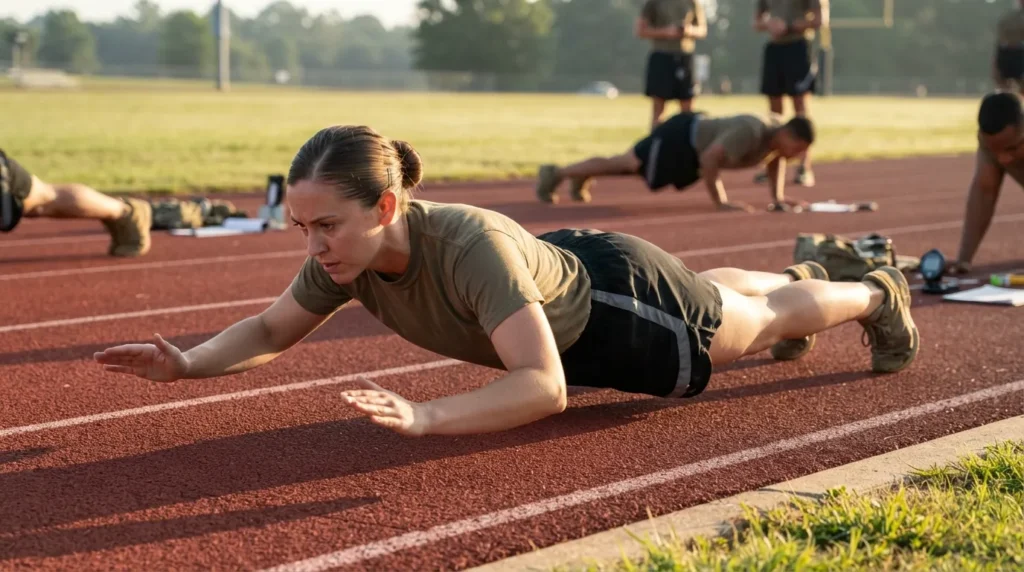
A hand-release push-up (HRP) is a push-up variant where, at the bottom of each rep, both hands come completely off the ground and the arms extend out to the sides before the next rep begins. It is the second event on the Army Fitness Test (AFT), tested for two minutes for maximum reps. The Army adopted the HRP in 2019 as part of the Army Combat Fitness Test (ACFT), and it survived the ACFT-to-AFT transition on June 1, 2025 as one of the five events that carried over unchanged (Source: Army.mil, “Army introduces new fitness test for 2025”).
The current AFT keeps five events: the three-repetition maximum deadlift, the hand-release push-up, the sprint-drag-carry, the plank, and the two-mile run. The one event dropped from the old ACFT lineup was the standing power throw, removed after Army medical data showed it was the single largest source of fitness-test musculoskeletal injuries (Source: Army.mil). The hand-release push-up was not touched by that change — it remains the test’s only push event, and as of this writing in 2026 there is no indication the Army plans to revert to the old unbroken push-up.
Hand-Release Push-Up Standard and Scoring
You get two minutes on the clock. Reps are counted only when every checkpoint of the movement is met — full lockout at the top, chest and hips touching down together, hands releasing to a T position, then returning to the ground. A minimum of 60 points is required on every AFT event, including the HRP, to earn a passing total (Source: Army.mil). General-standard Soldiers need 300 points across all five events; Soldiers in the 21 designated combat specialties need 350 points and are scored against the male standard regardless of sex (Source: Army.mil).
The table below shows reps needed for the three key score thresholds, minimum pass (60 points), a mid-range score (80 points), and max score (100 points), by age band and sex (Source: GoArmy.com, official AFT scoring standards).
| Age Band | Male 60 pts | Male 80 pts | Male 100 pts | Female 60 pts | Female 80 pts | Female 100 pts |
|---|---|---|---|---|---|---|
| 17–21 | 15 | 37 | 58 | 11 | 23 | 53 |
| 22–26 | 14 | 37 | 61 | 11 | 23 | 50 |
| 27–31 | 14 | 37 | 62 | 11 | 23 | 48 |
| 32–36 | 13 | 36 | 60 | 11 | 23 | 47 |
| 37–41 | 12 | 35 | 59 | 10 | 22 | 43 |
| 42–46 | 11 | 34 | 57 | 10 | 21 | 40 |
| 47–51 | 11 | 32 | 55 | 10 | 20 | 38 |
| 52–56 | 10 | 30 | 51 | 10 | 19 | 36 |
| 57–61 | 10 | 18 | 46 | 10 | 15 | 24 |
| 62+ | 10 | 17 | 43 | 10 | 15 | 24 |
Reading the table: a 24-year-old male needs 14 reps to clear the 60-point floor, 37 for 80 points, and 61 for a max score. A 24-year-old female needs 11, 23, and 50 reps for the same three thresholds. Notice the minimum pass threshold barely drops with age (it floors at 10 reps from the low 50s onward for men and stays at 10 for women across most bands), while the 100-point ceiling drops much faster — the test gets easier to pass but harder to max as you age.
How to Do a Hand-Release Push-Up
The official standard breaks the HRP into a starting position and four movements per rep (Source: GoArmy.com, AFT Event 2 standard).
Starting position: lie prone, facing the start line. Hands are flat on the ground with index fingers roughly inside the outer edges of the shoulders. Chest, front of the hips, and thighs are all touching the ground. Feet are together or up to one boot width apart, ankles flexed so the toes, not the tops of the feet, are the contact point.

- Push up as one unit. Drive through the hands and extend the elbows fully, keeping the body rigid from head to ankles, until you reach the front-leaning rest (top plank) position.
- Lower under control. Bend the elbows and lower the body back down so the chest, hips, and thighs touch the ground at essentially the same time, not the chest first with the hips trailing.
- Release to the T position. Fully extend both arms out to the sides until they are generally straight, lifting the hands completely off the ground. This is the checkpoint graders are watching for.
- Reset and repeat. Return the hands to the starting position under the shoulders and drive back up into the next rep. The clock runs continuously for two minutes; you can rest at the top or the bottom, but not in a bent or sagging position.
Common Mistakes and No-Rep Reasons
Graders watch for a specific set of breaks. Any one of these on a given rep means that rep does not count, even if the rest of the movement looked clean (Source: GoArmy.com).
- Sagging or piking hips. Losing the straight line from head to ankles at any point in the rep, including the up and down phases, not just the extended positions.
- Incomplete lockout. Elbows not fully extending at the top before you start lowering back down.
- Uneven touchdown. Chest, hips, and thighs not landing on the ground at essentially the same time, usually from raising the hips first to “cheat” the chest down faster.
- Partial hand release. Hands not coming fully off the ground, or not reaching a generally straight T position out to the sides.
- Feet drifting apart. Feet spreading wider than one boot width, which changes the base of support and the difficulty of the hold.
- Resting out of position. You can rest at the top (arms locked) or at the bottom (hands released) between reps, but bending at the hips, knees, or neck while resting is a form break, not a legal rest.
Muscles Worked
The pectoralis major is the prime mover, with the triceps doing most of the secondary work extending the elbow through lockout (Source: Fitness Volt exercise analysis). The anterior and posterior deltoids stay under tension through the full range, and because you have to actively retract your shoulder blades to lift your hands off the ground and reach the T position, the mid-trapezius and rhomboids get meaningfully more work than they do in a standard push-up, where the hands never leave the floor (Source: Fitbod exercise database).
Core engagement is constant. Abdominals and obliques have to hold the plank line through both the pressing phase and the momentary dead-stop at the bottom, when you no longer have ground contact at the hands to help stabilize the torso. Glutes and hamstrings switch on briefly during the arm-extension phase to help keep the lower body rigid while the upper body moves independently of it.
Why the Army Uses This Instead of Standard Push-Ups
Three reasons show up consistently in the Army’s own explanations for the switch.
First, grading accuracy. Standard push-ups are notoriously hard to score consistently. Graders have to judge partial range of motion in real time, and soldiers can hyperextend the lower back or lift only the chest without fully returning to the start position, which inflates rep counts without matching the intended standard (Source: Army.mil, “New changes to ACFT being rolled out to impact all Soldiers”). Forcing a dead stop with hands off the ground gives graders one unambiguous checkpoint per rep instead of a moving target.
Second, it removes the bounce. In an unbroken push-up, tendons store and return elastic energy at the bottom of each rep, letting fatigued lifters “rebound” off the chest with less true muscular work. Releasing the hands kills that stretch-reflex assist entirely, so every rep has to be produced by the chest, triceps, and shoulders from a static dead stop, which is a more honest test of pressing strength under fatigue (Source: T3, “I tried the new Army Fitness Test push up variation”).
Third, combat relevance. Army fitness doctrine frames the HRP as a proxy for repetitive, sustained pushing tasks a Soldier might actually perform, shoving a disabled vehicle, clearing an obstacle, or pushing away from a downed position, rather than a gym-style strength test with no operational analog (Source: Army.mil).
How to Train for the Hand-Release Push-Up
The HRP punishes lifters who only train the concentric (pushing up) phase. Because the bounce is gone, you need genuine strength off a dead stop, plus enough shoulder and triceps endurance to hold form for the full two minutes. A six-week block built around three sessions a week is enough to move most lifters up one or two score bands.

Weeks 1 and 2: Build the Pattern
Practice the exact movement at low volume so the hand-release, T-position, and re-set become automatic instead of something you have to think about mid-set. Three sets of 8 to 12 slow, strict-form HRPs, two to three times per week, resting a full two minutes between sets. If you cannot yet lock out 8 clean dead-stop reps, do them from an elevated surface (a bench or step) to reduce the load while keeping the full range of motion.
Weeks 3 and 4: Add Volume
Shift toward the muscular-endurance demand of the actual test. Four sets of max-effort strict HRPs with 90 seconds rest, aiming to add one to two reps per set each week. Add a secondary pressing day: standard push-ups, dips, or light dumbbell bench work for 3 sets of 12 to 15, to build the raw strength reserve that HRP endurance is drawn from.
Weeks 5 and 6: Simulate Test Conditions
Run the actual two-minute test format once a week: max reps in two minutes with a training partner or coach checking your form against the no-rep list above, since form breaks under fatigue are the main way lifters lose points they thought they had earned. On the other two sessions, keep strict-form volume work but drop total sets slightly to let the two-minute test day itself be the hardest session of the week.
FAQ
Is the hand-release push-up still part of the Army Fitness Test in 2026?
Yes. The AFT replaced the ACFT as the Army’s test of record on June 1, 2025, and kept the hand-release push-up as its second event, alongside the deadlift, sprint-drag-carry, plank, and two-mile run. The only event dropped from the old ACFT was the standing power throw (Source: Army.mil).
How many hand-release push-ups do you need to pass the AFT?
You need at least 60 points on the HRP event specifically, and 300 points total across all five events for the general standard (350 for combat-designated specialties). At 60 points, the rep requirement ranges from 10 to 15 reps for men and 10 to 11 reps for women, depending on age band (Source: GoArmy.com).
What counts as a no-rep on the hand-release push-up?
Sagging hips, an incomplete elbow lockout at the top, chest and hips not touching down together, hands not fully releasing to the T position, feet spreading past one boot width apart, or resting in a bent position instead of a straight line. Any one of these on a given rep means that rep is not counted.
How is the hand-release push-up different from a regular push-up?
In a standard push-up your hands stay on the ground the whole time, which lets fatigued lifters use tendon rebound to bounce out of the bottom position. The hand-release version forces a full dead stop with hands off the ground and arms extended to the sides before every rep, removing that rebound and giving graders a single, unambiguous checkpoint to judge.
Can you rest during the hand-release push-up event?
Yes. You may rest at the top in the locked-out arm position or at the bottom with hands released, and the clock keeps running. What you cannot do is rest in a bent, sagging, or piked position, since that counts as a form break rather than a legal rest.
What is a good hand-release push-up score for a 25-year-old male soldier?
For the 22 to 26 age band, a male needs 14 reps for 60 points, 37 reps for 80 points, and 61 reps for a maximum 100 points. Anything in the high 30s to low 40s puts you comfortably in the middle of the scoring range (Source: GoArmy.com).
Do officers and enlisted soldiers have different hand-release push-up standards?
No. Scoring is based on age and sex, not rank. The one rank-agnostic split is combat versus general standard: Soldiers in 21 designated combat specialties are scored against the male rep numbers regardless of their own sex, while everyone else uses the standard age-and-sex table (Source: Army.mil).
How often should you train hand-release push-ups before test day?
Two to three dedicated sessions per week for at least six weeks is enough to move most lifters up a full score band, provided you also train general pressing strength (dips, bench work, standard push-ups) so the muscular-endurance ceiling has something to draw from.
Sources and Verification
- Army.mil, “Army introduces new fitness test for 2025” (AFT replaces ACFT June 1, 2025; five-event lineup; standing power throw removed)
- Army.mil, “New changes to ACFT being rolled out to impact all Soldiers” (grading rationale for hand-release standard)
- GoArmy.com, “Hand-Release Push-Up (HRP) | AFT Event 2” (official movement standard and scoring bands)
- Fitness Volt, hand-release push-up exercise analysis (primary and secondary muscles worked)
- Fitbod exercise database, hand-release push-up entry (shoulder-girdle and trapezius engagement)
- T3, “I tried the new Army Fitness Test push up variation” (tendon-rebound and dead-stop mechanics)