

CPAT Training Plan: 8-Week Program to Beat the 10:20 Cutoff
TL;DR — How Do You Train for the CPAT to Beat the 10:20 Cutoff?
A CPAT training plan needs to build three things in order: aerobic base, loaded-carry strength, and grip endurance, then rehearse all 8 events back-to-back under the real 10:20 clock. Most candidates who fail don’t fail on strength; they fail because nobody trained them to move efficiently through eight fatiguing tasks in a row while wearing 50 pounds of vest. This 8-week plan follows that logic week by week, event by event.
Table of contents

What Is the CPAT?
The Candidate Physical Ability Test (CPAT) is a standardized, timed obstacle course that measures whether a firefighter candidate can physically perform core job tasks — climbing, dragging, carrying, forcing entry, searching, and rescuing — under load. It was developed jointly by the International Association of Fire Fighters (IAFF) and the International Association of Fire Chiefs (IAFC) in 1999, and more than 900 fire departments and jurisdictions across the U.S. and Canada now use it as their pre-hire physical standard (Source: IAFF, iaff.org/cpat, 2026).
The test is a legally defensible screen, built specifically to hold up in court as job-related rather than arbitrary. That’s why the events look nothing like a gym workout and everything like a fireground: dragging hose, carrying saws, raising a ladder, crawling a maze.
The 8 CPAT Events (In Order)
- Stair Climb — 3 minutes on a StepMill at 60 steps/minute wearing a 75-lb load.
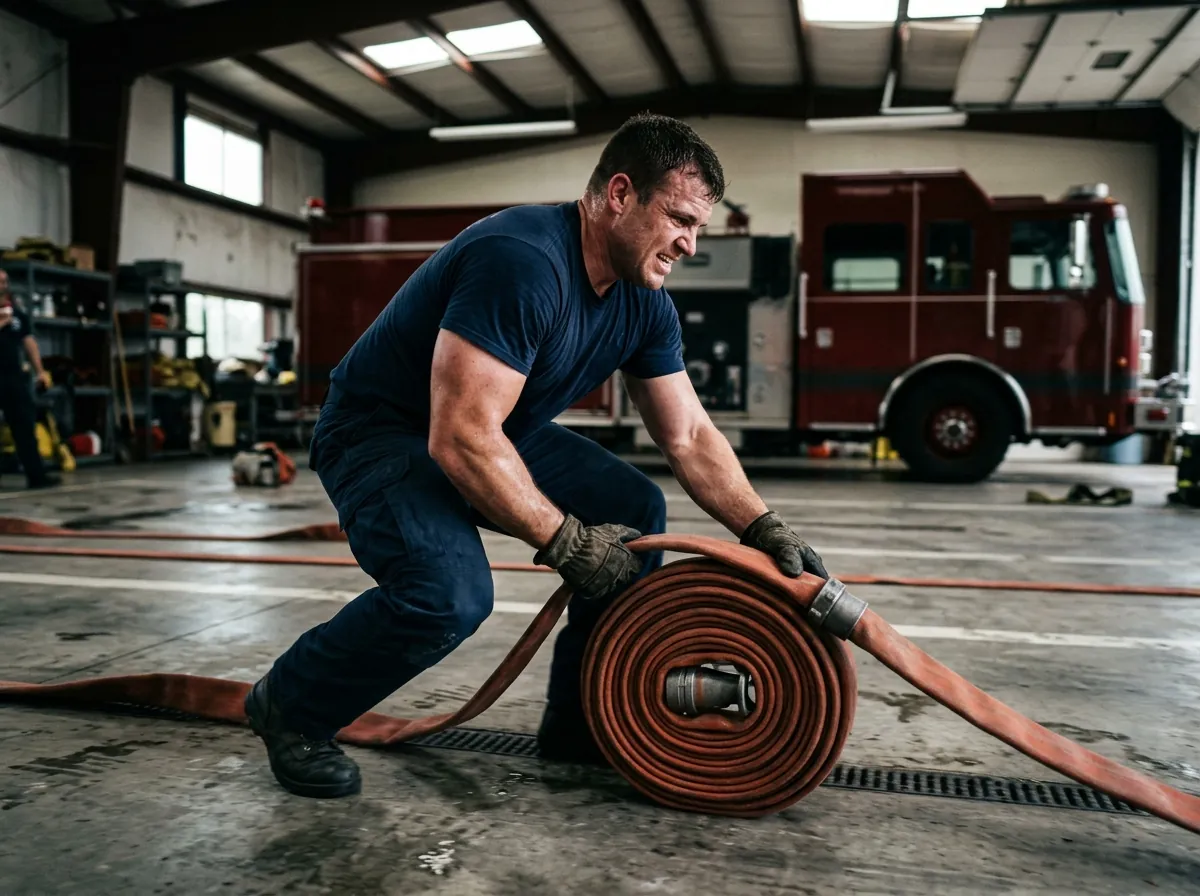
- Hose Drag — Drag a charged hose line 75 feet, turn 90 degrees, advance another 25 feet, then drop to one knee and pull the hose in.
- Equipment Carry — Remove two saws from a rack and carry them 75 feet round trip without setting them down.
- Ladder Raise and Extension — Raise a 24-foot ladder from horizontal to vertical, then extend the fly section hand-over-hand using a halyard rope.
- Forcible Entry — Strike a mechanized measuring device with a 10-lb sledgehammer until it registers enough cumulative force.
- Search — Crawl through a dark, enclosed maze with narrowed turns and obstacles.
- Rescue — Drag a 165-lb mannequin 35 feet, pivot around a barrel, and drag it 35 feet back (Source: allfirefighter.com CPAT prep guide, 2026).
- Ceiling Breach and Pull — Use a pike pole to push open and pull down a weighted overhead device for a set number of reps.
CPAT Event Specs Table
Every event after the first is completed wearing a 50-lb vest that simulates SCBA and turnout gear. For the Stair Climb only, candidates add a 25-lb shoulder pack, bringing that single event’s load to 75 lb total (Source: IAFF/IAFC CPAT program specs, cross-referenced via allfirefighter.com, 2026).
| Event | Distance/Reps | Equipment Weight | Time Budget | Common Fail Point |
|---|---|---|---|---|
| Stair Climb | 3 min continuous + 20-sec warm-up | 75 lb (50-lb vest + 25-lb pack) | ~3 min 20 sec | Grabbing the rail — instant disqualification |
| Hose Drag | 75 ft + 90-degree turn + 25 ft + kneeling pull | 50-lb vest, hose resistance | Roughly 30-45 sec | Losing grip on the kneeling pull; no hip drive left |
| Equipment Carry | 75 ft round trip | 50-lb vest + ~32 lb per saw | Roughly 30-40 sec | Forearm failure before the return trip |
| Ladder Raise and Extension | One raise, one extension | 50-lb vest, 24-ft ladder | Roughly 30 sec | Slamming the ladder down — instant disqualification |
| Forcible Entry | Strike until force threshold hit | 50-lb vest, 10-lb maul | Roughly 30-60 sec | Arm-only swings that burn out before threshold |
| Search | Full maze traverse | 50-lb vest only | Roughly 30-60 sec | Panic in confined turns, not lack of fitness |
| Rescue | 70 ft total drag | 50-lb vest + 165-lb mannequin | Roughly 30 sec | Losing lower-body drive, dragging with arms alone |
| Ceiling Breach and Pull | 5 sets of push/pull reps | 50-lb vest, pike pole resistance | Roughly 30-45 sec | Shoulder fatigue on an already-exhausted body |
How Much Weight Do You Carry During the CPAT?
You wear a 50-lb weighted vest for the entire test, which stands in for the weight of an SCBA pack and turnout gear a real firefighter carries on a call. For the Stair Climb event only, you add a 25-lb pack split across both shoulders (two 12.5-lb weights), bringing that single event to 75 lb total. The extra pack comes off once you step off the StepMill, and the 50-lb vest stays on for the remaining seven events (Source: IAFF CPAT program, iaff.org/cpat, 2026).
That distinction matters for training. A lot of candidates only ever train with a 50-lb vest and get blindsided by the extra 25 lb on the very first event, when their legs are freshest but the load is heaviest.
What’s the CPAT Time Limit?
The CPAT time limit is 10 minutes and 20 seconds to complete all eight events, run as one continuous, sequential course — not eight separate timed attempts. Once the clock starts, it doesn’t stop between stations. Candidates walk (not run) 85 feet between each event, which functions as the only built-in recovery you get (Source: IAFF/IAFC CPAT Orientation Guide, cross-referenced via publicsafetytesting.com, 2026).
That 85-foot walk is a deliberate design choice, not an accident. It’s long enough to get your heart rate to drop slightly and reset your grip, but short enough that you can’t fully recover. Training your ability to partially recover while walking under load is one of the most overlooked pieces of CPAT prep — most gym-based programs never simulate it at all.
Is the CPAT Pass/Fail or Scored?
The CPAT is strictly pass/fail — there’s no point total, no partial credit, and no “good enough” score. You either finish all eight events within 10:20 while following every event’s specific rules, or you fail the entire test (Source: IAFF CPAT program, iaff.org/cpat, 2026).
This is the part candidates underestimate most. Fail one event (grab a stair rail, slam a ladder, drop the equipment carry) and the whole test is over, regardless of your time on the other seven. There’s no averaging your way to a pass. That single-point-of-failure structure is exactly why the 8-week plan below spends real time on technique, not just conditioning.
CPAT Pass Rate: What the Data Actually Shows
No single governing body publishes a uniform national CPAT pass rate — the IAFF and IAFC don’t release aggregated pass/fail data across the 900+ jurisdictions that use the test, so any “national average” you see online is really an estimate stitched together from individual department reports. The most detailed public figure available comes from a single department: Gainesville Fire Rescue Department in Florida reported an 85.94% overall pass rate in a 2003 internal study submitted to the U.S. Fire Administration’s Executive Fire Officer Program. That’s one department’s hiring cycle, not a national benchmark (Source: Berryman, K.M., “Examining the Use of the Candidate Physical Abilities Testing Within Gainesville Fire Rescue Department,” USFA Executive Fire Officer Program, 2003).
That same Gainesville study also found a striking gender gap: 91.53% of male candidates passed versus 20% of female candidates in that cycle. Treat that figure as a single-department, single-year data point, not a national statistic. The same study found that candidates who self-rated their fitness level as “very active” passed at 100%, and that departments offering an 8-week (or longer) CPAT prep academy saw meaningfully better outcomes than departments that didn’t (Source: Berryman, K.M., USFA EFOP, 2003).
Other sources online commonly cite an “86% national pass rate.” That number traces back to this same Gainesville figure being repeated without its original context, not to a fresh national dataset. Treat any specific CPAT pass-rate percentage you read with that caveat. What’s consistent across departments, even without unified data, is which events cause the most trouble.
| Event | Estimated Fail Rate/Difficulty Note | Why It Fails | Source |
|---|---|---|---|
| Stair Climb | Named the most-failed event in allfirefighter.com’s department prep-guide data | Sustained cardio under peak load (75 lb) at the start of the test, when candidates often go out too fast | Firehouse and fire-training forums; cross-referenced across multiple department prep guides, 2026 |
| Rescue | High difficulty, especially for smaller-framed candidates | Requires hip-driven pulling strength most gym routines never train directly | allfirefighter.com CPAT prep guide, 2026 |
| Ceiling Breach and Pull | High fail rate on fatigued shoulders | Comes last in the sequence, after seven events have already drained upper-body endurance | allfirefighter.com CPAT prep guide, 2026 |
| Equipment Carry | Moderate difficulty | Grip and forearm failure before the 75-ft round trip finishes | allfirefighter.com CPAT prep guide, 2026 |
| Search | Low physical fail rate, higher psychological fail rate | Confined-space anxiety disqualifies otherwise-fit candidates | allfirefighter.com CPAT prep guide, 2026 |
The 8-Week CPAT Training Plan
Eight weeks is enough time to build that same three-part progression, as long as you sequence it instead of doing everything at once. The progression below moves from general conditioning to full-load simulation to a tapered peak, mirroring how the Gainesville study found longer prep academies outperformed shorter ones (Source: Berryman, K.M., USFA EFOP, 2003). If you’re also working from a broader bodyweight base, see also our 8-Week Military Calisthenics Plan, which covers similar loaded-conditioning fundamentals and pairs well as a lead-in.
Weeks 1-2 — Base Conditioning and Movement Patterns
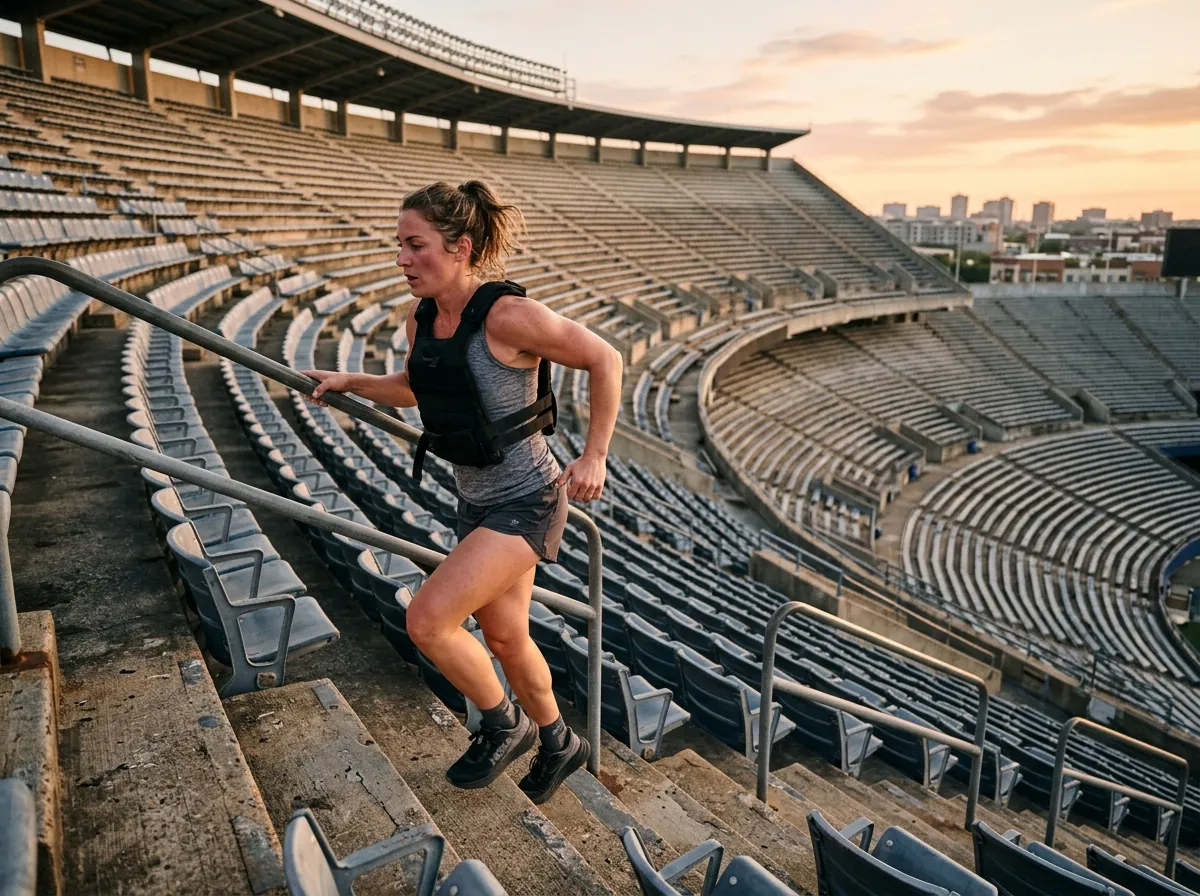
Build your aerobic engine and groove the movement patterns you’ll load later: stair climbing, dragging, carrying, crawling. Three to four sessions per week: 20-30 minutes of incline treadmill or StepMill work at a conversational pace, plus bodyweight circuits covering squats, lunges, push-ups, rows, and farmer’s carries. No added weight yet — this phase is about movement quality and building the cardio base everything else sits on.
Weeks 3-4 — Load Introduction
Add external load gradually. Start wearing a 20-30 lb vest during stair sessions and carries, working toward the actual 50-lb CPAT vest weight by the end of week 4. Introduce sled drags or heavy carries (farmer’s carry, sandbag carry) twice a week to start building the pulling and gripping strength the Hose Drag and Rescue events demand. Keep stair sessions under 5 minutes at this stage — you’re building tolerance to load, not simulating the test yet.
Weeks 5-6 — Event-Specific Simulation
Start replicating individual CPAT events with real or improvised equipment: sled pulls that mimic the Hose Drag’s kneeling finish, double-sandbag carries for the Equipment Carry, tire-flip or sledgehammer-strike drills for Forcible Entry. This is also the phase to prioritize grip and forearm endurance work specifically — dead hangs, farmer’s carries for time, and thick-grip carries — because five of the eight CPAT events (Hose Drag, Equipment Carry, Ladder Raise, Rescue, Ceiling Breach) fail on grip before they fail on anything else. Two to three dedicated grip sessions per week, 10-15 minutes each, pays off disproportionately here.
Week 7 — Full Course Rehearsal
Run all eight events back-to-back, in order, under something close to the real 10:20 clock, ideally at a facility with actual CPAT equipment or close substitutes. This week reveals where your weak transitions are — most candidates discover their conditioning is fine but their pacing between events is off. Do one full rehearsal early in the week and one toward the end, with lighter technique work on the days between.
Week 8 — Taper and Test-Ready
Cut training volume by 40-50% while keeping intensity and specificity high. Two short, sharp sessions: one light full-course walkthrough at reduced pace, one pure technique day on your weakest event. Then rest the final 2-3 days before test day. The goal is walking in fresh, not fried. Overtraining in the final week is one of the most common self-inflicted CPAT failures.
How to Train for the CPAT Stair Climb (Highest Fail-Rate Event)
Train the exact protocol you’ll face: a 20-second warm-up at 50 steps per minute on a StepMill (not a stair stepper or real stairs, the pacing is different), followed immediately by 3 minutes at 60 steps per minute wearing 75 lb total (Source: Firefighter101, cpat-stair-climb-speed, 2026). Grasping the rail during the timed portion, even briefly, ends the test, so your training has to build the balance and pacing to never need it.
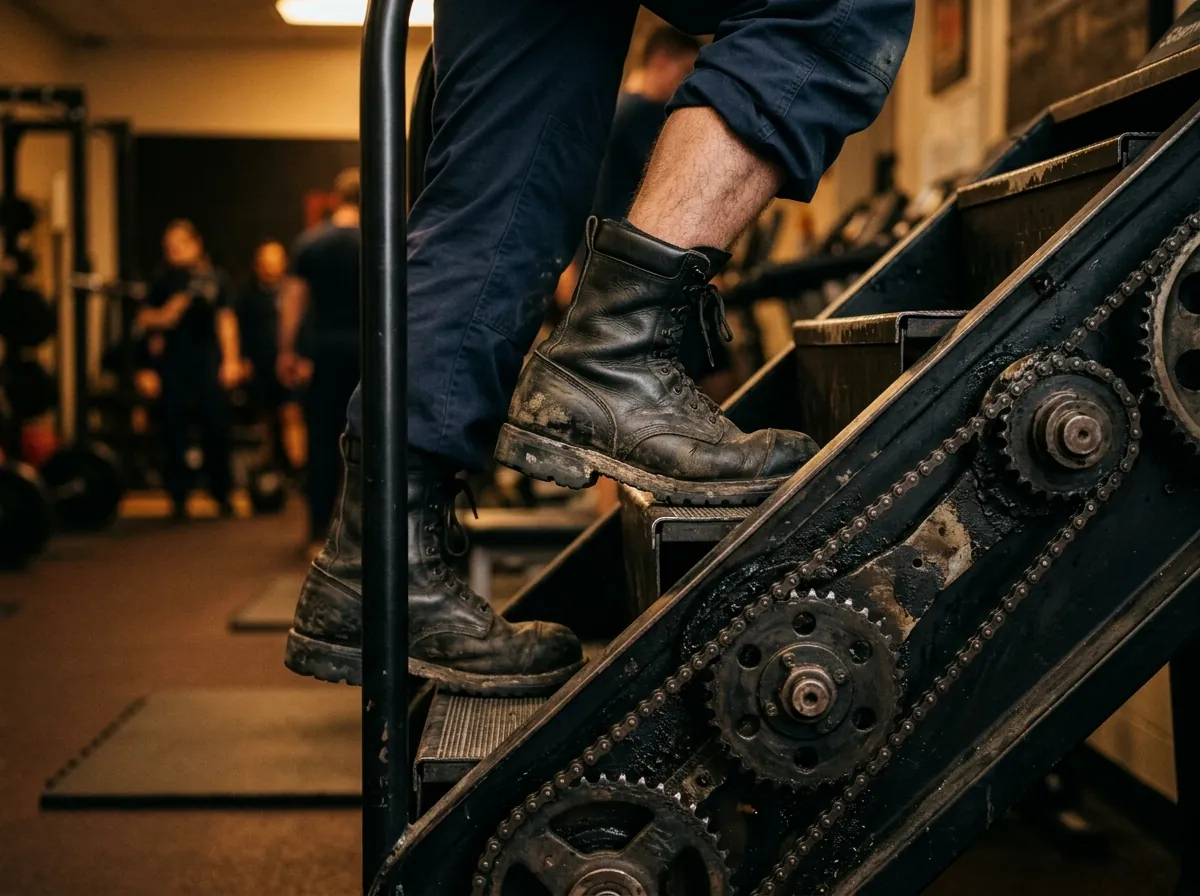
Most generic prep advice stops at “do stairs with a weighted vest.” That’s not specific enough. Here’s a more targeted protocol:
- Weeks 3-4: StepMill intervals at 50-55 steps/min for 3-5 minutes, vest weight building from 20 lb to 50 lb, no rail contact allowed even in practice.
- Weeks 5-6: Full-spec sessions — 20-second warm-up at 50 steps/min, then exactly 3 minutes at 60 steps/min, full 75-lb load, twice a week. Log whether you touch the rail; if you do, that’s your next session’s focus, not a footnote.
- Week 7: Insert the Stair Climb as the first event in your full-course rehearsal, since that’s where it sits on test day and where your legs are least fatigued but the pace demand is highest.
Grip and balance carry over from this block whether you train them separately or not. The StepMill’s handrail is off-limits, so your core and ankle stability matter as much as your legs. Add single-leg balance work and unweighted StepMill sessions at faster cadences (65-70 steps/min) once a week to build a pacing buffer above the required 60.
If you’re also building general grip capacity for the Rescue and Hose Drag events, treat that work as complementary to Stair Climb prep, not separate from it. Fatigued forearms from over-gripping the rail, even in your head, show up as wasted energy on the climb itself.
Can You Retake the CPAT If You Fail?
Yes, in most cases — but the retake policy depends entirely on the testing agency and the individual fire department, not a single national rule. Some testing networks let you retake the CPAT as often as you like, while individual hiring departments may only accept results from a single attempt or set their own waiting period before they’ll honor a retest (Source: National Testing Network CPAT FAQ, 2026). Some agencies apply an informal standard of roughly eight weeks between attempts, on the reasoning that it’s enough time to meaningfully improve conditioning, but that’s a guideline some jurisdictions follow, not a universal IAFF rule (Source: Emergency Services Education Center, CPAT program page, 2026).
The practical takeaway: check the specific policy of the department and testing network you’re applying through before you assume you get another shot. Don’t build your prep plan around an assumed universal retake window — verify it directly.
FAQ
What is the CPAT time limit?
10 minutes and 20 seconds to complete all eight events in sequence, with an 85-foot walk (not run) allowed between each event as your only recovery (Source: IAFF/IAFC CPAT program, 2026).
What are the 8 CPAT events in order?
Stair Climb, Hose Drag, Equipment Carry, Ladder Raise and Extension, Forcible Entry, Search, Rescue, and Ceiling Breach and Pull.
How much weight do you carry during the CPAT?
A 50-lb vest for the entire test, plus an additional 25-lb pack (75 lb total) during the Stair Climb only.
How long should you train for the CPAT?
Eight weeks is a solid minimum if you’re already moderately active; departments that ran 8-week-plus prep academies reported better outcomes than shorter programs in the Gainesville Fire Rescue study (Source: Berryman, K.M., USFA EFOP, 2003). Less conditioned candidates may need 10-12 weeks.
What is the CPAT pass rate?
There’s no unified national figure. The most detailed public data point — 85.94% — comes from one department’s 2003 hiring cycle (Gainesville Fire Rescue), not an aggregated national dataset (Source: Berryman, K.M., USFA EFOP, 2003).
Which CPAT event has the highest fail rate?
According to allfirefighter.com’s prep data and multiple department pre-academy guides, the Stair Climb is the toughest event for most candidates, largely because it front-loads sustained cardio demand at the very start of the test.
Can you retake the CPAT if you fail?
Usually yes, but policy varies by testing network and hiring department — some allow unlimited retakes, others set waiting periods or accept only one attempt per hiring cycle. Verify directly with your specific department.
Is the CPAT pass/fail or scored?
Strictly pass/fail. Failing any single event under its specific rules fails the entire test, regardless of your time on the others.
Sources and Verification
- IAFF — Candidate Physical Ability Test (CPAT)
- IAFF — CPAT 2nd Edition Manual (PDF)
- allfirefighter.com — CPAT Test Prep Guide, 2026
- nmcpat.com — CPAT Details
- Firefighter101 — CPAT Stair Climb Speed
- Berryman, K.M., USFA Executive Fire Officer Program, 2003
- National Testing Network — CPAT FAQ
- Emergency Services Education Center — CPAT
- Public Safety Testing — Firefighter CPAT