TL;DR — Which protein shakes actually help you gain weight?
Protein shakes for weight gain work by adding a daily calorie surplus of ~300–500 kcal (about 0.5–1 lb/week) in easy-to-drink liquid form. Aim for 500–800+ kcal and 20–40g protein per shake, built from whole milk, banana, oats, nut butter, and whey or plant protein. Below: 12 recipes, macros, and store-bought picks.
Table of contents
A shake won’t add a pound on its own. It adds calories you’d otherwise struggle to chew, and calories are the entire game when you’re trying to gain. If you can’t finish a big meal, drinking 700 dense calories is the shortcut. This page gives you 12 protein shakes for weight gain with real macros, a full comparison table, the surplus math, an honest look at store-bought mass gainers, and how to avoid gaining pure fat.
How protein shakes help you gain weight
Protein shakes help you gain weight only when they push your total intake above what you burn. A surplus of roughly 300–500 extra calories a day translates to about 0.5–1 pound gained per week, since one pound of body weight stores close to 3,500 calories (Source: Mayo Clinic, 2024). The shake is a delivery system for those extra calories, not magic — one or two a day alongside your meals, never instead of them.
Liquid calories help because they don’t trigger the same fullness as solid food, so you can take in more without feeling stuffed. That’s the whole appeal for anyone who fills up fast. The protein matters too: it’s what steers the extra weight toward muscle instead of fat, especially when you’re lifting.
Muscle vs fat: gaining the right weight
To gain lean mass rather than just padding, hit your protein and train against resistance. The International Society of Sports Nutrition puts the optimal intake for building muscle at roughly 1.4–2.0 g of protein per kg of body weight per day, spread across the day in doses of about 20–40g every 3–4 hours (Source: Jäger et al., JISSN, 2017). A 75 kg (165 lb) lifter is looking at roughly 105–150g daily. A single shake with a scoop of whey covers 25–50g of that.
Calories drive the scale up; protein and training decide what kind of weight it is. Skip the lifting and a chunk of your surplus lands as fat. For a full plan on turning surplus calories into muscle, see our guide to maximize muscle building.
How many calories should a weight-gain shake have?
A weight-gain shake should carry 500–800+ calories to meaningfully move the scale. Anything under about 400 kcal is a protein snack, not a gainer — fine for topping off protein, too small to build a surplus on its own. The exact number depends on how big your daily calorie gap is and how many shakes you’re drinking.
Most of my clients land in the 600–750 range for a once-a-day shake, or two 500-kcal shakes if one large drink kills their appetite for real food. Push toward 1,000 only if your gap is genuinely huge or you’re a hardgainer who barely registers liquid calories.
Quick calorie-surplus calculator
Here’s the arithmetic, no app required:
- Estimate your TDEE (total daily calories burned). A rough starting point: body weight in lbs × 15 for moderately active people. A 160 lb lifter ≈ 2,400 kcal/day.
- Add your surplus. For steady lean gains, add 300–500 kcal. That’s your daily target: 2,700–2,900 kcal.
- Fill the gap with a shake. If you’re already eating ~2,400 from meals, a single 750-kcal shake gets you to ~3,150 — comfortably into surplus, with room to spare on a low-appetite day.
- Weigh weekly, not daily. Aim for 0.5–1 lb up per week (Source: Mayo Clinic, 2024). Gaining faster than ~1 lb/week usually means more fat than muscle; adjust the surplus down if the mirror says so.
Track it for two weeks. If the scale hasn’t budged, add 200 kcal and reassess — bodies burn more than formulas predict. Timing your calories around training helps too; see what to eat before the gym.
12 high-calorie protein shakes for weight gain
Every recipe below follows the same build: a calorie-dense liquid base (whole milk usually), a protein source, a slow carb like oats or fruit, a fat like nut butter or avocado, and something for flavor. Macros are for the full recipe as written and are approximate — brand and portion swing them. Start with the hero.
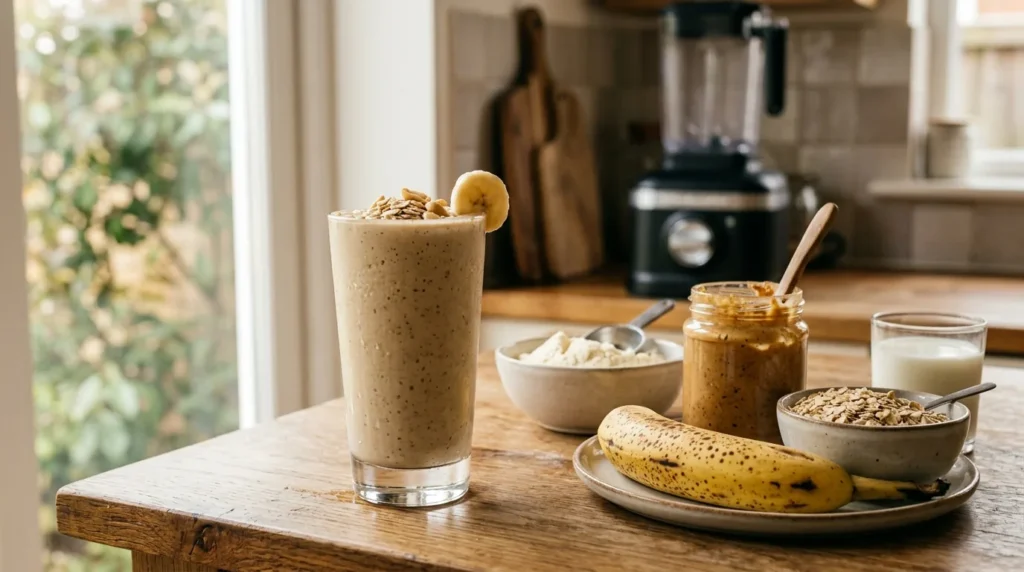
1. Classic Mass Builder (the hero) — start here
This is the one I hand every new client. It’s cheap, it blends smooth, and it tastes like a banana milkshake — nobody quits it after week one. Two-scoop appetites can double the milk.
Ingredients: 1 cup whole milk · 1 medium banana · 2 tbsp peanut butter · ½ cup rolled oats · 1 scoop whey.
Method: Blend milk and oats first for 20 seconds to soften the oats, then add everything else and blend until smooth.
- Macros: 750 kcal · 46g protein · 77g carbs · 28g fat
- Key ingredients: whole milk, banana, peanut butter, oats, whey
2. 1,000-Calorie Monster
For hardgainers and post-lift refueling on training days. It’s thick — treat it as a meal, not a snack, and sip it over 20 minutes.
Ingredients: 1.5 cups whole milk · ½ cup rolled oats · 2 tbsp peanut butter · 1 banana · 1 scoop whey · 1 tbsp honey · ½ cup full-fat Greek yogurt.
Method: Blend milk, oats and yogurt, then add the rest.
- Macros: 1,000 kcal · 59g protein · 104g carbs · 38g fat
- Key ingredients: whole milk, oats, peanut butter, banana, whey, honey, Greek yogurt
3. Chocolate Peanut Butter Bulk
Dessert energy, honest macros. The cocoa deepens the chocolate whey without adding sugar.
Ingredients: 1.5 cups whole milk · 1 scoop chocolate whey · 2 tbsp peanut butter · 1 banana · 1 tbsp cocoa powder.
Method: Blend all until smooth; add ice for a thicker shake.
- Macros: 700 kcal · 46g protein · 60g carbs · 31g fat
- Key ingredients: whole milk, chocolate whey, peanut butter, banana, cocoa
4. Oatmeal Cookie Gainer
Tastes like a blended oatmeal cookie. Almond butter and cinnamon do the heavy lifting on flavor.
Ingredients: ½ cup rolled oats · 1 cup whole milk · 1 scoop vanilla whey · 1 tbsp honey · 2 tbsp almond butter · dash cinnamon.
Method: Soak oats in the milk 5 minutes, then blend everything.
- Macros: 680 kcal · 44g protein · 65g carbs · 30g fat
- Key ingredients: oats, whole milk, vanilla whey, almond butter, honey
5. Avocado Green Gainer
The one that gets vegetables into people who won’t eat a salad. You taste banana and vanilla, not spinach — I promise.
Ingredients: ½ avocado · 1 cup spinach · 1.5 cups whole milk · 1 scoop vanilla whey · 1 banana · 1 tbsp honey.
Method: Blend spinach with the milk first until no flecks remain, then add the rest.
- Macros: 640 kcal · 40g protein · 72g carbs · 25g fat
- Key ingredients: avocado, spinach, whole milk, vanilla whey, banana
6. Berry Yogurt Weight-Gain Shake
Lighter and tarter than the milkshake-style recipes, with the highest protein-per-calorie ratio here — good for a hot day when heavy shakes turn your stomach.
Ingredients: 1 cup mixed berries · 1 cup full-fat Greek yogurt · 1 cup whole milk · 1 scoop whey · ¼ cup rolled oats.
Method: Blend all until smooth.
- Macros: 630 kcal · 53g protein · 54g carbs · 23g fat
- Key ingredients: mixed berries, full-fat Greek yogurt, whole milk, whey, oats
7. Dairy-Free Vegan Mass Shake
No dairy, no whey, still 700 calories. Chia adds fiber and thickness. If dairy-free is your whole priority rather than weight gain, I go deeper on allergen-friendly formulas in our dairy-free protein shakes roundup — this is just the one vegan option in the weight-gain set.
Ingredients: 1.5 cups soy or oat milk · 1 scoop plant protein · 2 tbsp peanut butter · 1 banana · ¼ cup rolled oats · 1 tbsp chia seeds.
Method: Blend, then let sit 3 minutes so the chia thickens it.
- Macros: 700 kcal · 44g protein · 70g carbs · 30g fat
- Key ingredients: soy/oat milk, plant protein, peanut butter, banana, oats, chia
8. Coffee Mocha Gainer
My morning pick when I’ve skipped breakfast. The caffeine hit makes it feel like a treat, not a chore.
Ingredients: ½ cup cold brew coffee · 1 cup whole milk · 1 scoop chocolate whey · 1 banana · ¼ cup rolled oats · ½ cup vanilla ice cream.
Method: Blend all with a handful of ice.
- Macros: 600 kcal · 38g protein · 73g carbs · 19g fat
- Key ingredients: cold brew, whole milk, chocolate whey, banana, ice cream
9. Tropical Mango-Coconut
Vacation in a glass. Canned light coconut milk brings the fat and the flavor; the Greek yogurt keeps protein up.
Ingredients: 1 cup mango · ½ cup canned light coconut milk · 1 cup whole milk · 1 scoop vanilla whey · ½ cup full-fat Greek yogurt · 1 tbsp honey.
Method: Blend all until smooth.
- Macros: 650 kcal · 43g protein · 64g carbs · 26g fat
- Key ingredients: mango, coconut milk, whole milk, vanilla whey, Greek yogurt
10. Cookies and Cream Dessert Shake
The indulgent one. I’d reserve this for training days or when appetite is on the floor — it’s the closest thing on this list to a milkshake, sugar and all.
Ingredients: 1.5 cups whole milk · 1 scoop vanilla whey · 1 cup vanilla ice cream · ¼ cup rolled oats · 2 crushed sandwich cookies.
Method: Blend milk, whey and oats, then pulse in the ice cream and cookies so you keep some crunch.
- Macros: 800 kcal · 44g protein · 83g carbs · 33g fat
- Key ingredients: whole milk, vanilla whey, vanilla ice cream, oats, cookies
11. Real-Food No-Powder Shake
No protein powder at all — for people who don’t want supplements. Use pasteurized liquid eggs only; never raw shell eggs, because of salmonella risk. Protein runs a little lower than the powder recipes, which is expected.
Ingredients: 1.5 cups whole milk · 6 tbsp pasteurized liquid egg · ¼ cup rolled oats · 1 tbsp peanut butter · 1 banana.
Method: Blend everything on high for a full 45 seconds.
- Macros: 650 kcal · 32g protein · 64g carbs · 31g fat
- Key ingredients: whole milk, pasteurized egg, oats, peanut butter, banana
12. Bedtime Casein Recovery Shake
Casein digests slowly, which makes it my go-to before sleep — a steady protein drip through the night. Greek yogurt reinforces the slow-release protein.
Ingredients: 1 cup whole milk · 1 scoop casein · ½ cup full-fat Greek yogurt · 1 tbsp peanut butter · ¼ cup rolled oats · dash cinnamon.
Method: Blend until thick and pudding-like; add milk to thin if needed.
- Macros: 560 kcal · 48g protein · 37g carbs · 25g fat
- Key ingredients: whole milk, casein, Greek yogurt, peanut butter, oats
Recipe comparison table
Every recipe at a glance, sorted highest to lowest calories. This is the view no single recipe post gives you — pick by the calorie tier and protein target that fit your surplus.
| Recipe | Cal | Protein | Carbs | Fat | Key ingredients | ~Cost/serving |
|---|---|---|---|---|---|---|
| 1,000-Calorie Monster | 1,000 | 59g | 104g | 38g | milk, oats, PB, banana, whey, honey, yogurt | $2.40 |
| Cookies and Cream Dessert | 800 | 44g | 83g | 33g | milk, whey, ice cream, oats, cookies | $2.10 |
| Classic Mass Builder (hero) | 750 | 46g | 77g | 28g | milk, banana, PB, oats, whey | $1.80 |
| Dairy-Free Vegan Mass | 700 | 44g | 70g | 30g | soy/oat milk, plant protein, PB, banana, oats, chia | $2.60 |
| Chocolate Peanut Butter Bulk | 700 | 46g | 60g | 31g | milk, choc whey, PB, banana, cocoa | $1.70 |
| Oatmeal Cookie Gainer | 680 | 44g | 65g | 30g | oats, milk, vanilla whey, almond butter, honey | $2.20 |
| Tropical Mango-Coconut | 650 | 43g | 64g | 26g | mango, coconut milk, milk, whey, yogurt | $2.40 |
| Real-Food No-Powder | 650 | 32g | 64g | 31g | milk, pasteurized egg, oats, PB, banana | $1.60 |
| Avocado Green Gainer | 640 | 40g | 72g | 25g | avocado, spinach, milk, whey, banana | $2.30 |
| Berry Yogurt | 630 | 53g | 54g | 23g | berries, yogurt, milk, whey, oats | $2.50 |
| Coffee Mocha Gainer | 600 | 38g | 73g | 19g | cold brew, milk, choc whey, banana, ice cream | $2.00 |
| Bedtime Casein | 560 | 48g | 37g | 25g | milk, casein, yogurt, PB, oats | $2.20 |
What to add to a shake for more calories
The highest-leverage add-ins are fat and calorie-dense carbs, because they pack the most calories into the least volume — you want more energy, not more stomach-filling bulk. Two tablespoons of nut butter or a tablespoon of oil can add 100–190 calories you’ll barely notice.
Per-item calorie boosts, roughly:
- Peanut or almond butter — ~190 kcal / 2 tbsp
- Olive or MCT oil — ~120 kcal / 1 tbsp (flavorless, blends invisibly)
- Rolled oats — ~150 kcal / ½ cup
- Avocado — ~120 kcal / ½ fruit
- Whole milk instead of water — adds ~90 kcal / cup versus water, plus protein
- Full-fat Greek yogurt — ~110 kcal / ½ cup, plus ~9g protein
- Dry milk powder — ~80 kcal / ¼ cup, protein without extra liquid
- Honey or maple syrup — ~64 kcal / tbsp
- Vanilla ice cream — ~140 kcal / ½ cup (taste win, more sugar)
My default move for someone who can’t gain: swap water for whole milk and add a tablespoon of oil. That’s ~200 extra calories with zero added volume and no change in taste.
Homemade vs store-bought mass gainers
Homemade wins on cost, carb quality, and control; store-bought wins on convenience and raw calorie density. A blender shake runs under $2.50 a serving with whole-food carbs you actually digest well. Commercial mass gainers deliver 1,000+ calories in one scoop with no prep — but many lean heavily on added sugar and maltodextrin, a cheap refined carb that spikes blood sugar and can upset your gut in big doses (Source: Healthline, 2024).
| Homemade hero shake | Store-bought mass gainer | |
|---|---|---|
| Calories/serving | 750 | 1,000–1,280 |
| Protein | 46g | 50–52g |
| Carb source | oats, banana, milk (whole-food) | often maltodextrin + added sugar |
| Added sugar | low (fruit-based) | often 15–20g+ |
| Cost/serving | ~$1.80 | ~$2.25–$7.70 |
| Prep | blender, ~3 min | scoop + shake |
| Control over ingredients | full | none |
For most people, homemade is the better default. Store-bought earns its place when you genuinely can’t hit calories any other way — travel, a brutal appetite, or a schedule with no time to blend.
Best store-bought mass gainers for weight gain
Store-bought makes sense when convenience or sheer calorie volume beats everything else — a hardgainer who can’t out-eat their metabolism, or someone always on the road. My top pick for value and clean-ish carbs is Naked Mass; for the cheapest calories, Optimum Nutrition Serious Mass.
Disclosure: The links below are Amazon affiliate links. If you buy through them, Gymstips may earn a small commission at no extra cost to you. It doesn’t change what I recommend — I picked these on specs, not payouts.
| Product | Cal/serving | Protein | Carbs/sugar | Key feature | ~Cost/serving | Best for |
|---|---|---|---|---|---|---|
| ON Serious Mass | 1,250 | 50g | 250g+ / high | cheapest calories | ~$2.25 | budget hardgainers |
| Naked Mass | 1,250 | 50g | 252g / 5g sugar | cleanest carb source, NSF | ~$7.70 | minimal-additive gainers |
| Dymatize Super Mass Gainer | 1,280 | 52g | 245g / moderate | 1g creatine + 10.7g BCAAs | ~$3.30 | lifters wanting built-in creatine |
| Crazy Nutrition Mass Gainer | 487 | 40g | 55g / low | lean, controlled top-up | ~$2.60 | smaller, controlled surpluses |
| Homemade hero shake | 750 | 46g | 77g / low | whole-food carbs, full control | ~$1.80 | most people, most of the time |
Optimum Nutrition Serious Mass
The category default and the cheapest way to buy calories in bulk. Around 1,250 calories and 50g protein per 2-scoop serving, with 250g+ carbs (Source: Optimum Nutrition, 2026). The carbs are mostly maltodextrin, so it’s calorie-dense but not clean — and two scoops is a genuinely huge drink most people cut in half. Best for: budget hardgainers who need maximum calories per dollar. Check current price of ON Serious Mass on Amazon.
Naked Mass
The premium, short-ingredient pick. 1,250 calories, 50g protein, ~252g carbs, and only 5g sugar per serving, using tapioca maltodextrin and grass-fed whey plus casein — no artificial anything, NSF certified (Source: Naked Nutrition, 2026). You pay for it: it’s the priciest per serving here, but it’s the cleanest carb source of the four. Best for: anyone who wants mass calories without a long additive list. Check current price of Naked Mass on Amazon.
Dymatize Super Mass Gainer
The muscle-focused option. 1,280 calories, 52g protein, 245g carbs, plus 1g creatine and 10.7g BCAAs per serving from a whey-isolate-and-casein blend (Source: Dymatize, 2026). Highest protein of the group and it mixes smoothly. Best for: lifters who want the protein and creatine built in. Check current price of Dymatize Super Mass Gainer on Amazon.
Crazy Nutrition Mass Gainer
The lean gainer. Around 487 calories, 40g protein, and 55g carbs per serving — roughly a third the calories of the others (Source: Crazy Nutrition, 2026). The lower calorie count is the point: it’s a controlled top-up for people who want a modest surplus without a 1,200-calorie bomb, and it’s closest to a homemade shake in size. Best for: smaller, more controlled surpluses and easier digestion. Check current price of Crazy Nutrition Mass Gainer on Amazon.
Healthy vs unhealthy weight gain
Healthy weight gain comes from a nutrient-dense surplus paired with training, so most of the new weight is muscle and usable mass — not just fat. Mayo Clinic frames adding weight the right way as eating more nutrient-rich, higher-calorie foods across 5–6 smaller meals a day, not loading up on empty sugar (Source: Mayo Clinic, 2024). The same logic applies to shakes.
A shake built on whole milk, oats, banana, and nut butter delivers protein, fiber, and micronutrients along with the calories. A sugar-bomb gainer — or a homemade shake that’s basically ice cream and syrup — adds calories too, but skewed toward fat gain, blood-sugar swings, and the GI distress that comes with slamming a big maltodextrin load. Whole-food carbs like oats are simply tolerated better than refined maltodextrin at high volumes (Source: Healthline, 2024).
Gaining faster than about 1 lb a week almost always means extra fat, not extra muscle. And if you’re underweight or gaining feels impossible despite eating more, talk to a doctor or registered dietitian — unintentional low weight can have a medical cause worth ruling out.
Tips for hardgainers and skinny guys
If you can’t eat enough, drink it. That’s the whole hardgainer playbook: liquid calories slip past a small appetite in a way a second plate of food never will. Everything else is timing, frequency, and training.
- Frequency beats size. Two 500-calorie shakes across the day are easier to stomach than one 1,000-calorie monster that kills your dinner.
- Time it around training and sleep. A shake after lifting refuels and feeds recovery; a casein-based one before bed drips protein overnight. A pre-workout protein shake can also help you train harder in the first place.
- Never replace meals — add to them. Shakes are extra calories, not substitutes. If a shake kills your appetite for real food, shrink it or move it between meals.
- Lift, and progress the load. Without resistance training, a bigger share of your surplus lands as fat. Progressive overload is what turns those calories into muscle.
- Be consistent. A 300-calorie daily surplus held for a month beats a huge one you abandon in a week. Weigh weekly and adjust.
Frequently asked questions
How do you gain weight with protein shakes?
Drink one or two high-calorie shakes a day on top of your regular meals to create a calorie surplus of about 300–500 extra calories, which adds roughly 0.5–1 lb per week. Pair the surplus with resistance training so more of the new weight is muscle. Shakes add weight only when they push your total intake above what you burn.
What’s the best homemade weight-gain shake?
The Classic Mass Builder — 1 cup whole milk, 1 banana, 2 tbsp peanut butter, ½ cup oats, and 1 scoop whey. It delivers about 750 calories and 46g protein, blends smooth, tastes like a banana milkshake, and costs under $2 a serving. It’s the shake I start almost every client on.
How many calories should a weight-gain shake have?
Aim for 500–800+ calories to meaningfully build a surplus. Below about 400 calories a shake is a protein snack rather than a gainer. Scale the number to your daily calorie gap: if you need 500 extra calories a day, a single 750-calorie shake covers it with margin.
Are mass gainers good or bad for weight gain?
They work for convenience and sheer calorie density, but many rely on added sugar and maltodextrin, which can spike blood sugar and upset your stomach in large doses. They’re a reasonable tool when you can’t hit calories otherwise. For most people, a homemade shake with whole-food carbs is cheaper and better tolerated.
What’s the fastest shake to gain weight?
The highest-calorie option you’ll actually drink daily. The 1,000-Calorie Monster homemade recipe or a store-bought mass gainer at ~1,250 calories both build weight fast when used in a surplus. Faster isn’t always better, though — gaining more than about 1 lb a week tends to mean extra fat.
Do protein shakes make you gain weight?
Only in a calorie surplus. Protein by itself won’t add weight without extra total calories, and a shake that fits within your maintenance calories won’t move the scale. Weight gain comes from eating more than you burn; the shake is just an easy way to add those calories.
What can I add to a shake for more calories?
Nut butter (~190 kcal per 2 tbsp), oats (~150 per ½ cup), avocado (~120 per half), olive or MCT oil (~120 per tbsp), whole milk instead of water (~90 extra per cup), full-fat Greek yogurt, dry milk powder, and honey. Fats and oats add the most calories with the least added volume.
How can a skinny guy or hardgainer gain weight?
Eat your calories when you can’t chew them — lean on calorie-dense liquid shakes, eat frequently, and split intake into smaller doses so a big shake doesn’t kill your appetite. Train with progressive resistance so the surplus builds muscle, and stay consistent: a smaller surplus held for weeks beats a huge one you quit.
Sources
- Mayo Clinic — Underweight? See how to add pounds healthfully (nutrient-dense surplus, 5–6 meals/day, ~500 kcal surplus): mayoclinic.org
- Jäger R. et al. — International Society of Sports Nutrition Position Stand: Protein and Exercise, JISSN, 2017 (1.4–2.0 g/kg/day; 20–40g per dose every 3–4h): PMC5477153
- Healthline — mass gainer / added-sugar and maltodextrin caveat, whole-food carb tolerance (RD-reviewed): healthline.com
- Optimum Nutrition — Serious Mass product specs: product listing
- Naked Nutrition — Naked Mass product specs: product listing
- Dymatize — Super Mass Gainer product specs: product listing
- Crazy Nutrition — Mass Gainer product specs: product listing