
By James Nolan, NSCA-CPT
TL;DR — Are dairy-free protein shakes actually lactose-free?
Dairy-free protein shakes and powders are built from plant sources — pea, brown rice, hemp, or soy — or from non-milk animal proteins like egg white and beef isolate, so they carry no milk, lactose, casein, or whey at all. Every truly dairy-free option is also lactose-free by default. Whey isolate is the confusing one: it’s lactose-reduced, not dairy-free. For ready-to-drink, my top picks are Owyn, Koia, and Ripple; for powder, a pea-and-rice blend like Orgain wins on amino profile and price.
Table of contents
What dairy-free protein actually means
A dairy-free protein contains zero milk-derived ingredients — no whey, no casein, no milk-protein concentrate, no lactose, no butterfat. It’s sourced instead from plants (pea, brown rice, hemp, soy, pumpkin seed) or from animals that aren’t cows’ milk, namely egg white and beef isolate. Because lactose lives only in milk, anything genuinely dairy-free is automatically lactose-free too.
That last point trips people up constantly, so it’s worth stating plainly: “lactose-free” and “dairy-free” are not synonyms. One removes a sugar. The other removes an entire food group. You can have a lactose-free product that still contains milk protein — and for one group of readers, that difference is a medical problem, not a technicality.
If you’re new to building shakes around training, our guide on what to eat before the gym pairs well with everything below.
Dairy-free vs lactose-free vs vegan — the distinction competitors skip
These three labels overlap but mean different things. Dairy-free = no milk-derived ingredient of any kind. Lactose-free = the milk sugar (lactose) has been removed or broken down, but milk proteins (whey, casein) can still be present. Vegan = no animal products at all, which rules out egg white and beef isolate even though both are dairy-free.
Here’s why the gap matters, and it’s the one thing I won’t let you skim past. A milk allergy and lactose intolerance are two completely different conditions. Lactose intolerance is a digestive shortfall — your gut doesn’t make enough lactase to break down milk sugar, so you get bloating and cramps, unpleasant but never dangerous (Source: Walgreens/CVS Health, 2024). A milk allergy is an immune reaction to the proteins casein and whey, and it can escalate to anaphylaxis (Source: Mayo Clinic, 2024).
The practical takeaway: a “lactose-free” whey still contains whey protein. If you’re lactose intolerant, that’s usually fine. If you have a milk allergy, a lactose-free whey can still trigger an immune reaction, because the allergen was never the sugar — it was the protein (Source: Mayo Clinic, 2024). Milk-allergic readers need genuinely dairy-free products and should read every allergen line themselves.
Is whey protein dairy-free? (isolate vs concentrate lactose)
No. Whey is a milk protein, so no form of whey is dairy-free — not even whey isolate. What isolate is, is very low in lactose.
Whey isolate runs about 90% protein and only 0.5–1% lactose by weight, versus roughly 5–8% lactose in whey concentrate (Source: Healthline, 2024; Paleo Pro, 2024). In real scoops that’s about 0.15–0.3 g of lactose per serving of isolate against 1.5–2.4 g for concentrate — the extra filtration strips most of the sugar out. So a lactose-intolerant lifter often handles isolate fine and reacts to concentrate. But “low-lactose” is not “dairy-free.” Isolate is still made from milk and still carries whey protein, which makes it unsafe for anyone with a true milk allergy (Source: Healthline, 2024).
One regulatory wrinkle worth knowing: the FDA has never defined a “lactose-free” threshold for supplements, because lactose intolerance isn’t classified as a food allergy. There’s no legal cutoff a powder must hit to use that phrase (Source: Sheet Labels/FDA labeling guidance, 2024). Read the ingredient panel, not the front of the tub.
Dairy-free protein sources at a glance
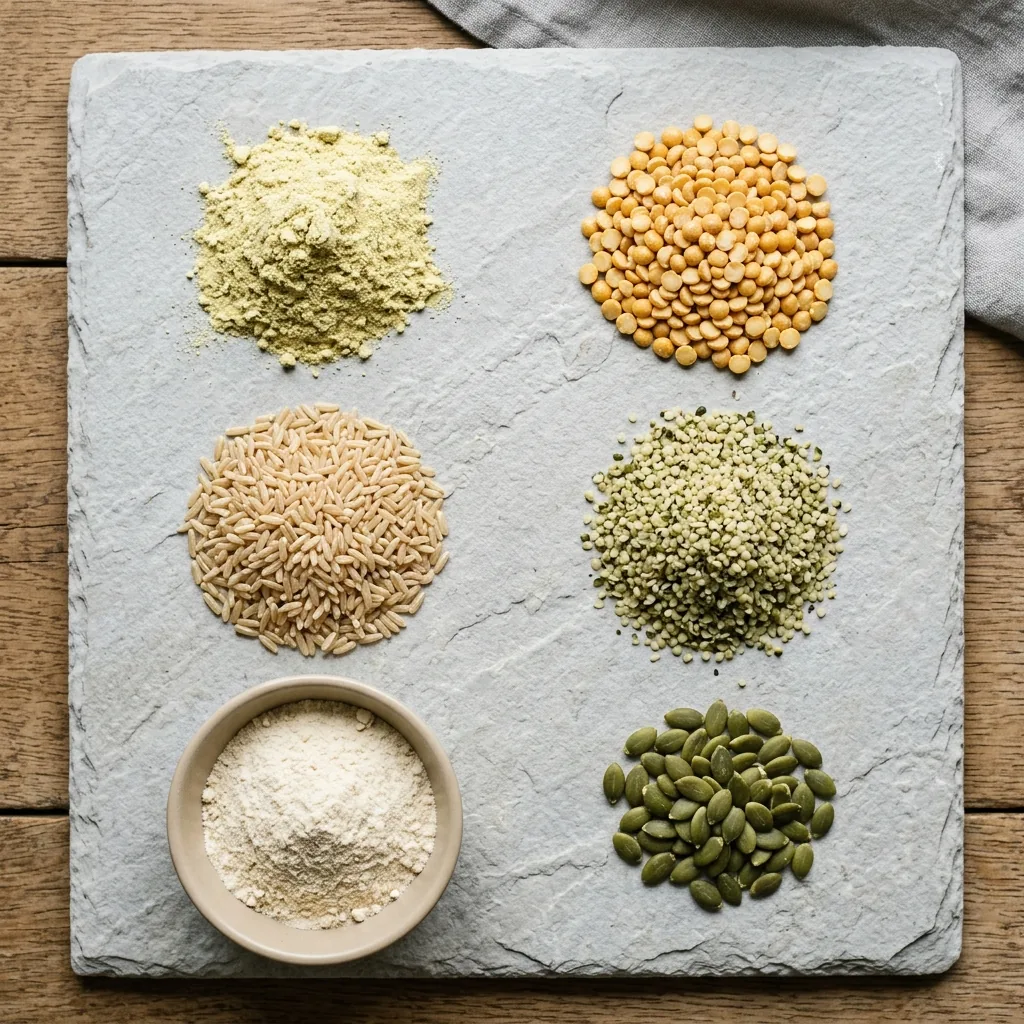
- Pea protein — high in lysine and BCAAs, slightly short on methionine. The workhorse of plant blends.
- Brown rice protein — the mirror image: strong in methionine, low in lysine. Pairs with pea to fill the gap.
- Hemp protein — lower protein density, high in fiber and omega-3s; more of a whole-food add than a lean isolate.
- Soy protein isolate — one of the few single plant sources that’s already a complete protein; a common allergen, though.
- Egg white protein — animal-source, dairy-free, complete amino profile, very digestible. Not vegan.
- Beef protein isolate — animal-source, dairy-free, high protein per scoop; naturally low in some aminos so quality varies by brand.
- Collagen — dairy-free but not a complete protein and low in leucine; good for skin/joints, poor as your main muscle protein.
Pea and rice together form a complete amino-acid profile — pea’s lysine covers rice’s shortfall, and rice’s methionine covers pea’s (Source: Naked Nutrition, 2024; NutriFitt, 2024). That’s why the best plant powders blend the two instead of leaning on one.
The 6 best dairy-free protein shakes (ready-to-drink)
The best dairy-free RTD shakes right now are Owyn, Koia, Ripple, Orgain Vegan, Evolve, and Aloha — all pea- or rice-based, all 18–20 g protein per bottle, all shelf-stable. Grab-and-go convenience is the whole point; you trade a little cost per gram for not owning a shaker. Below, what each one’s best at.
Disclosure: Gymstips earns a commission on qualifying Amazon purchases through the links below, at no extra cost to you. We only list products we’d actually drink. Allergen status reflects each product’s current label at time of writing — always re-check the panel, since formulas change.
- Owyn — 20 g (best allergen-friendly all-rounder)
- Ripple — 20 g (best pure pea, cleanest label)
- Koia — 18 g (best flavor / meal-replacement feel)
- Orgain Vegan — 20 g (best with added greens)
- Evolve — 20 g (best budget RTD)
- Aloha — 20 g (best low-sugar / keto-leaning)
Owyn is the one I hand to people who are juggling several allergies. Its pea-pumpkin seed-flax blend is free of the top allergens, and the label lists dairy-free, gluten-free, and soy-free (Source: Owyn Amazon listing, 2025). Twenty grams, decent 140-ish calories, and — this is the firsthand part — it’s one of the smoother plant RTDs I’ve had; less of the gritty aftertaste that sinks a lot of pea shakes. Buy Owyn on Amazon.
Ripple runs on pea protein alone and keeps the label short: dairy, soy, nut, gluten, and lactose all called out as absent (Source: Ripple Amazon listing, 2025). Twenty grams, calcium and iron added. If you want the fewest moving parts, this is it. Buy Ripple on Amazon.
Koia blends brown rice, pea, and chickpea and drinks more like a treat than a supplement — it’s the one non-vegans in my gym actually ask for by name. Eighteen grams, dairy-free, gluten-free, soy-free per label (Source: Koia Amazon listing, 2025). Buy Koia on Amazon.
Orgain Vegan stacks pea and brown rice with fruits and veggies for people who want a bit of a greens boost baked in. Twenty grams, no soy or dairy ingredients on the label (Source: Orgain Amazon listing, 2025). Buy Orgain Vegan shake on Amazon.
Evolve is the value play — same 20 g pea protein, 10 g fiber, usually the lowest cost per bottle of this group. Flavor is more workmanlike than exciting. Buy Evolve on Amazon.
Aloha leans low-sugar and paleo-friendly, pea and brown rice with MCT oil, no stevia or sugar alcohols. Good pick if you’re watching carbs. Twenty grams, gluten-free and soy-free per label (Source: Aloha Amazon listing, 2025). Buy Aloha on Amazon.
If you’re timing one of these around training, here’s how to think about a pre-workout protein shake.
Best dairy-free protein powders (gluten-free options too)
The best dairy-free powder for most people is a pea-and-rice blend — Orgain Organic is my default pick for the complete amino profile at a fair price. If you need certified gluten-free, single-source rice or a labeled-GF blend is the safer bet. Below, the pick for each job.
Best plant-based pick (pea + rice blend)
Orgain Organic Vegan does the fundamentals right: 21 g protein from pea and brown rice plus chia, no lactose ingredients, no soy, gluten-free on the label (Source: Orgain Amazon listing, 2025). The pea-rice combo gives you the complete amino profile discussed above, and it mixes cleaner than most organic powders. Who it’s for: anyone who wants one reliable everyday plant protein and doesn’t want to think hard about it. Roughly $1.30–$1.60 a serving. Buy Orgain Organic on Amazon.
Best gluten-free protein powder
Naked Rice is single-source organic brown rice protein with one ingredient and a gluten-free, soy-free, dairy-free label (Source: Naked Nutrition Amazon listing, 2025). Twenty-five grams a scoop. Single-source rice is slightly short on lysine on its own, so if muscle-building is the goal, blend it with a pea protein or eat varied protein across the day. Who it’s for: readers who want the shortest possible ingredient list and certified-clean sourcing. Around $1.40 a serving. Buy Naked Rice on Amazon.
Best for building muscle (complete amino profile)
Vega Sport Premium is built for training: 30 g protein per serving from a pea-forward blend with 5 g BCAAs, and it’s NSF Certified for Sport, which matters if you get drug-tested (Source: Vega Amazon listing, 2025). Higher protein per scoop helps you clear the leucine threshold that plant proteins need to match whey for muscle. Who it’s for: lifters who want a plant powder dosed for performance. About $2.00–$2.30 a serving. Buy Vega Sport on Amazon.
Is plant protein actually as good as whey here? Yes, with a caveat: well-formulated plant blends match whey for muscle protein synthesis when the dose is adequate — roughly 30 g with about 2.5–3 g of leucine — because plant sources carry a little less leucine gram-for-gram (Source: News-Medical, 2025). Blended and properly dosed, they build muscle just as well.
Best budget dairy-free powder
NOW Sports Pea Protein is the price-per-gram champion: 24 g of pea protein, unflavored, no frills, and it comes in big tubs that drop the per-serving cost hard (Source: NOW Foods Amazon listing, 2025). Unflavored means you’re blending it into a smoothie, not sipping it with water. Who it’s for: high-volume users who care about cost per gram over taste. Often under $1.00 a serving in the larger size. Buy NOW Sports Pea on Amazon.
Best non-plant option (egg white / beef isolate)
Not everyone who skips dairy wants plants. If you tolerate animal protein but not milk, two options deliver a complete profile without a single milk ingredient.
Naked Egg is egg-white protein and sunflower lecithin — that’s the whole label. Twenty-five grams, dairy-free, gluten-free, soy-free, paleo (Source: Naked Nutrition Amazon listing, 2025). Egg white is highly digestible and complete. Who it’s for: paleo eaters and milk-avoiders who aren’t vegan. Around $1.60 a serving. Buy Naked Egg on Amazon.
Equip Prime is grass-fed beef protein isolate, 21 g a scoop, labeled gluten-free and dairy-free (Source: Equip Foods Amazon listing, 2025). It mixes surprisingly thin for a beef protein and skips the chalk. Who it’s for: carnivore/paleo lifters who want animal protein without whey. Roughly $2.00 a serving. Buy Equip Prime on Amazon.
Dairy-free protein compared — all 12 picks side by side
Every product above in one place. Sort it by source if you have an allergy, by protein grams if you’re chasing muscle, or by cost if you’re on a budget. Prices are approximate per serving and move with pack size and promotions.
| Product | Type | Protein source | Dairy-free? | Gluten-free? | Soy-free? | Protein g | Calories | ~$/serving | Buy |
|---|---|---|---|---|---|---|---|---|---|
| Owyn | RTD | Pea + pumpkin + flax | Yes | Yes | Yes | 20 | ~140 | ~$3.00 | Amazon |
| Ripple | RTD | Pea | Yes | Yes | Yes | 20 | ~150 | ~$3.00 | Amazon |
| Koia | RTD | Brown rice + pea + chickpea | Yes | Yes | Yes | 18 | ~180 | ~$3.20 | Amazon |
| Orgain Vegan | RTD | Pea + brown rice + chia | Yes | Yes | Yes | 20 | ~160 | ~$2.80 | Amazon |
| Evolve | RTD | Pea | Yes | Yes | Yes | 20 | ~170 | ~$2.30 | Amazon |
| Aloha | RTD | Pea + brown rice + pumpkin | Yes | Yes | Yes | 20 | ~150 | ~$3.30 | Amazon |
| Orgain Organic | Powder | Pea + brown rice + chia | Yes | Yes | Yes | 21 | ~150 | ~$1.45 | Amazon |
| Vega Sport | Powder | Pea blend | Yes | Yes | Yes | 30 | ~170 | ~$2.15 | Amazon |
| NOW Sports Pea | Powder | Pea | Yes | Yes | Yes | 24 | ~120 | ~$0.95 | Amazon |
| Naked Rice | Powder | Brown rice | Yes | Yes | Yes | 25 | ~120 | ~$1.40 | Amazon |
| Naked Egg | Powder | Egg white | Yes | Yes | Yes | 25 | ~110 | ~$1.60 | Amazon |
| Equip Prime | Powder | Beef isolate | Yes | Yes | Yes | 21 | ~100 | ~$2.00 | Amazon |
How do you choose the right dairy-free protein?
Start with why you’re avoiding dairy. Lactose intolerance gives you the widest menu — even low-lactose whey isolate may sit fine. A milk allergy narrows it to genuinely dairy-free products only. Vegan rules out egg and beef. After that, it comes down to format, price, and taste. Here’s how the trade-offs actually shake out.
RTD shake vs powder — which should you buy?
Buy powder if you drink protein daily or care about cost; buy ready-to-drink if convenience wins. The math isn’t subtle. A plant powder runs roughly $1.00–$1.60 per 20–25 g serving, while an RTD bottle is $2.30–$3.30 for a similar dose — you’re paying two to three times as much for the bottle and the water inside it.
Powder also wins on protein density and control: you pick the dose, the liquid, and the calories. RTD wins on friction — nothing to mix, nothing to clean, easy to stash in a bag or a desk drawer. My honest split: powder at home, a couple of RTDs on hand for travel and long days. You don’t have to choose one forever.
Reading allergen labels and cross-contamination
For a milk allergy, the ingredient list isn’t the whole story — the advisory line is. “May contain milk” or “made in a facility that also processes milk” signals possible cross-contamination on shared equipment, and that trace exposure can be enough to trigger an allergic reaction (Source: FDA allergen guidance, 2025). For lactose intolerance, that trace is almost always harmless.
So the label reads differently depending on which condition you have. Intolerant readers can focus on the ingredients. Allergic readers need a clean ingredient list and an acceptable advisory statement — and because manufacturers change facilities and formulas, that has to be re-checked per purchase. I won’t tell you a specific tub here is “safe for a milk allergy,” because the only current source of truth is the panel in your hand.
Taste and mixability (plant proteins are chalkier)
Plant proteins are grittier than whey — that’s just chemistry, and anyone who tells you otherwise is selling something. Pea and rice have more particulate and a heavier mouthfeel, so they can drink chalky in plain water. Two fixes that actually work from years of making these: blend with cold liquid and something creamy (a frozen banana, oat milk, a spoon of nut butter), and let the shake sit a minute so the powder fully hydrates before you drink.
Among the powders here, Orgain and Vega mix the smoothest for me; single-source rice like Naked Rice is the grittiest and really wants a blender. Among the RTDs, Owyn and Koia are the least “planty.” Beef isolate like Equip is thinner than you’d expect and mixes clean. For more on building these into a real routine, browse our nutrition guides.
Dairy-free protein FAQ
Is whey protein dairy-free?
No. Whey is a protein found in milk, so no form of whey is dairy-free. Even whey isolate, which has almost no lactose, is still milk-derived and unsafe for anyone with a milk allergy.
What’s the difference between dairy-free and lactose-free?
Lactose-free means the milk sugar has been removed, but milk proteins like whey and casein can still be present. Dairy-free means no milk-derived ingredient at all. Every dairy-free product is lactose-free, but not every lactose-free product is dairy-free.
Does whey protein isolate have lactose?
Only a trace, roughly 0.5 to 1 percent by weight, versus about 5 to 8 percent in whey concentrate. That is often low enough for lactose-intolerant people to tolerate, but isolate is still made from milk, so it is not dairy-free or safe for a milk allergy.
What is the best dairy-free protein powder?
A pea-and-rice blend, because the two sources combine into a complete amino-acid profile. Orgain Organic is a strong everyday pick, and Vega Sport is better if you want a higher 30-gram dose for training.
Can lactose-intolerant people drink whey?
Often yes, in the form of whey isolate, which has very little lactose. Whey concentrate has far more and is more likely to cause symptoms. Anyone with a true milk allergy should avoid all whey, isolate included.
Is plant protein as good as whey for building muscle?
Yes, when it is a complete or blended source and the dose is adequate, around 30 grams with roughly 2.5 to 3 grams of leucine. Plant proteins carry slightly less leucine per gram, so a marginally larger serving closes the gap.
Which protein powder is dairy and gluten free?
Several. A certified single-source brown rice powder like Naked Rice, or a pea-rice blend like Orgain Organic that lists gluten-free on the label. Always confirm the gluten-free claim on the current panel if you have celiac disease.
Are dairy-free protein shakes good for weight loss?
They can help, mainly by boosting protein and satiety, which makes it easier to eat less overall. They are not magic, though; total daily calories still decide the outcome.
Sources
- Healthline — Whey Protein Isolate vs Concentrate: healthline.com
- Paleo Pro — Does Whey Protein Have Lactose: paleopro.com
- Mayo Clinic — Milk allergy, Symptoms and causes: mayoclinic.org
- Walgreens — Milk allergy vs lactose intolerance: blog.walgreens.com
- CVS Health — Milk allergy vs lactose intolerance: cvs.com
- Sheet Labels — Labeling Lactose-Free Products (FDA): sheetlabels.com
- FDA — Dietary Supplement Labeling Guide: fda.gov
- FDA food allergen guidance (2025) via Covington: cov.com
- Naked Nutrition — Pea + Rice Protein for Muscle: nakednutrition.com
- NutriFitt — Rice and Pea Protein Amino Match: nutrifitt.com
- News-Medical — Plant-based protein blends can match whey for recovery (2025): news-medical.net
- Product allergen and nutrition data: Owyn, Ripple, Koia, Orgain, Evolve, Aloha, Vega, NOW Foods, Naked Nutrition, and Equip Foods Amazon listings (2025).