

USAFA Fitness Test: The Candidate Fitness Assessment Explained
TL;DR — What Is the USAFA Fitness Test (CFA)?
The “USAFA fitness test” that shows up in admissions searches is the Candidate Fitness Assessment (CFA) — a six-event battery (basketball throw, pull-ups or flexed-arm hang, shuttle run, modified sit-ups, push-ups, one-mile run) that every applicant to the U.S. Air Force Academy must complete as part of their application file. It is not the same test active-duty Airmen take. Candidates arrange their own certified administrator, complete all six events in one sitting, and results factor into the Academy’s Whole Candidate Score.
Table of contents

What Is the USAFA Fitness Test (CFA)?
The USAFA fitness test is officially called the Candidate Fitness Assessment, and it’s the physical-readiness measure required of every applicant seeking admission to the Air Force Academy — not a test given to cadets or Airmen already serving. Academy admissions describes it as a test of “strength, agility, speed and endurance” used to predict whether a candidate can handle the physical program at USAFA (Source: academyadmissions.com, Physical Requirements, 2026).
The CFA isn’t unique to the Air Force Academy. West Point, the Naval Academy, the Coast Guard Academy, and the Merchant Marine Academy all use the same six-event battery to evaluate admissions candidates (Source: westpoint.edu Candidate Fitness Assessment page; usna.edu Candidate Fitness Assessment page; usmma.edu Candidate Fitness Assessment page, 2026). West Point administers the assessment and publishes the master instructions manual that the other academies reference, which is why you’ll see near-identical event descriptions and scoring language across academy admissions sites.
One wrinkle specific to USAFA: while West Point and the Naval Academy convert each event to a 0–100 scale score and average the six into a composite, Air Force Academy admissions describes the CFA as pass-fail — you clear the standard on each event or you don’t (Source: academyadmissions.com, Physical Requirements, 2026). USAFA doesn’t publish a fixed minimum score chart, so third-party prep sites that list precise “passing” numbers are estimates, not official figures. Treat any minimum-score table you find online — including ballpark figures later in this guide — as a planning benchmark, not a guarantee.
Results factor into the Academy’s Whole Candidate Score alongside academics, leadership, and other admissions criteria.
The 6 CFA Events
The CFA is six events, administered back-to-back in a fixed order with set rest periods between them, on one test day. You can’t split it across multiple sessions or retake individual events to build a better composite — the sequencing is intentional, because it’s designed to test performance under accumulated fatigue, not fresh-legs maximums (Source: apply.westpoint.edu, CFA Instructions, 2026).
- Basketball Throw. Kneeling behind a line, you throw a men’s basketball as far as possible using an overhand motion, one hand only for the release. You get three attempts in a two-minute window, and the best throw counts. It measures upper-body power and coordination — not basketball skill.
- Pull-Ups (or Flexed-Arm Hang for women). From a dead hang with a pronated grip, you pull your chin above the bar in cadence, with a two-minute time limit. Kipping, kicking, or bicycling the legs voids the rep. Female candidates may substitute the flexed-arm hang: an isometric hold with the chin above the bar, timed until the chin drops below bar level.
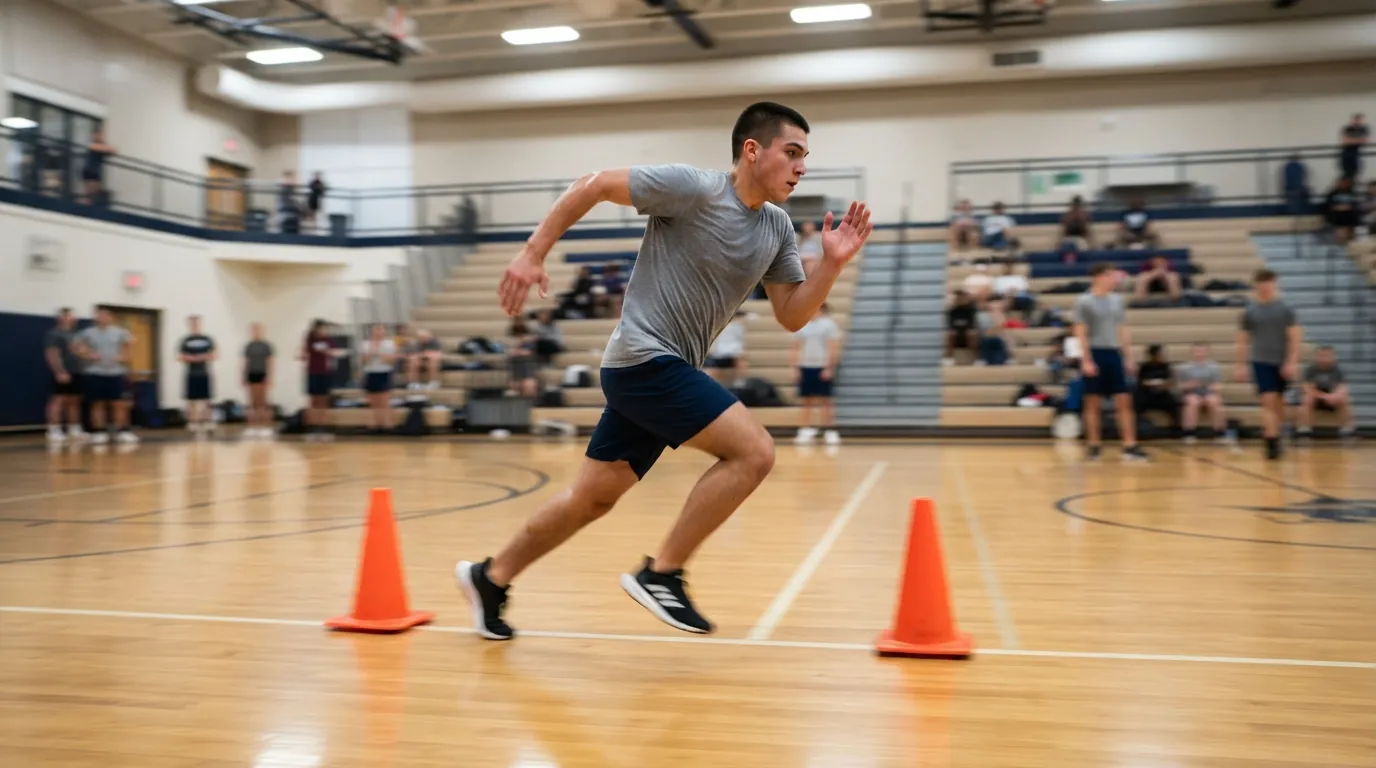
- Shuttle Run. Starting behind a line, you sprint out roughly 30 feet, touch the line with your hand and foot, sprint back through the start line, then repeat the out-and-back a second time. Two trials, best time counts. It’s a change-of-direction and acceleration test, not a straight-line sprint.
- Modified Sit-Ups. Lying on your back with knees bent around 90 degrees and arms crossed over your chest, you curl up until your elbows touch your thighs, then lower until your shoulder blades touch the ground. You get one two-minute trial — longer than the standard one-minute sit-up test most people expect, which is why pacing matters here.
- Push-Ups. From the standard front-leaning rest position, you lower until your upper arms are at least parallel to the ground, then press back to full extension. Like the sit-up event, this is a single two-minute trial, not the one-minute window used on most military PT tests.
- One-Mile Run. A timed mile with no stated time cap, run continuously (walking is allowed but strongly discouraged). It’s the last event, run after five events have already taxed your grip, shoulders, and core — which is why pacing and prior conditioning matter more here than raw mile-time talent.

CFA Scoring Standards
Every CFA event converts a raw score to a 0–100 scale, and 105 feet on the basketball throw or 18 pull-ups (men) already caps the scale at 100 — going further doesn’t add points. The table below uses the maximum-performance figures published on West Point’s official Candidate Fitness Assessment page, the same reference document used across USAFA and the other service academies.
| Event | Men (100-pt max) | Women (100-pt max) |
|---|---|---|
| Basketball Throw | 105 ft | 68 ft |
| Pull-Ups | 18 reps | 7 reps |
| Shuttle Run | 7.8 sec | 8.6 sec |
| Modified Sit-Ups | 95 reps | 95 reps |
| Push-Ups | 75 reps | 50 reps |
| One-Mile Run | 5:20 | 6:00 |
A few honest caveats worth stating plainly. First, USAFA does not publish an official minimum “passing” line the way it publishes these maximums — admissions officers weigh event performance individually rather than against one public cutoff (Source: academyadmissions.com, Physical Requirements, 2026). Second, prep sites circulate estimated minimum benchmarks — figures in the range of roughly 2 pull-ups, a sub-8-minute mile, and 30+ push-ups for male candidates show up repeatedly — but these are third-party estimates compiled from candidate reporting, not an Academy-issued chart (Source: combatfitness.co, USAFA CFA Minimum Scores guide, 2026, which itself notes the Academy no longer publishes an official minimum chart). Use them as a floor to clear comfortably, not a target to aim for.
Competitive applicants are scoring well above any minimum on most events.
How the CFA Is Administered
You don’t take the CFA at USAFA or in front of an admissions officer — you arrange it yourself, locally, with an approved administrator, then submit the results through your candidate portal. The Academy is strict about who qualifies to run the test and how it’s scored, because the CFA only means something if every candidate takes it under the same conditions.
Approved administrators include PE teachers, athletic coaches, AFJROTC or JROTC instructors, service academy liaison officers, active-duty commissioned officers or NCOs from any branch, or another service academy representative (Source: academyadmissions.com, Physical Requirements, 2026; apply.westpoint.edu CFA Instructions, 2026). The one hard rule that trips people up: your administrator cannot be a relative or your personal coach — someone with a direct stake in your success can’t also certify your score (Source: apply.westpoint.edu, CFA Instructions, 2026).
Timing-wise, the CFA becomes relevant once you’re an active applicant, not before. You enter your administrator’s contact information through the candidate portal, the administrator receives instructions and a link to submit results, and the completed test — all six events, in sequence, in one sitting — gets reported back through that same portal (Source: academyadmissions.com, Candidate Phase, 2026). This typically happens during the “Candidate Activities” stage of the application, alongside your medical exam and nomination paperwork, well before the Academy finalizes offers.
Two integrity details matter for anyone taking this seriously: the administrator has to be present and read the test instructions aloud verbatim before each event, and the score that gets reported has to come from one complete, in-sequence administration — you can’t mix your best basketball throw from a practice run with your best mile time from test day (Source: apply.westpoint.edu, CFA Instructions, 2026). Practice attempts before the record test are encouraged. Stitching together a composite score from multiple sessions is not allowed.
How to Train for the CFA
Train the CFA as six distinct skills, not one generic fitness plan — a strong runner with no pull-up base will bomb event two, and a gymnast with no aerobic engine will fade on the mile. Build a program that touches all six in the weeks before your test date, with extra volume on your weakest one or two events.
- Basketball Throw: This rewards explosive, full-body power more than arm strength alone. Medicine-ball overhead throws and rotational throws for reps build the same movement pattern. Practice the actual throwing motion, since technique (hip drive, release angle) adds distance fast for beginners.
- Pull-Ups / Flexed-Arm Hang: If you can’t do a dead-hang pull-up yet, build toward it with negative reps (jump to the top, lower slowly) and banded assisted pull-ups, then drop the band as you progress. For the flexed-arm hang, train the hold directly — timed hangs at chin-above-bar height, building duration week over week.
- Shuttle Run: Practice the actual turn, not just straight-line speed. Set up two lines 30 feet apart and drill the plant-and-pivot; most time gets lost in the direction change, not the sprint itself.
- Modified Sit-Ups: Because this is a two-minute trial, not one minute, you need core muscular endurance, not just raw sit-up strength. Practice full two-minute sets at a sustainable pace rather than going all-out for 30 seconds and fading.
- Push-Ups: Same logic — it’s a two-minute window. Build to sets where you can hold strict form (full arm extension, controlled descent) for the full duration rather than maxing out fast and breaking form.
- One-Mile Run: This comes after five fatiguing events, so train it tired sometimes — run a mile time trial at the end of a strength session, not just on fresh legs. That’s a more honest simulation of test-day conditions than a standalone time trial.
CFA vs. the Air Force PT Test (PFRA)
These are two different tests for two completely different populations, and mixing them up is the single most common mistake in CFA searches. The CFA is a one-time admissions requirement for civilians applying to become cadets. The Air Force PT Test — officially the Physical Fitness Readiness Assessment, or PFRA — is the recurring fitness test that active-duty Airmen and Guardians take throughout their careers, roughly twice a year (Source: Air & Space Forces Magazine, “Air Force: Twice-a-Year PT Tests, 2-Mile Runs Coming in 2026,” 2026). If you’ve already got a commission or you’re serving, the test that applies to you is the PFRA, covered in detail in our Air Force PT Test guide — not this one.
| CFA (USAFA Fitness Test) | PFRA (Air Force PT Test) | |
|---|---|---|
| Who takes it | Applicants seeking admission to USAFA (or any service academy) | Active-duty Airmen and Guardians |
| When | Once, during the application process | Roughly twice yearly, ongoing through a career |
| Events | Basketball throw, pull-ups/flexed-arm hang, shuttle run, modified sit-ups, push-ups, 1-mile run | 2-mile run (or HAMR shuttle), push-ups or hand-release push-ups, sit-ups/cross-leg crunches/plank |
| Body composition | Not part of the CFA | Measured separately, up to 5 days before the test |
| Scoring | Composite 0–100 per event (pass-fail emphasis at USAFA) | Weighted score: run 50%, push-ups 15%, core 15%, plus body comp |
| Who administers it | Candidate-arranged: PE teacher, coach, JROTC instructor, officer/NCO | Official unit-level PT testers |
The events don’t overlap much either. The CFA includes a basketball throw and a shuttle run that the PFRA doesn’t touch, and the PFRA’s 2-mile run replaced what used to be a 1.5-mile run as of the 2026 test cycle, with official scored testing resuming September 1, 2026 after a pause and diagnostic period earlier in the year (Source: Air & Space Forces Magazine, 2026).
If you’re prepping for basic training or your first career PFRA after commissioning through USAFA, note that Basic Cadet Training uses its own separate physical fitness test — with events like pull-ups, push-ups, sit-ups, a standing long jump, and timed runs — administered during BCT itself, distinct from both the CFA you already passed to get admitted and the PFRA you’ll take once you’re commissioned (Source: usafa.edu, Basic Cadet Training page; usafawebguy.com, Physical Fitness Test entries, 2026).
FAQ
Is the USAFA fitness test the same as the Air Force PT test?
No. The USAFA fitness test is the Candidate Fitness Assessment (CFA), a one-time admissions requirement with six events including a basketball throw and shuttle run. The Air Force PT test (PFRA) is a separate, recurring test for active-duty Airmen with different events, taken roughly twice a year.
How many events are on the CFA?
Six: basketball throw, pull-ups (or flexed-arm hang for women), shuttle run, modified sit-ups, push-ups, and a one-mile run, all completed in one sitting in a fixed order.
Who can administer the CFA?
A PE teacher, athletic coach, JROTC/AFJROTC instructor, service academy liaison officer, active-duty officer or NCO, or another service academy representative. Your administrator cannot be a relative or your personal coach.
Is the CFA pass or fail, or is it scored?
USAFA describes the CFA as pass-fail, evaluating performance event by event rather than publishing one composite cutoff. Some other academies, like West Point, average the six events into a 0–100 composite score that feeds their admissions formula.
What’s a good score on the USAFA fitness test?
There’s no official published minimum, but competitive applicants clear each event comfortably above any estimated floor — third-party guides suggest male candidates aim well past roughly 2 pull-ups, an 8-minute mile, and 30 push-ups, and female candidates aim similarly above minimum estimates. Treat these as floors to clear early in training, not targets.
When do I take the CFA in the application process?
After you’ve started your application and entered an administrator’s contact information through your candidate portal, typically during the same window as your medical exam and nomination paperwork — well before final admissions decisions.
Can I retake the CFA if I don’t like my score?
Yes, candidates can generally arrange a new test administration if time allows before application deadlines, but each submitted score must come from one complete, in-sequence test — you can’t combine results from different sessions.
Does the CFA include a body composition or weight check?
No. Body composition isn’t part of the CFA. That’s a component of the active-duty PFRA, not the admissions test.
Sources and Verification
- Candidate Fitness Assessment Instructions (official PDF manual) — apply.westpoint.edu, 2026
- Candidate Fitness Assessment — U.S. Military Academy West Point
- Physical Requirements — U.S. Air Force Academy Admissions
- Candidate Phase — U.S. Air Force Academy Admissions
- The Candidate Fitness Assessment — U.S. Naval Academy
- Candidate Fitness Assessment — U.S. Merchant Marine Academy
- USAFA CFA Minimum Scores guide — combatfitness.co, 2026 (third-party estimate, cited as such)
- Basic Cadet Training — United States Air Force Academy
- Physical Fitness Test (PFT) for Basic Cadets — USAFA Webguy
- Air Force: Twice-a-Year PT Tests, 2-Mile Runs Coming in 2026 — Air & Space Forces Magazine
- Internal: Air Force PT Test guide — gymnasetips.com