

Treadmill Workout Guide: 6 Routines to Pair With Strength Training

Gymnase Tips is reader-supported. Some links may be Amazon affiliate links; if you buy through them we may earn a small commission at no extra cost to you.
TL;DR — Which Treadmill Workout Should You Do?
The best treadmill workout depends on your training goal and what you did in the gym that day. The six routines below — steady-state walks, incline power walks, 12-3-30, interval runs, HIIT sprints, and endurance progression runs — burn between 150 and 400+ kcal per 30 minutes and each slot into a calisthenics or strength schedule differently. Pick your goal from the decision matrix below, then follow the minute-by-minute plan.
Table of contents
6 Best Treadmill Workouts (With Minute-by-Minute Plans)
The six treadmill workouts below range from 20-minute HIIT sprints to 45-minute endurance progression runs. Each includes a structured speed, incline, and duration table so you can load the settings and go — no guesswork. Every routine also notes where it fits in a strength-training week, because cardio that wrecks your leg day is cardio programmed wrong.
- Steady-State Walk — 20-30 min at 3.0-3.5 mph, 1% incline; ideal for beginners and recovery days
- Incline Power Walk — 25-30 min ramping from 0% to 8-10% incline; burns roughly 40% more than flat walking (Source: ACSM metabolic equations)
- 12-3-30 Workout — 30 min at 12% incline, 3.0 mph; low-impact endurance builder popularized by Lauren Giraldo
- 30-Minute Interval Run — alternating 5.0 mph jog and 7.0-8.0 mph run; approximately 310 kcal per session for a 75 kg person
- HIIT Sprint Intervals — 20 min of 30-second sprints and 60-second recovery; highest calorie burn per minute of any routine here
- Endurance Progression Run — 35-45 min with speed increasing every 5-10 min; builds aerobic base and VO2 max

Steady-State Walk (Beginner)
A steady-state treadmill walk at 3.0-3.5 mph and 1-2% incline for 20-30 minutes is the simplest entry point for anyone new to treadmill training. It sits in heart rate zone 2, keeps RPE low (3-4 out of 10), and pairs well with upper-body calisthenics days since it places zero stress on the legs beyond gentle movement.
| Time (min) | Speed (mph) | Incline (%) | RPE |
|---|---|---|---|
| 0-3 | 2.5 | 0 | 2 |
| 3-8 | 3.0 | 1 | 3 |
| 8-22 | 3.5 | 1 | 3-4 |
| 22-27 | 3.0 | 1 | 3 |
| 27-30 | 2.5 | 0 | 2 |
Increase total time by 5 minutes each week until you reach 30 minutes comfortably. Once 30 minutes at 3.5 mph feels easy, graduate to the incline power walk. You can also pair this walk with bodyweight circuits for fat loss on alternating days.
Incline Power Walk
An incline power walk burns roughly 40% more calories than flat walking at the same pace, according to the ACSM metabolic walking equation (Source: ACSM, 2022). At 3.5 mph, going from 0% to 5% grade raises the MET value from approximately 3.6 to 5.1 — a meaningful jump for a workout that still feels like walking.
This routine ramps incline progressively, then steps it back down. Keep your hands off the rails (more on that later).
| Time (min) | Speed (mph) | Incline (%) | RPE |
|---|---|---|---|
| 0-3 | 3.0 | 0 | 2 |
| 3-7 | 3.5 | 2 | 3 |
| 7-11 | 3.5 | 4 | 4 |
| 11-15 | 3.5 | 6 | 5 |
| 15-19 | 3.5 | 8 | 6 |
| 19-22 | 3.5 | 10 | 7 |
| 22-25 | 3.5 | 6 | 5 |
| 25-28 | 3.0 | 3 | 3 |
| 28-30 | 2.5 | 0 | 2 |
Pair this with leg-day recovery. The incline loads the glutes and calves without the eccentric damage of running, making it a solid LISS (Low-Intensity Steady State) option the day after squats or lunges.
The 12-3-30 Workout
The 12-3-30 workout is 30 minutes at 12% incline and 3.0 mph — a viral routine created by influencer Lauren Giraldo, who first shared it on YouTube in 2019 before it exploded on TikTok in 2020 (Source: Good Morning America, 2022). It doubles as low-impact cardio for strength-training recovery days.
Despite the social media hype, the underlying physiology is sound. The 12% grade pushes your MET value to roughly 7.0 at walking speed, which translates to about 265 kcal per 30 minutes for a 75 kg person (Source: ACSM metabolic walking equation). That puts it between an incline walk and an interval run for calorie expenditure.
| Time (min) | Speed (mph) | Incline (%) | RPE |
|---|---|---|---|
| 0-3 | 2.5 | 0 | 2 |
| 3-5 | 3.0 | 6 | 4 |
| 5-30 | 3.0 | 12 | 6-7 |
| 30-33 | 2.5 | 3 | 3 |
| 33-35 | 2.0 | 0 | 2 |
One caveat: if you have to grip the handrails to maintain the incline, the grade is too steep for your current fitness. Drop to 8-10% and build up over weeks.
30-Minute Interval Run
A 30-minute interval run alternating between a 5.0 mph jog and 7.0-8.0 mph run burns approximately 310 kcal for a 75 kg person, based on MET values of 8.3 (jogging) and 11.8 (running at 7 mph) from the ACSM Compendium of Physical Activities. The alternating intensity keeps your heart rate elevated without the joint impact of sustained fast running.
| Time (min) | Speed (mph) | Incline (%) | RPE |
|---|---|---|---|
| 0-3 | 3.5 | 1 | 3 |
| 3-5 | 5.0 | 1 | 5 |
| 5-7 | 7.0 | 1 | 7 |
| 7-9 | 5.0 | 1 | 5 |
| 9-11 | 7.5 | 1 | 8 |
| 11-13 | 5.0 | 1 | 5 |
| 13-15 | 7.5 | 1 | 8 |
| 15-17 | 5.0 | 1 | 5 |
| 17-19 | 8.0 | 1 | 8-9 |
| 19-21 | 5.0 | 1 | 5 |
| 21-23 | 7.5 | 1 | 8 |
| 23-25 | 5.0 | 1 | 5 |
| 25-27 | 7.0 | 1 | 7 |
| 27-30 | 3.5 | 1 | 3 |
Pair this with non-leg calisthenics days. A push or pull session in the morning and an interval run in the evening works well. Do not stack this the day before heavy squats or pistols. If you train at home, combine this with fat loss exercises you can do at home on your strength days.
HIIT Sprint Intervals
HIIT sprint intervals on a treadmill deliver the highest calorie burn per minute of any routine in this guide. During sprint phases, a 75 kg person burns roughly 14-16 kcal per minute, compared to 5-6 kcal per minute during steady walking (Source: ACSM MET Compendium). The total session is only 20 minutes, but it earns additional calories through EPOC — the elevated oxygen consumption that continues for hours after high-intensity work (Source: Borsheim and Bahr, Sports Medicine, 2003).
| Time (min) | Speed (mph) | Incline (%) | RPE |
|---|---|---|---|
| 0-3 | 3.5 | 1 | 3 |
| 3-3:30 | 8.0-9.0 | 1 | 9 |
| 3:30-4:30 | 3.5 | 1 | 4 |
| 4:30-5:00 | 8.0-9.0 | 1 | 9 |
| 5:00-6:00 | 3.5 | 1 | 4 |
| Repeat 30s sprint / 60s recovery for 8-10 rounds | |||
| 17-20 | 3.0 | 0 | 3 |
Advanced athletes can narrow the ratio to 30 seconds on / 45 seconds off, or bump sprint speed to 9.0-10.0 mph. These treadmill intervals are a core part of HYROX preparation as well. But the rule stays the same: never schedule HIIT the day before or after a heavy leg session. Upper-body or skill days only.
Endurance Progression Run
An endurance progression run starts at conversational pace and increases speed every 5-10 minutes, building aerobic capacity over 35-45 minutes. This is for intermediate and advanced runners who want to develop their aerobic base without the monotony of running the same pace for 40 minutes straight. It also teaches pacing discipline — a skill that transfers to any endurance event.
| Time (min) | Speed (mph) | Incline (%) | RPE |
|---|---|---|---|
| 0-5 | 4.0 | 1 | 3 |
| 5-10 | 5.0 | 1 | 4 |
| 10-20 | 5.5 | 1 | 5 |
| 20-30 | 6.0 | 1 | 6 |
| 30-37 | 6.5 | 1 | 7 |
| 37-40 | 7.0 | 1 | 8 |
| 40-45 | 4.0 | 0 | 3 |
Pair with light calisthenics (mobility work, handstand practice) or designate this as a standalone cardio day. Increase the top-end speed by 0.5 mph every two weeks as your aerobic fitness improves. If outdoor running appeals to you, compare treadmill running to rucking for cardio to decide which format suits your goals.
How Many Calories Does Each Treadmill Workout Burn?
Calorie burn varies dramatically by workout type: a 75 kg person burns roughly 150 kcal walking versus 350 kcal doing HIIT sprints in the same 30 minutes. The table below uses ACSM MET-based equations to estimate calorie expenditure across all six routines at three body weights (Source: ACSM metabolic equations; ACE Physical Activity Calorie Counter).
| Workout | 60 kg (132 lb) | 75 kg (165 lb) | 90 kg (198 lb) |
|---|---|---|---|
| Steady-State Walk | 120 kcal | 150 kcal | 180 kcal |
| Incline Power Walk | 165 kcal | 205 kcal | 245 kcal |
| 12-3-30 | 210 kcal | 265 kcal | 315 kcal |
| 30-Min Interval Run | 250 kcal | 310 kcal | 375 kcal |
| HIIT Sprints* | 280 kcal | 350 kcal | 420 kcal |
| Endurance Progression | 240 kcal | 300 kcal | 360 kcal |
All values normalized to 30 minutes. The HIIT session is 20 minutes; the 30-minute figure accounts for the higher per-minute burn rate. EPOC may add an estimated 6-15% more calories in the hours after HIIT (Source: Borsheim and Bahr, Sports Medicine, 2003).
Rail-holding penalty: Gripping the treadmill handrails can cut calorie expenditure by up to 20-25%, according to research from the University of Massachusetts-Lowell published in the International Journal of Exercise Science (Source: Cybex / UMass-Lowell, 2014). If you need the rails for balance, the speed or incline is set too high. Dial it back.
Which Treadmill Workout Matches Your Goal?
Your goal determines your workout. Fat loss pairs best with incline walks or intervals done 3-4 times per week, while active recovery calls for steady-state walking 1-2 times per week. The matrix below maps five common goals to the right routine, session length, and weekly frequency.
| Goal | Recommended Workout | Duration | Frequency |
|---|---|---|---|
| Fat loss | Interval Run or Incline Power Walk | 30 min | 3-4x/week |
| Endurance / aerobic base | Endurance Progression Run | 35-45 min | 2-3x/week |
| Active recovery | Steady-State Walk or 12-3-30 | 20-35 min | 1-2x/week |
| HIIT conditioning | HIIT Sprint Intervals | 20 min | 2x/week max |
| Beginner fitness | Steady-State Walk | 20-30 min | 3x/week |
Two notes. First, fat loss ultimately requires a calorie deficit — no treadmill routine overrides a surplus. For a complete program, pair your treadmill sessions with fat loss exercises you can do at home. Second, HIIT twice a week is a ceiling, not a floor. More than that stacks poorly with strength training and increases injury risk.
Sample Weekly Schedule — Treadmill + Calisthenics
A proven weekly split pairs HIIT treadmill sessions with upper-body calisthenics days and steady-state walks with leg-day recovery. The cardinal rule: never stack HIIT and leg work back-to-back. High-intensity sprints and heavy squats compete for the same recovery resources, and one or both will suffer.
Here is a 7-day schedule built around 3 calisthenics sessions and 2-3 treadmill sessions, with one full rest day.
| Day | AM Session | PM Session (or single session) |
|---|---|---|
| Monday | Push calisthenics (push-ups, dips, pike press) | HIIT Sprint Intervals (20 min) |
| Tuesday | — | Steady-State Walk or 12-3-30 (recovery) |
| Wednesday | Pull calisthenics (pull-ups, rows, curls) | — |
| Thursday | — | 30-Min Interval Run |
| Friday | Legs + core (squats, lunges, L-sits) | — |
| Saturday | — | Incline Power Walk (30 min, active recovery) |
| Sunday | Rest | Rest |
Why this pairing works:
- Monday: HIIT follows an upper-body session, so your legs are fresh for sprints.
- Tuesday: LISS walking flushes the legs without adding training stress. Good recovery.
- Wednesday: Pull day is arm-dominant. No treadmill needed — save the energy.
- Thursday: Interval run hits the cardiovascular system hard. Legs had a day off from both calisthenics and HIIT.
- Friday: Leg day stands alone. No cardio stacked on top.
- Saturday: Incline walking after leg day promotes blood flow to sore muscles without eccentric loading. This is active recovery done right.
- Sunday: Full rest. You earned it.
Adjust the template to fit your schedule, but protect the principle: high-intensity cardio and leg-heavy strength training need at least 24 hours of separation.
If you already follow a hybrid dumbbell-calisthenics routine or a 5-day hybrid plan that includes cardio days, slot the treadmill sessions into your existing off days rather than adding volume.
Treadmill Tips Most Guides Skip
Three evidence-backed treadmill adjustments can meaningfully change your results. Most treadmill workout articles skip these entirely.
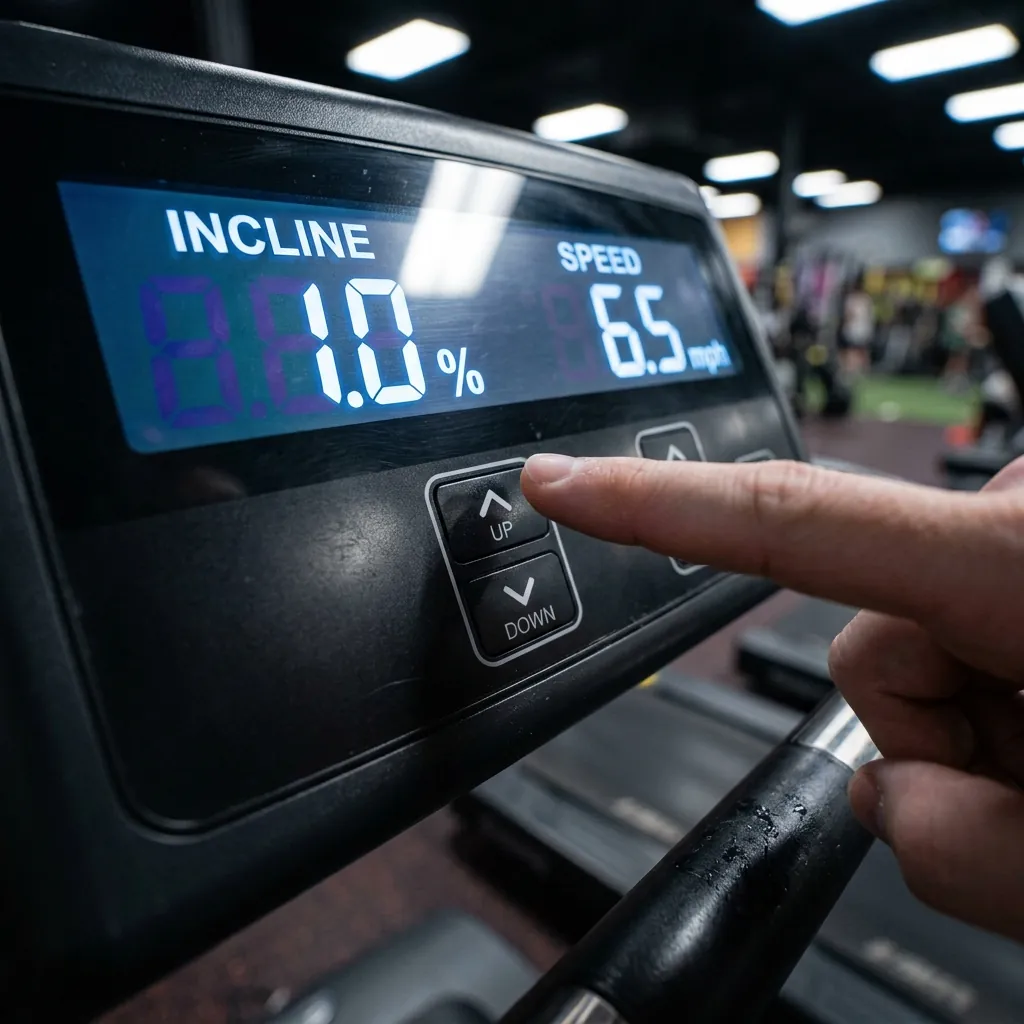
1. Set 1% incline to simulate outdoor running. A landmark 1996 study by Jones and Doust in the Journal of Sports Sciences found that a 1% treadmill grade most accurately reflects the energetic cost of outdoor running at speeds above 2.9 m/s (roughly 6.5 mph). The reason: no air resistance indoors. If you run on a treadmill at 0% incline, you are doing slightly less work than you would outside at the same pace (Source: Jones and Doust, Journal of Sports Sciences, 1996).
2. Release the rails. Holding treadmill handrails reduces calorie expenditure by up to 25% and changes your gait mechanics. A 2014 study by researchers at UMass-Lowell found that leaning back on handrails during incline walking cut calorie burn by 31.8% (Source: International Journal of Exercise Science, 2014). If you cannot maintain the incline without gripping the rails, lower the grade until you can walk hands-free.
3. A 5% incline increases calorie burn by roughly 40%. Using the ACSM metabolic walking equation, raising the incline from 0% to 5% at 3.5 mph increases the MET value from approximately 3.6 to 5.1 — a 42% jump in energy expenditure (Source: ACSM metabolic equations). That is the single biggest return on effort for walkers.
4. Progressive overload: change one variable at a time. Increase speed or incline between sessions, not both simultaneously. Jumping from 3.0 mph at 0% to 3.5 mph at 5% in one session is a recipe for shin splints and frustration. Add 0.5 mph per week, or 1-2% incline per week. Not both.
FAQ
Is 30 minutes on a treadmill enough to lose weight?
Yes — 30 minutes of moderate-intensity treadmill exercise burns roughly 250-310 kcal for a 75 kg person, depending on speed and incline (Source: ACSM MET Compendium). That said, weight loss requires a sustained calorie deficit. The treadmill session helps create that deficit, but it will not override excess calories from diet. Consistency matters more than duration: three 30-minute sessions per week will outperform one 90-minute session.
What is the 12-3-30 treadmill workout?
The 12-3-30 is a treadmill routine set to 12% incline, 3.0 mph, for 30 minutes. Created by influencer Lauren Giraldo and shared on YouTube in 2019, it went viral on TikTok in 2020 (Source: Good Morning America, 2022). It functions as a LISS workout — low-impact, steady-state cardio that builds endurance without high joint stress. A 75 kg person burns approximately 265 kcal per session.
How long should a beginner walk on a treadmill?
Start with 20 minutes at 3.0-3.5 mph and 1% incline. Add 5 minutes per week until you reach 30 minutes comfortably. Most beginners hit that mark within 2-3 weeks. Once 30 minutes feels routine, increase either speed (to 3.5-4.0 mph) or incline (to 3-5%) — not both at once.
Is it better to run or walk on a treadmill for fat loss?
Both work. Running burns more calories per minute — roughly 10-12 kcal/min versus 4-5 kcal/min for walking at a 75 kg body weight. But walking is more sustainable, easier on joints, and accessible to beginners. Interval training splits the difference: alternating jog and run phases burn close to running-level calories while being more manageable over 30 minutes. HIIT intervals also produce greater EPOC (excess post-exercise oxygen consumption), which adds a small but real calorie burn after the session ends.
How to combine treadmill with strength training?
Schedule HIIT or interval treadmill sessions on upper-body training days, and use LISS walking on leg-day recovery days. Never stack high-intensity cardio and heavy leg training on the same day or back-to-back days. See the weekly schedule section above for a concrete 7-day template pairing 3 calisthenics days with 2-3 treadmill sessions.
What treadmill speed and incline burns the most calories?
The highest calorie burn comes from the highest sustainable speed and incline — but sustainability is the key word. For most intermediate exercisers, a practical sweet spot is 6.0-7.0 mph at 2-3% incline, which produces roughly 10-14 kcal per minute at a 75 kg body weight. Pushing to 8+ mph at 5%+ incline burns more per minute but is unsustainable beyond short sprint intervals.
Sources
- ACSM Metabolic Equations / MET Compendium — calorie estimates, MET values for walking and running
- Jones, A.M. and Doust, J.H. (1996). “A 1% treadmill grade most accurately reflects the energetic cost of outdoor running.” Journal of Sports Sciences, 14(4), 321-327
- Borsheim, E. and Bahr, R. (2003). “Effect of exercise intensity, duration and mode on post-exercise oxygen consumption.” Sports Medicine, 33(14), 1037-1060
- Cybex / UMass-Lowell (2014). Handrail effect on treadmill calorie burn. International Journal of Exercise Science
- ACE Physical Activity Calorie Counter
- ABC News / Good Morning America — “What to know about the TikTok-famous 12-3-30 treadmill workout”
- TrainCalc — Incline Treadmill Walking Calorie Calculator (ACSM-based)