

By Gymstips Editorial. Published August 22, 2026.
Gymnase Tips is reader-supported. Some links may be Amazon affiliate links; if you buy through them we may earn a small commission at no extra cost to you.
TL;DR — What is the best hybrid training program?
A hybrid training program pairs heavy lifting with structured running across a 12-week block, phased Foundation (weeks 1–4), Build (5–8), and Peak (9–12). Most people run it 5 days a week, beginners 4, advanced 6. The plan below is free, un-gated, and comes with a printable PDF. It is built on current concurrent-training research showing hypertrophy and 1RM survive if you program the two well.
Download the 12-week PDF (no email required) · If you were looking for the bodyweight version, see the dumbbell + calisthenics hybrid instead.
Table of contents
What is a hybrid training program?
A hybrid training program combines heavy strength work with structured endurance training — usually running — inside the same weekly plan, spread across 4 to 6 sessions. Programmed well, it grows strength and cardiovascular fitness in parallel. The catch: hard lifts and hard runs need at least six hours of separation to protect the strength adaptation.
That is the whole definition. Everything else is scheduling.
3, 4, 5, or 6 days a week — how the splits compare
| Days/week | Lift × Run | Best for | Weekly time | Tradeoff |
|---|---|---|---|---|
| 3 | 2 × 1 | Return-from-layoff, over-45s | ~3.5 h | Slow progress on both sides |
| 4 | 2 × 2 | Beginners, busy schedules | ~5 h | Balanced but light on volume |
| 5 | 3 × 2 | Most intermediates (recommended) | ~6.5 h | Sweet spot for gains + fitness |
| 6 | 3 × 3 or 4 × 2 | Experienced hybrid athletes | ~8.5 h | Fatigue accumulates fast |
Skip the 6-day split unless you have run a hybrid block before. The interference cost climbs steeply once weekly volume crosses about 5 hours of running (see the table further down).
The science: does concurrent training actually kill gains?
Programmed properly, no. Robert Hickson’s 1980 paper — the study that gave us the term “interference effect” — showed leg strength plateaued and then dropped in weeks 9–10 of a punishing 10-week block that mixed 5 heavy leg sessions with 6 endurance sessions per week (Source: European Journal of Applied Physiology, 1980). That was an extreme dose. Four decades of follow-up have softened the picture considerably.
Schumann and colleagues pooled 43 studies in a 2021 Sports Medicine meta-analysis and reported a standardized mean difference of −0.01 for hypertrophy and −0.06 for maximal strength between concurrent and strength-only training — statistically indistinguishable. Explosive strength took a real hit at SMD −0.28, worst when both modalities ran in the same session (Source: Sports Medicine, 2021).
Wilson and colleagues, working from 21 studies in the Journal of Strength and Conditioning Research, isolated running as the specific interference driver. Cycling did not blunt hypertrophy; running did, and the damage scaled with endurance frequency (correlation −0.26 to −0.35) and duration (−0.29 to −0.75) (Source: JSCR, 2012).
The mechanism, per Coffey and Hawley’s molecular-signalling review, is competition between AMPK (activated by endurance) and mTORC1 (the muscle-growth pathway). Same-session overlap muddies the signal; time separation cleans it up (Source: Journal of Physiology, 2017).
The interference effect, quantified
Meta-data tells you the average. What it does not tell you is where your mileage sits on the tradeoff curve. The Interference-Cost Table below is the practical translation.
Who this program is for (and who should skip it)
Anyone with 6 to 12 months of consistent lifting who can run 3 miles without stopping. The plan assumes a working squat, deadlift, bench, and overhead press pattern and a heart rate that behaves during easy running.
Good fit if you:
- Want to hold onto strength while training for a 5K, 10K, or a HYROX-style event
- Have a physical job and need both a strong back and a working aerobic base
- Are coming off a pure lifting or pure running block and want to stop losing the other side
Not a fit if you:
- Have never lifted heavy — build a base first with a beginner strength plan
- Are inside 12 weeks of a marathon or a powerlifting meet — pick a lane
- Are already sleep-deprived or under-eating — hybrid work amplifies both
If the strength side is your weak point, the 4-day scaled plan below protects lifts while still building an aerobic engine.
Choosing your weekly split: 3, 4, 5, or 6 days
Five days is the default. It gives three lifts and two runs — enough volume on each side to progress, few enough sessions to recover between them. Drop to four if you are new to structured running. Push to six only if you have run at least one 12-week hybrid block before and you sleep 8 hours consistently.
The comparison table above covers the tradeoffs. One rule stays constant across every split: the hardest lift and the hardest run of the week should never share a day.
The full 12-week hybrid training program
Three phases: Foundation (weeks 1–4) builds an aerobic base and grooves the main lifts at 70–80% 1RM. Build (5–8) adds tempo running and top-set strength work. Peak (9–12) layers in intervals and finishes with a 1RM test and a mandatory deload. The template below assumes the recommended 5-day split; adjust volumes down for the 4-day beginner variation, up for the 6-day.
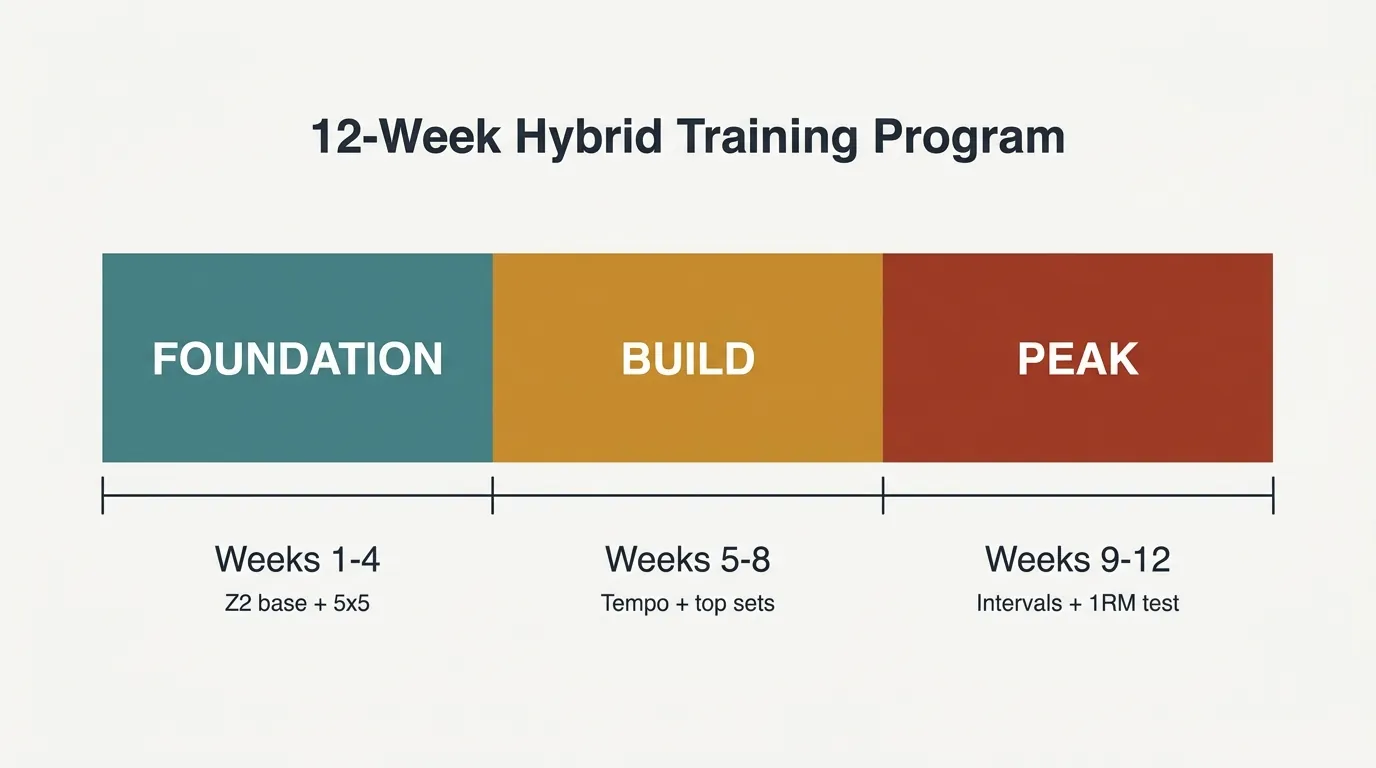
Phase 1: Foundation (weeks 1–4)
| Day | Session | Prescription |
|---|---|---|
| Mon | Lower strength | Squat 5×5 @ 70% · RDL 3×8 · Split squat 3×10/side · Plank 3×45s |
| Tue | Easy run (Z2) | 30–40 min conversational pace, HR ~70% max |
| Wed | Upper strength | Bench 5×5 @ 70% · Row 4×8 · Overhead press 3×8 · Pull-up 3×AMRAP |
| Thu | Rest or 20-min mobility | Full rest preferred |
| Fri | Full-body strength | Deadlift 5×5 @ 70% · DB press 3×10 · Chin-up 3×6 · Farmer carry 3×40m |
| Sat | Long easy run (Z2) | 45–60 min, HR ~70% max |
| Sun | Rest | Non-negotiable |
RPE cap: 7. If bar speed slows on the last set of squats, stop early. The Foundation block is about honest technique and an aerobic base, not personal records.
Phase 2: Build (weeks 5–8)
| Day | Session | Prescription |
|---|---|---|
| Mon | Lower — top set | Squat: work to a 3-rep @ RPE 8, then 3×5 @ 80% of that · RDL 3×6 · Bulgarian split squat 3×8/side |
| Tue | Tempo run | 10 min Z2 warm-up · 20 min at threshold (comfortably hard) · 10 min Z2 cool-down |
| Wed | Upper — top set | Bench: 3-rep @ RPE 8, then 3×5 back-off · Weighted pull-up 4×5 · OHP 3×6 |
| Thu | Rest | Check deload triggers (see callout) |
| Fri | Full-body power-endurance | Deadlift 3×3 @ 85% · Push press 3×5 · KB swing 5×15 · Farmer carry 3×50m |
| Sat | Long easy run (Z2) | 60–75 min |
| Sun | Rest | — |
Deload trigger check happens Thursday of week 6 and week 8. See the callout under “What breaks in weeks 6–9.”
Phase 3: Peak (weeks 9–12)
| Day | Session | Prescription |
|---|---|---|
| Mon | Lower — heavy | Squat 5×3 @ 85% · Front squat 3×5 · Nordic curl 3×6 |
| Tue | Intervals | 10 min Z2 · 6×3 min @ 5K pace, 2 min jog rest · 10 min Z2 |
| Wed | Upper — heavy | Bench 5×3 @ 85% · Weighted pull-up 4×4 · OHP 4×4 |
| Thu | Rest | — |
| Fri | Full-body top set | Deadlift: work to a heavy triple · Push press 4×3 · Chin-up 3×AMRAP |
| Sat | Long run with surges | 60 min Z2 with 6×30s pickups in the second half |
| Sun | Rest | — |
Week 11: test week — squat 1RM Monday, bench 1RM Wednesday, deadlift 1RM Friday, easy 30-min Z2 Saturday.
Week 12: mandatory deload. Cut all lifting volume to 40% and drop running to 3 easy Z2 sessions of 25 minutes. Do not skip this.
Download the full 12-week PDF — same tables, printable on 2 pages. Jump to download →
Beginner variation: the 4-day scaled plan
Two lifts, two runs, RPE-capped, no interval work. This variation is for anyone under 12 months of consistent lifting or under 3 months of consistent running. Every run stays in Zone 2 — no tempo, no intervals — for the full 12 weeks.
| Day | Session | Prescription |
|---|---|---|
| Mon | Full-body strength A | Squat 3×5 @ RPE 7 · Bench 3×5 · Row 3×8 · Plank 2×30s |
| Tue | Easy run | 25–35 min Z2 |
| Wed | Rest | — |
| Thu | Full-body strength B | Deadlift 3×5 @ RPE 7 · Overhead press 3×5 · Chin-up 3×AMRAP |
| Fri | Rest | — |
| Sat | Long easy run | 35–50 min Z2, grows to 60 min by week 12 |
| Sun | Rest | — |
Progress load by ~2.5 kg on lower lifts and ~1 kg on upper lifts each week you hit every rep clean. Miss a rep — hold the load for another week. If you would rather stay off the road entirely, the 5-day dumbbell + bodyweight variation is a legitimate substitute.
A basic doorway pull-up bar and a chest-strap heart-rate monitor cover most of the equipment the beginner plan needs beyond a barbell.
The Interference-Cost Table (running mileage vs strength)
Every extra weekly mile buys aerobic fitness at some cost to the strength side. Below is what most hybrid athletes need to know, translated from the Schumann 2021 meta, Wilson 2012 meta, and Coffey & Hawley’s mechanism review. Numbers are directional — bodyweight, sleep, and fueling all shift the curve.
| Weekly running (mi) | Hypertrophy impact | 1RM impact | Explosive/power impact | Extra recovery days |
|---|---|---|---|---|
| 0–10 | None | None | None | 0 |
| 10–20 | None (if fueled) | None | Mild attenuation | 0–1 |
| 20–30 | Mild attenuation | Mild | Moderate attenuation | 1 |
| 30+ | Notable attenuation | Mild–notable | Significant attenuation | 1–2 |
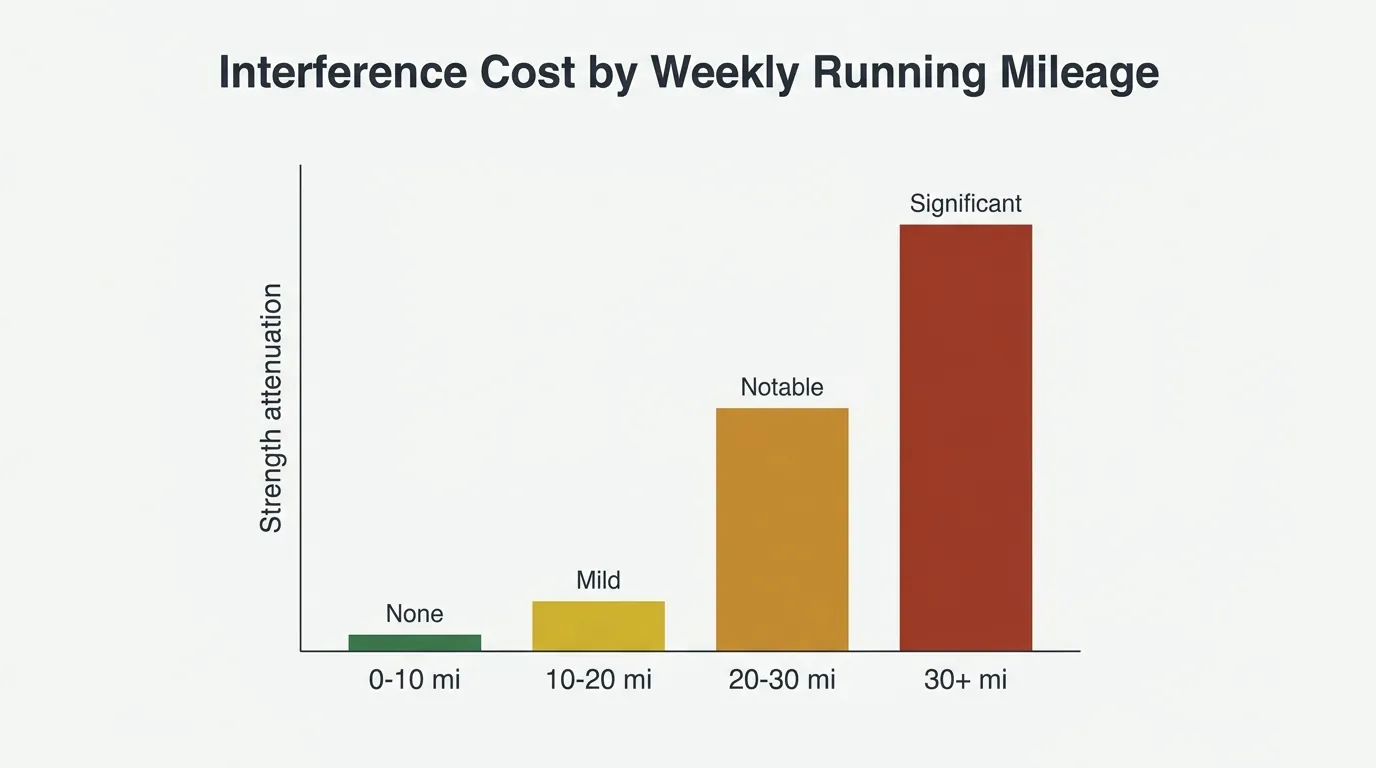
The takeaway: if your priority is a squat PR, hold weekly mileage under 20. If you are training for a half marathon, accept that squat numbers will hold, not climb, while mileage sits in the 30+ bucket. Explosive lifts (cleans, jumps, sprint work) are the first thing to suffer at any mileage above 10.
The 3 rules of programming lifts and runs together (the hybrid tax)
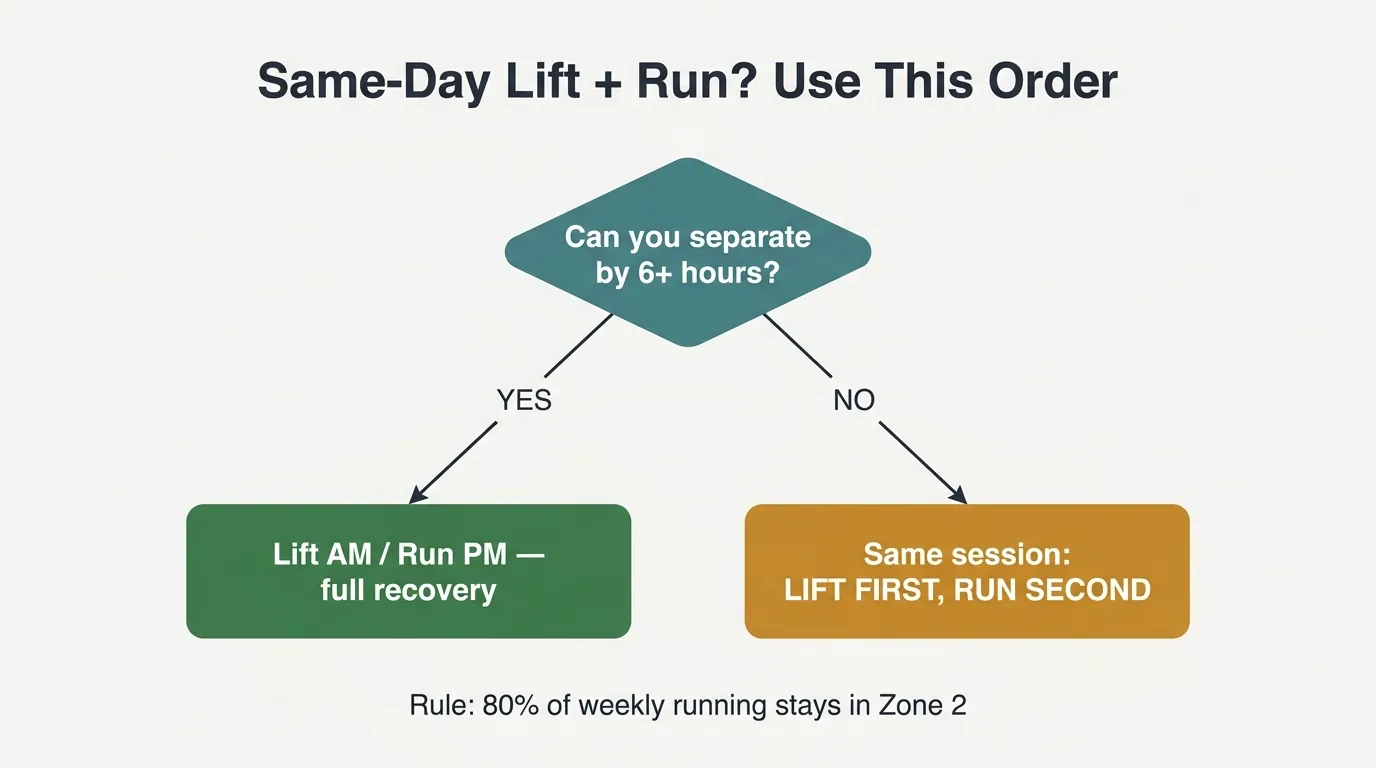
Hybrid work has a tax. You can either pay it in worse recovery, or you can pay it in scheduling discipline. The three rules below are the scheduling version — coaches like Nick Bare and Fergus Crawley teach variants of all three, and every one shows up somewhere in the concurrent-training literature.
- The 6-hour rule. Separate hard lifts and hard runs by at least 6 hours; 24 hours is better. Coffey & Hawley’s signalling work is the mechanism — AMPK activation from endurance suppresses mTORC1 for several hours after the run (Source: Journal of Physiology, 2017). Same-session pairings are where Schumann’s meta caught the biggest strength decrement.
- Lift-first if you must combine. If the schedule forces both into one session, lift first, run second. Wilson’s data shows same-day pairings cost the most hypertrophy specifically when endurance preceded resistance work (Source: JSCR, 2012).
- The 80/20 easy-running rule. Roughly 80% of weekly running minutes stay in Zone 2; only 20% goes to tempo, threshold, or intervals. Stephen Seiler’s polarized-training research is the source most endurance coaches lean on here — it protects the strength side by keeping the majority of running below the metabolic-cost threshold that eats into recovery.
What breaks in weeks 6–9 and when to deload
Roughly two-thirds of the way through a 12-week block, something usually cracks. Grip fails first on top-set deadlifts. Resting heart rate creeps up. Sleep gets restless. Coaches like Fergus Crawley call this the “crash window” and program a preemptive deload against it. The trigger list below is drawn from that practitioner consensus and from overreaching markers documented in the endurance-training literature.
Deload triggers — cut volume to 40% for one week if 2 or more hit:
- Grip failure on the top set of a lift you owned two weeks ago.
- Resting heart rate up 7+ bpm from your 4-week baseline, three mornings running.
- Sleep latency over 30 minutes on training nights.
- Mid-week Z2 pace slower at the same heart rate as last week.
- Motivation cliff — you dread the next session more than one day in a row.
Two triggers is not a suggestion. Two triggers is the deload. The block will still work — Schumann’s meta was full of studies with deload weeks baked in.
Nutrition and recovery in a hybrid block
Concurrent training amplifies whatever you are already doing poorly with food and sleep. Fix the four levers below before touching a supplement stack.
- Protein 1.6–2.2 g/kg bodyweight/day, spread across 3–5 feedings. This is the range the International Society of Sports Nutrition position stand endorses for hypertrophy under an energy-demanding block.
- Carbs scale with mileage. Add roughly 5 g/kg on weeks above 30 miles; long-run and interval days need higher carb intake the night before and morning of.
- Sleep 7.5–9 hours. Non-negotiable — the deload triggers above hit twice as fast on 6 hours.
- One full rest day per week. Sunday in the templates above. Do not fill it with “active recovery” that becomes a third run.
A basic foam roller is enough for tissue work; skip percussion guns unless you already own one.
Frequently asked questions
How many days a week should you do hybrid training?
Five days is the sweet spot for most intermediates — three lifts, two runs. Beginners should start with four (two of each). Six days is only sustainable if you have completed at least one 12-week hybrid block and you sleep eight hours consistently. Below three days a week, you will not accumulate enough weekly stimulus on either side to see meaningful progress.
Can you build muscle and run at the same time?
Yes. The 2021 Schumann meta-analysis in Sports Medicine pooled 43 studies and found no significant difference in hypertrophy or 1RM strength between concurrent training and strength-only training. Explosive power took a small hit. The keys are separating hard lifts and hard runs by at least six hours, eating enough protein (1.6–2.2 g/kg), and keeping weekly running mileage in a range that matches your strength goal.
What is the difference between hybrid training and CrossFit?
Hybrid training programs strength and endurance as separate, structured sessions across the week — a Monday squat day, a Tuesday Z2 run, and so on. CrossFit blends both inside single high-intensity workouts (WODs). Hybrid produces bigger 1RMs and better aerobic base development because each modality gets a full-quality session; CrossFit produces better mixed-modal work capacity. Different tools for different goals.
Can you do a hybrid training program without running?
Yes, but call it what it is: strength + low-impact endurance. Swap every run for the same duration on a rower, an assault bike, a swim, or a ruck. Wilson’s 2012 meta actually found cycling produced no measurable interference with hypertrophy, so a bike-based hybrid may protect strength gains slightly better than a run-based one. Keep the 6-hour separation and the 80/20 easy/hard rule regardless of modality.
Hybrid training is also a third option beyond gym vs calisthenics for lifters who want a full aerobic engine on top of raw strength.
Download the free 12-week hybrid training PDF
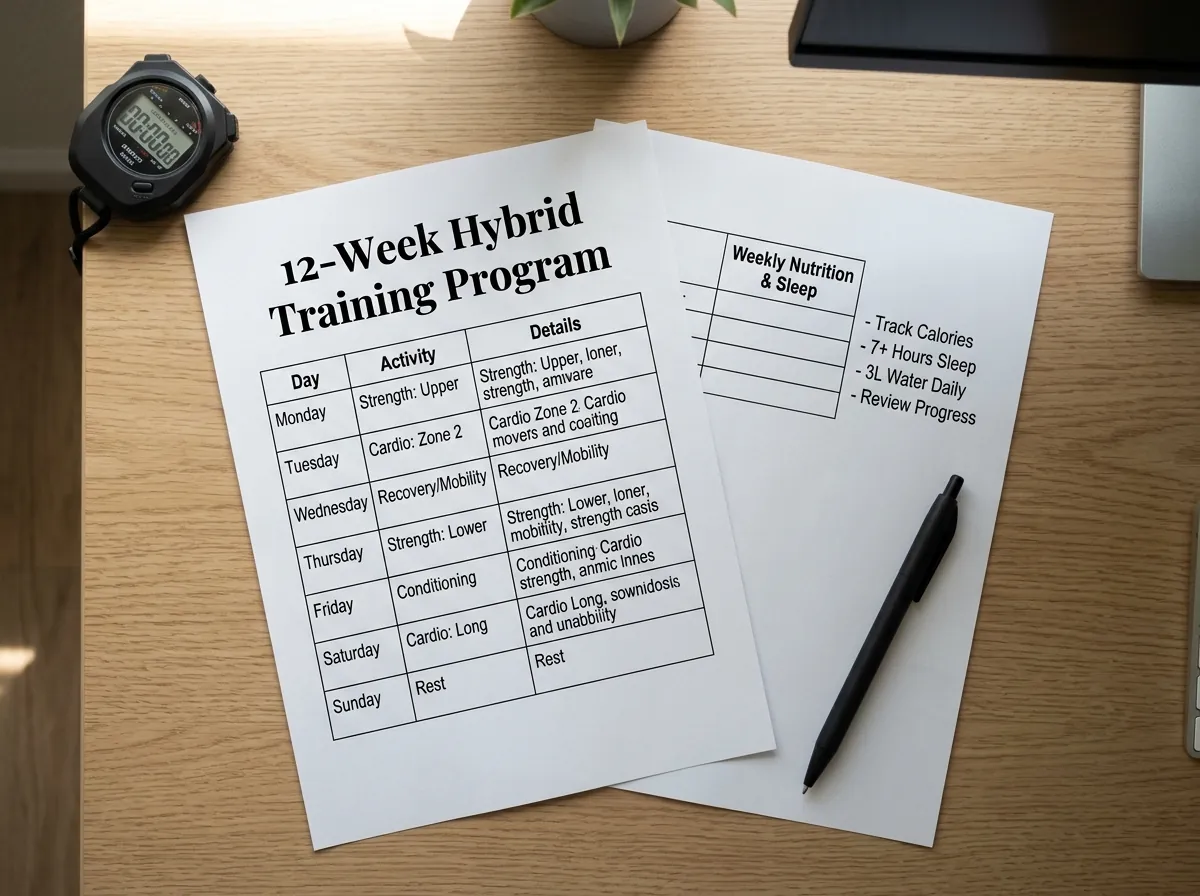
Two-page printable, black-and-white friendly, no email required. Contains the full 12-week Mon–Sun program, the three hybrid-tax rules, and the deload trigger checklist.
For a bodyweight-first take on the same idea, see the dumbbell + calisthenics hybrid. For strength + tactical conditioning, the military-style conditioning day plugs neatly into Saturday.
Sources
- Hickson, R.C. (1980). Interference of strength development by simultaneously training for strength and endurance. European Journal of Applied Physiology and Occupational Physiology, 45(2–3), 255–263. link.springer.com
- Wilson, J.M., Marin, P.J., Rhea, M.R., et al. (2012). Concurrent training: A meta-analysis examining interference of aerobic and resistance exercises. Journal of Strength and Conditioning Research, 26(8), 2293–2307. journals.lww.com
- Schumann, M., Feuerbacher, J.F., Sünkeler, M., et al. (2021/2022). Compatibility of concurrent aerobic and strength training for skeletal muscle size and function: an updated systematic review and meta-analysis. Sports Medicine, 52, 601–612. link.springer.com
- Coffey, V.G. & Hawley, J.A. (2017). Concurrent exercise training: do opposites distract? Journal of Physiology, 595(9), 2883–2896. physoc.onlinelibrary.wiley.com