Best Glute Machines: Gym Guide + Home Options (2026)
By the Gymstips Training Team | Last updated September 24, 2026
Gymnase Tips is reader-supported. Some links may be Amazon affiliate links; if you buy through them we may earn a small commission at no extra cost to you.
TL;DR — What Are the Best Glute Machines?
The best glute machines for most gym-goers are the hip thrust machine, cable kickback station, and GHD. Each targets a different part of the glute complex — gluteus maximus, medius, or minimus. Below, we rank 10 machines by muscle activation, difficulty, and gym availability, then give you a ready-to-use 4-week glute machine workout.
Table of contents
What Is a Glute Machine?
A glute machine is any gym apparatus designed to isolate or heavily load the gluteal muscles: gluteus maximus, medius, and minimus. Common examples include hip thrust machines, cable kickback stations, hip abductors, and glute-ham developers (GHDs). They provide a fixed range of motion (ROM) that lets you progressively overload the glutes with less stabilizer demand than free weights.
Your glutes handle three primary joint actions: hip extension (driving your hips forward), hip abduction (moving your leg away from your midline), and hip external rotation. Different machines bias different actions, which is why no single glute machine covers everything. A smart program uses at least two.
People search for this category under dozens of names. Glute workout machine, butt exercise machine, gym equipment for buttocks, gym equipment for bum, bum gym machines, gym machines for booty — they all point to the same equipment list. Even “glute lift machine” usually refers to a hip thrust station or a dedicated glute drive. The gym machines for glutes names that matter are the ten below.
For a broader look at every lower-body station, see our guide to leg workout machines.
10 Best Glute Machines for Gym and Home
These are the best machines for glutes ranked by muscle activation and gym availability, based on published EMG data and practical programming value. Whether you are shopping for booty workout machines at the gym or picking the best glute workout equipment for a home setup, this list covers both.
1. Hip Thrust Machine
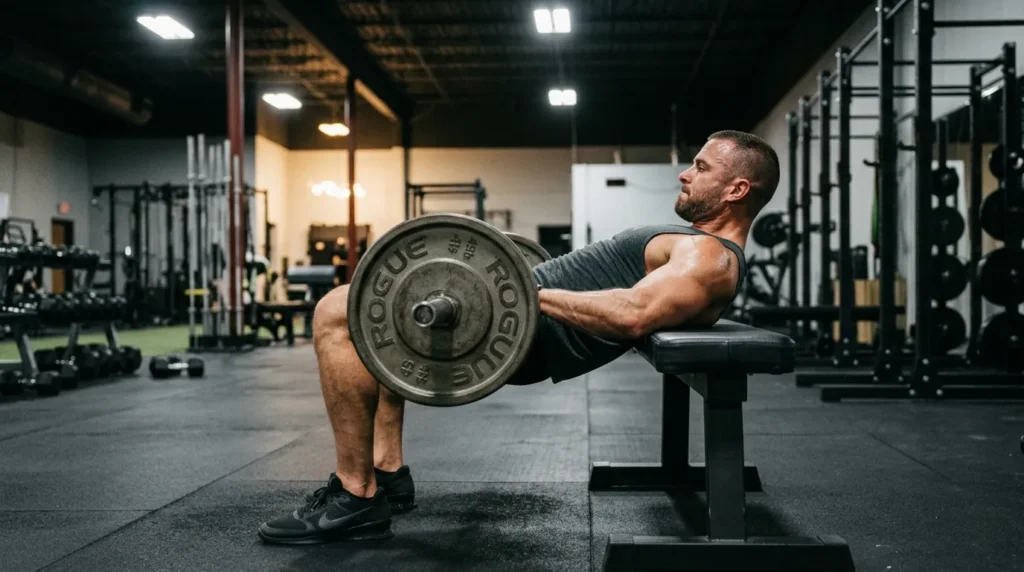
The hip thrust machine is the single best exercise machine for glutes if your goal is gluteus maximus hypertrophy. A 2020 systematic review by Neto et al. reported that the traditional barbell hip thrust produces mean glute-max activation of 69.5-86.7% MVIC depending on electrode placement, roughly double the back squat’s numbers (Source: Neto et al., Journal of Sports Science & Medicine, 2020). These figures align with the original Contreras et al. 2015 study that first documented the comparison (Source: Contreras et al., Journal of Applied Biomechanics, 2015).
A dedicated glute machine gym station locks your back against a pad, removing spinal loading entirely. You push through full hip extension with zero setup time. If someone asks you for the best workout machine for glutes, point them here.
Form cues: Plant feet hip-width apart, roughly a shin-length from your glutes. Drive through your heels. Squeeze at full lockout for two seconds. Do not hyperextend your lumbar spine — stop when your torso and thighs form a straight line.
Home option: A barbell hip thrust with a bench works identically. You lose the back pad, but the movement pattern and loading are the same.
2. Cable Kickback Station
Cable kickbacks target both the gluteus maximus and gluteus medius through a standing hip-extension pattern. The cable provides constant tension across the entire ROM, something free weights cannot match at the top of a kickback. This is one of the most searched glute exercises machine movements for good reason — it is simple to learn and effective from day one.
Form cues: Set the pulley at ankle height. Attach an ankle strap. Lean your torso forward roughly 30 degrees — this lengthens the glute max at the start, increasing the stretch under load. Keep your working leg straight or with a slight bend. Avoid rotating your lower back; your hips should stay square throughout.
Home option: Loop a resistance band around your ankles and perform the same motion. Tension drops as you return to start, but it still works for higher-rep finisher sets.
3. Glute-Ham Developer (GHD)
The GHD is a posterior-chain compound machine. Reverse hyperextensions on the GHD challenge the glute max through full hip extension from a stretched position. The 2020 Neto et al. systematic review placed the hex-bar deadlift at 88% MVIC and conventional deadlifts at 64.5% MVIC — the reverse hyper on a GHD trains the same hip-extension pattern without axial loading (Source: Neto et al., Journal of Sports Science & Medicine, 2020).
Form cues: Adjust the pad so your hip crease sits just past the edge. For reverse hypers, let your legs hang, then extend your hips until your body forms a straight line. Control the eccentric — a 2-3 second lowering phase is non-negotiable.
Home option: A Nordic curl strap setup with your feet anchored trains the posterior chain, though the emphasis shifts more toward hamstrings than glute max.
4. Hip Abduction Machine
This is the best gym equipment for glutes when your weak link is the gluteus medius — the muscle responsible for hip abduction and single-leg stability. Most commercial gyms stock a seated hip abduction/adduction machine, making it one of the most common glute exercises gym machines on any floor.
Form cues: Sit upright for standard glute medius emphasis. Lean forward 20-30 degrees to shift load toward the upper gluteus maximus fibers. Push against the pads through the full range and hold peak abduction for one second.
Home option: Banded lateral walks with a mini band around your knees. Three sets of 15 steps per direction replicates the movement pattern.
5. Leg Press (Glute-Emphasis Foot Placement)
The leg press becomes a strong glute machine when you adjust foot position. A high-and-wide stance on the platform lengthens the glute max at the bottom of the rep and reduces quad dominance.
The Neto et al. 2020 review found that squat-type movements produced pooled glute max activation around 53% MVIC, with deeper ROM increasing activation substantially. The leg press follows a similar principle: depth matters more than load for glute recruitment (Source: Neto et al., Journal of Sports Science & Medicine, 2020).
Form cues: Place your feet high on the platform, slightly wider than shoulder width. Lower the sled until your knees reach at least 90 degrees — deeper is better if your lower back stays flat against the seat. Do not bounce at the bottom.
Home option: Goblet squats with a kettlebell in a deep squat stance. You lose the loaded isolation, but the movement pattern is close.
6. Smith Machine (Hip Thrust / Split Squat)
The Smith machine is the most versatile butt workout machine in a commercial gym. You can run hip thrusts, split squats, lunges, and even standing calf raises on one station. For glutes, the barred path locks you into a straight line, which simplifies setup and lets you push heavier loads on hip thrusts without needing a spotter. If you train at a big booty gym where the dedicated hip thrust machine always has a line, the Smith machine is your backup.
Form cues: For Smith machine hip thrusts, position a bench perpendicular to the bar. Set your feet forward of the bar path so your shins are roughly vertical at lockout. For Bulgarian split squats, keep your rear foot on a bench behind you, lunge deep, and keep your front shin vertical.
Home option: Loaded Bulgarian split squats with dumbbells.
7. Hack Squat Machine
The hack squat loads the glute max and quads through a deep squat pattern with back support. The fixed sled angle lets you go deeper than most lifters manage on a barbell squat, and that additional ROM drives glute max recruitment higher. Among machines good for glutes, the hack squat is the one most people underrate.
Form cues: Place your feet high on the platform. Push through your heels. Aim for a full-depth rep where your thighs break parallel. If your heels lift, use a heel wedge to maintain contact.
Home option: Barbell hack squats (bar behind your legs) are possible but awkward. A goblet squat to a deep box is a more practical substitute.
8. Pendulum Squat
Pendulum squats are rising in gym availability. The arc-based movement path keeps constant tension on the glutes and quads through the entire ROM, unlike a hack squat where the resistance curve lightens at the top.
Form cues: Lean back into the pad. Place your feet flat, shoulder-width. Control the descent for two seconds and drive through your heels.
Home option: Limited. A bodyweight sissy squat variant targets quads more than glutes. For a home pendulum substitute, deep goblet squats are the closest match.
9. Cable Pull-Through
The cable pull-through is an underrated glute max isolation movement. It trains the hip-hinge pattern with continuous cable tension, making it a strong finishing exercise on a glute-focused day. Any butt machine gym that has a cable stack can run this movement.
Form cues: Attach a rope handle at the lowest pulley height. Straddle the cable, facing away from the stack. Hinge at your hips while keeping a slight knee bend. Drive your hips forward to standing. Squeeze your glutes at the top for a full second.
Home option: Banded pull-throughs using a long loop resistance band anchored at ground level. Same pattern, slightly less consistent tension.
10. Stair Stepper / StairMaster (Honorable Mention)
The StairMaster earns an honorable mention. It will not build maximal glute size the way a hip thrust or cable kickback will, but it does deliver sustained glute-endurance work and can be used for active-recovery cardio between heavy leg days. Skip the treadmill and bike if glute activation is your priority — those machines target quads and calves far more.
Form cues: Do not lean on the rails. Stand tall and drive each step deep enough that your hip actually extends. Shallow, fast steps become a calf exercise.
Home option: Weighted step-ups using an aerobic step platform onto a 16-18 inch box. Loaded step-ups actually produced the highest pooled glute max EMG (125% MVIC) in the Neto et al. 2020 review (Source: Neto et al., Journal of Sports Science & Medicine, 2020). They are arguably better than the StairMaster for pure glute work.
Glute Machine Comparison Table
This table maps each machine to its primary glute target, training type, and real-world availability so you can pick the right gym equipment for glutes based on your setup. It also shows which ones double as the best exercise equipment for buttocks at home.
| Machine | Primary Glute Target | Compound or Isolation | Difficulty | Typical Gym Availability | Home Option |
|---|---|---|---|---|---|
| Hip Thrust Machine | Glute Max | Compound | Beginner | Common | Yes (bench + barbell) |
| Cable Kickback Station | Glute Max + Med | Isolation | Beginner | Common | Yes (bands) |
| GHD (Reverse Hyper) | Glute Max | Compound | Intermediate | Common | Partial (Nordic curl) |
| Hip Abduction Machine | Glute Med | Isolation | Beginner | Very Common | Yes (banded walks) |
| Leg Press (High Feet) | Glute Max + Quads | Compound | Beginner | Very Common | Yes (goblet squat) |
| Smith Machine | Glute Max | Compound | Intermediate | Very Common | Yes (dumbbells) |
| Hack Squat | Glute Max + Quads | Compound | Intermediate | Common | Partial (barbell hack) |
| Pendulum Squat | Glute Max + Quads | Compound | Intermediate | Uncommon | No |
| Cable Pull-Through | Glute Max | Isolation | Beginner | Common | Yes (banded) |
| StairMaster | Glute Max (endurance) | Cardio | Beginner | Very Common | Yes (step-ups) |
Reading this table: If you want to target the gluteus medius specifically — the muscle that shapes the upper-outer glute shelf — the hip abduction machine and cable kickback station are your best picks. For raw gluteus maximus size, the hip thrust machine and hack squat offer the most direct overload. The best gym machines for glutes overall? The hip thrust and hip abduction machines, because they cover the two main glute actions (extension and abduction) with beginner-friendly setups.
How to Use a Glute Machine: Form Cues and Common Mistakes
Correct glute machine form comes down to three things: full range of motion through the hip, a deliberate squeeze at peak contraction, and zero lower-back compensation. Get those right and the specific machine matters less.
Universal form principles:
- Full ROM. Half reps slash your results. EMG data consistently shows that deeper hip flexion at the start and full hip extension at lockout produce higher glute activation. Do not cut depth to chase heavier weight.
- Peak squeeze. Hold the top of each rep for 1-2 seconds. This eliminates momentum and forces the glute to generate force at its shortest muscle length, where most lifters lose tension.
- Controlled tempo. Lower the load for at least 2 seconds on every eccentric. If you cannot control the weight down, it is too heavy.
- Mind-muscle connection. Think about driving through your heels and pushing the floor away. Cuing heel drive shifts emphasis from quads to glutes on virtually every lower-body machine.
Common Mistakes
- Partial reps. The single most common error. If your hips are not reaching full extension on hip thrusts or full depth on leg presses, you are leaving glute activation on the table.
- Too much weight. Ego loading shifts the work to your lower back and quads. Drop the weight by 20%, use full ROM, and feel the difference.
- Wrong seat or pad adjustment. On the hip abduction machine, sitting too far forward or back changes the resistance angle and can load your hip flexors instead of your glute medius.
- Lumbar compensation. Arching your lower back at the top of a hip thrust or cable kickback means your glutes are not doing the work. Your spine should stay neutral throughout.
- Bouncing. Using momentum at the bottom of a leg press or hack squat removes the stretch-reflex training stimulus. Pause for a beat at the bottom, then drive.
Sample Glute Machine Workout (4-Week Progression)
This 4-week glute machine workout uses three machines available in most commercial gyms. Start with the loading in Week 1 and add one set or 5-10% load each week. Run it twice per week with at least 48 hours between sessions. Building gym booty is a volume game — progressive overload over weeks, not one heroic session.
A 2017 meta-analysis by Schoenfeld et al. found a graded dose-response relationship between weekly training volume and hypertrophy, with 10 or more sets per muscle group per week producing significantly greater growth than fewer than 5 sets (Source: Schoenfeld et al., Journal of Sports Sciences, 2017). This program starts at 9 sets per session and builds to 11 by Week 4, giving you 18-22 weekly glute sets when run twice a week.
Workout Table
| Exercise | Sets | Reps | Rest | Tempo |
|---|---|---|---|---|
| Hip Thrust Machine | 3 | 8-10 | 90 sec | 2-0-1-2 (2s down, no pause, 1s up, 2s squeeze) |
| Hip Abduction Machine (leaned forward) | 3 | 12-15 | 60 sec | 2-0-1-1 |
| Cable Pull-Through | 3 | 12-15 | 60 sec | 2-1-1-1 |
Total per session: 9 sets. Weekly volume (2x frequency): 18 sets. That is higher than the minimum effective volume of 6-8 sets per week and well within the maximum adaptive range of 8-24 sets per week cited by RP Strength for glute hypertrophy (Source: RP Strength, 2024).
4-Week Progression Schedule
| Week | Hip Thrust | Hip Abduction | Cable Pull-Through | Total Weekly Sets |
|---|---|---|---|---|
| Week 1 | 3 x 10 @ RPE 7 | 3 x 15 @ RPE 7 | 3 x 15 @ RPE 7 | 18 |
| Week 2 | 3 x 10 @ RPE 8 (+5% load) | 3 x 15 @ RPE 8 | 3 x 12 @ RPE 8 (+5% load) | 18 |
| Week 3 | 4 x 8 @ RPE 8 (+5% load) | 3 x 12 @ RPE 8 (+5% load) | 3 x 12 @ RPE 8 | 20 |
| Week 4 | 4 x 8 @ RPE 9 (+5% load) | 4 x 12 @ RPE 9 | 3 x 10 @ RPE 9 (+5% load) | 22 |
After Week 4, take a deload week: cut volume in half and reduce loads by 40%. Then repeat the cycle with your new baseline weights.
Why these three machines? The hip thrust covers glute max in hip extension. The hip abduction machine (leaned forward) covers glute medius and upper glute max. The cable pull-through reinforces the hip-hinge pattern with constant tension. Together, they hit all three gluteal muscles across two joint actions.
What Is the Best Glute Machine for Home?
The best glute machine for home is a dedicated hip thrust platform with plate loading. It covers the highest-activation glute exercise without needing a full gym setup. If you can only buy one piece of glute training equipment for a home gym, this is it.
Top 3 home picks:
- Hip thrust platform with plate loading — Replaces a full hip thrust machine and doubles as the best exercise machine for buttocks lift work at home. Brands like the Booty Builder and BC Strength make dedicated units.
- Cable pulley system — A wall-mounted or door-mounted pulley handles cable kickbacks, pull-throughs, and dozens of other glute exercises. Best bang-for-the-buck booty workout equipment for a home setup.
- Resistance band set — The cheapest entry point. Bands handle kickbacks, lateral walks, pull-throughs, and glute bridges. Tension is inconsistent across the ROM compared to cables, but the cost is minimal.
For anyone searching for a glute machine home workout on a budget, a heavy long-loop band and a sturdy bench cover 80% of what a commercial glute machine gym offers. You do not need to match the full gym equipment for glutes to get strong, growing glutes at home.
Glute Machine vs Free Weights
Neither is universally better. Glute machines excel at isolation and progressive overload on a single joint action. Free weights recruit more stabilizers and allow greater movement variety. The best glute program uses both.
Where machines win:
- Fixed ROM means less technical skill required. Beginners can load glutes from Day 1 without mastering a barbell hip hinge.
- Isolation is easier. A hip abduction machine removes every other muscle from the equation. You cannot do that with a barbell.
- Progressive overload is precise. Most machines use pin-loaded weight stacks with 5-10 lb increments.
Where free weights win:
- Greater stabilizer demand means more overall muscle recruitment per rep.
- Movement variety. A single pair of adjustable dumbbells can run hip thrusts, split squats, Romanian deadlifts, lateral lunges, and step-ups.
- No gym dependency. You do not need a gym membership to train glutes with free weights.
The verdict: Use machines as your primary glute volume, then add free-weight compounds (deadlifts, squats, lunges) for overall lower-body development. Arguing over which is “better” is a false choice.
FAQ
What machines at the gym work your glutes?
The main gym machines for glutes are the hip thrust machine, hip abduction/adduction machine, cable station (for kickbacks and pull-throughs), GHD, leg press, Smith machine, hack squat, and pendulum squat. Most commercial gyms stock at least five of these. The hip abduction machine is the most universally available glute-specific station. If you need a quick reference for what machines work glutes, the comparison table above lists all ten with their target muscles.
What is the best glute machine at Planet Fitness?
Planet Fitness locations almost always have a seated hip abduction machine and a Smith machine. Those two are your best options at Planet Fitness for direct glute work. Some locations also carry a cable station for kickbacks and a leg press. Equipment varies by club, so check your specific location before relying on a particular machine.
How many glute exercises should I do per workout?
Three to four exercises per glute session is the productive range for most lifters. Research supports 10+ working sets per muscle group per week for hypertrophy (Source: Schoenfeld et al., Journal of Sports Sciences, 2017). Split that across 2-3 sessions and you land at 3-5 exercises per workout. More exercises per session increases fatigue without proportionally increasing growth stimulus.
Can you build glutes with machines only?
Yes. Machines can provide sufficient progressive overload and ROM for glute hypertrophy. A combination of the hip thrust machine, hip abduction machine, and a cable station covers all three gluteal muscles across both hip extension and hip abduction. You do not strictly need barbells or dumbbells for glute growth, though free weights add movement variety that machines cannot fully replicate.
What is the difference between a glute press and a leg press?
A glute press machine is designed specifically for hip extension — your back stays fixed and you press a foot platform backward by extending your hips, similar to a hip thrust. A standard leg press involves knee and hip extension simultaneously, making it a quad-dominant compound exercise. You can make a leg press more glute-focused by using a high-and-wide foot placement and going to full depth, but it will never isolate glutes the way a dedicated glute press does.
Sources
- Contreras B, Vigotsky AD, Schoenfeld BJ, Beardsley C, Cronin J. “A Comparison of Gluteus Maximus, Biceps Femoris, and Vastus Lateralis Electromyographic Activity in the Back Squat and Barbell Hip Thrust Exercises.” Journal of Applied Biomechanics. 2015;31(6):452-458. https://pubmed.ncbi.nlm.nih.gov/26214739/
- Neto WK, Soares EG, Vieira TL, et al. “Gluteus Maximus Activation during Common Strength and Hypertrophy Exercises: A Systematic Review.” Journal of Sports Science & Medicine. 2020;19(1):195-203. https://pmc.ncbi.nlm.nih.gov/articles/PMC7039033/
- Schoenfeld BJ, Ogborn D, Krieger JW. “Dose-response relationship between weekly resistance training volume and increases in muscle mass: A systematic review and meta-analysis.” Journal of Sports Sciences. 2017;35(11):1073-1082. https://pubmed.ncbi.nlm.nih.gov/27433992/
- RP Strength. “Glute Hypertrophy Training Tips.” https://rpstrength.com/blogs/articles/glute-hypertrophy-training-tips (Retrieved 2026-09-24)