TL;DR — Which leg workout machines should you use?
Leg workout machines let you train every lower-body muscle on a fixed, guided path — which makes them safer and easier to learn than a loaded barbell. Build your leg day around the leg press, hack squat, leg extension, lying and seated leg curl, hip thrust, adductor/abductor, and calf raise. Machines are beginner-friendly and unmatched for isolation. The table below maps each one to the muscle it hits.
Table of contents
What are leg workout machines?
Leg workout machines are fixed-path resistance machines that load your lower-body muscles through a guided range of motion, so the machine controls the movement instead of your stabilizers. That guidance is the whole point: less balance demand, less technique to learn, and a straight line from effort to the target muscle.
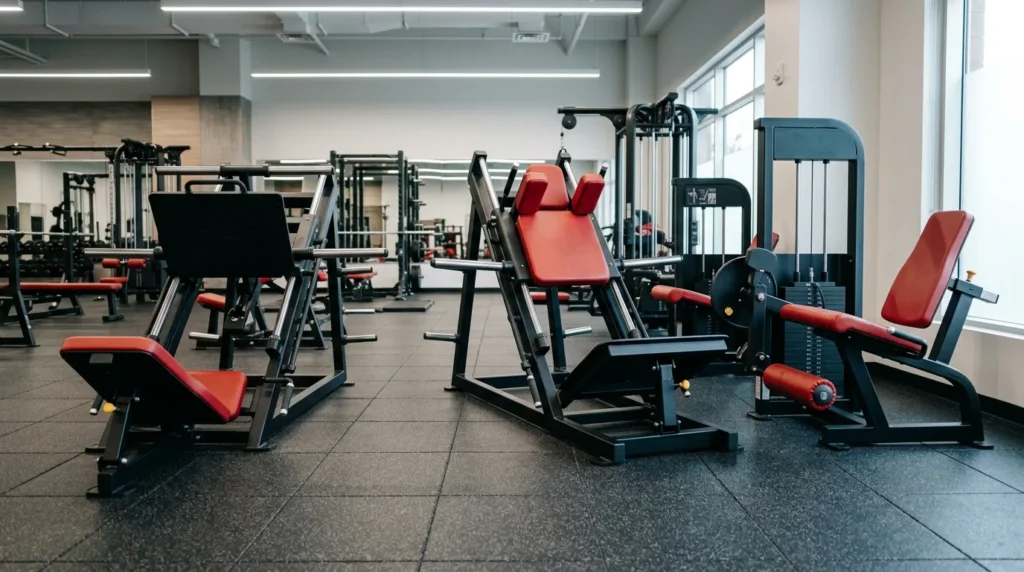
They come in three broad builds. Plate-loaded machines (you add barbell plates) give the heaviest ceiling and are common on leg presses and hack squats. Selectorized machines use a weight stack and a pin — fast to adjust, ideal for drop sets on curls and extensions. Bodyweight-leverage units, like some hip thrust and glute-drive stations, use your own mass plus bands or light plates. Beginners, people returning from injury, and anyone chasing pure isolation get the most from them.
Leg machine comparison table
Read the table left to right: find the muscle you want to grow, check whether the movement is compound (multi-joint, more total load) or isolation (single-joint, more targeted), then see if a home version exists and roughly what it costs in 2026. Compound machines belong early in your session; isolation machines finish the job. Home prices are U.S. street prices as of 2026 and move with steel costs.
| Machine | Primary muscle | Secondary muscles | Movement type | Home-viable? | Home price (USD, 2026) |
|---|---|---|---|---|---|
| Leg press | Quads | Glutes, hamstrings | Compound | Compact version | $700–$2,500 |
| Hack squat | Quads | Glutes, hams | Compound | Compact version | $700–$2,000 |
| Leg extension | Quads (VMO) | — | Isolation | Yes | $130–$600 |
| Lying leg curl | Hamstrings | Calves | Isolation | Yes | $300–$600 |
| Seated leg curl | Hamstrings | Calves | Isolation | Compact version | $400–$800 |
| Hip thrust machine | Glutes | Hamstrings | Compound | Yes | $400–$900 |
| Smith machine (legs) | Quads | Glutes, hams | Compound | Yes | $500–$1,500 |
| Hip adductor | Inner thigh | Glutes | Isolation | Compact version | $300–$1,200 |
| Hip abductor | Glute medius | Outer glutes | Isolation | Compact version | $300–$1,200 |
| Standing calf raise | Gastrocnemius | Soleus | Isolation | Compact version | $200–$700 |
| Seated calf raise | Soleus | Gastrocnemius | Isolation | Yes | $300–$550 |
| Glute kickback | Glute max | Hamstrings | Isolation | Compact version | $250–$800 |
New to training legs and not sure where machines fit against bodyweight work? Our guide to how to tone your legs covers the pairing.
Every leg machine at the gym, explained
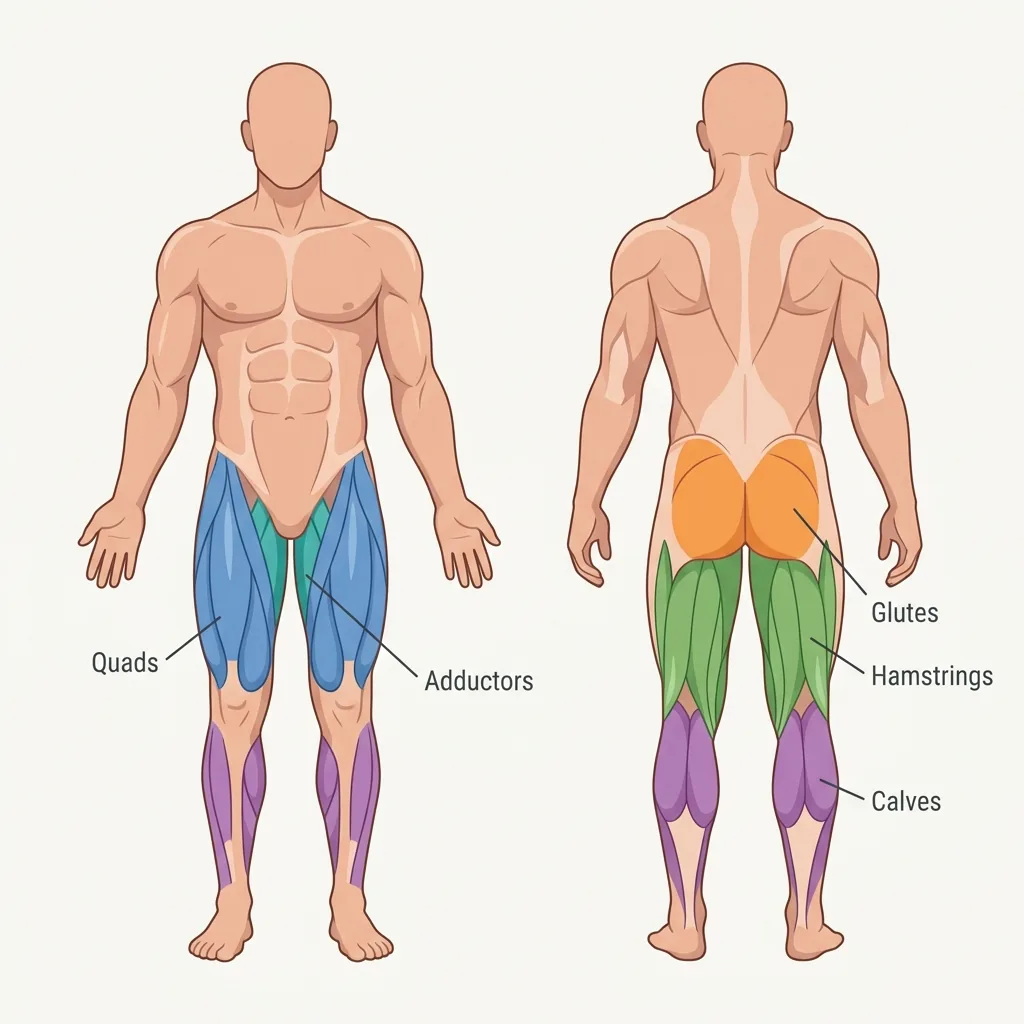
Gym leg machines fall into five jobs: compound pushers (leg press, hack squat, Smith), the hinge/glute group (hip thrust, kickback), the isolation curl-and-extension pair (leg extension, leg curl), the adduction/abduction machines for the inner and outer thigh, and the calf raises. Below, each machine gets a one-line definition, the muscle it trains, a couple of setup cues, and the single mistake that wastes the set.
Leg press
The leg press is a seated machine that works the quads, glutes, and hamstrings by pushing a weighted platform away from your body along a fixed track. It’s the safest way to move heavy load through your legs without balancing a bar.
- Muscle worked: quads primarily; glutes and hamstrings assist, more so with a higher foot placement.
- How to use it: press your lower back flat into the pad, place feet mid-platform shoulder-width, and lower until your knees reach about 90 degrees.
- Common mistake: locking the knees hard at the top and letting the hips curl off the seat at the bottom. Both spike joint stress; stop just short of lockout and keep your tailbone down.
Hack squat machine
The hack squat machine is an angled sled you load with plates and squat against, with your back and shoulders braced by pads — a quad-dominant squat pattern with almost no balance requirement. It bridges the gap between a free squat and the leg press.
- Muscle worked: quads, with glute involvement as you go deeper.
- How to use it: feet lower on the platform to bias the quads, shoulders driving into the pads, descend to at least parallel.
- Common mistake: cutting depth to load more plates. Half-reps train ego, not quads — shorten the weight, lengthen the range.
Leg extension machine (quad machine)
The leg extension machine isolates the quadriceps by straightening your knee against a padded lever while you sit fixed in the seat. It’s the most direct quad builder in the gym and the go-to for the teardrop VMO near the knee.
- Muscle worked: quadriceps, including the vastus medialis (VMO). EMG work shows knee extension and leg press produce similar peak quad activation, so it earns its place as a finisher (Source: Journal of Strength & Conditioning Research / PubMed, 1994).
- How to use it: align the pivot with your knee, pad on the lower shin, and squeeze at full extension for a beat.
- Common mistake: swinging the weight up with momentum. Control the lowering — the eccentric is where the growth stimulus lives.
Lying leg curl (ham curl machine)
The lying leg curl has you face-down curling a padded lever toward your glutes, isolating the hamstrings through knee flexion. This is the machine most people mean when they say “ham curl machine.”
- Muscle worked: hamstrings, with calf assistance.
- How to use it: hips pinned to the bench, pad on the back of your ankles, curl until the lever nearly touches your glutes.
- Common mistake: letting the hips lift off the pad to yank the weight up. Keep them down; if you can’t, drop the load.
Seated leg curl
The seated leg curl trains the hamstrings from a seated, upright position, pulling a pad down and under with your heels while a lap pad holds your thighs in place. The hip-flexed position stretches the hamstrings harder than the lying version.
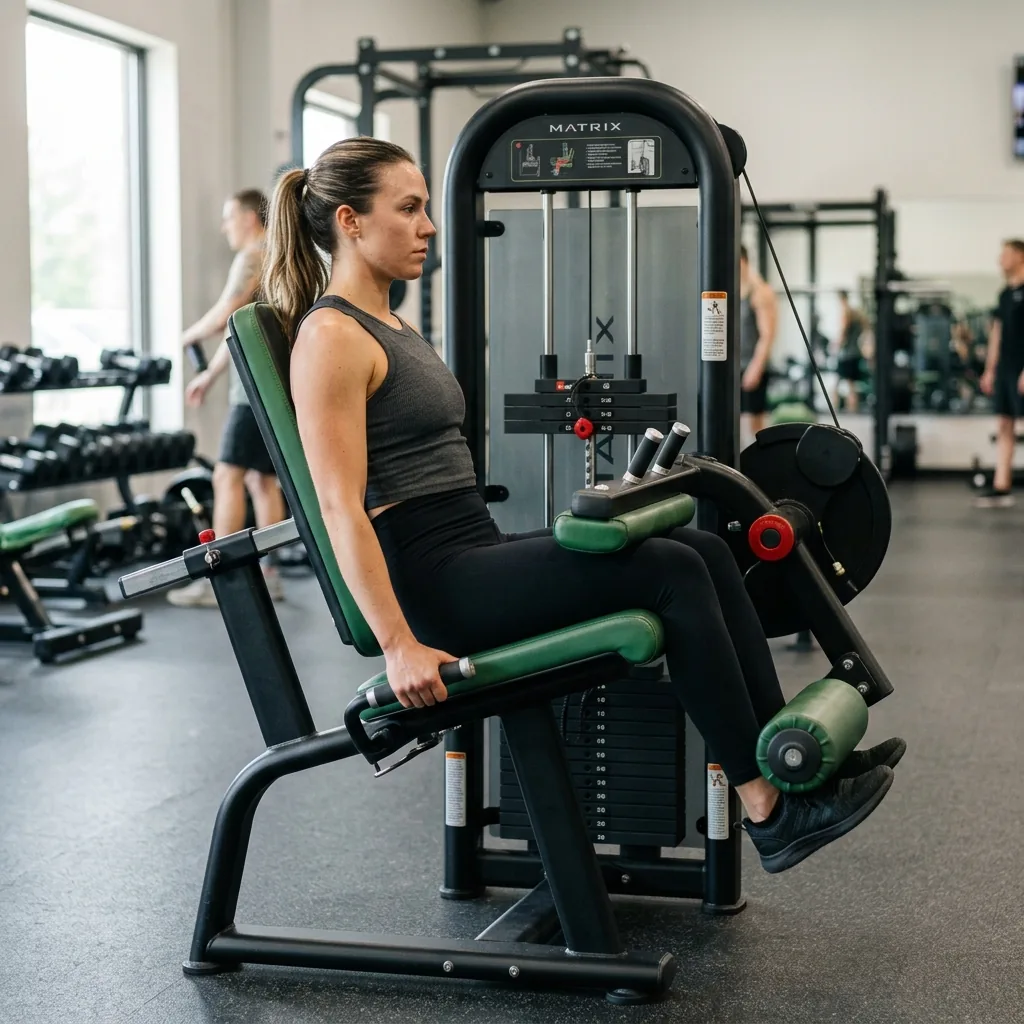
- Muscle worked: hamstrings.
- How to use it: set the back pad so your knees line up with the pivot, thigh pad snug, and curl through a full range.
- Common mistake: a loose thigh pad that lets your legs ride up, stealing tension. Cinch it down before your first rep.
Hip thrust machine
The hip thrust machine (or glute drive) loads a hip extension by bracing your upper back against a pad and driving a weighted lap pad up with your glutes. It’s the strongest dedicated glute-mass builder among the machines.
- Muscle worked: gluteus maximus, hamstrings assisting.
- How to use it: upper back on the pad, chin tucked, drive to full hip extension and squeeze — ribs down, don’t overarch.
- Common mistake: overextending the lower back at the top instead of finishing with the glutes. Think “flat, not arched” at lockout.
Smith machine (for legs)
The Smith machine is a barbell fixed to vertical rails, letting you squat, lunge, or hip thrust on a guided path with built-in safety catches. It’s a middle ground between free weights and full machines.
- Muscle worked: quads and glutes on squats; hamstrings on Romanian deadlifts.
- How to use it: step your feet slightly forward of the bar for squats so your knees track safely, and use the hook catches as spotters.
- Common mistake: treating the fixed bar path as a free squat. Your foot position, not the bar, dictates where the load lands — set it deliberately.
Hip adductor / abductor machine
These paired machines train the inner thigh (adductor, legs squeezing together) and outer glute (abductor, legs pushing apart) against a resistance stack while you sit. Same seat, opposite jobs.
- Muscle worked: adductors (inner thigh) versus gluteus medius (outer hip).
- How to use it: set the range so the stretch is challenging but pain-free, move slowly, and pause at the end position.
- Common mistake: stacking heavy plates and bouncing through a short, jerky range. These are accessory movements — control beats load.
Standing / seated calf raise machine
Calf raise machines load your calves through ankle extension, either standing (knee straight, hitting the gastrocnemius) or seated (knee bent, hitting the soleus). Run both to build the full calf.
- Muscle worked: gastrocnemius standing; soleus seated.
- How to use it: drive up onto the balls of your feet to a full peak, then lower until you feel a deep stretch at the bottom.
- Common mistake: short, bouncy reps. Calves respond to a big stretch and a full contraction — slow the bottom down.
Glute kickback machine
The glute kickback machine isolates one glute at a time by pushing a pad or lever back and up against resistance while you brace your torso. It’s a low-skill way to add direct glute volume.
- Muscle worked: gluteus maximus, hamstrings assisting.
- How to use it: hinge slightly forward, drive the working leg straight back to a squeeze, and avoid arching your lower back to cheat the rep.
- Common mistake: using the lower back to fling the leg. Keep the movement at the hip and pause at the top.
What each machine is also called (glossary)
Gym slang and manufacturer names create a lot of confusion — the same machine can wear four different labels depending on who’s talking. Here’s the plain-English translation so you can find the right station and search the right long-tail term.
| Common name | Also called |
|---|---|
| Leg press | 45° sled, plate-loaded leg press, “leg pushing machine” |
| Hack squat | Reverse hack, angled squat machine |
| Leg extension | Quad machine, knee extension, “leg lift machine” |
| Lying/seated leg curl | Ham curl machine, hamstring machine, leg flexion |
| Hip thrust machine | Glute drive, glute machine, hip bridge machine |
| Adductor machine | Inner-thigh machine, “good girl” machine |
| Abductor machine | Outer-thigh machine, “bad girl” machine, hip machine |
| Calf raise | Calf machine, donkey/standing/seated calf |
| Glute kickback | Glute machine, cable/pendulum kickback |
Note: “leg lift machine” is ambiguous — it points to leg extensions in most gyms but to captain’s-chair leg-raise stations in others. Search by muscle to avoid the mix-up.
Leg machines vs. free weights: which is better?
Both build muscle about equally — a 2023 systematic review and meta-analysis of 13 studies (1,016 participants) found no significant difference in hypertrophy between machine and free-weight training over six-plus weeks (Source: BMC Sports Science, Medicine and Rehabilitation, 2023). The split is elsewhere: machines win on isolation, safety, and a short learning curve, while free weights build more stabilizer strength and carry over better to sport and daily movement.
That same review found strength gains are test-specific: free-weight training improved free-weight tests more, machine training improved machine tests more (Source: BMC Sports Science, Medicine and Rehabilitation, 2023). Translation — you get strong at what you practice. Neither tool is “better” in a vacuum.
So the honest answer for most lifters is: use both. Anchor your leg day with a compound movement (a barbell squat or a leg press), then let machines pile on targeted volume where a free weight can’t — direct hamstring curls, quad extensions, adduction, and calves. If you train exclusively at home with no barbell, machines and bodyweight work will still get you most of the way; see our lower-body workouts with no equipment and bodyweight leg workouts for the non-machine side.
Which leg machine should a beginner use first?
Start with the leg press. It’s a compound movement that loads your quads, glutes, and hamstrings while the machine handles your balance and back support, so you can learn to push heavy safely before anything else. Once the leg press feels natural, layer in the leg extension and seated leg curl to hit quads and hamstrings directly.
Add the adductor/abductor machines and a calf raise after that, and you’ve covered every lower-body muscle without ever needing to balance a bar. The rationale is simple: compound first while you’re fresh and coordinated, isolation second when a single muscle just needs more volume. Two machine leg sessions a week, 12–15 reps per set, is plenty to start (Source: Planet Fitness / NSCA beginner guidance).
A machine-only leg day (sample routine)
You can train a complete leg day on machines alone. Lead with the biggest compound pushers while you’re fresh, move to the isolation curls and extensions, and finish with the smaller adductor/abductor and calf work. Below is a full session; rest 90–120 seconds between compound sets and 45–60 seconds on isolation, working the last couple of reps of each set close to failure (RPE 8–9).
| Order | Machine | Sets × reps |
|---|---|---|
| 1 | Leg press | 3 × 10–12 |
| 2 | Hack squat | 3 × 10 |
| 3 | Leg extension | 3 × 12–15 |
| 4 | Seated leg curl | 3 × 12 |
| 5 | Hip thrust machine | 3 × 10 |
| 6 | Standing calf raise | 4 × 12–15 |
| 7 | Adductor + abductor | 2 × 15 each |
That’s roughly 20 working sets across the whole lower body — enough weekly volume when run twice, since the 2026 ACSM position stand puts effective hypertrophy training at 10-plus hard sets per muscle group per week across a broad load range (Source: ACSM, 2026). Progress by adding a small plate or a rep once you hit the top of a range with clean form.
Best home leg machines you can buy
Disclosure: Gymstips is reader-supported. Links to products may be Amazon affiliate links (tag
gymnasetips-20); we may earn a commission at no extra cost to you. We only recommend gear worth owning based on specs, build, and reviews.Advertisement
Most compound gym leg machines have a compact or plate-loaded home version — pick by the space you have, your budget, and the muscle you most want to grow. Home demand isn’t going anywhere either: the global home fitness equipment market sat at roughly $12.9 billion in 2025 and is projected near $13.6 billion in 2026 (Source: Fortune Business Insights, 2025). The four picks below cover quads, hamstrings, glutes, and calves without needing a commercial footprint. Prices are approximate U.S. street prices as of 2026.
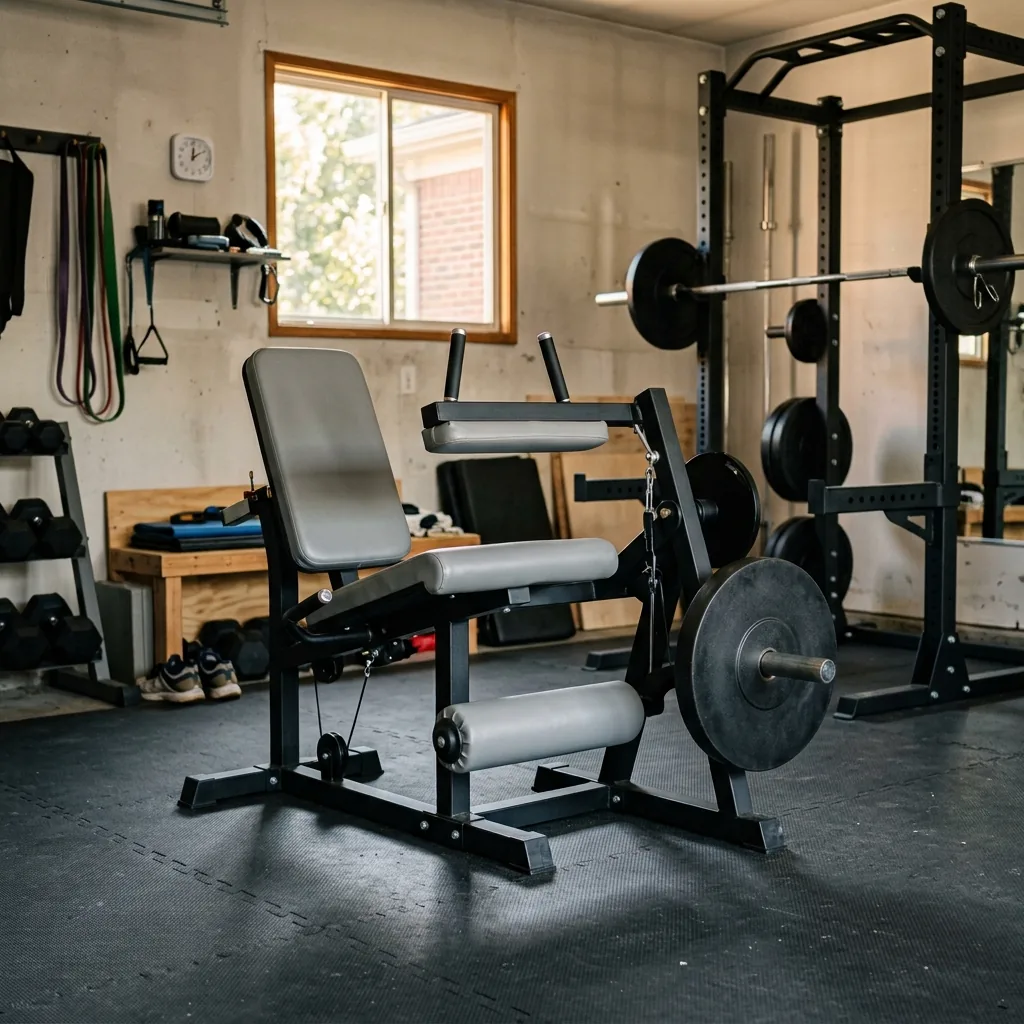
Best quad and hamstring combo: Titan Fitness Leg Extension and Curl Machine
One machine, both isolations. A quick-switch pull-pin flips it from leg curls to leg extensions in seconds, it’s rated to 300 lb, and it loads with the Olympic plates you likely already own. Best for a garage gym that wants direct quad and hamstring work without two separate stations. Roughly $450–$550. View on Amazon
Best glute builder: Core Home Fitness Glute Drive Plus
A no-assembly hip thrust station that pivots to support your spine through the thrust, converts to a flat bench, and folds for storage — it ships with band resistance up to about 190 lb total. Best for lifters who prioritize glutes and are short on floor space. Roughly $450–$600. View on Amazon
Best calf machine: Titan Fitness Seated Calf Raise Machine
Knees locked at 90 degrees to isolate the soleus, dual Olympic sleeves loading up to 550 lb, and four thigh-pad positions. Best if your calves are a weak point and you want serious loadable resistance. Roughly $300–$380. View on Amazon
Budget pick: Fitness Reality X-Class Leg Developer Attachment
The cheapest way onto this list. This preacher-curl-and-leg-developer attachment bolts to a compatible bench or rack, takes up to a 180 lb plate load, and adds leg extensions and curls for a fraction of a standalone machine. Best for a bench-based starter home gym. Roughly $110–$150. View on Amazon
Building the whole room, not just the leg corner? Our home gym workouts guide covers programming around a limited equipment list.
Frequently asked questions
What machines work your legs at the gym?
The core lineup is the leg press, hack squat, leg extension, lying and seated leg curl, hip thrust machine, hip adductor and abductor machines, and standing and seated calf raises. Together they cover quads, hamstrings, glutes, inner and outer thigh, and calves — a full lower body without free weights.
Are leg machines as effective as squats?
For pure muscle growth, yes. A 2023 meta-analysis of 13 studies found no significant hypertrophy difference between machine and free-weight training (Source: BMC Sports Science, Medicine and Rehabilitation, 2023). Squats build more stabilizer strength and athletic carryover, so most lifters use both rather than choosing one.
What is the best leg machine for overall mass?
The leg press. It lets you move the most total load across quads, glutes, and hamstrings with minimal technique or injury risk, which makes it the best single machine for lower-body size. Pair it with a hack squat and direct hamstring curls for complete development.
Which leg machine is best for glutes?
The hip thrust (glute drive) machine. It loads hip extension directly against your glutes at their strongest position, making it the top machine for glute mass. The abductor machine and glute kickback add useful supporting volume for the upper and side glutes.
What is the ham curl machine, and what does it work?
The ham curl machine is the lying or seated leg curl. It isolates the hamstrings through knee flexion — you curl a padded lever toward your glutes. The seated version stretches the hamstrings harder; the lying version keeps constant tension. Both build the back of the thigh.
Can you build legs with machines only?
Yes. Machines can train every lower-body muscle, and research shows machine-only training produces hypertrophy comparable to free weights (Source: BMC Sports Science, Medicine and Rehabilitation, 2023). Combine a leg press or hack squat with curls, extensions, hip thrusts, and calf raises, and progressively add load.
What leg machine is best for beginners?
The leg press. It’s a compound movement with full back support and a fixed path, so you can push meaningful weight safely while learning. Add the leg extension and seated leg curl next. Twelve to fifteen reps, two sessions a week, is a solid starting point.
Is the leg press bad for your knees or back?
Not when used correctly. The leg press is a closed-chain movement that keeps axial spine load lower than a barbell squat, but flexing the knees past 90 degrees or letting your hips curl off the seat raises joint stress (Source: NSCA, Knee Movement and Exercise Guidelines). Keep your lower back flat, stop short of lockout, and control depth.
Sources and references
- Heidel et al. Effect of free-weight vs. machine-based strength training on maximal strength, hypertrophy and jump performance — a systematic review and meta-analysis. BMC Sports Science, Medicine and Rehabilitation, 2023. pmc.ncbi.nlm.nih.gov/articles/PMC10426227
- NSCA. Knee Movement and Exercise Guidelines. nsca.com
- Signorile et al. An Electromyographical Comparison of the Squat and Knee Extension. Journal of Strength & Conditioning Research, 1994. journals.lww.com
- ACSM. Resistance Training Prescription for Muscle Function, Hypertrophy, and Physical Performance in Healthy Adults (2026 position stand). acsm.org
- Fortune Business Insights. Home Fitness Equipment Market Size, Share (2025). fortunebusinessinsights.com
- Planet Fitness. 4 Beginner-Friendly Leg Machines and How to Use Them. planetfitness.com