
Last updated: May 2026 — written by the Gymnase Tips training team.
The U.S. Army Special Forces training program — the pipeline that produces Green Berets — begins with Special Forces Assessment and Selection (SFAS), an 18-day evaluation conducted at Fort Liberty (formerly Fort Bragg) in North Carolina. SFAS is followed by the Special Forces Qualification Course (SFQC, often called the "Q Course"), a 12-to-18 month training pipeline covering language, small unit tactics, military occupational specialty (MOS) skills, and the unconventional warfare exercise known as Robin Sage. To enter SFAS, candidates must meet specific physical, mental, citizenship, and security requirements — and historically, only about 30–40% of candidates pass selection. This guide breaks down the green beret physical requirements, the SFAS structure, the SFQC pipeline, how to prepare, and how Special Forces selection compares to the other special operations pipelines (Ranger RASP, Navy SEAL BUD/S, Marine MARSOC).
Quick reference: Special Forces selection at a glance
| Stage | Length | Location | Pass rate |
|---|---|---|---|
| Special Forces Prep Course (SFPC) | 4 weeks | Fort Liberty, NC | ~85% |
| Special Forces Assessment & Selection (SFAS) | 18 days | Camp Mackall (Fort Liberty) | 30–40% |
| Special Forces Qualification Course (SFQC) | 12–18 months | Fort Liberty + worldwide | ~70% of SFAS-passers |
| Total time to Green Beret tab | ~14–22 months | — | — |
Special Forces physical requirements
To enter the SF training program, candidates must meet baseline physical standards before SFAS even begins:
Army Fitness Test (AFT) score
- Minimum: Pass the AFT Combat Standard (350+ total points, 60+ per event)
- Recommended: 450+ for competitive entry
- See our AFT score chart 2026 for the current scoring tables
Specific physical benchmarks
- 5-mile run: under 40:00 (8:00 mile pace) — recommended
- 12-mile ruck march: under 3:00 with 50-lb ruck — recommended
- 6-mile ruck march: under 1:30 with 35-lb ruck — recommended for SFAS readiness
- Strict pull-ups: 10+ minimum, 15+ recommended
- Swim qualification: 50-meter swim in uniform + boots, then tread water for 5 minutes
The "recommended" numbers reflect what successful SFAS candidates typically demonstrate at arrival — not formal entry requirements, but the realistic level needed to perform under SFAS conditions.
Other green beret physical requirements
- Age: 20–32 at time of application (waivers available)
- Height/weight: Within Army standards for age and height
- Vision: Correctable to 20/20, no color-blindness disqualifications for most MOSs
- Airborne qualified: Required (or to be completed during pipeline)
- Medical clearance: Pass full Class II flight physical
The 18-day SFAS structure
Special Forces Assessment and Selection is graded on four pillars: physical fitness, intelligence, leadership, and resilience. The 18 days are intentionally unpredictable — candidates don’t know which event is graded, when sleep will come, or what the standards are.
Days 1–4: In-processing and baseline tests
- AFT administration
- Land navigation written test
- Swim qualification
- Initial briefings and gear issue
Days 5–9: Land navigation phase
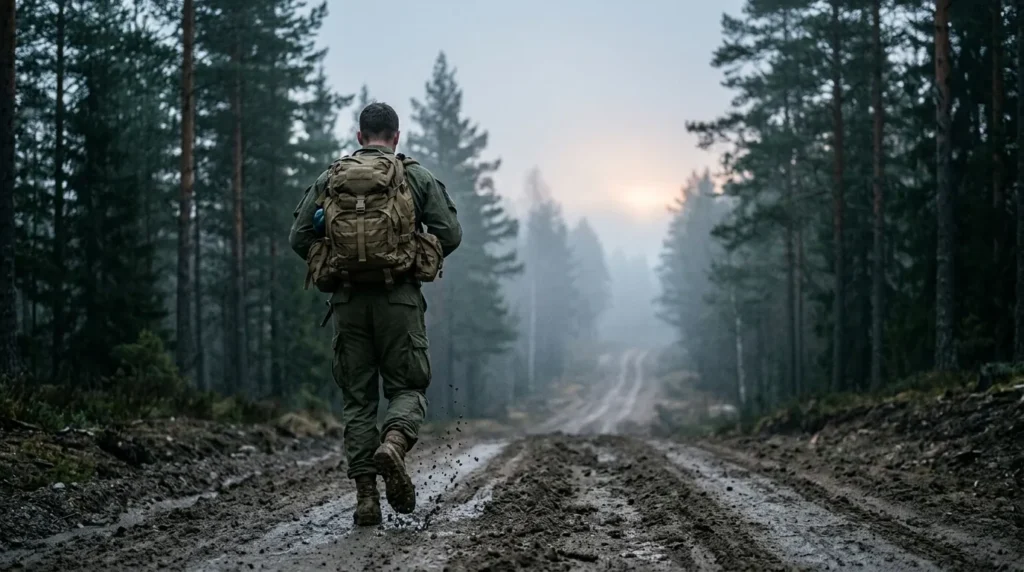
The defining stage of SFAS. Candidates conduct STAR course — multiple long-distance, point-to-point land navigation events with rucksacks, on rough terrain, day and night, with strict time limits. Failure to find points in time = drop. Most candidates wash out here.
- Day land navigation: 18 km with full ruck
- Night land navigation: 12 km with full ruck
- Multiple consecutive days of navigation
- Cumulative fatigue is the test
Days 10–14: Team week
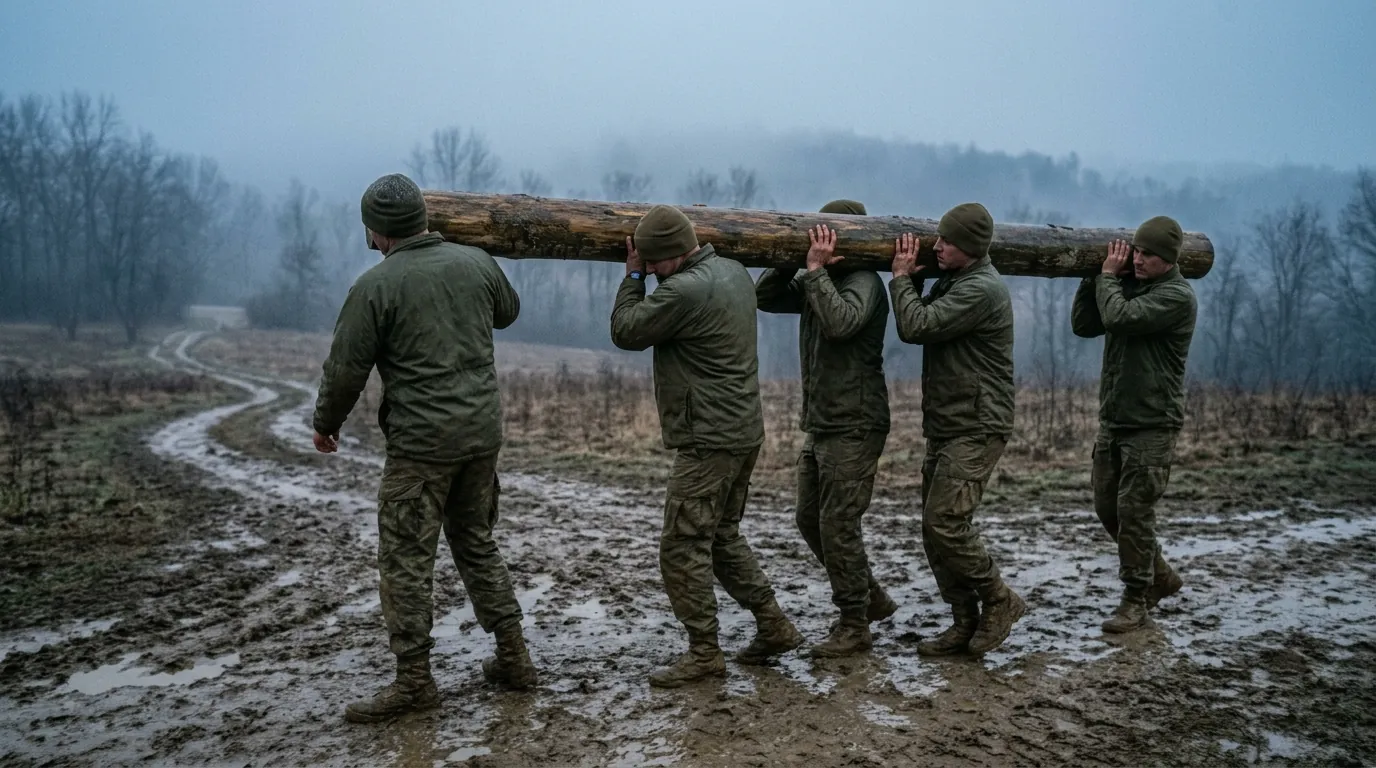
Candidates rotate through small-unit problem-solving events that emphasize teamwork and leadership. Cadre observe how candidates lead, follow, communicate under stress, and handle failure.
- Log PT (carrying telephone-pole-sized logs as a team)
- Stretcher carries with simulated casualties
- Boat carries
- Obstacle problem-solving
Days 15–18: Final boards and selection
- Psychological evaluation
- Cadre boards review each candidate
- Select / non-select decisions
About 30–40% of candidates earn "select" status. The rest are returned to their previous units.
The SFQC: 12–18 months of follow-on training
Selected candidates enter the Special Forces Qualification Course (SFQC), divided into phases:
Phase I: SFQC Phase 1 (Small unit tactics)
Approximately 6 weeks. Covers basic infantry skills at the Special Forces level — patrolling, ambushes, raids, reconnaissance.
Phase II: MOS training
8–12 weeks depending on MOS. Each Green Beret is trained in one of 5 specialties:
- 18A: Officer / Detachment Commander
- 18B: Weapons Sergeant
- 18C: Engineer Sergeant
- 18D: Medical Sergeant (the longest pipeline — up to 50 weeks)
- 18E: Communications Sergeant
Phase III: Robin Sage
The capstone exercise. Candidates spend 4 weeks in the fictional country of "Pineland" (exercise area in rural North Carolina) conducting unconventional warfare alongside role-playing guerrilla forces. Pass Robin Sage and you graduate the Q Course.
Phase IV: SERE School
Survival, Evasion, Resistance, and Escape training. 3 weeks. Required before deployment.
Phase V: Language training
13–25 weeks at the Defense Language Institute. Each Green Beret learns a language relevant to their assigned regional command (e.g., Spanish for SOUTHCOM, Arabic for CENTCOM, Korean for INDOPACOM).
After completing all phases, the candidate earns the green beret and is assigned to an operational Special Forces Group.
How to prepare for the special forces training program
A 6-month SFAS prep block:
Months 1–2: Build aerobic base
- 4 runs per week, mix of easy and tempo
- 2 ruck marches per week, building from 4 miles at 30 lb to 8 miles at 45 lb
- Strength training 3 days/week (compound lifts: deadlift, squat, bench, overhead press, pull-ups)
- Calisthenics 2 days/week (volume work for push-ups, sit-ups, pull-ups)
Months 3–4: Increase ruck volume
- 1 long ruck per week (12+ miles at 50 lb)
- 1 fast ruck per week (6 miles under 1:30 at 35 lb)
- Running drops to 3 sessions/week (one tempo, one interval, one long)
- Strength training maintained at 3 days/week
- Add land navigation practice (compass + map work)
Months 5–6: SFAS-specific simulation
- Multi-day weekend events combining navigation, ruck, and physical work
- Sleep-deprivation training (one week of 4–5 hours sleep nightly)
- Pull-up volume increased (target 15+ strict reps)
- Swim qualification drilled regularly
- Final 2 weeks: tapered volume, focused recovery
For the bodyweight strength component, our Army PRT drills, 28-day military workout, and how to get better at pull-ups guides give the rep targets and progression structure that align with SFAS physical demands.
SF vs Rangers vs SEALs vs MARSOC: how the special forces training program compares
| Program | Selection length | Pass rate | Primary focus | Total pipeline |
|---|---|---|---|---|
| Army Special Forces | 18 days SFAS | 30–40% | Unconventional warfare, foreign internal defense | 14–22 months |
| Army Rangers | 8 weeks RASP | ~50% | Direct-action raids, airfield seizures | 4–6 months |
| Navy SEALs | 24 weeks BUD/S | ~25% | Maritime special operations | 12–18 months |
| Marine MARSOC | A&S 23 days + ITC 9 months | ~35% (A&S) | Foreign internal defense, special reconnaissance | 9–12 months |
| Air Force PJ | 22 weeks pipeline | ~20% | Combat search and rescue | 18–24 months |
Each pipeline has a different selection signature. SFAS emphasizes intelligence, leadership, and the ability to function alone for extended periods. BUD/S emphasizes physical and mental toughness in a maritime environment. RASP emphasizes the ability to perform direct-action infantry tasks at elite standard.
For comparison data on Navy SEAL physical requirements, see our dedicated Navy SEAL physical requirements guide.
Common reasons candidates fail SFAS
The post-SFAS debrief identifies a consistent set of failure modes:
- Land navigation breakdown. Most washouts happen on the STAR course days. Candidates who don’t practice land navigation under fatigue conditions before SFAS struggle when sleep-deprived.
- Insufficient ruck conditioning. SFAS includes 100+ miles of rucking across the 18 days. Candidates who haven’t built up to 12+ mile rucks at 50 lb beforehand can’t recover between events.
- Quitting under fatigue. "Voluntary withdrawal" (VW) is the most common failure mode after physical injury. Candidates who haven’t trained sleep deprivation or accumulated fatigue mistake "tired" for "broken."
- Team-week conflict. Some candidates are physically capable but can’t function within a team under stress. Cadre identify these patterns quickly during team week.
- Injury. Stress fractures (from inadequate ruck preparation) and shin splints account for 5–10% of medical drops.
How long does it take to become a Green Beret?
From initial Special Forces volunteer status to operational Green Beret typically takes:
- 2 months: Special Forces Prep Course (SFPC)
- 18 days: SFAS
- 12–18 months: SFQC (varies by MOS and language assignment)
- Total: Approximately 14–22 months from joining the SF pipeline to earning the green beret
Add another 6–12 months for full operational deployment readiness with an SF team.
Special Forces training program FAQ
What’s the difference between Special Forces and Special Operations?
"Special Forces" refers specifically to the U.S. Army Green Berets. "Special Operations" is the umbrella term covering all elite military units: Special Forces, Rangers, Delta Force, Navy SEALs, MARSOC, Air Force PJs and CCT, etc. All Special Forces are Special Operations; not all Special Operations are Special Forces.
Can women apply for Special Forces?
Yes. As of 2016, all special operations roles are open to qualified women. Female candidates must meet the same physical and operational standards. The first female SFAS graduate completed selection in 2020.
Do I need prior military experience?
The "18X" program (also called the SF Direct Recruit program) allows civilians to enlist directly with a Special Forces contract. They go through Basic Combat Training, Advanced Individual Training as Infantry, Airborne School, and then enter the SF pipeline. Most successful 18X candidates have backgrounds in athletics, outdoor skills, or strong academic performance.
What’s the SF physical training like at SFAS?
Heavy emphasis on rucking under load, distance running, and team-based physical events (log PT, boat carries, stretcher carries). The events themselves aren’t more physically demanding than other special operations selections — what makes SFAS difficult is the cumulative fatigue across 18 days of sleep-deprivation and the cognitive demand of land navigation while exhausted.
What MOSs (jobs) are available in Special Forces?
Five enlisted SF MOSs: 18A (officer), 18B (weapons), 18C (engineer), 18D (medical), 18E (communications). All Green Berets are trained in one specialty plus cross-trained in basics of the others.
How much does a Green Beret get paid?
Base pay follows standard Army rank, plus several special pays: Special Duty Assignment Pay, Foreign Language Proficiency Pay, Jump Pay, and (for deployed soldiers) Hostile Fire Pay. A Staff Sergeant (E-6) Green Beret typically earns $55,000–80,000 annually depending on family status, location, and active deployments.
Where are Green Berets deployed?
Worldwide. Each of the 5 active-duty SF Groups has a regional alignment: 1st Group (Pacific), 3rd Group (Africa), 5th Group (Middle East), 7th Group (Latin America), 10th Group (Europe). Two National Guard SF Groups (19th and 20th) operate alongside.
Is Special Forces harder than BUD/S?
Different. BUD/S is more physically punishing in raw intensity (Hell Week, surf torture, the cold-water emphasis). SFAS is more cognitively demanding under fatigue (land navigation while sleep-deprived for days). Pass rates are similar (25–40% across both), suggesting both pipelines select equally hard for different qualities.
What’s the average age of a Green Beret?
Operational Green Berets average mid-to-late 20s, with senior NCOs and Warrant Officers in their 30s–40s. The mid-grade NCO Green Beret (E-6/E-7) is the operational core of the SF teams.
The bottom line: The Special Forces training program is the longest and most diverse in U.S. military special operations — 14–22 months from initial selection to green beret, covering physical fitness, leadership, language, and unconventional warfare. SFAS (18 days) is the gateway and where most candidates wash out, primarily during land navigation under fatigue. Green beret physical requirements include passing the AFT Combat Standard, completing 12-mile rucks under 3 hours, and demonstrating swim qualification in uniform. For SFAS-specific bodyweight prep see our Army PRT drills, Navy SEAL physical requirements, how to get better at pull-ups, and 8-week military calisthenics plan guides.


Pingback: Army Ranger Workout Plan: 12-Week RASP Selection Prep (2026)
Pingback: Marine Corps PFT 2026: Scoring, Standards & How to Train