
Last updated: May 2026 — written by the Gymnase Tips training team.
The inverted push-up is a vertical pressing exercise performed with the body in a pike position — hips raised high, hands and feet close together on the floor, head lowering toward the floor between the hands. It targets the deltoids, upper traps, triceps, and the upper portion of the chest, and serves as the primary stepping stone between the standard push-up and the handstand push-up. Most lifters who can do 20+ standard push-ups can perform their first 3–5 strict inverted push-ups within a single training session of dedicated practice, and the rep count climbs fast with structured volume work. This guide covers the proper form, the 4-step progression from standard push-up to handstand push-up, the common mistakes that limit gains, and a 6-week program that takes most trainees from "can’t hold a pike" to "10 strict inverted push-ups."
What is an inverted push-up?
The inverted push-up is the bodyweight calisthenics movement that bridges horizontal pressing (standard push-up, bench press) and full vertical pressing (handstand push-up, overhead press). Body position:
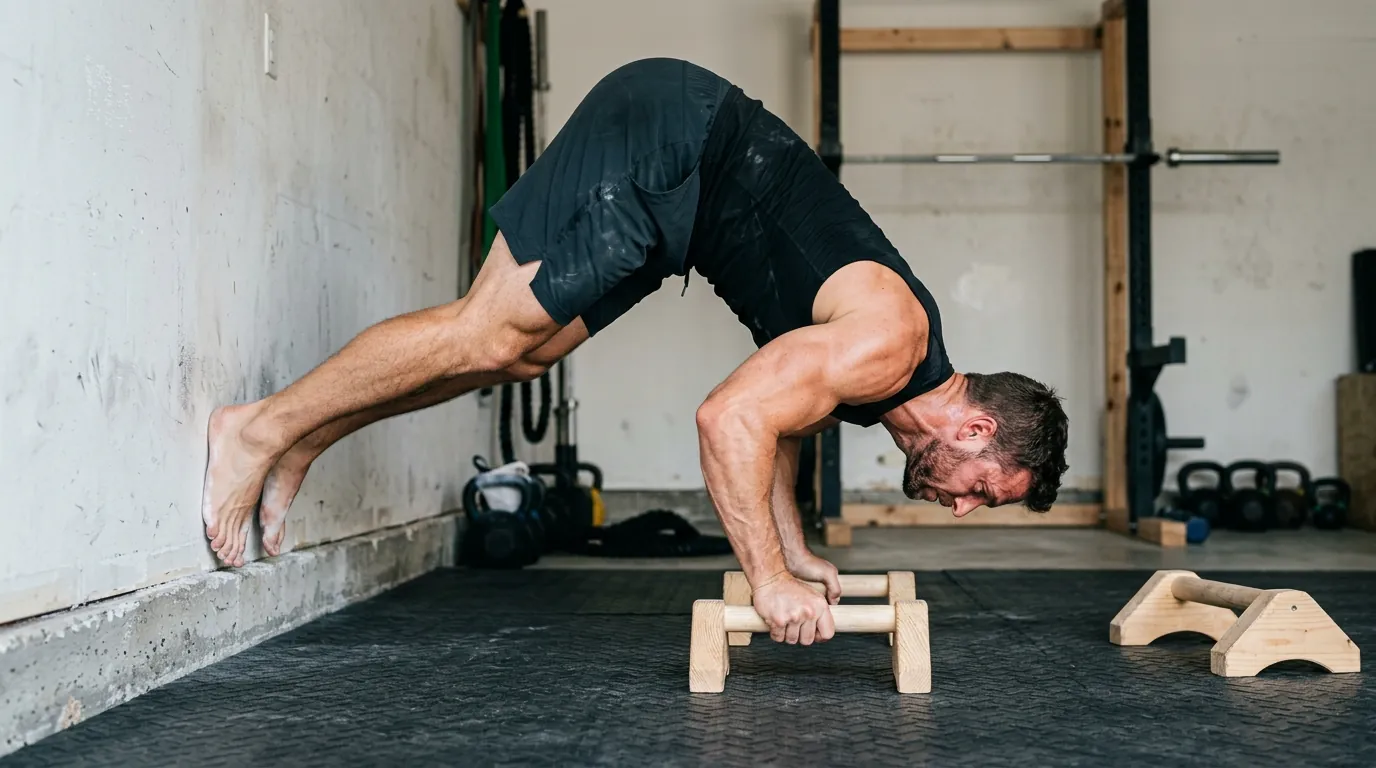
- Hands shoulder-width on the floor
- Feet close to hands (12–24 inches behind hand position)
- Hips piked high — the highest point of the body
- Body in an inverted-V shape
- Head lowering toward the floor between the hands as you press down
- Press back up to starting pike position
The "inversion" refers to the body being upside-down relative to a normal push-up — the pressing direction changes from horizontal to near-vertical. The closer your feet are to your hands, the closer to vertical the press becomes, and the harder the exercise. Soldiers often use the inverted push-up as preparation for the handstand push-up; gymnasts and calisthenics athletes use it as a programmable stand-alone strength movement.
Why train inverted push-ups?
Three reasons calisthenics athletes program inverted push-ups:
- Vertical pressing strength without weights. The standard push-up trains horizontal pressing only. Without dedicated vertical work, deltoid and upper-trap strength lags behind chest and triceps.
- Handstand push-up preparation. Going straight from push-ups to free-standing handstand push-ups is too big a strength jump. Inverted push-ups bridge the gap.
- Shoulder mobility and stability. Holding the inverted-V position trains shoulder flexion mobility, scapular upward rotation, and overhead stability — qualities that protect the shoulder under any vertical load.
It’s also a portable, equipment-free way to train the overhead press pattern. Travel, deployed, or training at home — the inverted push-up needs nothing but floor space.
Proper inverted push-up form
The setup
- Start in a standard push-up position
- Walk your feet toward your hands until your hips pike up sharply
- Hands shoulder-width, fingers spread, weight even across all four corners of each hand
- Head between the arms (not in front of them), eyes looking back at your feet
- Body forms a roughly 90-degree angle at the hips
The descent
- Bend at the elbows, lowering your head toward the floor between your hands
- Elbows track at roughly 45 degrees out from the body (not flared 90 degrees, not pinned to the body)
- Lower under control over 1.5–2 seconds
- Stop just before your forehead touches the floor (or touch lightly)
The press
- Press back up by extending the elbows
- Don’t rebound off the floor — pause briefly at the bottom, then press
- Lock out at the top, briefly hold the pike position, then descend again
- Maintain the pike throughout — don’t sag the hips or let them shift backward
The most common form fault is letting the head drift in front of the hands during the descent. This is a sign of insufficient shoulder mobility — the inverted push-up requires roughly 180 degrees of shoulder flexion, and many lifters lack that range. Work on shoulder mobility (downward dog stretches, doorway stretches) until you can keep your head between your hands throughout the rep.
The 4-step progression: from push-up to handstand push-up
Step 1: Standard push-up (horizontal press)
Build to 20+ strict push-ups in a single set before moving to inverted variations. If you can’t do 20 push-ups, the inverted push-up will reinforce poor form patterns. Spend 4–8 weeks building horizontal pressing volume first.
Step 2: Pike push-up (semi-vertical press)
The pike push-up is the "easy" inverted push-up — feet stay 24+ inches behind the hands, hip pike is shallow, the press direction is roughly 60 degrees from horizontal. Target: 15+ strict pike push-ups.
Step 3: Inverted push-up (steep vertical press)
Walk feet closer to hands (12–18 inches), hips piked high, near-vertical press direction. Head lowers to the floor between the hands. Target: 10+ strict inverted push-ups.
Step 4: Wall handstand push-up (full vertical press)
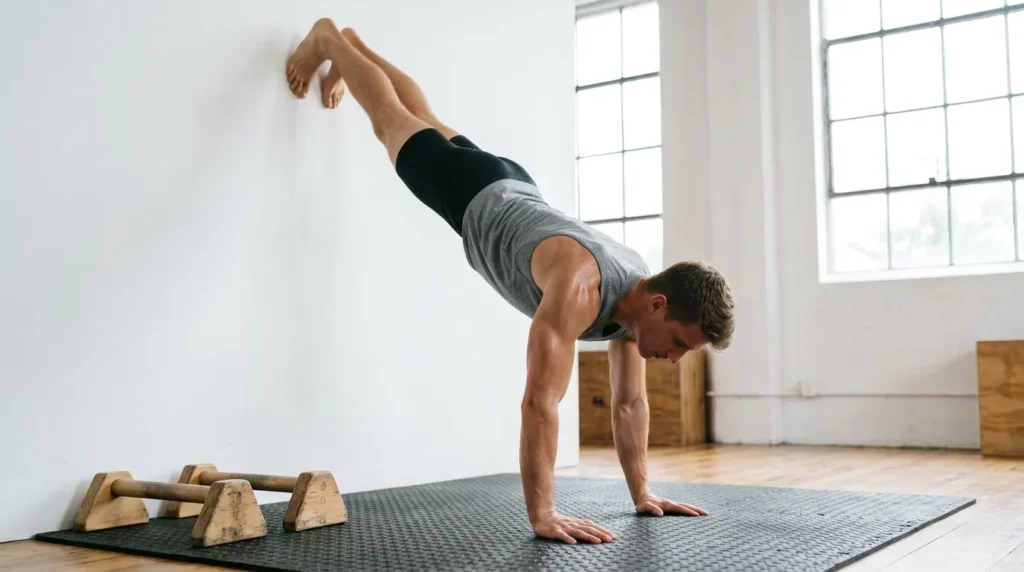
Hands 6–12 inches from a wall, kick up into a handstand with feet against the wall for balance, lower head to floor and press back up. Target: 5+ strict wall handstand push-ups.
Step 5 (advanced): Free-standing handstand push-up
Same as step 4 but without the wall. Requires both pressing strength AND balance — the balance component takes most calisthenics athletes 6–12 months of dedicated handstand practice independent of strength training.
Most lifters spend 6–10 weeks at each step. Don’t skip steps; the strength curve and shoulder mobility requirements ramp up at each level.
6-week inverted push-up program
For lifters who can already do 20 push-ups but 0 inverted push-ups. Goal: build to 8–10 strict inverted push-ups in 6 weeks.
Frequency: 3 days per week
Train inverted push-ups on the same days as your push-up sessions, but FRESH (before push-ups, not after). The inverted variation is more taxing — train it first.
Week 1–2: Pike push-up base
- 4 sets of 8 pike push-ups, 90 seconds rest
- Add 1 negative inverted push-up (descent only) at end of each session, 3 reps
- Goal: clean pike push-up form, build descent control
Week 3–4: Inverted push-up volume
- 4 sets of 6 strict inverted push-ups (or as many as possible up to 6), 90 seconds rest
- 2 sets of pike push-ups at end (8–10 reps each)
- Goal: first reps of full inverted push-up
Week 5: Density push
- 4 sets of 7 inverted push-ups, 60 seconds rest
- 1 set max-effort inverted push-ups at end of session (track this number)
- Goal: rep count climbing week-over-week
Week 6: Test + deload
- Mon: light session, 3 × 5 inverted push-ups
- Wed: rest from pressing
- Fri: test day — warm up, then 2 max-effort sets, 5 minutes rest between, take the higher number
Most lifters who follow this program land at 8–12 strict inverted push-ups by test day.
5 inverted push-up variations
| Variation | Difficulty | Best for |
|---|---|---|
| Pike push-up (shallow) | 4/10 | Beginners building toward inverted |
| Inverted push-up (steep) | 6/10 | Standard goal movement |
| Elevated-feet inverted push-up | 7/10 | Steeper angle, more vertical |
| Wall-supported inverted push-up | 7/10 | Adding wall for steep angle support |
| Deficit inverted push-up | 8/10 | Hands on parallettes for deeper ROM |
| Wall handstand push-up | 8/10 | Full vertical press |
Common inverted push-up mistakes
- Head drifting in front of hands. Sign of insufficient shoulder mobility. Add daily downward-dog stretching and doorway flexion work for 6+ weeks before pushing inverted push-up volume.
- Sagging hips during descent. The pike must hold throughout the rep. If hips drop, you’ve turned the movement back into a horizontal push-up. Cue: "press the hips up to the ceiling" throughout.
- Bouncing off the floor. Each rep should pause briefly at the bottom. Bouncing builds momentum patterns that don’t transfer to weighted overhead pressing.
- Flared elbows. Elbows should track at 45 degrees from the body, not 90 degrees. Flared elbows put unnecessary stress on the rotator cuff.
- Skipping pike push-ups. Going straight from standard push-ups to inverted push-ups skips a meaningful adaptation phase. The pike push-up isn’t optional in the progression — it’s a 4–6 week stepping stone.
- Training inverted push-ups when fatigued. Programming them at the end of a 60-minute upper-body session means you’re testing leftover capacity, not building strength. Fresh sessions only.
Inverted push-up vs handstand push-up
| Factor | Inverted push-up | Handstand push-up |
|---|---|---|
| Body position | Pike (V-shape) | Vertical (line) |
| Press direction | ~80 degrees from horizontal | 90 degrees (true vertical) |
| Strength required | High | Very high |
| Balance required | Minimal | Significant (or wall) |
| Mobility required | High | Very high |
| Programmable volume | High | Lower (CNS cost) |
The handstand push-up is the goal movement for many calisthenics athletes; the inverted push-up is the practical training tool that builds the strength to perform it. Most calisthenics programs use 3–5 sets of 8–10 inverted push-ups as the primary vertical pressing volume, with 1–2 sets of handstand push-ups as the heavy max-effort capstone.
How inverted push-ups fit into a military-style training program
The inverted push-up isn’t typically tested in military fitness assessments (the Army AFT uses hand-release push-ups, the Navy SEAL PST uses standard push-ups). But it has high transfer to military-relevant tasks: shouldering rucks, reaching overhead under load, climbing rope, climbing walls. It also serves as a high-quality unilateral preparation: once you can do 10 strict inverted push-ups, single-arm push-up progressions become feasible.
For military-style programs that include vertical pressing work see our Army PRT drills (the Preparation Drill includes pressing patterns) and our Navy SEAL calisthenics workout for SEAL-style upper-body conditioning.
Inverted push-up FAQ
Are inverted push-ups the same as pike push-ups?
Closely related but not identical. Pike push-ups are the easier version with feet farther from hands and a shallower pike. Inverted push-ups are the steeper version with feet close to hands and a near-vertical press direction. Pike push-ups are the progression step before inverted push-ups.
How many inverted push-ups should I aim for?
10 strict inverted push-ups is the threshold most calisthenics programs treat as "competent vertical pressing." Below that, you’re still in the building phase. Above 15, you have the strength baseline to start training wall handstand push-ups.
Are inverted push-ups bad for the neck?
Done with proper form, no — the load distributes through the arms and shoulders, not the neck or head. Touching the head lightly to the floor at the bottom is fine; resting weight on the head (head-driven inversion) is not. If your neck feels stressed, your form is wrong: shorten the range of motion or step back to pike push-ups.
Can inverted push-ups replace shoulder presses?
For bodyweight athletes, yes. For lifters whose primary goal is overhead strength, weighted overhead pressing builds maximum strength faster. The two complement each other; many calisthenics + strength athletes program both.
How long until I can do a handstand push-up?
If you can already do 10 strict inverted push-ups, expect 6–10 weeks to your first wall handstand push-up. Free-standing handstand push-ups take an additional 6–12 months for most lifters because of the balance requirement.
Should I do inverted push-ups every day?
No. Inverted push-ups are a high-CNS-cost movement and respond to 2–3 sessions per week. Daily training leads to plateau and shoulder irritation.
Why do inverted push-ups feel harder than push-ups?
Two reasons: vertical pressing recruits more deltoid and upper trap (smaller muscle groups than the chest used in horizontal pressing), and the pike position eliminates the chest’s ability to contribute much force. The strength jump from horizontal to vertical pressing is significant for most lifters.
Can I do inverted push-ups if my shoulders are tight?
Only if you can hold a clean pike position with your head between (not in front of) your hands. If your shoulders restrict that, build mobility first via downward-dog stretches and doorway flexion stretches for 6+ weeks before adding inverted push-up volume.
The bottom line: the inverted push-up is the bridge between horizontal push-ups and handstand push-ups — the calisthenics movement that builds vertical pressing strength without weights. Build to 20+ standard push-ups first, then progress through pike push-up → inverted push-up → wall handstand push-up over 4–6 months. The 6-week program above takes most lifters from 0 to 8–10 strict reps. For pull-up balance to your pressing work, see our how to get better at pull-ups guide. For full upper-body bodyweight programming see our Army PRT drills, 28-day military workout, and 8-week military calisthenics plan.



Pingback: Air Force PT Test 2026: New PFRA Standards & How to Train