
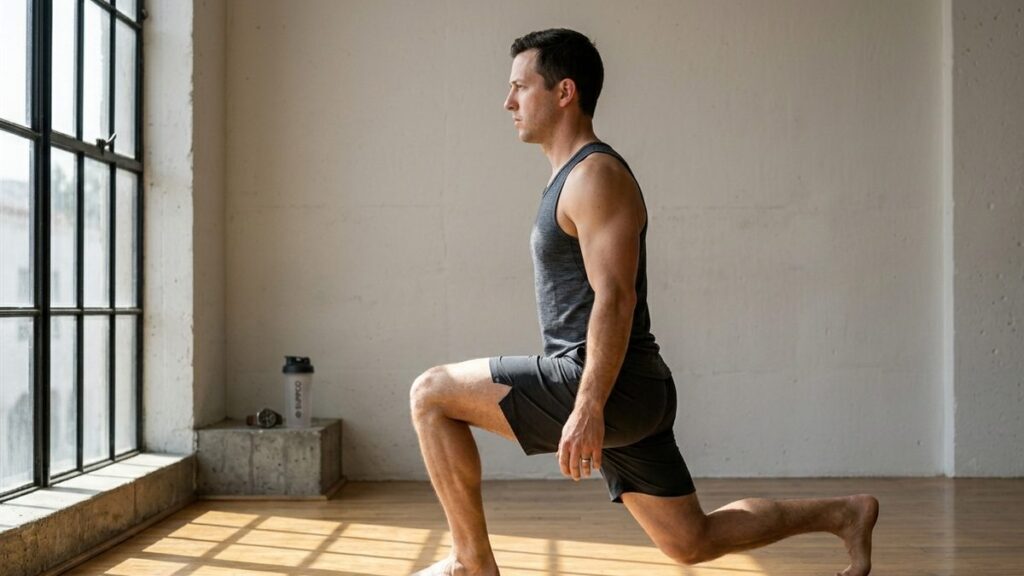
Last updated: May 2026 — written by James Nolan, Gymnase Tips senior trainer. Designed for home trainees with zero equipment.
A lower body workout without equipment can build serious leg, glute, and hamstring strength when it uses unilateral exercises (Bulgarian split squats, single-leg glute bridges, pistol progressions) rather than just high-rep bodyweight squats. Two sessions per week with 5 to 6 exercises per session, mixing bilateral strength moves with unilateral hypertrophy work, produces measurable lower-body development over 4 to 8 weeks. The plan below requires zero equipment beyond a chair or bench for elevated foot work and uses progressive variation difficulty rather than just rep accumulation to keep the stimulus growing.
This is the 4-week lower body plan for trainees with no gym access who want real leg development — with a warm-up, rest prescriptions, scaling rules, and the unilateral logic that makes it work.
Why Unilateral Work Matters Most
Bodyweight squats stop building muscle once you can do 30+ strict reps — the limiting factor becomes muscular endurance, not strength. Unilateral exercises (Bulgarian split squats, single-leg glute bridges, pistol progressions) load each leg with up to 80% of body weight, putting the working leg in the 8 to 12 rep hypertrophy zone where mass actually builds.
The principle in one sentence: once high-rep bodyweight squats become easy, the leg needs unilateral loading to keep progressing, not more reps.
Weekly Schedule
- Monday: Lower Body A (quad-dominant)
- Thursday: Lower Body B (posterior chain emphasis)
- Tuesday / Friday: 20 to 30 minutes of upper body or active recovery
- Wednesday / Weekend: rest or walking
Two leg sessions per week is the right starting frequency for bodyweight training. Three works for advanced trainees with carefully managed volume, but most home lifters get more progress from 2 quality sessions than 3 fatigued ones.
5-Minute Warm-Up
- 30 seconds jumping jacks or jogging in place
- 10 hip circles each direction
- 10 leg swings each leg, front to back
- 10 bodyweight squats at slow tempo
- 10 walking lunges
Lower Body A — Quad Focus
- Bulgarian split squats — 4 sets of 8 to 12 per leg [90 sec between sides]
- Bodyweight squats (slow tempo, 3-sec descent) — 4 sets of 15 to 25 [90 sec]
- Reverse lunges — 3 sets of 10 per leg [75 sec]
- Step-ups (onto chair or bench) — 3 sets of 10 per leg [75 sec]
- Wall sit — 3 sets of 45 to 60 seconds [60 sec]
Lower Body B — Posterior Chain
- Single-leg glute bridges — 4 sets of 10 to 12 per side [60 sec]
- Hip thrusts (shoulders on chair) — 4 sets of 12 to 15 [75 sec]
- Nordic curls (assisted, hands ready to catch) — 3 sets of 5 to 8 [2 min]
- Cossack squats — 3 sets of 6 to 8 per side [90 sec]
- Calf raises (single leg) — 4 sets of 15 to 25 per side [45 sec]
Note on Nordic curls: these are extremely demanding. Start with hands ready to catch yourself, control as much of the lowering phase as you can, and use your hands to push back up. A negative rep that ends with you catching yourself at 70% is still a productive rep — don’t expect full reps for the first 6 to 12 weeks.
4-Week Progression
- Week 1 — Establish. Lower end of every rep range. Focus on slow tempo — 3-second descent on every rep. Record sets.
- Week 2 — Add reps. Add 1 to 2 reps per set on anything you finished at the low end of the range last week.
- Week 3 — Top of every rep range. Slow the eccentric further — 4-second descent. This dramatically increases time under tension without needing more reps.
- Week 4 — Add a set or graduate. Add a 5th set to Bulgarian split squats and bodyweight squats. Advanced trainees: introduce assisted pistol squats (holding a doorframe for balance) for 3 sets of 5 per leg.
Form Priorities
- Bulgarian split squats: back foot on the chair, front foot far enough forward that the front knee tracks over the ankle at the bottom. Lower until the back knee almost touches floor.
- Step-ups: drive through the front heel, don’t push off the back foot. The back foot is for balance, not propulsion.
- Single-leg glute bridges: drive through the working heel, squeeze the glute hard at the top, lower under control. Keep hips level — the non-working side shouldn’t dip.
- Cossack squats: sit deep into one side with that foot flat, opposite leg straight with foot flexed. Knee tracks over the working foot, not collapsing inward.
If the Plan Is Too Hard — or Too Easy
If you can’t hit the lower end of a rep range:
- Bulgarian split squats → stationary split squats with hand on a wall
- Nordic curls → banded Nordic curls, or eccentric-only at lower angles
- Cossack squats → lateral lunges (less depth, both feet stay flat)
- Single-leg glute bridges → two-leg glute bridges
If everything feels too easy by week 2: you’re past beginner level. Progress to assisted pistol squats, shrimp squats, and weighted variations (filling a backpack with books works). See our 12 bodyweight leg exercises ranked by difficulty for the harder progressions.
What to Expect at the End of Week 4
- Bulgarian split squat: +3 to 5 reps per leg on max set
- Bodyweight squat: +10 to 20 reps on max set with slow tempo
- Glute bridge: noticeably stronger lockout, glutes that actually feel sore the day after training
- Visible change: firmer quad sweep and glute shape in 6 to 10 weeks; meaningful muscle thickness takes 12+ weeks
Lower Body Workout FAQ
Can you build legs without weights or machines?
Yes — for the first 12 to 24 months of training. Unilateral exercises plus advanced variations (pistols, shrimps, Nordic curls) provide adequate load for hypertrophy. Beyond that, weighted variations or external loading become important for continued mass gain on the largest muscle group in the body.
How often should I train legs without equipment?
Twice per week is optimal — bodyweight leg work is less neurally fatiguing than heavy barbell training, but the connective tissues still need recovery. Some advanced trainees handle 3 sessions weekly when split into easy/medium/hard days.
Are bodyweight squats enough for legs?
Not after the first 2 to 3 months. Once you can do 30+ strict bodyweight squats, hypertrophy stalls. From that point, unilateral work and harder variations drive continued progress.
Why are my legs so sore after these workouts?
Slow-tempo bodyweight work produces significant muscle damage — expect serious DOMS for the first 2 to 3 weeks, then it subsides as the muscle adapts. Walking the next day helps; complete rest sometimes makes soreness worse. If soreness is still severe at week 4, drop volume by 25% for the next week, then build back up.
The bottom line: a lower body workout without equipment works when it leans on unilateral movements, slow tempo, and progressive variation difficulty — not high-rep bodyweight squats alone. Warm up, train twice per week, progress weekly, and respect the soreness in the first 2 weeks. For the broader leg system, see our bodyweight leg workouts guide.

Pingback: Leg Strengthening Exercises for Seniors: 10 Safe Moves