
Last updated: May 2026 — written by the Gymnase Tips training team.
Home gym workouts are structured training sessions you can perform in a small space — typically a bedroom, garage, or living room — using nothing more than bodyweight, a pair of dumbbells, a pull-up bar, or resistance bands. The 12 routines below cover push, pull, legs, full-body strength, conditioning, and mobility — each one tested to work in under 250 square feet and 45 minutes.
You don’t need a rack, a bench, or a $3,000 cable stack to make progress. What you need is a small set of versatile tools, a plan that rotates push and pull patterns through the week, and the discipline to actually walk into the room and start. Below, we’ll cover the minimum equipment list, then the 12 routines, then how to combine them into a full week.
Minimum equipment for a home gym
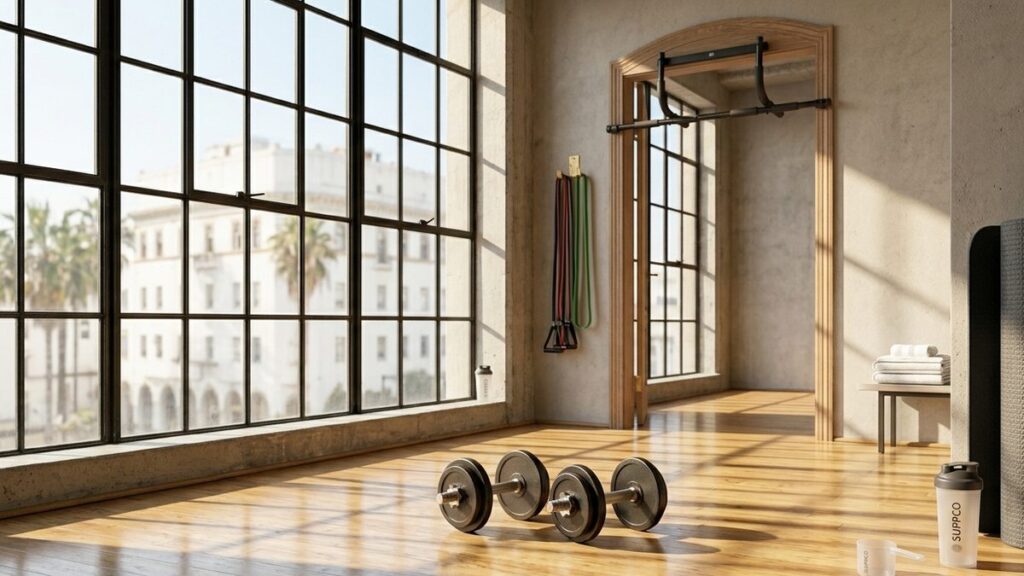
You can run all 12 routines below with just three pieces of gear. Total cost: under $200 if you shop carefully.
- Adjustable dumbbells (10–50 lb pair): handles 80% of resistance work.
- Doorframe pull-up bar: unlocks vertical pulling, hangs, leg raises.
- Resistance bands (light + heavy loop): for assistance, mobility, and travel days.
Optional but useful: a yoga mat, a sturdy chair (for dips and elevated push-ups), and a kettlebell if you want explosive conditioning options. The U.S. Physical Activity Guidelines recommend at least 150 minutes of moderate activity plus 2 strength sessions per week — every routine below counts toward that minimum.
The 12 home gym workouts
1. Bodyweight Push Day (30 min)
- Push-ups — 4 × max
- Pike push-ups — 3 × 10
- Diamond push-ups — 3 × max
- Decline push-ups — 3 × 12
- Plank — 3 × 60 sec
For variations, see our full push-up variations guide.
2. Bodyweight Pull Day (30 min)
- Pull-ups — 5 × max
- Inverted rows (under a sturdy table) — 4 × 12
- Dead hangs — 3 × 30 sec
- Scapular pulls — 3 × 10
3. Dumbbell Push Day (40 min)
- Floor press — 4 × 8
- Standing overhead press — 3 × 10
- Lateral raises — 3 × 15
- Overhead tricep extension — 3 × 12
4. Dumbbell Pull Day (40 min)
- Bent-over rows — 4 × 10
- Single-arm rows — 3 × 12 each
- Hammer curls — 3 × 12
- Rear delt fly — 3 × 15
5. Bodyweight Leg Day (35 min)
- Squats — 4 × 20
- Bulgarian split squats — 3 × 10 each
- Pistol squat progression — 3 × 5 each
- Calf raises — 4 × 25
More options in our bodyweight leg workouts guide.
6. Dumbbell Leg Day (40 min)
- Goblet squats — 4 × 12
- Romanian deadlifts — 4 × 10
- Walking lunges — 3 × 12 each
- Calf raises (loaded) — 4 × 20
7. Full-Body Dumbbell Circuit (30 min)
Five rounds, 45 sec work / 15 sec rest:
- Goblet squats
- Floor press
- Bent-over rows
- Romanian deadlifts
- Push press
8. Bodyweight HIIT (20 min)
Eight rounds, 30 sec work / 15 sec rest:
- Burpees
- Mountain climbers
- Jump squats
- Push-ups
9. Resistance Band Full Body (35 min)
- Banded squats — 4 × 15
- Banded rows — 4 × 12
- Banded overhead press — 3 × 12
- Banded pull-aparts — 3 × 20
- Banded hip thrusts — 3 × 15
10. Hybrid Push (Dumbbells + Bodyweight) (40 min)
- Floor press — 4 × 8
- Push-ups — 3 × max
- Lateral raises — 3 × 15
- Pike push-ups — 3 × 10
11. Hybrid Pull (Dumbbells + Bodyweight) (40 min)
- Pull-ups — 4 × max
- Single-arm rows — 3 × 12 each
- Inverted rows — 3 × 12
- Hammer curls — 3 × 12
This pairs well with our pull-up variations guide if you want to swap grips week to week.
12. Mobility + Recovery (25 min)
- Cat-cow — 2 × 10
- World’s greatest stretch — 2 × 5 each
- Deep squat hold — 3 × 60 sec
- Couch stretch — 2 × 60 sec each
- Dead hang — 2 × 30 sec
- Foam rolling — 5 min
How to combine the 12 routines into a week
Pick one of the three weekly templates below depending on your goal. All three rotate the 12 routines so you train each pattern twice and recover adequately.
Strength template (5 days)
- Mon: Routine 3 (DB Push)
- Tue: Routine 4 (DB Pull)
- Wed: Routine 6 (DB Legs)
- Thu: Routine 10 (Hybrid Push)
- Fri: Routine 11 (Hybrid Pull)
- Sat–Sun: Routine 12 (Mobility) or rest
Bodyweight template (4 days)
- Mon: Routine 1 (BW Push)
- Tue: Routine 2 (BW Pull)
- Thu: Routine 5 (BW Legs)
- Sat: Routine 8 (HIIT) or Routine 7 (Circuit)
Fat-loss template (5 days)
- Mon: Routine 7 (Full-Body Circuit)
- Tue: Routine 8 (HIIT)
- Wed: Routine 9 (Resistance Band)
- Thu: Routine 5 (BW Legs)
- Fri: Routine 7 again
FAQ
Can I build muscle with a home gym?
Yes — provided you progressively overload the lifts. With dumbbells and a pull-up bar, intermediate lifters can keep adding muscle for years. The plateau usually only hits when you can do 15+ pull-ups and need 80+ lb dumbbells, at which point you may want to add heavier equipment.
How much space do I need?
A 6-by-8-foot area is enough for every routine in this guide — that’s about the size of a queen bed. You need overhead clearance for the pull-up bar (standard 7-foot ceilings work) and floor space to lie down for floor presses.
How often should I do home gym workouts?
For general fitness, 3–4 sessions a week is the sweet spot. For visible muscle growth or fat loss, 4–5 sessions plus daily walking. Rest days matter — muscle is built when you recover, not when you train.
Are home workouts as effective as a commercial gym?
For 90% of trainees pursuing general strength, hypertrophy, and fat loss, yes. Commercial gyms have an edge for very advanced lifters who need 200+ lb dumbbells, specialty machines, or barbell-specific lifts like sumo deadlifts. Most people never reach that ceiling.
What’s the single best home gym investment?
A pair of adjustable dumbbells. They cost $200–400, take up less than a square foot of floor space, and replace 10–15 fixed dumbbells. Second priority: a pull-up bar. Third: resistance bands. With those three, you’ve covered every movement pattern.
The bottom line: a home gym doesn’t need to look like a gym to work like one. Three pieces of equipment, 12 well-designed routines, and a weekly template are enough to build strength, muscle, and conditioning for years. Start with whichever template matches your goal, run it for 8 weeks, then adjust. For more home-only programming options, our dumbbell + bodyweight 5-day plan is a solid next step.


Pingback: Calisthenics Workout Equipment: 8 Items That Matter