
Gymnase Tips is reader-supported. When you buy through links on our site, we may earn an affiliate commission at no extra cost to you.
TL;DR — Which Thigh Stretches Should You Do?
Thigh stretches target four muscle groups: quadriceps (front), hamstrings (back), adductors (inner), and the IT band/TFL (outer). The 12 stretches below cover all four regions with three moves each. Hold static stretches for 10–30 seconds, repeat 2–4 times per side, and stretch after a brief warm-up — not on cold muscles (Source: Garber et al., ACSM Position Stand, Medicine & Science in Sports & Exercise, 2011).
Table of contents
Pair these with our arm stretches guide for a full upper- and lower-body flexibility session.
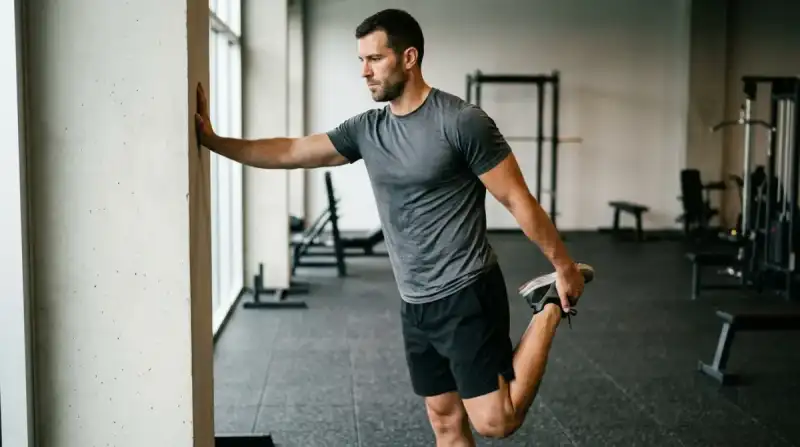
Every Thigh Stretch at a Glance
- Standing Quad Stretch — front thigh
- Kneeling Hip Flexor Stretch — front thigh
- Side-Lying Quad Stretch — front thigh
- Seated Hamstring Stretch — back thigh
- Supine Hamstring Stretch — back thigh
- Standing Hamstring Stretch — back thigh
- Butterfly Stretch — inner thigh
- Side Lunge Stretch — inner thigh
- Frog Stretch — inner thigh
- Standing Cross-Leg Stretch — outer thigh
- Seated Figure-Four Stretch — outer thigh
- Lying IT Band Stretch — outer thigh
This table maps each stretch to its target muscle and difficulty so you can pick the right ones fast.
| Stretch | Target Muscle | Difficulty | Equipment | Hold Time |
|---|---|---|---|---|
| Standing Quad Stretch | Quadriceps (rectus femoris, vastus group) | Beginner | Wall or chair for balance | 20–30 sec |
| Kneeling Hip Flexor Stretch | Rectus femoris + iliopsoas | Beginner | Yoga mat | 20–30 sec |
| Side-Lying Quad Stretch | Quadriceps (deep stretch) | Intermediate | None | 20–30 sec |
| Seated Hamstring Stretch | Hamstrings (biceps femoris, semitendinosus) | Beginner | None | 20–30 sec |
| Supine Hamstring Stretch | Hamstrings | Beginner | Towel or stretching strap | 20–30 sec |
| Standing Hamstring Stretch | Hamstrings | Beginner | Step, bench, or low chair | 20–30 sec |
| Butterfly Stretch | Adductors (adductor longus, gracilis) | Beginner | None | 20–30 sec |
| Side Lunge Stretch | Adductors | Intermediate | None | 20–30 sec |
| Frog Stretch | Adductors (deep stretch) | Intermediate | Yoga mat | 20–30 sec |
| Standing Cross-Leg Stretch | IT band, TFL | Beginner | Wall for balance | 20–30 sec |
| Seated Figure-Four Stretch | IT band, TFL, glutes | Beginner | Chair | 20–30 sec |
| Lying IT Band Stretch | IT band, TFL | Intermediate | None | 20–30 sec |
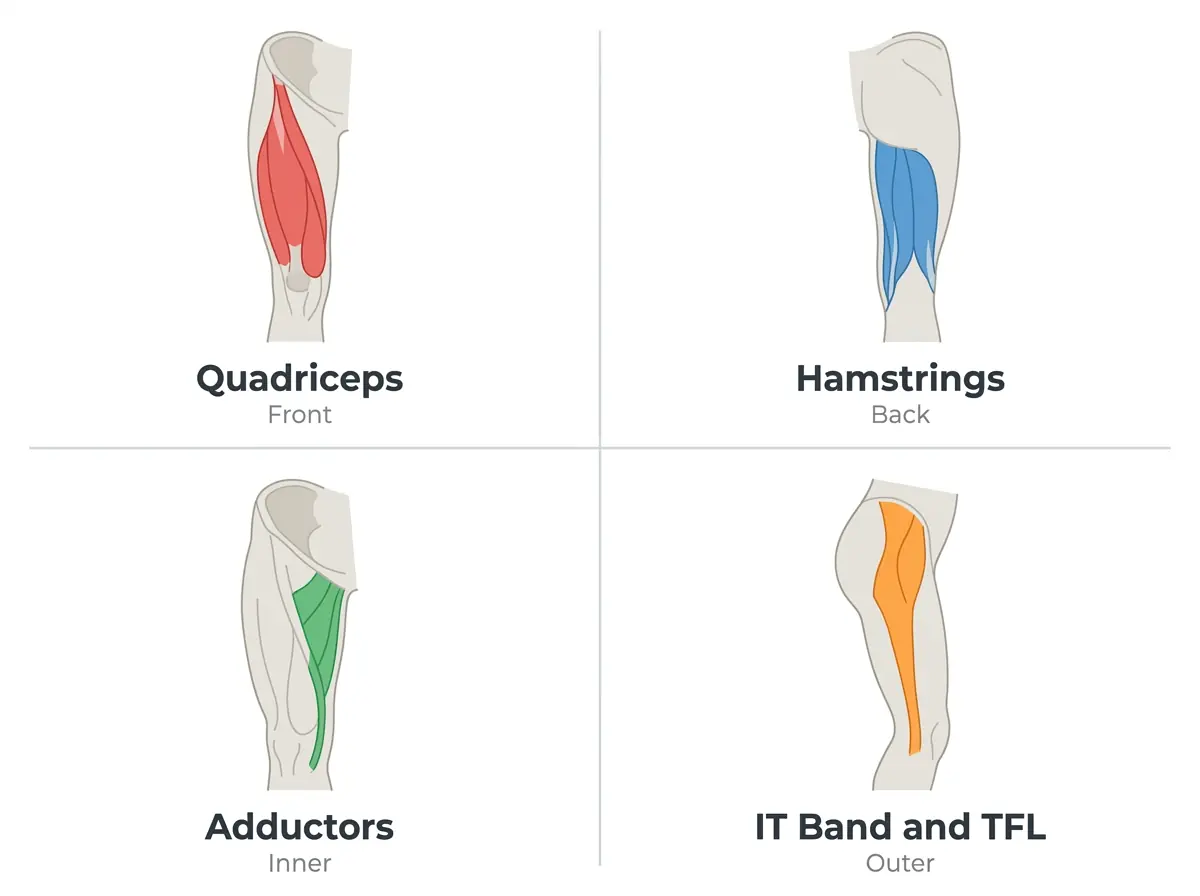
Why Your Thighs Feel Tight
Prolonged sitting is the most common culprit. Spending 6–8 hours a day with hips flexed at 90 degrees shortens the hip flexors and stiffens the hamstrings — one cross-sectional study found 82% of students who sat that long tested positive for hamstring tightness (Source: Fatima et al., Saudi Journal of Sports Medicine, 2017). But sitting is not the only factor.
Other contributors: high training volume without adequate recovery, dehydration (which reduces tissue elasticity), weak glutes forcing neighboring muscles to overcompensate, and postural habits like anterior pelvic tilt that keep quads and hip flexors chronically shortened.
The fix is not complicated. Daily stretching combined with movement breaks and targeted strengthening corrects most cases. Strengthen weak glutes with bodyweight leg workouts.
Front Thigh Stretches (Quadriceps)
The standing quad stretch, kneeling hip flexor stretch, and side-lying quad stretch target the four muscles on the front of your thigh — the rectus femoris, vastus lateralis, vastus medialis, and vastus intermedius. Together, these three moves progress from basic to deep, covering the full quadriceps group plus the hip flexors.
Foam roller prep: Before stretching, spend 30–60 seconds rolling your quads with a foam roller. Combining foam rolling with stretching may improve physical performance markers compared to stretching alone, so it is worth the extra minute (Source: Konrad et al., Journal of Sports Science and Medicine, 2021).
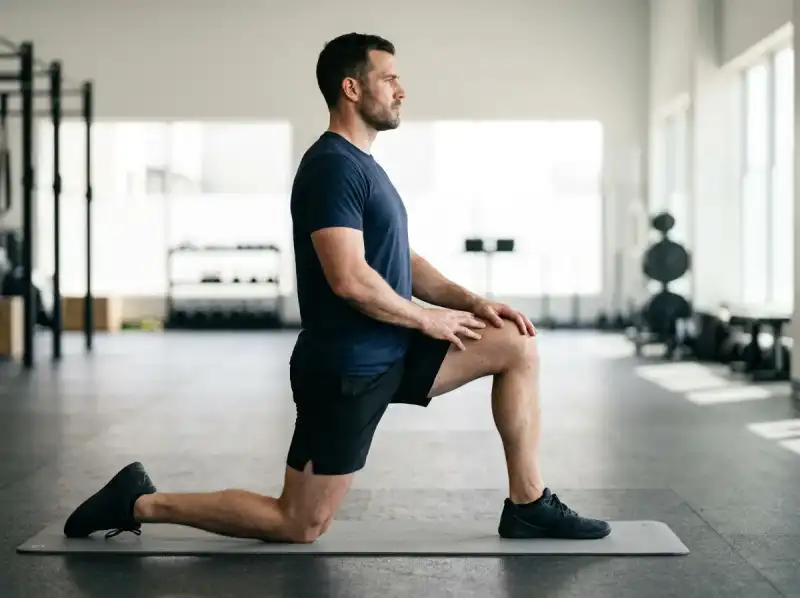
Standing Quad Stretch
The one everyone knows. Simple does not mean worthless — this stretch hits all four quadriceps heads effectively.
- Stand on your left leg. Place your left hand on a wall or chair back.
- Bend your right knee and grab your right ankle (not the top of your foot) with your right hand.
- Pull your heel toward your glute. Keep both knees close together.
- Hold 20–30 seconds. Switch sides. Repeat 2–4 times per leg.
Keep your torso upright. The moment you lean forward, you lose the stretch on the rectus femoris.
Desk-worker modification: Do this standing behind your office chair, using the backrest for balance.
Kneeling Hip Flexor Stretch
This one targets the rectus femoris and the iliopsoas — the deep hip flexor that gets brutally tight from sitting.
- Kneel on your right knee on a mat. Place your left foot flat on the floor in front of you, knee bent at 90 degrees.
- Shift your hips forward until you feel a stretch in the front of your right thigh and hip.
- Stay tall through your torso. Do not lean forward.
- Hold 20–30 seconds. Switch sides. Repeat 2–4 times.
Squeeze your right glute at the end range to deepen the stretch. That posterior tilt intensifies the pull on the hip flexor.
Senior modification: Place a folded towel under the kneeling knee for comfort, and use a sturdy chair beside you for support.
Side-Lying Quad Stretch
A deeper alternative to the standing version — and the best option if balance is an issue.
- Lie on your left side with your legs stacked.
- Bend your right knee and grab your right ankle with your right hand.
- Pull your heel toward your glute. Gently push your right hip forward to increase the stretch.
- Hold 20–30 seconds. Switch sides. Repeat 2–4 times.
This position removes the balance challenge entirely, which means you can focus on pushing deeper into the stretch rather than staying upright.
Back Thigh Stretches (Hamstrings)
The seated hamstring stretch, supine hamstring stretch with a towel, and standing hamstring stretch cover the three muscles running down the back of your thigh — the biceps femoris, semitendinosus, and semimembranosus. These muscles cross both the hip and the knee, so form cues matter: hinge at the hips, do not round your back.
Foam roller prep: Roll the back of each thigh from just above the knee to the sit bone for 30–60 seconds per side before stretching.
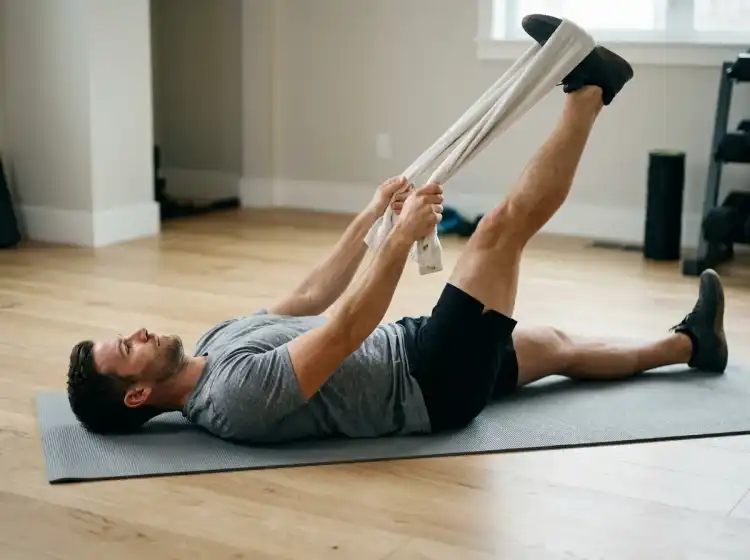
Seated Hamstring Stretch
The simplest hamstring stretch. Also the one most people do wrong.
- Sit on the floor with your right leg extended straight in front of you. Bend your left knee and place the sole of your left foot against your right inner thigh.
- Hinge forward at the hips, reaching toward your right foot.
- Stop when you feel a stretch behind your right thigh. Do not round your lower back.
- Hold 20–30 seconds. Switch legs. Repeat 2–4 times.
The hinge-at-hips cue is critical. Rounding your back shifts the stretch to your lumbar spine, which is not the target and can aggravate existing back issues.
Supine Hamstring Stretch With a Towel
The best starting point for anyone with very tight hamstrings. The towel or stretching strap does the work so you can relax into the stretch.
- Lie on your back with both legs flat on the floor.
- Loop a towel or strap around the ball of your right foot.
- Keeping your right leg straight, use the towel to gently pull your leg toward the ceiling.
- Stop when you feel a moderate stretch. Hold 20–30 seconds. Switch legs. Repeat 2–4 times.
Keep your opposite leg flat on the ground and your hips square. Letting the non-working leg float upward reduces the stretch.
Senior modification: Bend the non-working knee with that foot flat on the floor to reduce lower-back strain.
Standing Hamstring Stretch
The most functional of the three — this mimics the hip-hinge pattern you use picking things up off the floor.
- Place your right heel on a low step, bench, or sturdy chair. Keep your right leg straight.
- Hinge forward at the hips until you feel a stretch in the back of your right thigh.
- Place your hands on your left thigh for support if needed.
- Hold 20–30 seconds. Switch legs. Repeat 2–4 times.
Adjust the height of the surface to control intensity. A lower step is easier; a higher surface is more advanced.
Inner Thigh Stretches (Adductors)
The butterfly stretch, side lunge stretch, and frog stretch target the adductor group — primarily the adductor longus, adductor magnus, and gracilis on the inner thigh. These muscles pull the legs together and get tight in anyone who sits with knees together for long periods or trains heavy squats and deadlifts.
Foam roller prep: Roll the inside of each thigh from knee to groin for 30–60 seconds. This one feels intense. Start with light pressure.
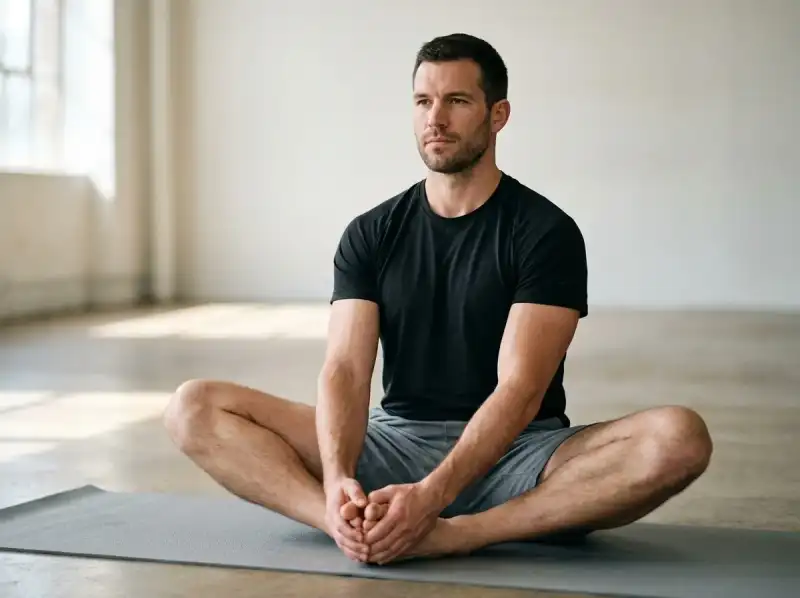
Butterfly Stretch
Seated, easy to do anywhere, and one of the most effective adductor stretches available.
- Sit on the floor with the soles of your feet together and your knees out to the sides.
- Hold your feet with both hands.
- Sit tall and gently press your knees toward the floor using your elbows.
- Hold 20–30 seconds. Repeat 2–4 times.
Do not force your knees down. Gravity and gentle elbow pressure are enough. Forcing risks straining the groin.
Desk-worker modification: Sit at the edge of your office chair with feet flat and wide, knees dropping outward. Not as deep, but hits the same muscles during a work break.
Side Lunge Stretch
A dynamic option that works well as a pre-workout warm-up when done with controlled movement rather than a static hold.
- Stand with your feet wide apart, about double shoulder width.
- Shift your weight to the right, bending your right knee while keeping your left leg straight.
- Sit your hips back as you lower. You should feel a stretch along your left inner thigh.
- Hold 20–30 seconds for a static stretch, or flow side to side for 8–10 reps as a dynamic warm-up.
Keep your chest up and both feet flat. If your heel lifts, narrow your stance.
Frog Stretch
The most intense adductor stretch in this list. Go slowly.
- Start on all fours on a mat.
- Spread your knees as wide as comfortable, with your feet turned outward so the insides of your feet rest on the floor.
- Lower your hips back and down, keeping your back flat.
- Hold 20–30 seconds. Repeat 2–4 times.
Start with your knees only slightly wider than hip width and increase the spread over days and weeks. Pushing too far too fast risks a groin strain. This is a stretch that rewards patience.
Outer Thigh Stretches (IT Band and TFL)
The standing cross-leg stretch, seated figure-four stretch, and lying IT band stretch target the iliotibial band and the tensor fasciae latae on the outside of the thigh. Most thigh-stretching guides skip this region entirely — that is a mistake. Outer thigh tightness contributes to knee pain, IT band syndrome, and hip discomfort, especially in runners.
Foam roller prep: IT band foam rolling is probably the best-known foam rolling application. Roll the outside of each thigh from hip to just above the knee for 30–60 seconds. It will be uncomfortable. That discomfort is normal.
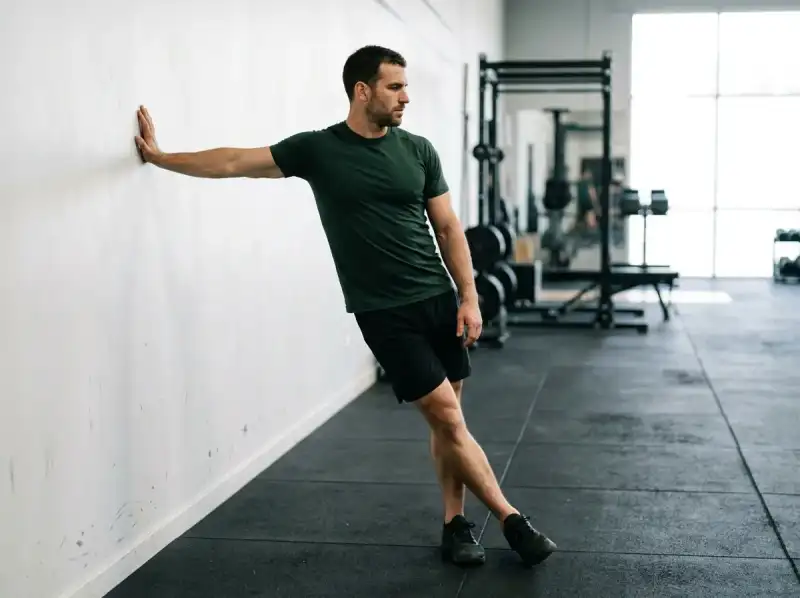
Standing Cross-Leg Stretch
A quick stretch you can do anywhere with a wall nearby.
- Stand with your left side facing a wall, left hand on the wall for balance.
- Cross your right leg behind your left leg.
- Lean your left hip toward the wall until you feel a stretch along the outside of your left thigh.
- Hold 20–30 seconds. Switch sides. Repeat 2–4 times.
The lean is what makes it work. If you stand straight, nothing happens.
Seated Figure-Four Stretch
Chair-friendly, discreet, and effective. The single best outer-thigh stretch for anyone stuck at a desk all day.
- Sit in a sturdy chair with both feet flat on the floor.
- Cross your right ankle over your left knee, forming a figure-four shape.
- Sit tall and gently press your right knee down with your right hand.
- Lean forward slightly from the hips to deepen the stretch.
- Hold 20–30 seconds. Switch sides. Repeat 2–4 times.
This also hits the piriformis and deep external rotators. Two-for-one.
Senior modification: Stay upright instead of leaning forward. The figure-four position alone provides a meaningful stretch.
Lying IT Band Stretch
The deepest outer thigh stretch in this set. Best done on a mat after training.
- Lie on your back with both legs straight.
- Lift your right leg and cross it over your body to the left, keeping it as straight as possible.
- Use your left hand to gently press your right leg toward the floor.
- Keep your right shoulder pinned to the ground.
- Hold 20–30 seconds. Switch sides. Repeat 2–4 times.
You should feel this from the outside of the hip down through the outer thigh. If you feel it in your lower back instead, bend the crossing knee slightly.
When to Stretch — Pre-Workout, Post-Workout, or Daily?
Do dynamic thigh stretches before training and static holds after. A meta-analysis of 104 studies found that pre-exercise static stretching reduced maximal strength by an average of 5.4%, with the effect increasing as stretch duration increased — holds over 45 seconds per muscle group showed the largest deficits (Source: Simic et al., Scandinavian Journal of Medicine & Science in Sports, 2013). The safest approach: save static work for after your session.
| Timing | Stretch Type | Examples | Hold / Reps |
|---|---|---|---|
| Pre-workout | Dynamic only | Leg swings, walking lunges, side lunge flows | 8–10 reps per movement |
| Post-workout | Static holds | Any of the 12 stretches above | 20–30 sec, 2–4 reps per side |
| Daily maintenance | Gentle static holds | Pick 1 from each region (see routine below) | 20–30 sec, 2 reps per side |
For a full warm-up sequence, see our workout mobility routine.
How to Stretch Your Thighs Safely
Hold each stretch for 10–30 seconds, perform 2–4 repetitions per side, and breathe steadily throughout (Source: Garber et al., ACSM Position Stand, 2011). For older adults, the ACSM recommends longer holds of 30–60 seconds. Never stretch completely cold muscles — a 5-minute walk or light jog first is enough.
Discomfort is normal. Pain is not. You should feel a pulling sensation in the target muscle, not a sharp or burning pain in a joint. If a stretch triggers sharp pain, numbness, or tingling, stop immediately.
See a doctor if you feel sharp pain or the tightness does not improve with consistent daily stretching.
5-Minute Daily Thigh Stretch Routine
Hold each of these four stretches for 30 seconds per side — one from each thigh region — and you are done in under five minutes.
- Standing Quad Stretch (front) — 30 sec per leg
- Supine Hamstring Stretch (back) — 30 sec per leg
- Butterfly Stretch (inner) — 30 sec total
- Seated Figure-Four Stretch (outer) — 30 sec per leg
Do this on a yoga mat or carpeted floor. Total time: roughly 4.5 minutes including transitions. Do it daily — consistency matters more than intensity with flexibility work.
For full-body mobility, pair this with our calisthenics mobility exercises.
FAQ
How do you loosen tight thigh muscles?
Combine daily static stretching (20–30 second holds per muscle) with foam rolling before each session and movement breaks every 60–90 minutes if you sit for long periods. Consistency beats intensity — stick with it daily and most people notice a difference within a few weeks.
How long should you hold a thigh stretch?
The ACSM recommends 10–30 seconds per static stretch for most adults, with 2–4 repetitions per muscle group (Source: Garber et al., ACSM Position Stand, 2011). Older adults benefit from longer holds of 30–60 seconds.
Should you stretch thighs before or after a workout?
Dynamic stretches (leg swings, walking lunges) before training. Static holds after. Static stretching before intense exercise can temporarily reduce maximal strength output (Source: Simic et al., 2013). See the timing section above (When to Stretch) for the full breakdown.
Can tight thighs cause back pain?
Yes. Tight hamstrings pull the pelvis into posterior tilt, flattening the lumbar curve and increasing stress on the lower back. Tight hip flexors do the opposite — they pull the pelvis into anterior tilt, compressing the lumbar spine from the other direction. Research has found significantly reduced hamstring flexibility in patients with chronic low back pain compared to healthy individuals (Source: PMC, 2026). Stretching both muscle groups helps restore neutral pelvic alignment.
Why are my thighs so tight?
The usual suspects: prolonged sitting (6+ hours daily), high training volume without recovery stretching, dehydration, and weak glutes that force the quads and hamstrings to compensate. See the “Why Your Thighs Feel Tight” section above for more detail.
What stretches work the inner thighs?
The butterfly stretch, side lunge stretch, and frog stretch all target the adductor muscles on the inner thigh. See the Inner Thigh Stretches (Adductors) section above for step-by-step instructions.
Sources
- Garber CE, Blissmer B, Deschenes MR, et al. “American College of Sports Medicine position stand. Quantity and quality of exercise for developing and maintaining cardiorespiratory, musculoskeletal, and neuromotor fitness in apparently healthy adults: guidance for prescribing exercise.” Medicine & Science in Sports & Exercise, 43(7):1334–1359, 2011 — PubMed
- Simic L, Sarabon N, Markovic G. “Does pre-exercise static stretching inhibit maximal muscular performance? A meta-analytical review.” Scandinavian Journal of Medicine & Science in Sports, 23(2):131–148, 2013 — Wiley
- Konrad A, Nakamura M, Tilp M, et al. “The Accumulated Effects of Foam Rolling Combined with Stretching on Range of Motion and Physical Performance.” Journal of Sports Science and Medicine, 20:535–545, 2021 — JSSM
- Fatima G, Qamar MM, Ul Hassan J, Basharat A. “Extended sitting can cause hamstring tightness.” Saudi Journal of Sports Medicine, 17(2):110–113, 2017 — LWW
- “The Association Between Hamstring Tightness and Chronic Low Back Pain: A Comparative Study.” PMC, 2026 — PMC
- Boukabache A, et al. “Prolonged sitting and physical inactivity are associated with limited hip extension: A cross-sectional study.” Musculoskeletal Science and Practice, 2021 — ResearchGate