Gymnase Tips is reader-supported. Some links may be Amazon affiliate links; if you buy through them we may earn a small commission at no extra cost to you.
TL;DR — Which Arm Stretches Should You Do?
The best arm stretches target four muscle groups: biceps, triceps, forearms, and shoulder-adjacent muscles. Hold static stretches 10-30 seconds for 2-3 sets after training; use dynamic stretches (arm circles, swings) as warm-ups. Below: 12 stretches organized by muscle group, two ready-made routines, and a diagnostic for tight spots.
Table of contents
Quick-Reference Table: All 12 Arm Stretches at a Glance
Here are all 12 arm stretches covered in this guide, sorted by muscle group.
| Stretch | Target Muscle | Type | Hold/Reps | Best For |
|---|---|---|---|---|
| Doorway Biceps Stretch | Biceps | Static | 10-30 s x 2-3 | Post-pull workouts |
| Wall Biceps Stretch | Biceps | Static | 10-30 s x 2-3 | Desk workers, tight chest |
| Behind-the-Back Biceps Stretch | Biceps | Static | 10-30 s x 2-3 | Quick standing stretch |
| Overhead Triceps Stretch | Triceps | Static | 10-30 s x 2-3 | Post-press workouts |
| Cross-Body Shoulder/Triceps Stretch | Triceps / Posterior deltoid | Static | 10-30 s x 2-3 | General upper-arm tightness |
| Towel Triceps Stretch | Triceps | Static | 10-30 s x 2-3 | Limited shoulder mobility |
| Wrist Flexor Stretch (Palm-Up) | Forearm flexors | Static | 10-30 s x 2-3 | Typing, gripping, climbing |
| Wrist Extensor Stretch (Palm-Down) | Forearm extensors | Static | 10-30 s x 2-3 | Typing, barbell work |
| Prayer Stretch | Forearm flexors / wrists | Static | 10-30 s x 2-3 | Wrist stiffness, desk work |
| Cross-Body Posterior Stretch | Posterior deltoid / triceps | Static | 10-30 s x 2-3 | Shoulder-arm junction tightness |
| Reverse Shoulder Stretch | Anterior deltoid / biceps | Static | 10-30 s x 2-3 | Rounded-shoulder posture |
| Arm Circles | Deltoids / upper arm | Dynamic | 10-15 each direction | Warm-up |
Biceps Stretches
Biceps stretches lengthen the front of the upper arm, which tightens from pulling movements and prolonged elbow flexion. Hold each for 10-30 seconds, 2-3 sets per side.
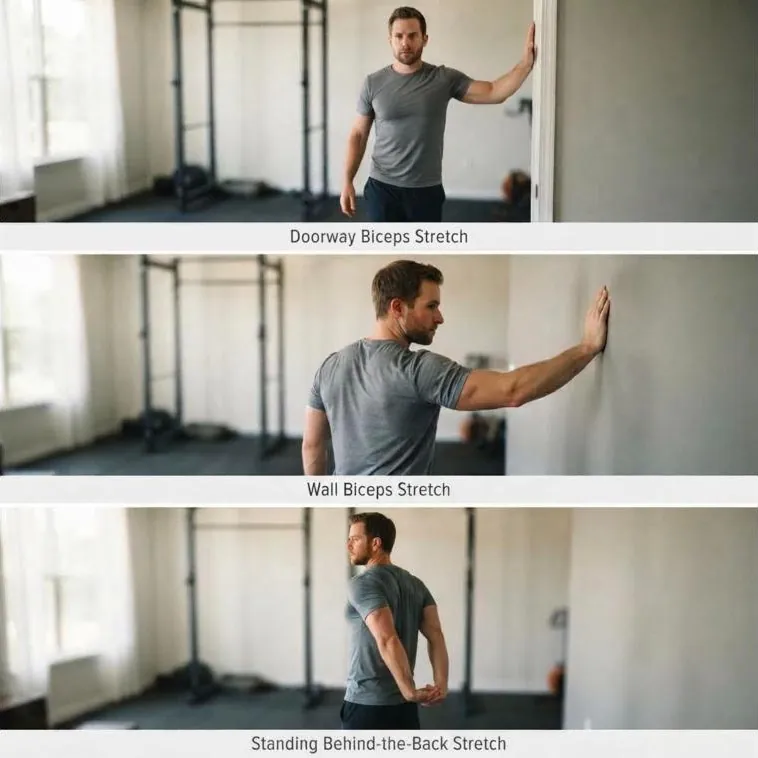
Doorway Biceps Stretch
- Stand in a doorway. Place your right palm flat on the door frame at shoulder height, fingers pointing behind you.
- Step forward with your right foot until you feel a stretch across the front of your upper arm and chest.
- Keep your arm straight and your shoulder blade pulled back — don’t let the shoulder roll forward.
- Hold 15-30 seconds. Switch sides.
Common mistake: Rotating the torso away from the arm. This shifts the stretch to the chest and off the biceps. Keep your hips and shoulders square to the doorway.
Wall Biceps Stretch
- Stand facing a wall, about arm’s length away. Place your right palm flat on the wall at shoulder height, fingers pointing out to the side.
- Slowly rotate your body away from the wall (turn left) until you feel a stretch in the biceps and front shoulder.
- Keep the arm straight and the palm pressed flat.
- Hold 15-30 seconds. Switch sides.
Common mistake: Bending the elbow. A bent arm reduces the stretch on the biceps brachii. Lock the elbow gently (not hyperextended).
Standing Behind-the-Back Biceps Stretch
- Stand upright. Clasp your hands behind your lower back with palms facing down.
- Straighten your arms and slowly lift your hands away from your body.
- Stop when you feel a stretch across the front of both upper arms. Keep your chest lifted.
- Hold 15-30 seconds.
Common mistake: Leaning the torso forward to lift the arms higher. Stand tall — the stretch should come from shoulder extension, not spinal flexion.
Triceps Stretches
Triceps stretches target the back of the upper arm. The overhead variation is the most common and effective — hold 15-30 seconds, pulling gently until you feel tension, never pain.
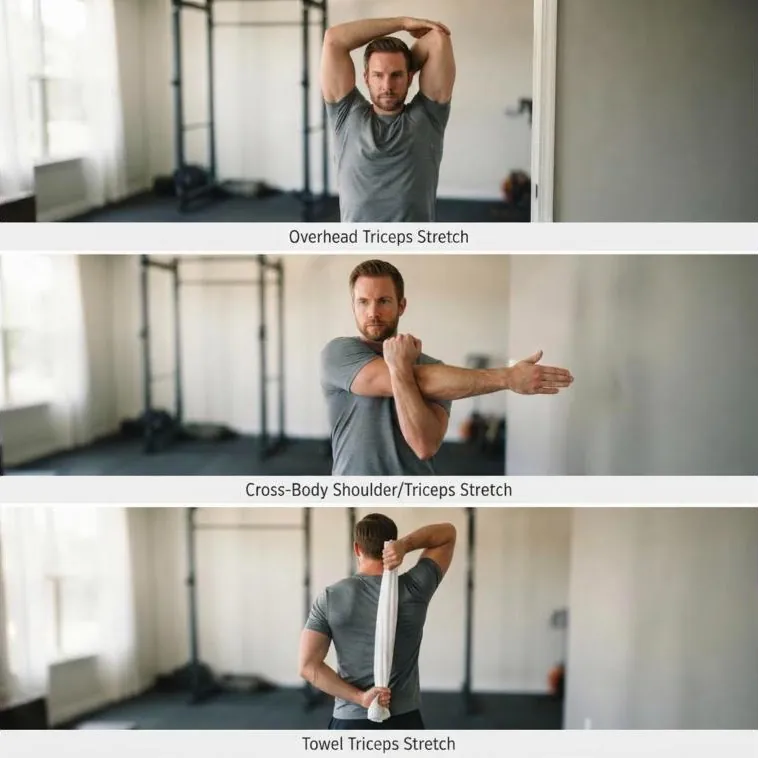
Overhead Triceps Stretch
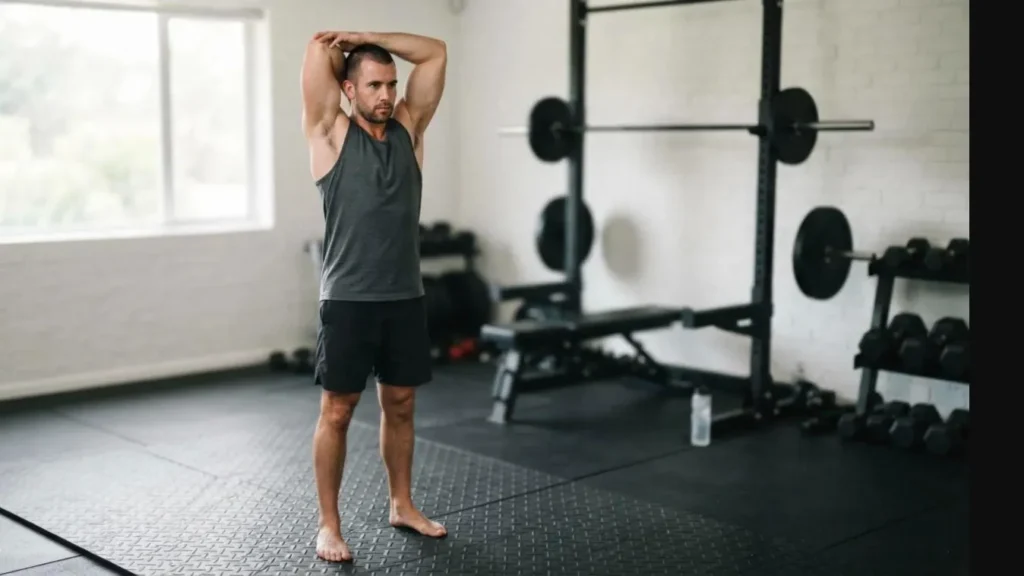
- Raise your right arm overhead. Bend the elbow so your hand drops behind your head toward your upper back.
- Use your left hand to gently press the right elbow back and down.
- Keep your head neutral — don’t push it forward to avoid the arm.
- Hold 15-30 seconds. Switch sides.
Common mistake: Pushing the head forward. This strains the neck and reduces the triceps stretch. Keep your ears aligned over your shoulders.
Cross-Body Shoulder/Triceps Stretch
- Bring your right arm across your chest at shoulder height.
- Use your left hand or forearm to press the right arm closer to your body.
- Pull until you feel a stretch in the back of the shoulder and outer triceps. Don’t rotate the torso.
- Hold 15-30 seconds. Switch sides.
Common mistake: Pulling the arm too low (below shoulder height). Keep it at or just below shoulder level to target the posterior deltoid and long head of the triceps.
Towel Triceps Stretch
- Hold a towel or stretch strap in your right hand. Raise that arm overhead and let it hang behind your back.
- Reach your left hand behind your lower back and grab the bottom of the towel.
- Gently pull down with the left hand to deepen the stretch in the right triceps.
- Hold 15-30 seconds. Switch sides.
Common mistake: Arching the lower back to compensate for tight shoulders. Brace your core and keep your ribs down. If you can’t reach the towel, use a longer strap.
Forearm and Wrist Stretches
Forearm and wrist stretches relieve tension from gripping, typing, and pulling exercises. Extend your arm, palm up or down, and gently pull fingers back for 15-30 seconds — that covers most forearm tightness. For deeper wrist mobility work, pair these with calisthenics mobility exercises.
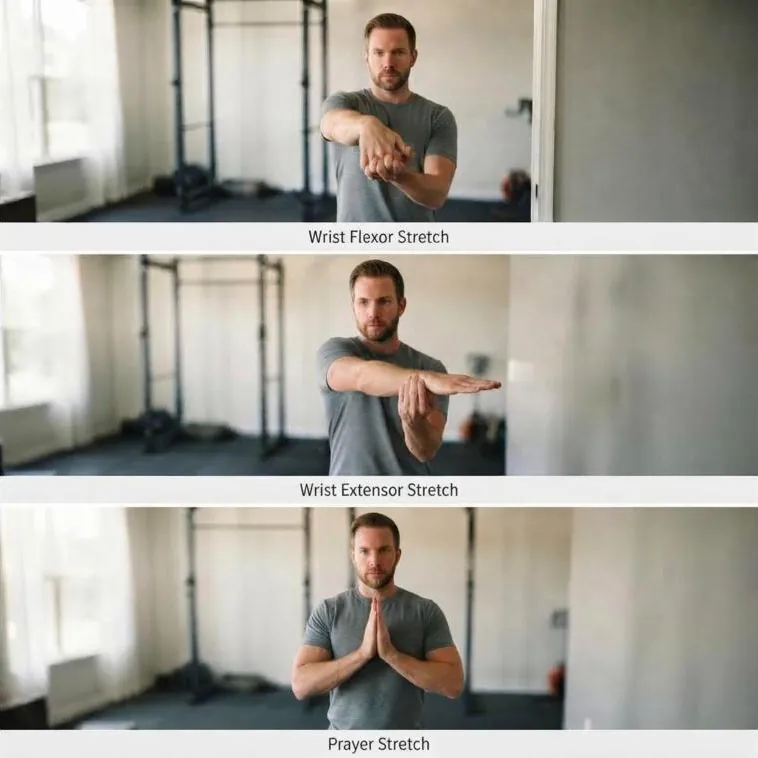
Wrist Flexor Stretch (Palm-Up)
- Extend your right arm in front of you, palm facing up, elbow straight.
- With your left hand, gently pull the right fingers down and back toward the floor.
- You should feel the stretch along the inner forearm (wrist flexors, including the brachioradialis).
- Hold 15-30 seconds. Switch sides.
Common mistake: Bending the elbow. A straight arm is necessary to fully lengthen the forearm flexors.
Wrist Extensor Stretch (Palm-Down)
- Extend your right arm in front of you, palm facing down, elbow straight.
- With your left hand, gently press the right fingers and hand downward toward the floor.
- Feel the stretch along the top of the forearm (wrist extensors).
- Hold 15-30 seconds. Switch sides.
Common mistake: Shrugging the shoulder up. Relax the shoulder down and away from your ear — the stretch happens in the forearm, not the trap.
Prayer Stretch
- Press your palms together in front of your chest, fingers pointing up, like a prayer position.
- Slowly lower your hands toward your waist while keeping the palms pressed together.
- Stop when you feel a stretch in the inner wrists and forearms.
- Hold 15-30 seconds.
Common mistake: Letting the palms separate at the heel of the hand. Keep full palm contact to maintain even pressure across the wrist joint.
Shoulder-Adjacent Arm Stretches
Several arm stretches double as shoulder stretches because the deltoid and rotator cuff cross both joints. The cross-body stretch and reverse shoulder stretch are the two most useful for general arm flexibility. These moves also show up in dedicated trapezius exercises work, since the upper traps influence shoulder position.
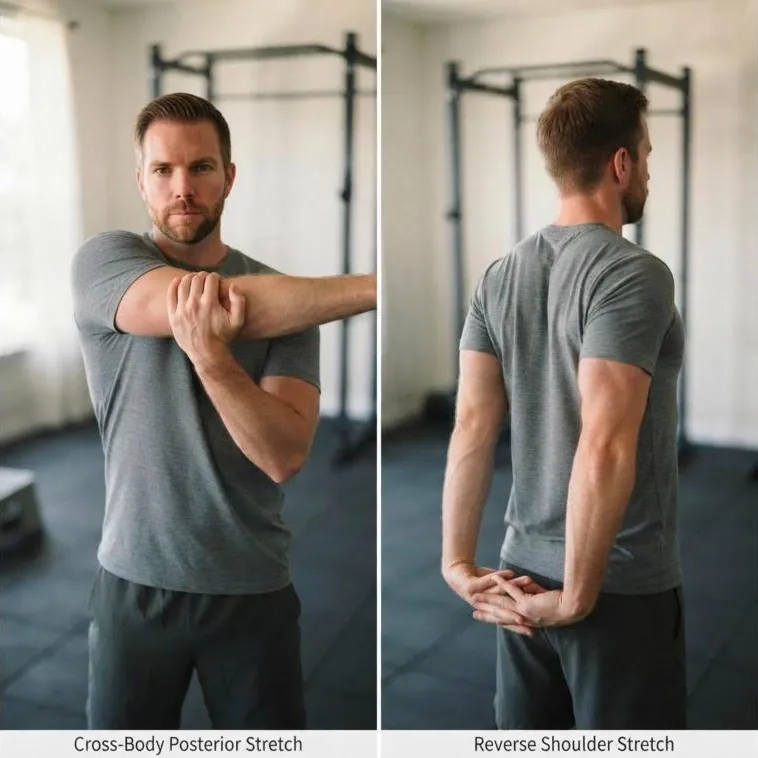
Cross-Body Posterior Stretch
- Bring your right arm across your chest. Use your left hand to hold it just above the elbow.
- Pull gently until you feel a deep stretch in the back of the shoulder and upper arm.
- Keep the shoulder relaxed — don’t hike it toward your ear.
- Hold 15-30 seconds. Switch sides.
Common mistake: Pulling the arm at the elbow joint rather than above it. Gripping the elbow itself can stress the joint. Hold the upper forearm or just above.
Reverse Shoulder Stretch (Clasped Hands Behind Back)
- Stand upright. Clasp your hands behind your back, interlacing the fingers.
- Straighten your arms and lift them away from your body while squeezing your shoulder blades together.
- You’ll feel a stretch across the front of both shoulders and biceps.
- Hold 15-30 seconds.
Common mistake: Rounding the upper back. The stretch targets the anterior shoulder and biceps — rounding forward defeats it. Stand tall, chest open.
How to Loosen Tight Arm Muscles
To loosen tight arm muscles, identify where the tightness sits — front of upper arm (biceps), back of upper arm (triceps), or forearm/wrist — then do 2-3 targeted stretches from the matching section above, holding 20-30 seconds for 2-3 sets.
| Tight Here? | Likely Cause | Do These Stretches |
|---|---|---|
| Front of upper arm | Curls, pull-ups, carrying heavy bags | Doorway Biceps Stretch, Wall Biceps Stretch |
| Back of upper arm | Overhead pressing, dips, push-ups | Overhead Triceps Stretch, Cross-Body Stretch |
| Inner forearm / wrist | Gripping, deadlifts, climbing, typing | Wrist Flexor Stretch, Prayer Stretch |
| Outer forearm | Keyboard use, barbell rows | Wrist Extensor Stretch |
If tightness persists after 2-3 weeks of consistent stretching, consider consulting a physical therapist. Persistent tightness sometimes signals an underlying issue that stretching alone won’t resolve.
Arm Stretches Before a Workout (Dynamic Routine)
Before training, use dynamic arm stretches — controlled movements through full range of motion — rather than static holds. A comprehensive warm-up that includes dynamic stretching can reduce or eliminate the performance impairments seen with static stretching alone (Source: Behm et al., European Journal of Applied Physiology, 2021).
Pre-Workout Arm Warm-Up (3-4 minutes):
- Arm Circles — 10 forward, 10 backward. Start small, progressively widen the circles. Moderate tempo.
- Arm Swings (Cross-Body) — 15 reps. Swing both arms horizontally across the chest, alternating which arm crosses on top. Controlled speed.
- Wrist Circles — 10 clockwise, 10 counterclockwise per hand. Interlace fingers for resistance.
- Overhead Reach to Triceps Pull — 8 per side. Reach one arm overhead, briefly pull the elbow behind the head (1-2 seconds), release, switch. Don’t hold long.
- Shoulder Pass-Throughs (with stick or resistance band) — 10 reps. Hold a stick or band wide, pass it from front to behind and back. Gradually narrow the grip.
Pair this warm-up with a pull-up bar workout if dead hangs are part of your session.
Arm Stretches After a Workout (Static Routine)
After training, use static arm stretches — hold each position 10-30 seconds for 2-3 sets. Post-workout static stretching may improve flexibility over time (Source: ACSM, Guidelines for Exercise Testing and Prescription, 11th ed., 2021).
Post-Workout Arm Cool-Down (5-6 minutes):
- Doorway Biceps Stretch — 20 seconds per side, 2 sets. Step forward slowly until you feel a moderate stretch.
- Overhead Triceps Stretch — 20 seconds per side, 2 sets. Gentle pressure on the elbow.
- Wrist Flexor Stretch — 20 seconds per side, 2 sets. Arm fully extended, palm up.
- Wrist Extensor Stretch — 20 seconds per side, 2 sets. Arm extended, palm down.
- Cross-Body Posterior Stretch — 20 seconds per side, 2 sets. Pull arm across chest below shoulder height.
How Long and How Often to Stretch Your Arms
Hold each static arm stretch for 10-30 seconds and repeat 2-4 times. Stretch at least 2-3 days per week — daily is better. These numbers come from the American College of Sports Medicine’s current exercise guidelines. Adults over 65 may benefit from holding stretches for 30-60 seconds (Source: ACSM, Guidelines for Exercise Testing and Prescription, 11th ed., 2021).
Consistency matters more than marathon sessions. Five minutes of targeted arm stretches after every workout will produce more flexibility gains over six weeks than one long stretching session on weekends.
Common Arm Stretching Mistakes
The most common arm stretching mistake is bouncing at end range, which triggers the stretch reflex and tightens the muscle you’re trying to lengthen. Hold still, breathe, and ease into the stretch gradually.
Other mistakes to avoid:
- Stretching into sharp pain. Tension is expected. Pain is not. If it hurts, back off or stop.
- Holding your breath. Breath-holding increases muscle tension. Breathe slowly and steadily through each hold.
- Skipping forearms and wrists. Most people stretch their biceps and triceps but ignore the forearms entirely — especially problematic for anyone who types, grips barbells, or climbs.
- Static stretching before heavy lifting. Research shows that prolonged static stretching before maximal effort can temporarily reduce strength and power output, especially when not followed by dynamic activity (Source: Behm et al., European Journal of Applied Physiology, 2021). Save static holds for after training. Use dynamic stretches to warm up.
Should You Stretch Your Arm If It Hurts?
Mild muscle tightness usually responds well to gentle stretching. Sharp pain, joint pain, or pain that worsens during a stretch is a signal to stop and consult a doctor or physical therapist — stretching through it can worsen the injury (Source: Mayo Clinic, Stretching: Focus on Flexibility, 2024).
Numbness, tingling, or swelling paired with pain warrants professional evaluation, not more stretching.
FAQ
What are the best arm stretches?
The overhead triceps stretch, doorway biceps stretch, and wrist flexor/extensor stretches cover most people’s needs. They hit the three major muscle groups in the arm. Check the quick-reference table above for the full list of 12 stretches sorted by target muscle.
Can arm stretches help with elbow pain?
Wrist flexor and extensor stretches may reduce forearm tension that contributes to tennis elbow (lateral epicondylitis) or golfer’s elbow (medial epicondylitis). However, clinical evidence supports stretching only as an adjunct to strengthening exercises, not a standalone treatment (Source: Lucado et al., Journal of Orthopaedic & Sports Physical Therapy, 2022). Persistent elbow pain warrants a medical evaluation.
Should you stretch your arms before or after a workout?
Both — but different types. Before training, use dynamic stretches (arm circles, swings, pass-throughs) to raise muscle temperature and prime range of motion. After training, use static holds (10-30 seconds) to promote flexibility. The two routines above lay out exactly which stretches to do and when.
Sources
- ACSM. Guidelines for Exercise Testing and Prescription. 11th ed. Philadelphia: Wolters Kluwer; 2021. ISBN: 978-1975150181.
- Behm DG, Kay AD, Trajano GS, Blazevich AJ. “Mechanisms underlying performance impairments following prolonged static stretching without a comprehensive warm-up.” European Journal of Applied Physiology. 2021;121:67-94. https://doi.org/10.1007/s00421-020-04538-8
- Mayo Clinic. “Stretching: Focus on flexibility.” https://www.mayoclinic.org/healthy-lifestyle/fitness/in-depth/stretching/art-20047931
- Lucado AM, et al. “Lateral Elbow Pain and Muscle Function Impairments: Clinical Practice Guidelines.” Journal of Orthopaedic & Sports Physical Therapy. 2022. https://doi.org/10.2519/jospt.2022.0302