
Last updated: May 2026 — written by the Gymnase Tips training team.
A pull-up bar workout is a complete upper-body training session using only a fixed bar — pull-ups, chin-ups, hangs, leg raises, and bar-supported variations train the back, biceps, forearms, abs, and shoulders without any other equipment. The most effective pull-up bar workouts run 8 exercises across pulling, hanging, and core patterns for 30 to 45 minutes. Most athletes can build a 4-week pull-up bar program that adds 30 to 50% to their strict pull-up max, develops grip strength meaningfully, and builds visible back, arm, and core musculature — provided the workout includes both vertical pulling (pull-ups) AND horizontal pulling (rows, if a low bar or doorway bar is available) plus hanging core work for the abs. This guide walks the 8 essential exercises, programs them across four difficulty levels, and provides a 4-week training schedule.
Table of Contents
- Why a Pull-Up Bar Workout Works
- Equipment Considerations
- The 8 Essential Exercises
- 4 Difficulty Levels
- 4-Week Training Schedule
- Common Mistakes
- FAQ
Why a Pull-Up Bar Workout Works
A single pull-up bar covers more upper-body training territory than any other piece of equipment in its price range:
- Vertical pulling — pull-ups, chin-ups, neutral-grip pulls. Hits lats, rhomboids, biceps, forearms, and grip directly.
- Hanging holds — dead hangs, scapular pulls, active hangs. Builds shoulder mobility, scapular control, and grip endurance.
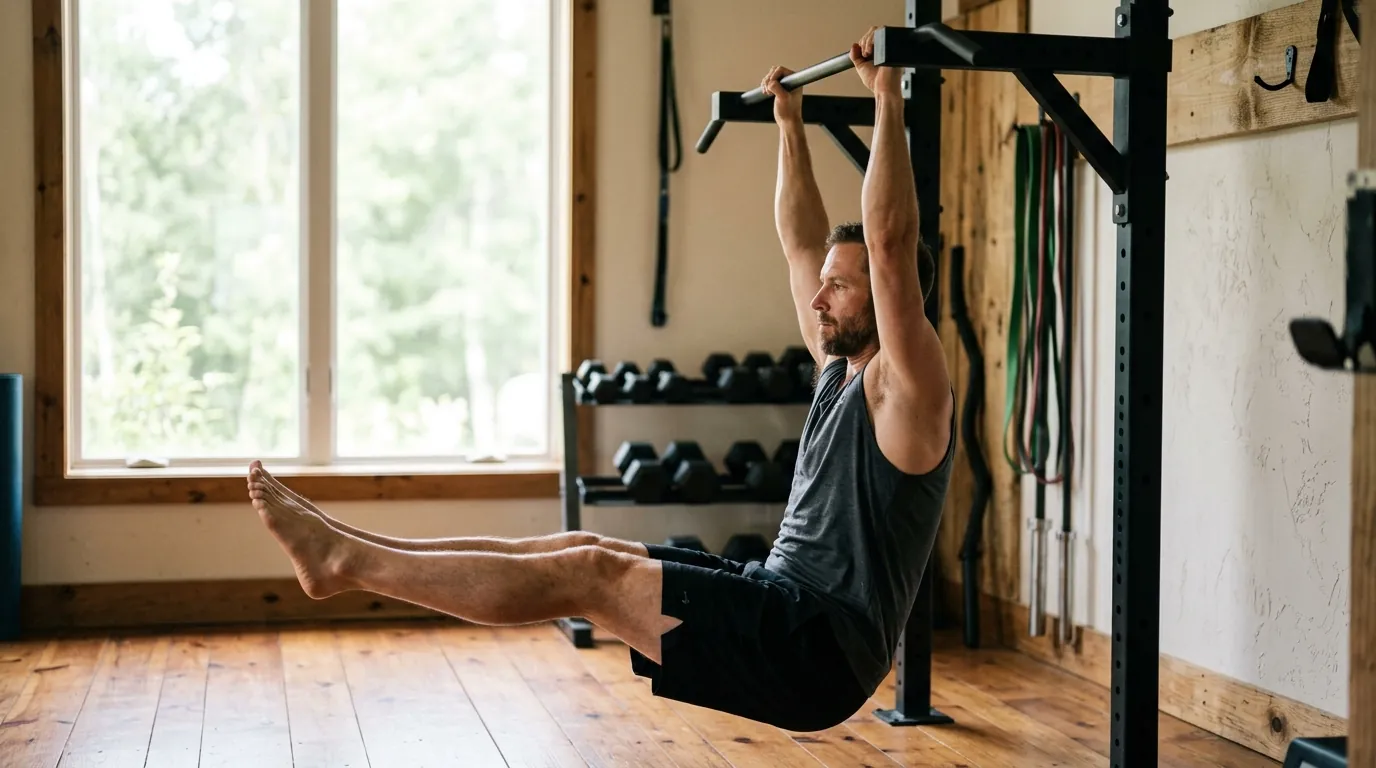
- Core via the bar — leg raises, knee tucks, toes-to-bar, windshield wipers. The bar lets gravity load the abs in ways floor work never can.
- Bar dips and bar muscle-up progressions — for advanced athletes, the bar becomes a press station too.
The training stimulus matches what most home-gym lifters need: pulling volume (most lifters under-train pulling vs. pressing) and core work that engages the entire trunk under load. A doorway pull-up bar costs $25–$50; a permanent ceiling- or wall-mounted bar costs $80–$150 and lasts decades.
Equipment Considerations
Not all pull-up bars work for every exercise. Three categories:
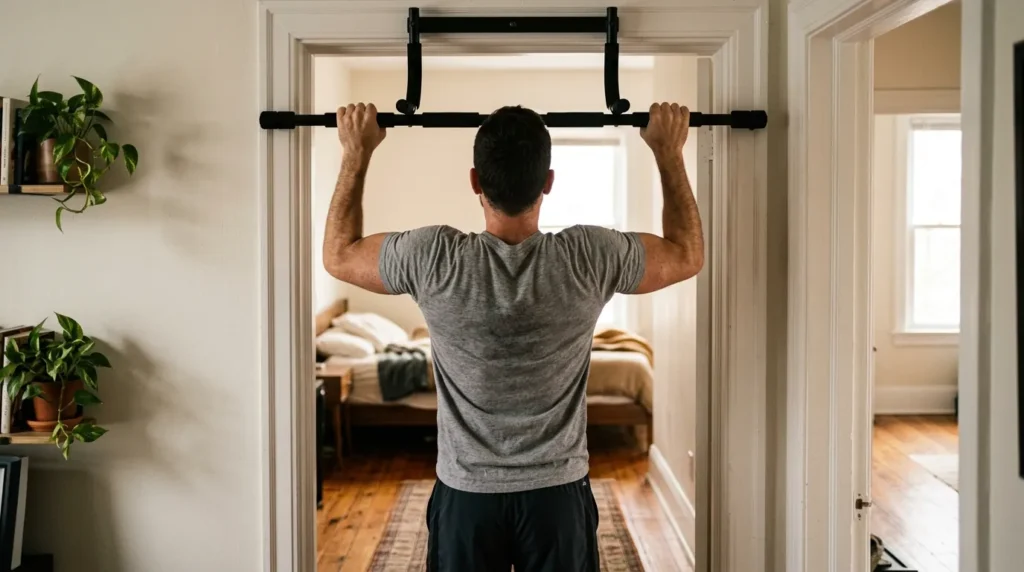
- Doorway bars — Spring-tension or screw-mount. Easy install, cheap, work for pull-ups, hangs, and basic core. Don’t trust them for kipping or muscle-up attempts; the load profile they’re designed for is strict pulling.
- Wall- or ceiling-mount bars — Permanent install via stud-mounted brackets. Handle full bodyweight + weighted work + dynamic movements. Best long-term option for serious training.
- Free-standing pull-up stations — Includes dip bars and lower bars. Most expensive but enables horizontal rows and bar dips that doorway and wall bars don’t.
For a complete pull-up bar workout, the most important consideration after structural integrity is bar height — at least 8″ of head clearance above the bar at full extension, plus 12+ inches of clearance for swing and active hang movements.
The 8 Essential Exercises
Pulling (Vertical)
- Pull-Up — Overhand grip, shoulder-width. The foundational vertical pulling movement. Hits lats and middle back primarily.
- Chin-Up — Underhand grip, shoulder-width. Shifts more emphasis to biceps; most athletes can do 2–3 more chin-ups than pull-ups.
- Neutral-Grip Pull-Up — Palms facing each other (requires a parallel-grip attachment or angled bar). Easiest on the elbows; great for high-volume work.
Hanging
- Dead Hang — Passive hang, arms straight, shoulders relaxed. Builds grip endurance and decompresses the spine. Goal: 60+ seconds.
- Scapular Pull-Up — From a dead hang, retract and depress your scapulae without bending the elbows. The shoulder blades pull down and back; the body rises slightly. Critical for scapular control on pull-ups.
Core
- Hanging Knee Raise — From a dead hang, pull knees toward chest. The most accessible hanging core movement.
- Hanging Leg Raise — Straight legs raised to horizontal (90°) or higher. Significantly harder than knee raises.
- Toes-to-Bar — Strict version: legs straight, lift to touch toes to the bar. Demands hamstring flexibility AND core strength.
4 Difficulty Levels
Level 1 — Beginner (0–3 strict pull-ups)
If you can’t yet do strict pull-ups, the workout is built around assisted pull-ups, scapular pulls, dead hangs, and knee raises. See our assisted pull-ups guide for the foundational progression to your first strict rep.
Level 2 — Novice (4–8 strict pull-ups)
Mix of pull-ups (4 sets × 60% max), chin-ups, hanging knee raises, and dead hangs. Volume work prioritized over max effort.
Level 3 — Intermediate (9–15 strict pull-ups)
Add weighted pull-ups (5–25 lbs), neutral-grip variations, hanging leg raises, and scapular pulls in higher volumes.
Level 4 — Advanced (15+ strict pull-ups)
Heavy weighted pull-ups (25–60 lbs), archer pull-ups, toes-to-bar volume, and skill-strength work toward muscle-ups and front lever progressions. See our muscle-up progression and advanced calisthenics workout.
4-Week Training Schedule
This schedule works for Levels 2–3. Run 3 sessions per week with at least 1 rest day between sessions.
Session A — Pull Volume Day
- Pull-ups: 5 sets × 60% max, 90s rest
- Chin-ups: 3 sets × 8 reps
- Hanging knee raises: 3 sets × 15 reps
- Dead hang: 3 × 30 seconds
Session B — Strength Day
- Weighted pull-ups (or band-assisted if novice): 4 sets × 5 reps
- Scapular pull-ups: 3 sets × 10 reps
- Hanging leg raises: 3 sets × 8 reps
- Active hang: 3 × 20 seconds
Session C — Mixed Day
- Pull-up max test (every 2 weeks); otherwise 3 sets × 70% max
- Neutral-grip pull-ups: 3 sets × 8 reps
- Toes-to-bar (or knee raises if needed): 3 sets × 10 reps
- Dead hang: 1 × max time
Track every session. After 4 weeks, retest your max pull-up count — most novice and intermediate athletes add 30–50% to their max from this protocol alone.
Common Pull-Up Bar Workout Mistakes
- Maxing out every session. Pulling responds to volume more than intensity. Submaximal sets across multiple sessions per week beat one max-effort session weekly.
- Skipping the hang work. Dead hangs and active hangs build grip endurance and shoulder mobility that pull-ups alone don’t develop. Five minutes of hanging per session compounds significantly.
- Ignoring scapular control. Scapular pull-ups train the small movement that initiates every good pull-up. Athletes who skip this stage develop pulling patterns where the shoulders shrug up rather than the scapulae depress and retract.
- Kipping for higher rep counts. Kipping pull-ups are a different exercise (more anaerobic, less strict strength). They don’t transfer to strict pull-up improvement. If you want strict pull-ups, train strict pull-ups.
- Overusing the bar without rest days. Pulling muscles and grip recover slower than pressing muscles. Three quality sessions per week beats five mediocre sessions for adaptation.
FAQ
Can I get a full upper-body workout from just a pull-up bar?
Pulling and core, yes. Pressing, no — pull-up bars don’t replace push-up volume or dip work. The complete bodyweight upper body uses a pull-up bar PLUS push-ups (and ideally dip bars or parallettes). See our military calisthenics workout guide for the full bodyweight upper-body framework.
How often should I do a pull-up bar workout?
3 sessions per week is the durable cadence for most novice and intermediate athletes. Advanced athletes can run 4–5 sessions if they program intensity carefully (one heavy day, one volume day, one skill day, one easy day). More than 5 sessions per week typically produces diminishing returns and accumulating elbow/shoulder discomfort.
Will a pull-up bar workout build muscle?
Yes — for back, biceps, forearms, and core. Visible hypertrophy in these muscle groups develops over 8–16 weeks of consistent training with progressive overload. Adding weighted pull-ups (vest or dip belt) accelerates this significantly once you can do 10+ strict bodyweight pull-ups.
Is a doorway pull-up bar good enough?
For strict pulling and basic core work, yes. For dynamic work (kipping, muscle-ups, weighted pulls), no — the load profile and stability requirements exceed what spring-tension and screw-mount doorway bars are designed for. If you’re serious about pull-up training, invest in a wall- or ceiling-mounted bar early.
Can a pull-up bar workout replace a gym?
For pulling and core, mostly. For pressing (chest, shoulders, triceps), no — you still need push-ups at minimum, and ideally dip bars or parallettes for full pressing development. For lower body, no — pull-up bars don’t address the legs at all. As one tool in a calisthenics setup, the pull-up bar is among the highest-value purchases you can make. As a sole training tool, it covers maybe 40% of what most athletes need.
How long until I can do my first pull-up?
4 to 12 weeks for most beginners following a structured progression. Athletes who weigh more or who arrive with limited pulling background take longer; those with prior weightlifting backgrounds (especially deadlifts and rows) often progress faster. See our assisted pull-ups guide for the on-ramp protocol.
Bottom Line
A pull-up bar workout covers more training territory than its price tag suggests — 8 essential exercises across pulling, hanging, and core patterns build the back, arms, forearms, grip, and abs without any other equipment. Run 3 sessions per week with the schedule above, train submaximal volume more than max effort, and don’t skip the hang work or scapular drills. For broader bodyweight training, see our military calisthenics workout guide, how to get better at pull-ups, assisted pull-ups, and list of military calisthenics exercises guides.