
By the Gymstips Coaching Team — Last updated June 2026
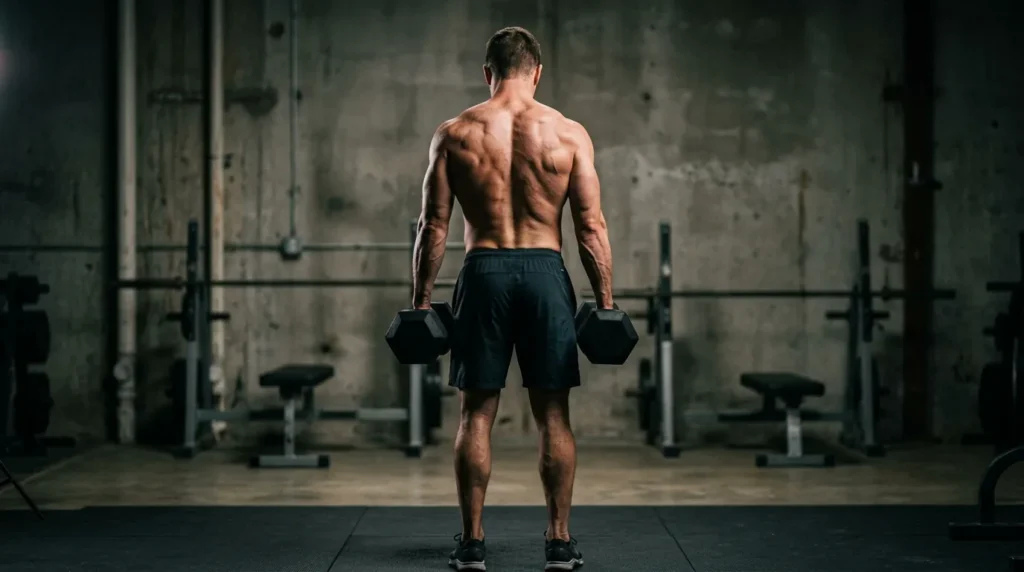
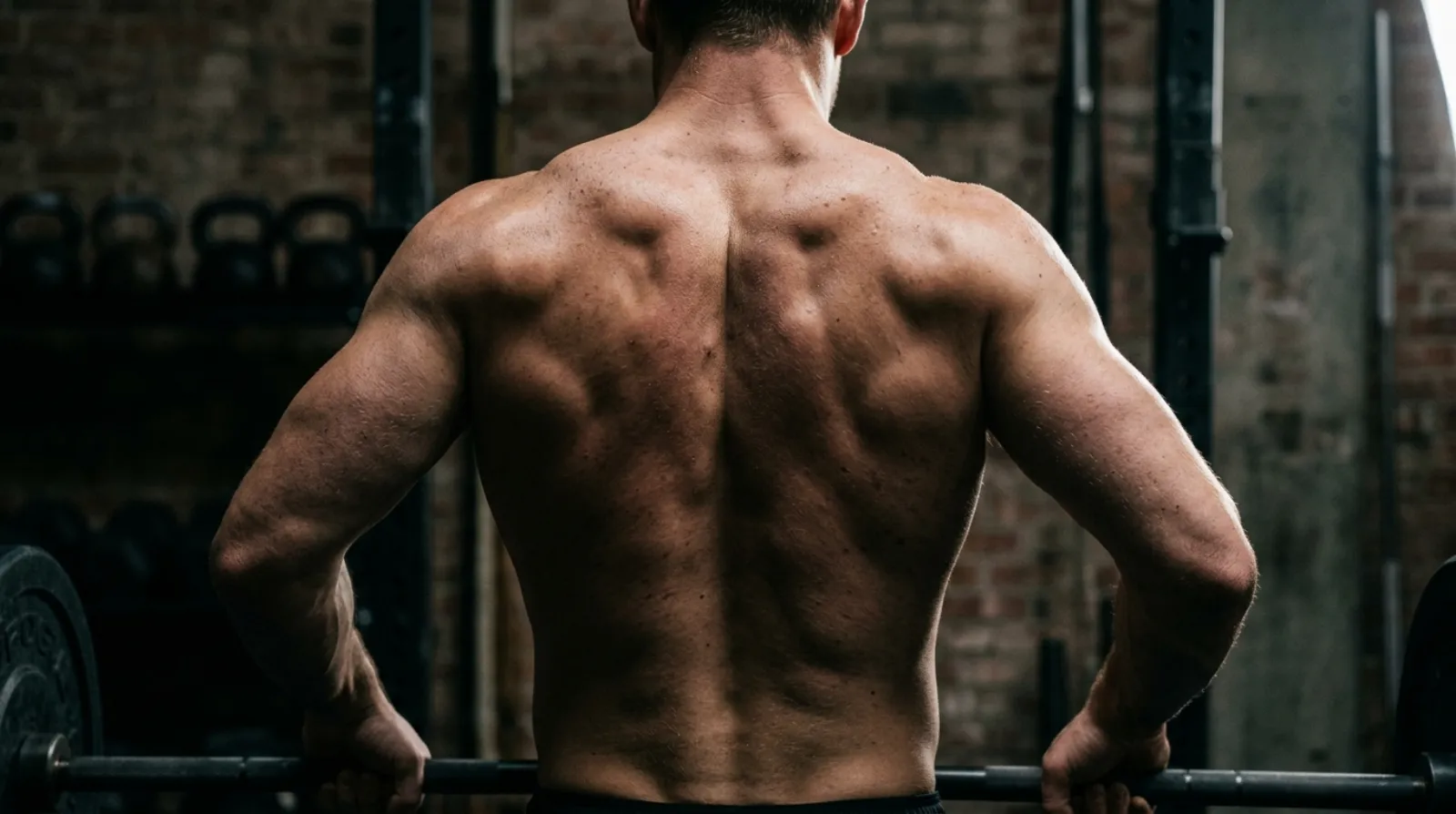
Most lifters train one trapezius — the lump that sits on top of the shoulder — and ignore the other two-thirds of the muscle that actually holds the shoulder blade in place. That mismatch is why your upper traps feel like rocks while your shoulders still round forward. Smart trapezius exercises hit all three regions, not just the shrug.
TL;DR — What Are the Best Trapezius Exercises for Each Region?
The best trapezius exercises by region are the barbell shrug for the upper traps, the prone T-raise (and chest-supported row) for the middle traps, and the prone Y-raise plus face pull for the lower traps. Train all three regions — not just shrugs — across 10–20 weekly sets, twice per week, at 1–3 reps in reserve, to build size, posture, and shoulder health.
Table of Contents
Trapezius Anatomy: Origin, Insertion, Innervation
The trapezius is a large, kite-shaped superficial muscle covering the upper back and posterior neck. It originates from the external occipital protuberance, the medial third of the superior nuchal line, the ligamentum nuchae, and the spinous processes of C7 down through T12. From that long midline origin, the fibers fan laterally to insert on the lateral third of the clavicle, the acromion, and the spine of the scapula (Source: Kenhub, 2025).
Motor innervation comes from the spinal accessory nerve (CN XI), with proprioceptive contributions from the ventral rami of C3 and C4. That dual supply matters clinically — a CN XI lesion (often iatrogenic, from neck surgery) produces shoulder drop and scapular winging on the affected side. Blood supply runs primarily through the transverse cervical artery, with contributions from the dorsal scapular and posterior intercostals.
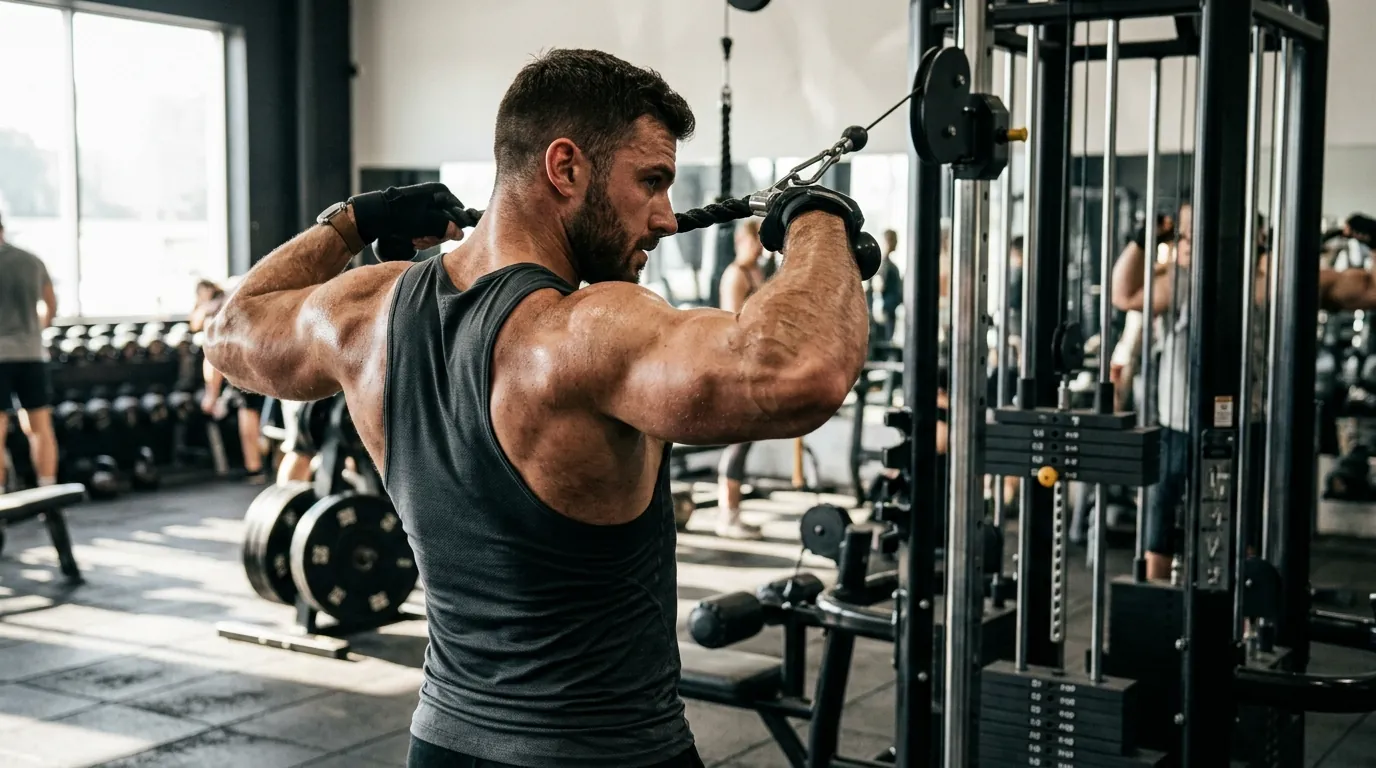
Functionally, the trapezius bridges the axial skeleton (skull and spine) to the shoulder girdle. Every time you reach overhead, the trap is steering the scapula. Every time you carry a heavy bag, it is suspending the entire shoulder girdle from your cervical spine.
For a deeper dive into innervation pathology and surface anatomy, see Physiopedia’s trapezius page and Kenhub.
Why the Trap Has Three Functional Regions
The trapezius is one muscle by name, but three muscles by behavior. Because the fibers fan out from a vertical origin to a roughly horizontal insertion, fiber direction changes dramatically from top to bottom — and fiber direction dictates action.
The upper fibers descend from the skull and pull the scapula up and back. The middle fibers run horizontally between the thoracic spine and the scapular spine, so they retract. The lower fibers ascend from the lower thoracic spine to the scapular spine, so when they shorten, they pull the scapula down and rotate it up. Researchers have shown these regions activate semi-independently, which is why region-specific programming is not just a marketing angle (Source: Johnson et al., Clinical Biomechanics, 1994).
Trapezius Function by Region (Upper, Middle, Lower)
The upper traps elevate and upwardly rotate the scapula and extend the neck. The middle traps retract. The lower traps depress and upwardly rotate — and together with serratus anterior they form the scapular force couple that allows you to raise your arm overhead without impinging the rotator cuff (Source: Cools et al., British Journal of Sports Medicine, 2014).
Region × Action Matrix
| Region | Fiber direction | Primary action | Posture role | Common dysfunction |
|---|---|---|---|---|
| Upper | Descending (top-down) | Scapular elevation, upward rotation, neck extension | Suspends shoulder girdle | Overactive, tonic; trigger points |
| Middle | Transverse (horizontal) | Scapular retraction | Pulls shoulder blades back | Weak, inhibited from desk posture |
| Lower | Ascending (bottom-up) | Depression, upward rotation | Anchors scapula down on rib cage | Weak; the #1 missing link in shoulder health |
Without lower-trap participation, the upper trap and levator scapulae take over scapular elevation, the scapula tips anteriorly, and you get the classic scapular dyskinesis pattern that shows up as forward head, rounded shoulders, and impingement under load.
A useful frame from coaching: most “tight upper trap” complaints are not tightness — they are an overactive upper trap working overtime because the lower trap clocked out years ago.
Are Your Lower Traps Weak? Three Self-Tests
Lower trap weakness almost never shows up as weakness — it shows up as compensation. These three screens, run on yourself in two minutes, will tell you.
1. Prone Y-Raise Hold. Lie face down on a bench, thumbs up, arms forming a Y at roughly 125° of abduction. Lift the arms 2 inches off the floor. Hold 30 seconds. If your upper traps shrug toward your ears, your neck cramps, or you cannot keep arms above the bench line, your lower traps are the limiter — not your delts.
2. Wall Slide Scapular Control. Stand with heels, glutes, mid-back, and the back of your hands against a wall, elbows at 90°. Slide the arms overhead while keeping the back of the hands in contact with the wall. Lose wall contact before 160°? Your lower traps cannot complete the upward-rotation phase.
3. Shrug-Without-Elevation Test. Stand tall. Try to set your shoulder blades “down and back” without shrugging up first. Most people cannot do this without a mirror cue — they elevate before depressing. That is the upper trap dominating the recruitment order.
In coaching, I run all three before programming any pressing volume with a new client. Failing two of three means we spend four weeks loading prone Ys and wall slides before adding overhead pressing back in.
Exercise × Region Activation Matrix (EMG-Backed)
This matrix synthesizes surface EMG findings across the major scapular muscle studies and grades 15 trapezius exercises as P (Primary, >60% MVIC), S (Secondary, 30–60% MVIC), or M (Minimal, <30% MVIC) for each trap region.
| Exercise | Upper | Middle | Lower |
|---|---|---|---|
| Barbell shrug | P | S | M |
| Dumbbell shrug | P | S | M |
| Trap bar carry | P | S | S |
| Snatch-grip high pull | P | P | S |
| Overhead carry | S | S | P |
| Prone T-raise (90° abd) | S | P | S |
| Chest-supported row | S | P | S |
| Seated cable row to sternum | S | P | S |
| Band pull-apart | M | P | S |
| Face pull (high elbow) | S | P | S |
| Prone Y-raise (125°) | S | S | P |
| Prone 1-arm trap raise | M | S | P |
| Overhead band pull-apart | S | S | P |
| Wall slide with lift-off | M | S | P |
| Lat pulldown w/ scap depression | M | S | P |
Synthesized from Andersen et al., J Strength Cond Res, 2009; Ekstrom, Donatelli & Soderberg, JOSPT, 2003; Cools et al., Am J Sports Med, 2007; and Schoenfeld et al., Sports Medicine, 2025 (Source: JOSPT 2003; Cools 2007 PubMed).
Two things to notice: (1) shrugs barely touch the lower trap, and (2) the lower-trap winners all involve overhead or sub-horizontal arm angles with the elbows extended — a pattern Cools demonstrated repeatedly.
Best Upper Trapezius Exercises
The upper trap responds to one stimulus better than any other: heavy vertical load with the scapula free to elevate. These five trapezius exercises cover heavy strength work, hypertrophy reps, and loaded carries.
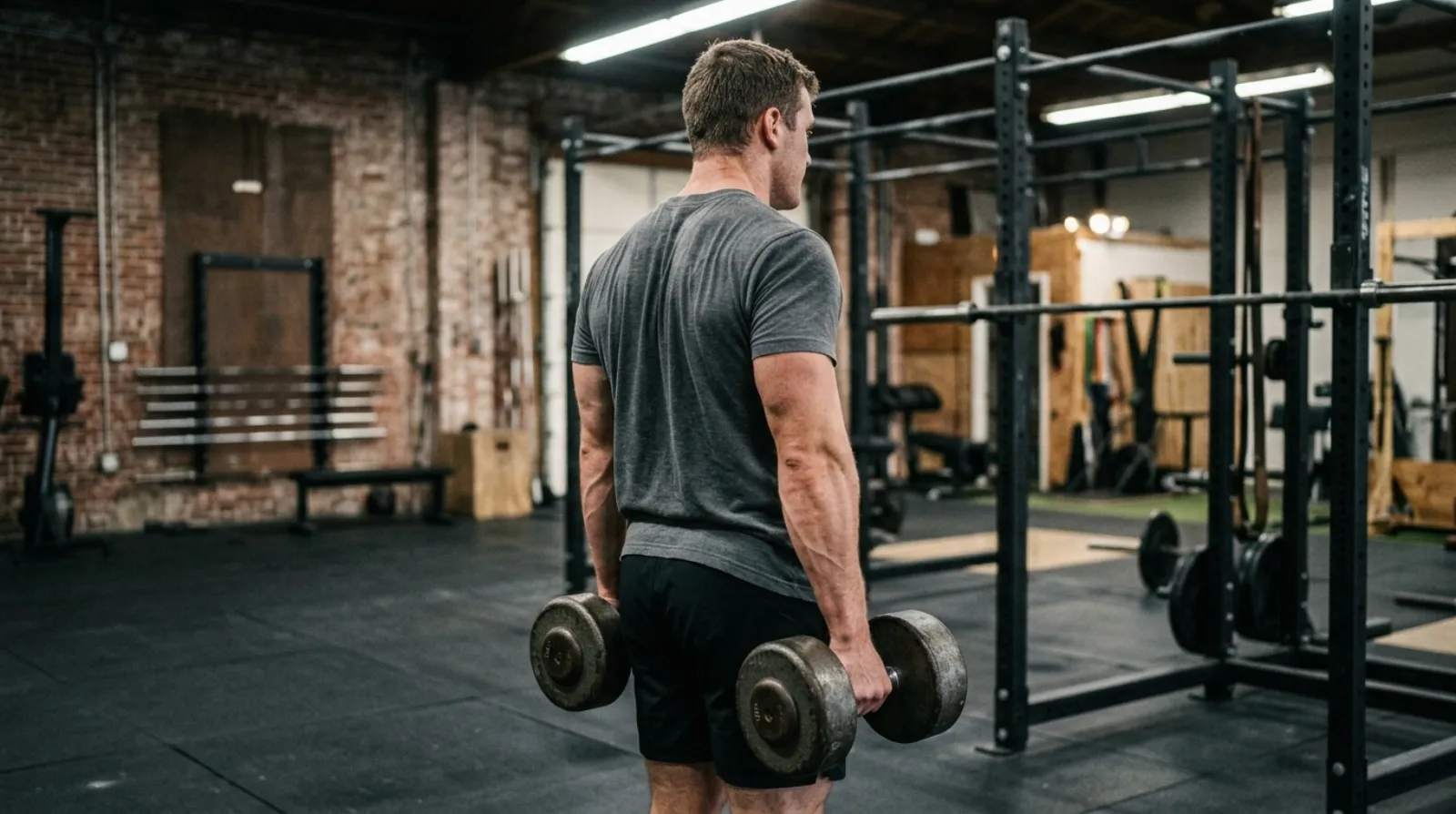
Barbell Shrug
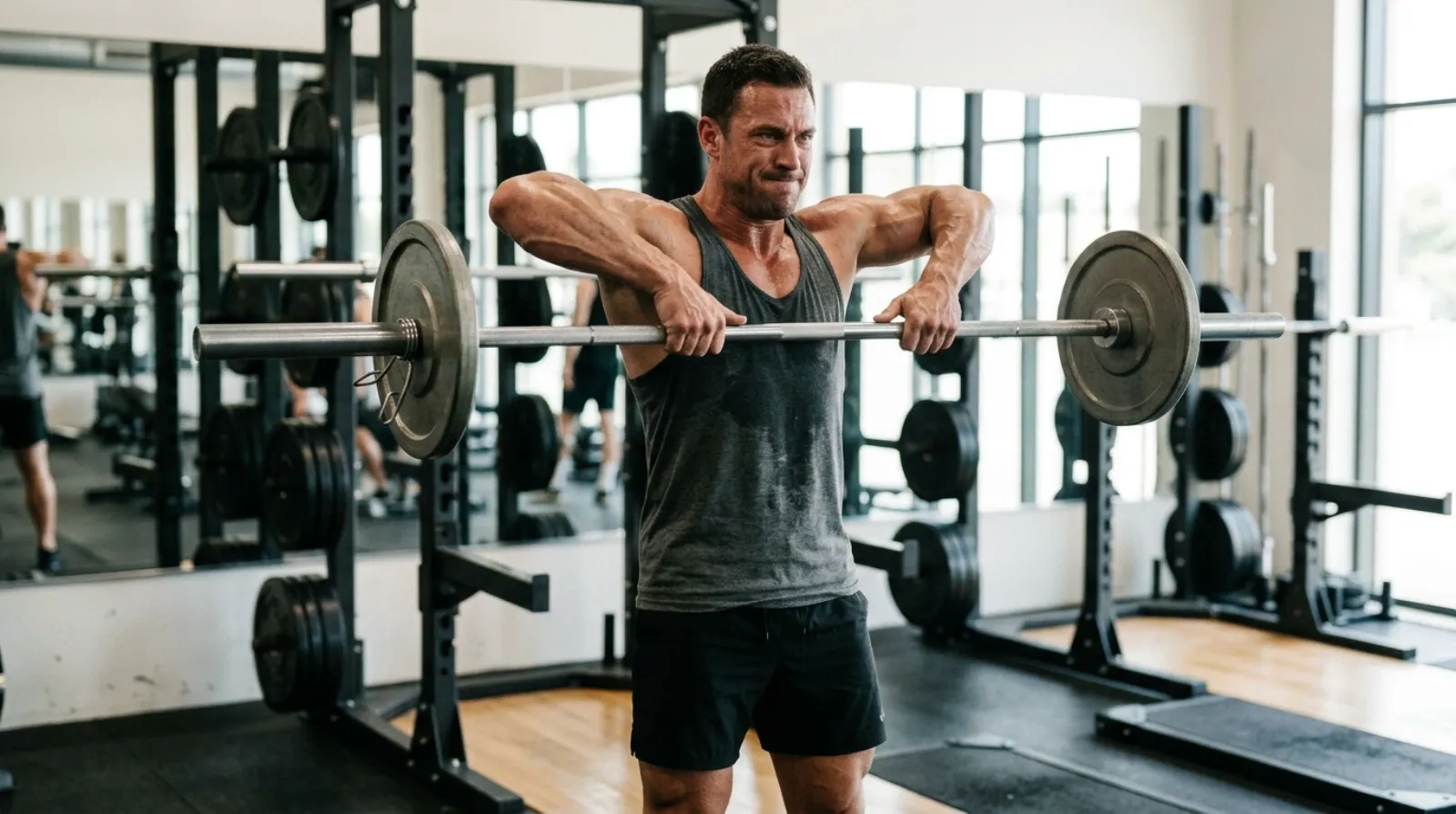
How-to: Hold a barbell at hip height, slightly wider than shoulder width, with a double-overhand or mixed grip. Shrug straight up toward the ears, pause 1 second at top, lower under control.
- Cue 1: “Shoulders to ears” — straight up, not back-and-around.
- Cue 2: Brace abs to keep the load from pulling you into lumbar extension.
- Common mistake: Rolling the shoulders. Rolling adds no trap work and stresses the AC joint.
Load/reps: 3–4 sets × 8–12 reps at ~60–75% of your deadlift hold weight (typical working load 135–315 lb / 60–143 kg).
Dumbbell Shrug
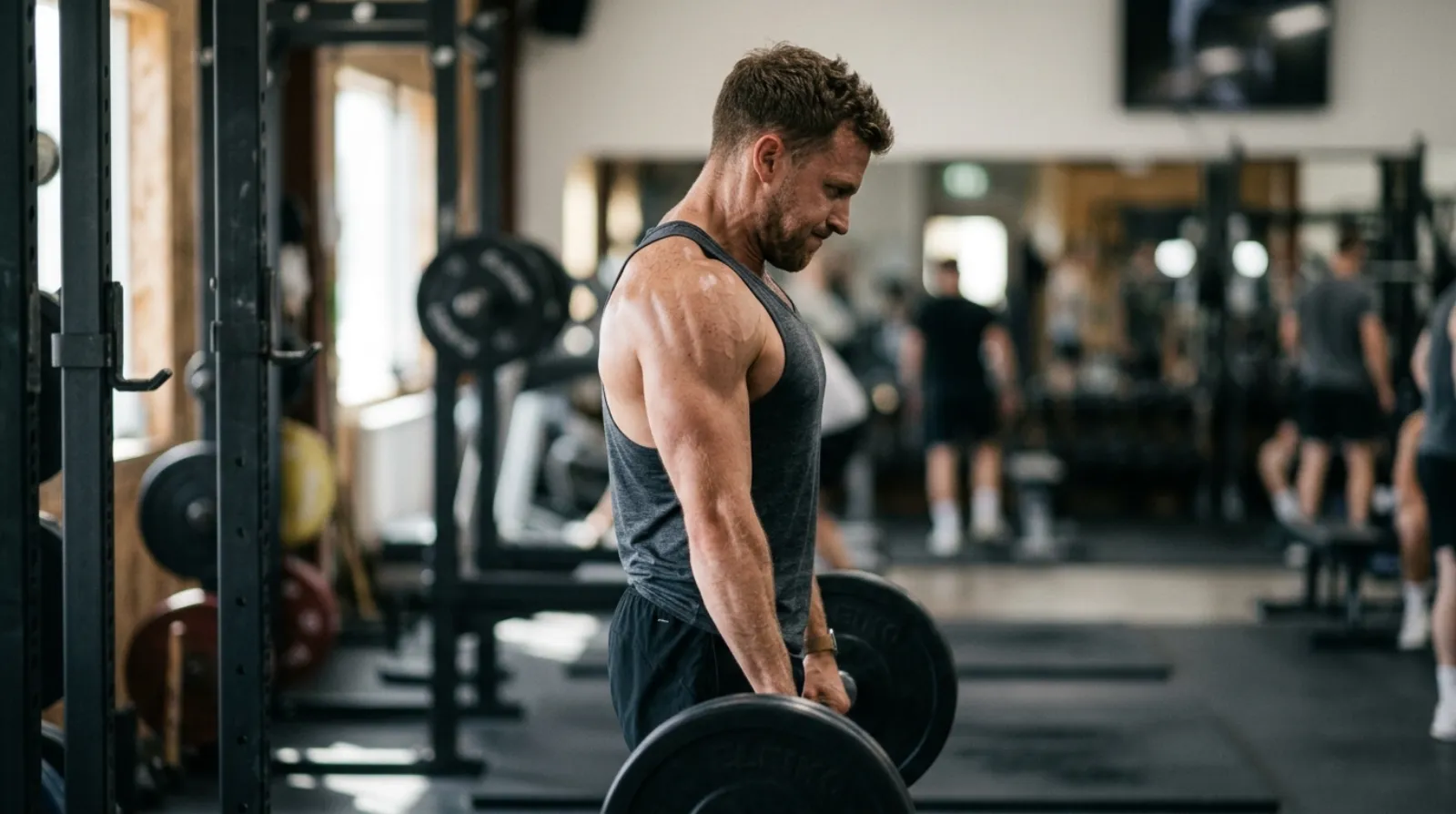
How-to: Stand tall holding heavy dumbbells at your sides, palms facing in. Shrug vertically, pause, lower fully.
- Cue 1: Let the arms hang dead — no biceps assist.
- Cue 2: Achieve full stretch at the bottom; range > range.
- Common mistake: Cutting the bottom half. The stretched position is where hypertrophy lives.
Load/reps: 3–4 × 10–15 reps at 60–120 lb / 27–54 kg per hand.
Trap Bar Carry / Shrug
How-to: Load a trap bar, deadlift to standing, then either walk (carry) or perform shrugs in place.
- Cue 1: Stay tall — no forward lean.
- Cue 2: Keep ribs stacked over pelvis; the trap, not the lumbar erectors, suspends the load.
- Common mistake: Treating it as a farmer’s walk for grip. You want time-under-tension on the trap.
Load/reps: 3 × 30–60 sec carries or 3 × 8–10 shrugs at bodyweight-plus (e.g., 185–405 lb / 84–184 kg).
Snatch-Grip High Pull
How-to: From a hang or floor position, grip the bar wide (snatch grip) and explosively pull to upper chest with high elbows.
- Cue 1: Lead with the elbows, not the hands.
- Cue 2: Finish on the balls of the feet — full triple extension drives the trap.
- Common mistake: Curling the bar with the biceps. The pull is leg-and-trap driven.
Load/reps: 4–6 × 3–5 reps at 95–185 lb / 43–84 kg.
Overhead Carry
How-to: Press a dumbbell or kettlebell overhead, lock the elbow, walk for time. Lower trap stabilizes the scapula; upper trap stabilizes the load.
- Cue 1: Bicep next to ear, not in front of the face.
- Cue 2: Reach tall — actively press into the ceiling the entire walk.
- Common mistake: Bent elbow drift. A soft elbow shifts load off the trap.
Load/reps: 3–4 × 30–45 sec per side at 25–60 lb / 11–27 kg.
Best Middle Trapezius Exercises
The middle traps live and die by horizontal pulling with the elbows wide. They are the muscle that owns scapular retraction — get them strong and rounded shoulders start to disappear. The same wide-elbow rowing that thickens the mid traps also builds a wider back — see our calisthenics back workout for bodyweight rowing progressions.
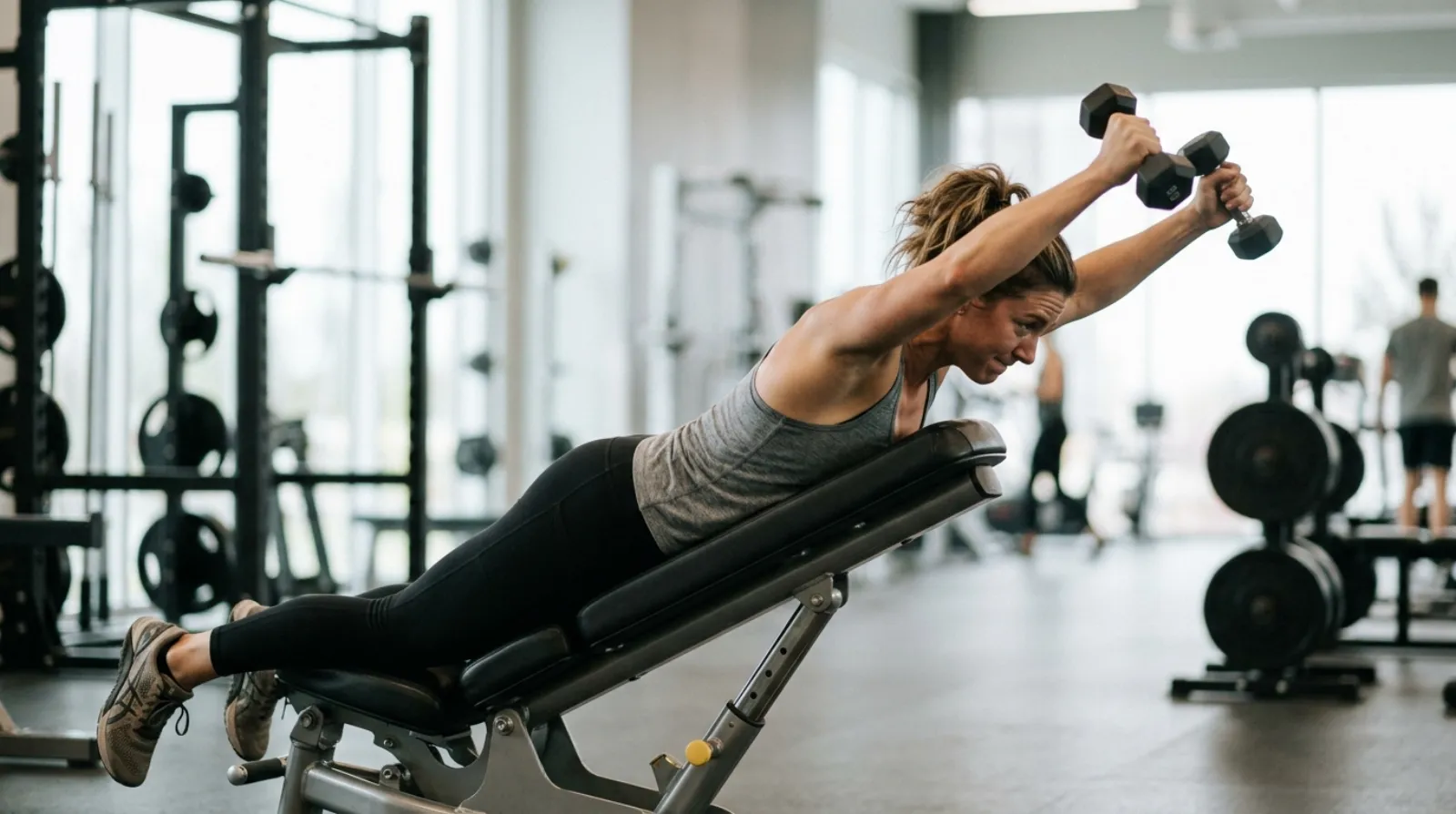
Prone T-Raise
How-to: Lie face-down on a bench, light dumbbells in hand, arms hanging straight down. Raise arms out to a T at shoulder height, thumbs up, squeezing shoulder blades together. Lower under control.
- Cue 1: Lead with the pinky, not the dumbbell.
- Cue 2: Pause 2 seconds at the top.
- Common mistake: Going too heavy. Over 10 lb / 4.5 kg per hand and the rear delts take over.
Load/reps: 3 × 12–15 reps at 5–10 lb / 2.3–4.5 kg.
Chest-Supported Row
How-to: Set an incline bench to ~30°, lie chest-down, row dumbbells with elbows flared to ~75°, driving the elbows toward the ceiling. For more chest-supported pressing and rowing without a spotter, see our workout bench exercises.
- Cue 1: Row toward your ribs, not your hips.
- Cue 2: Squeeze the shoulder blades together at the top, 1-second pause.
- Common mistake: Letting the elbows tuck in. Tucked elbows turn it into a lat row.
Load/reps: 3–4 × 8–12 reps at 25–50 lb / 11–23 kg per hand.
Seated Cable Row to Sternum
How-to: Use a straight bar or rope, sit tall, row the handle to the upper sternum with wide elbows.
- Cue 1: Pull elbows past the torso line.
- Cue 2: Don’t recline — chest stays vertical.
- Common mistake: Hunching forward on the eccentric. Maintain a tall spine through both phases.
Load/reps: 3 × 10–12 reps at 80–140 lb / 36–64 kg.
Band Pull-Apart
How-to: Hold a light band at shoulder height, arms straight, palms down. Pull the band apart until your chest is between your hands.
- Cue 1: Move from the shoulder blades, not the hands.
- Cue 2: Slow eccentric — 2 sec out, 2 sec back.
- Common mistake: Shrugging. If your ears rise, drop band tension.
Load/reps: 2–3 × 20–30 reps with a light–medium band.
Face Pull (mid-trap variation)
How-to: Set a cable rope at face height. Pull the rope to your forehead, leading with the elbows wide at ~90°.
- Cue 1: External rotate at the end — knuckles point up and back.
- Cue 2: Elbows above the wrists the entire pull.
- Common mistake: Pulling to the chin or chest. That makes it a row.
Load/reps: 3 × 15–20 reps at 30–60 lb / 14–27 kg.
Best Lower Trapezius Exercises
This is the section nearly every trap article skips, and it is the most important one if you want pain-free pressing for the next decade. The lower trap is the floor of scapular function — when it’s strong, the whole shoulder works. When it’s weak, every overhead rep grinds. Pair this work with direct deltoid training from our calisthenics shoulder workout for balanced, healthy shoulders.
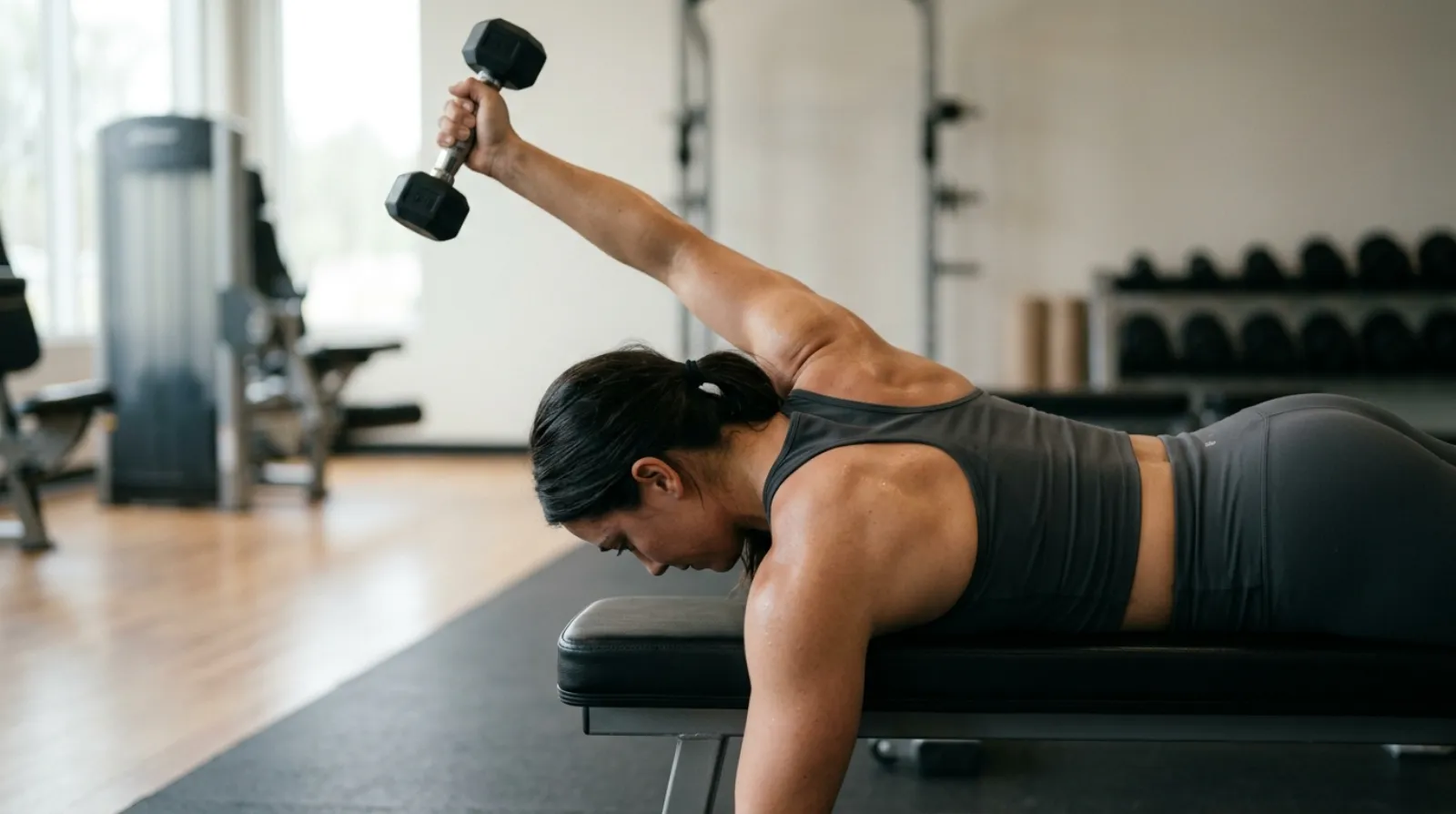
Prone Y-Raise
How-to: Lie face-down on a bench, thumbs up, arms forming a Y overhead at ~125° of abduction. Lift the arms as high as possible without shrugging. Lower slowly.
- Cue 1: Imagine sliding your shoulder blades into your back pockets.
- Cue 2: Pinky higher than thumb to bias external rotation.
- Common mistake: Shrugging up first. If your upper trap fires, drop the weight to zero and re-groove the pattern.
Load/reps: 3 × 12–15 reps at 0–5 lb / 0–2.3 kg. Yes, zero. The 125° angle was Cools’s specific finding for maximally biasing lower trap over upper trap (Source: Cools et al., 2007).
Prone 1-Arm Trap Raise (Cools “Y at 125°”)
How-to: Same setup as the Y-raise, but one arm at a time, with a moment of contralateral bracing. Lift one arm to the Y position, hold 2 seconds at top.
- Cue 1: Keep both hips pressed into the bench.
- Cue 2: Don’t rotate the torso — pure scapular work.
- Common mistake: Rolling the body to gain range. Range comes from the scapula, not the spine.
Load/reps: 3 × 8–10 reps per side, 0–8 lb / 0–3.6 kg.
Overhead Band Pull-Apart
How-to: Hold a light band overhead, arms straight, slightly wider than shoulder width. Pull the band apart and slightly down behind your head, then return.
- Cue 1: Drive elbows wide and slightly back.
- Cue 2: Don’t let the lumbar spine extend — ribs down.
- Common mistake: Using too heavy a band, which forces the upper traps to compensate.
Load/reps: 3 × 12–15 reps with a light band.
Wall Slide with Lift-Off
How-to: Stand with heels 4 inches from a wall. Press the back of the forearms and hands into the wall, elbows at 90°. Slide overhead, then once at the top, lift hands off the wall for 1 second.
- Cue 1: Maintain rib-pelvis stack the entire range.
- Cue 2: The lift-off is the lower-trap rep — the slide is the warm-up.
- Common mistake: Arching the low back to “reach” higher. That is fake range.
Load/reps: 3 × 8–10 reps, bodyweight.
Lat Pulldown with Scap Depression Emphasis
How-to: Set up for a standard lat pulldown. Before bending the elbows, initiate the rep by pulling the shoulder blades down — a 2-inch scapular pulldown — then complete the rep.
- Cue 1: “Pull the blades into the back pockets” before the elbows move.
- Cue 2: Pause 1 second at the bottom with shoulders depressed.
- Common mistake: Skipping the scapular initiation. The lats take over and the lower trap never gets recruited.
Load/reps: 3 × 10–12 reps at 70–130 lb / 32–59 kg.
After fifteen years of programming this on injured shoulders, here’s what actually happens: the first two weeks feel pointless — there’s no pump, the loads are absurdly light, and clients always ask “is this even working?” By week four, overhead pressing strength jumps 5–10% with no extra pressing volume. That’s the lower trap finally doing its job.
Bodyweight & At-Home Trapezius Exercises
You don’t need a rack to train traps. You need a floor, a doorway, and a loaded backpack.
- Prone Y-T-W Series. On the floor, run 8 Y-raises, 8 T-raises, 8 W-raises back-to-back. Three rounds. Hits all three regions in 4 minutes.
- Towel Pull-Apart. Hold a tightly rolled towel at shoulder height, arms straight, and pull outward against your own isometric resistance. 3 × 20 sec.
- Doorway Scap Slide. Stand in a doorway, forearms on the frame at 90°. Slide up and down, focusing on shoulder-blade glide. 3 × 8.
- Backpack Shrug. Load a backpack with 30–50 lb / 14–23 kg of books, hold by the straps at your sides, shrug. 3 × 12–15.
- Inverted Row (under a table or low bar). Body straight, pull chest to bar with wide elbows; progress these on a fixed bar with our pull-up bar workout. 3 × 8–12.
Run these at-home trapezius exercises three times per week and you’ll outwork most gym-goers’ trap programming.
Three Region-Targeted Trapezius Workouts
Each routine below stacks the trapezius exercises from the sections above. Pick the routine that matches your goal. Two sessions per week each. Add to your existing split or run as standalone scapular days.
Trap Mass Routine (upper-bias hypertrophy)
- Barbell shrug — 4 sets x 8-10 reps. Heavy vertical load, 1-second pause at top.
- Snatch-grip high pull — 4 sets x 5 reps. Lead with the elbows; full triple extension.
- Dumbbell shrug (1-sec stretch) — 3 sets x 12-15 reps. Full bottom stretch each rep.
- Trap bar carry — 3 sets x 40 seconds. Stay tall, ribs stacked.
- Face pull — 3 sets x 15 reps. High elbows, external rotation at the end.
Posture Reset Routine (mid + lower)
- Chest-supported row — 4 sets x 10 reps. Elbows wide, row to ribs, 1-second squeeze.
- Prone T-raise — 3 sets x 12 reps. Thumbs up, pause 2 seconds at top.
- Prone Y-raise — 3 sets x 12 reps at 125 degrees. No shrug — lower trap only.
- Band pull-apart — 3 sets x 25 reps. Slow eccentric, move from the shoulder blades.
- Wall slide with lift-off — 2 sets x 10 reps. The lift-off is the rep.
Shoulder Health Routine (lower trap + serratus)
- Wall slide with lift-off — 3 sets x 10 reps. Bodyweight, rib-pelvis stack.
- Prone 1-arm trap raise — 3 sets x 8 reps per side. Hips pressed into bench.
- Overhead band pull-apart — 3 sets x 12 reps. Light band, ribs down.
- Scap-depression lat pulldown — 3 sets x 10 reps. Initiate with scap pulldown before elbows move.
- Overhead carry — 3 sets x 30 seconds per side. Bicep next to ear.
How to Program Trapezius Training (Sets, Reps, Frequency)
The trapezius responds to the same hypertrophy dose-response as every other muscle: 10–20 hard sets per week, trained at 1–3 reps in reserve (RIR), split across at least 2 sessions (Source: Schoenfeld et al., Sports Medicine, 2025 — PubMed). The 2025 dose-response meta-regression confirmed ~0.24% hypertrophy gain per added set at average volumes.
But the three regions tolerate volume differently. The upper trap recovers fast and tolerates heavy load. The lower trap is small, slow-twitch dominant, and prefers high-rep, low-load, frequent practice — closer to a postural muscle than a prime mover.
Programming Table
| Region | Weekly sets | Reps | RIR | Frequency | Load |
|---|---|---|---|---|---|
| Upper | 10–16 | 6–15 | 1–2 | 2–3× | Heavy |
| Middle | 8–14 | 10–15 | 1–3 | 2× | Moderate |
| Lower | 6–12 | 12–20 | 2–4 | 2–4× | Very light |
In coaching, I split this across a push day (upper trap shrugs after pressing), a pull day (mid trap rows + face pulls), and a daily 5-minute lower-trap “snack” of prone Ys and wall slides done before pressing. That last piece doubles overhead pressing safety in clients with prior impingement. If you train on machines, the lat pulldown and seated-row stations in our upper body gym machine workout cover the same trapezius exercises.
Trapezius Stretches & Mobility
The upper trap rarely needs stretching as much as it needs the lower trap to do its share. That said, two mobilizations help.

- Upper trap stretch with scap depression. Sit tall. Anchor the opposite hand under your seat to depress that shoulder. Tilt your ear toward the opposite shoulder. Hold 30 seconds × 2. The seat-anchor is the key — without depression, you’re just hinging the cervical spine.
- Levator scapulae differentiation. From the same setup, rotate your nose down toward your armpit (instead of just lateral tilt). This targets the levator, which is often the actual culprit in “upper trap” tightness.
- Thoracic extension on a foam roller. Roller under mid-back, hands behind head, extend over the roller for 8 reps at 3 spinal levels. Restores the thoracic mobility that lets the scapula upwardly rotate freely.
Trapezius Pain: When It’s Training, When to See a Clinician
This section is educational and not medical advice.
Training soreness (DOMS) is bilateral, peaks 24–48 hours post-session, and resolves with movement. Trigger points are tender nodules that refer pain to the head or down the arm; they respond to manual work and load management. Both are usually self-limiting.
See a clinician promptly if pain radiates down the arm with numbness, tingling, or weakness in a specific finger pattern — that’s the red flag for cervical radiculopathy (Source: Mayo Clinic, 2025). Also escalate for: pain after a fall or trauma, night pain that wakes you, fever with neck stiffness, or visible shoulder drop and scapular winging (possible CN XI injury).
For a basic acute trapezius strain — sudden onset after a heavy lift, localized, no radiation — relative rest, gentle range-of-motion, and a 7–14 day deload usually resolve it (Cleveland Clinic on muscle strains). For persistent neck pain beyond 2 weeks, NHS guidance suggests evaluation.
When in doubt, see a sports physio. A 30-minute assessment beats a year of guessing.
Frequently Asked Questions
What do the trapezius muscles do?
The trapezius elevates, retracts, depresses, and upwardly rotates the scapula, and extends the neck. Its three regions divide the work: upper fibers shrug and stabilize the head, middle fibers retract the shoulder blades, and lower fibers anchor the scapula down while assisting overhead arm motion through the scapular force couple with serratus anterior.
What are the best exercises for the lower trapezius?
The highest-EMG lower-trap exercises are the prone Y-raise at ~125° of abduction, the prone 1-arm trap raise, overhead band pull-aparts, wall slides with lift-off, and lat pulldowns with deliberate scapular depression. Use very light loads — often zero external load — and prioritize the mind-muscle connection over weight.
How do I activate my middle traps?
Horizontal pulling with wide elbows is the key. Use chest-supported rows, prone T-raises with thumbs up, seated cable rows to the sternum, band pull-aparts, and high-elbow face pulls. Pause 1–2 seconds at peak contraction with shoulder blades fully retracted to bias the middle fibers over the rear delts and lats.
Are shrugs enough to build big traps?
No. Shrugs grow the upper trap effectively but barely touch the middle and lower regions. For full trapezius development — and for shoulder health — pair heavy shrugs with horizontal pulls (mid trap) and prone Y-raises or face pulls (lower trap). A trap that only knows how to shrug is a trap that contributes to bad posture.
How often should I train my traps?
Twice per week minimum for hypertrophy, based on current dose-response data showing roughly 10–20 hard weekly sets at 1–3 RIR drives most growth. The lower trap tolerates higher frequency — 3–4 light sessions per week — because the loads are tiny and the work is more skill than strain.
Why are my upper traps tight but my lower traps weak?
Because they are linked. When the lower trap is inhibited (common with desk posture and forward head), the upper trap and levator scapulae take over scapular elevation and run hot all day. The fix is rarely more stretching — it’s strengthening the lower trap so the upper can relax.
Can I train traps with just dumbbells at home?
Yes. Dumbbell shrugs hit the upper trap, prone T-raises with light dumbbells hit the middle, and prone Y-raises with no weight (or 2–5 lb / 1–2.3 kg) hit the lower. Add band pull-aparts and inverted rows on a sturdy table and you have full trapezius coverage without a gym.
What’s the difference between traps and rhomboids?
The rhomboids sit underneath the middle trapezius and also retract the scapula, but they downwardly rotate it — the opposite of what the trap does. The trapezius is bigger, more superficial, and contributes to upward rotation overhead; the rhomboids are smaller, deeper, and dominate scapular downward rotation during pulling.
Sources
- Kenhub — Trapezius muscle
- Physiopedia — Trapezius
- Ekstrom, Donatelli & Soderberg — JOSPT 2003
- Cools et al. 2007 — PubMed
- Cools et al. 2014 — BJSM
- Andersen et al. — J Strength Cond Res
- Schoenfeld et al. 2025 — PubMed
- Cleveland Clinic — Muscle strain
- NHS — Neck pain
- Mayo Clinic — Cervical radiculopathy

Pingback: Arm Stretches: 12 Best by Muscle Group (+ Routines)