
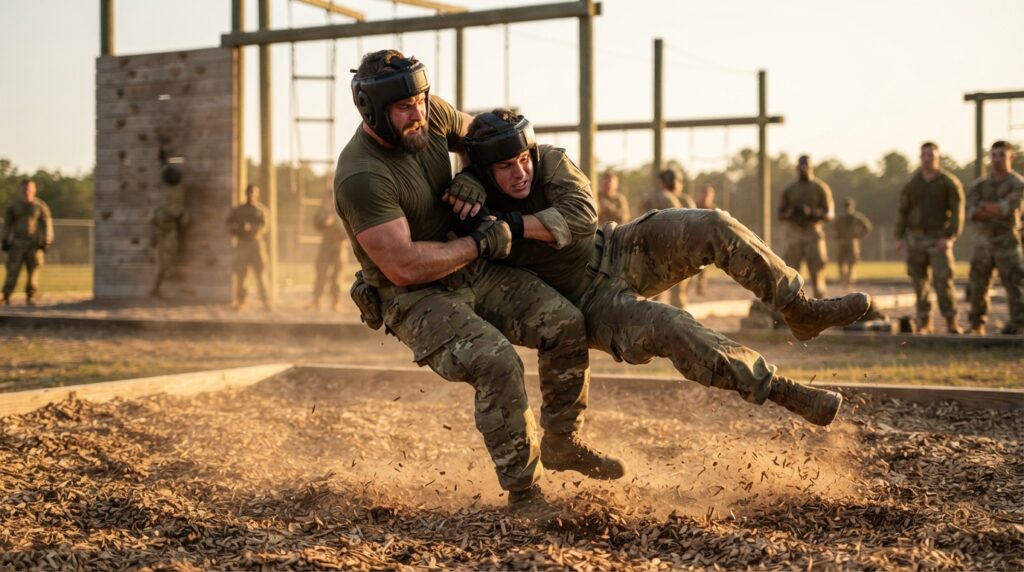
Combat skills training is the block of initial military training where recruits learn the hands-on tasks that keep them alive and effective in a combat environment — marksmanship, movement under fire, CBRN defense, hand-to-hand combatives, land navigation, and casualty care. Every branch builds it into basic training, but the depth, sequencing, and course names differ enough that “combat skills training” means a slightly different program depending on whether you’re headed to the Army, Marine Corps, Navy, or Air Force.
This guide breaks down exactly what’s taught in each core skill area, how the branches structure it differently, where it sits on the basic training timeline, and how to show up ready instead of playing catch-up in week one.
TL;DR — What Does Combat Skills Training Actually Cover?
Combat skills training is the hands-on portion of basic training where recruits learn marksmanship, movement under fire, CBRN defense, hand-to-hand combatives, land navigation, and casualty care. Every branch teaches it, but the Army and Marine Corps go deepest, while the Navy and Air Force fold it into narrower, mission-specific versions built around their own combat exposure.
Table of contents
What Combat Skills Training Actually Covers
Combat skills training is built around six core competency areas that show up, in some form, across every branch: marksmanship, individual movement techniques, CBRN defense, combatives, land navigation, and casualty care. Each one is a distinct block with its own instructors, standards, and graded evaluation.
Basic Rifle Marksmanship (BRM)
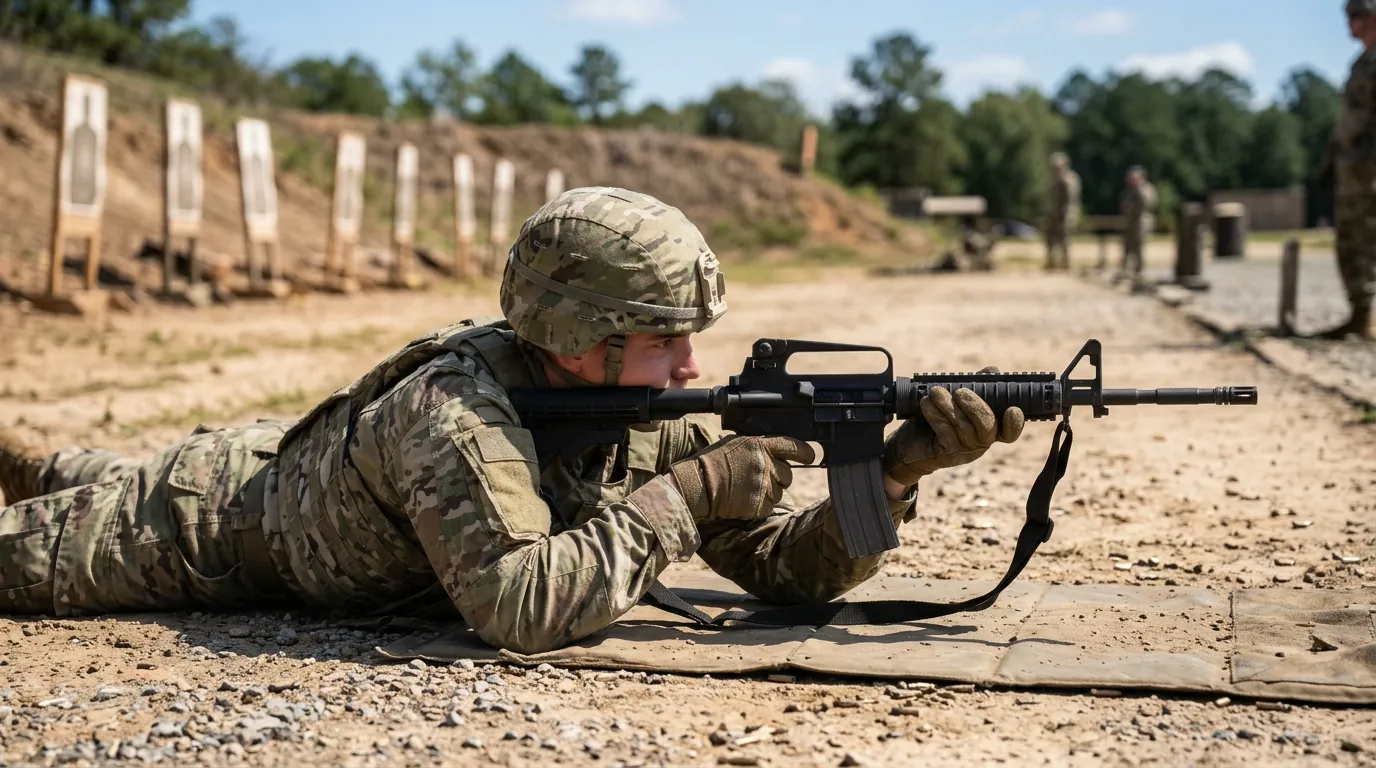
BRM starts with dry-fire fundamentals before recruits ever touch live ammunition. In Army Basic Combat Training, that means learning to “zero” a rifle by aligning sights to the individual shooter’s eye, then drilling trigger control — often with a wooden dowel and a coin balanced on the barrel to catch flinching — before moving to the qualification range (Source: Army Study Guide, 2026). Recruits fire at pop-up targets from 50 to 300 meters and must hit a minimum number to qualify; failing the record fire range typically means retesting before graduation.
Individual Movement Techniques (IMT)
IMT is how a single soldier moves under enemy observation or fire without getting shot. The Army teaches three techniques: the low crawl (flat on the ground, moving with elbows and toes when cover is minimal and fire is heavy), the high crawl (faster, still low-profile, used when concealment is decent but standing up isn’t an option), and the 3–5 second rush (a short sprint between covered positions, timed short enough that an enemy can’t track and fire accurately) (Source: U.S. Army ROTC / FM 3-21.8, 2024). These aren’t abstract drills — they’re graded in Basic Training and reinforced constantly in follow-on field exercises.
CBRN Defense
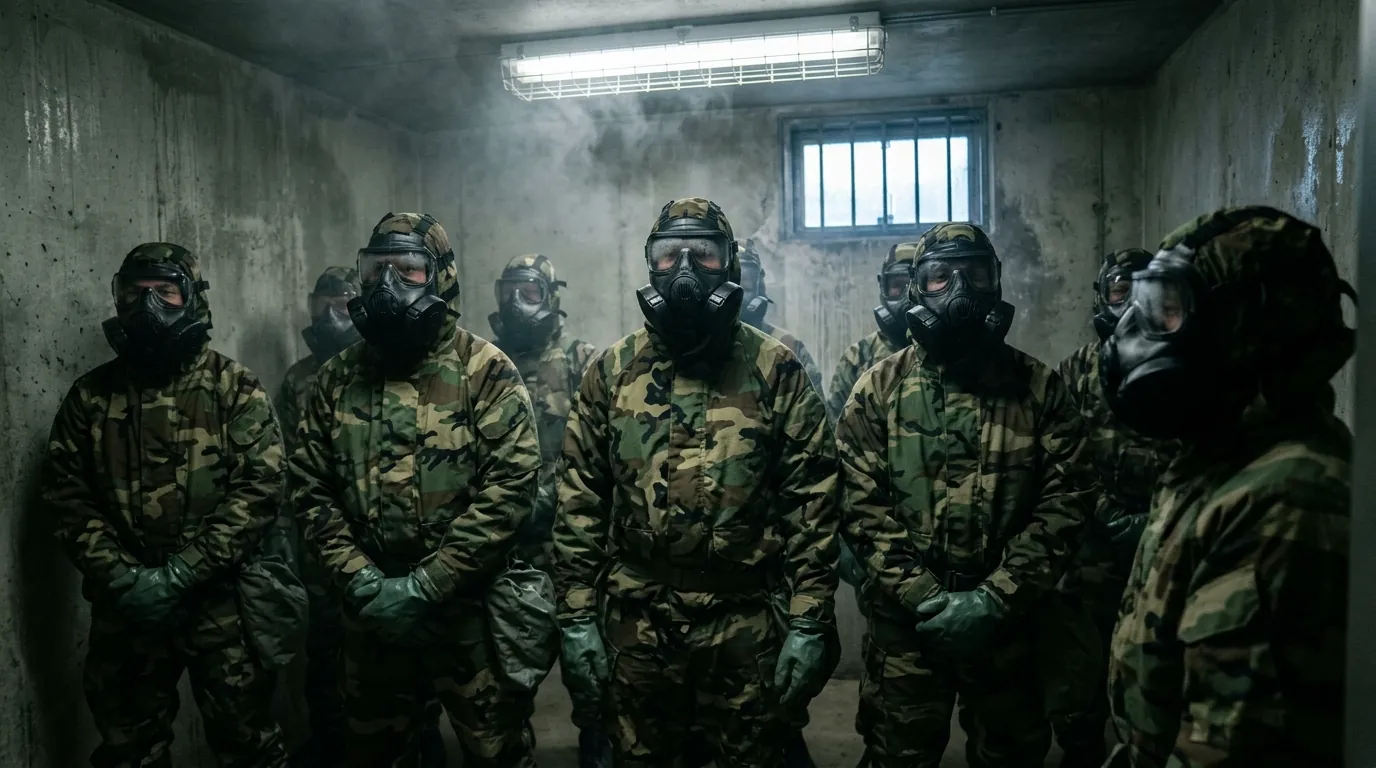
Chemical, Biological, Radiological, and Nuclear defense training teaches recruits to don a protective mask in seconds, wear MOPP (Mission-Oriented Protective Posture) gear correctly, and recognize contamination. MOPP gear includes a JSLIST protective suit — rubber boots, gloves, trousers, and a hooded jacket, often paired with M9 detector paper that changes color when exposed to chemical agents (Source: Operation Military Kids, 2026). The training culminates in the confidence chamber: recruits enter a room filled with CS gas (a riot-control agent, not a lethal one), break their mask seal, and practice clearing it and exiting under control. Breaking the mask seal in the chamber proves the equipment works, so soldiers trust it under real conditions.
Combatives
Hand-to-hand training is standardized across the Army under the Modern Army Combatives Program (MACP), a four-level system built around ground fighting, clinch work, and striking. Level 1 (Basic Combatives Course, 40 hours) is taught during Basic Training by drill sergeants who hold Level 2 or 3 certification. Level 2 (Tactical Combatives Course, 80 hours) trains soldiers to become unit-level instructors. Levels 3 and 4 are four-week courses run at the U.S. Army Combatives School at Fort Benning and produce master trainers (Source: Task and Purpose, 2026; U.S. Army, 2026). Every soldier gets Level 1 in Basic Training; going further is a career-path decision, not a default.
Land Navigation
Land nav is a graded skill, not a lecture. Recruits learn to orient a map, plot grid coordinates, and shoot an azimuth with a lensatic compass, then walk a dismounted course — typically laid out with points spaced 300 to 1,200 meters apart across a minimum 25-square-kilometer area — to find a set number of stakes within a three-to-four-hour window (Source: Army Study Guide, 2026). Miss too many points and you don’t pass. GPS isn’t part of the initial test; the Army wants soldiers who can navigate with a map, protractor, and compass when electronics fail.
Casualty Care (TCCC)
Tactical Combat Casualty Care (TCCC) is the Department of Defense’s standard for battlefield trauma care, and every recruit gets an introduction to it during combat skills training. TCCC is structured around three phases: Care Under Fire (return fire and stop life-threatening bleeding — nothing else, because you’re still being shot at), Tactical Field Care (a fuller assessment using the MARCH framework — Massive hemorrhage, Airway, Respiration, Circulation, Hypothermia/Head injury), and Tactical Evacuation Care (sustaining the casualty during transport) (Source: NAEMT, 2026). Tourniquet application under time pressure is the single most drilled skill in this block, because uncontrolled limb hemorrhage remains one of the most preventable causes of battlefield death.
Combat Skills Training by Branch
The core skills above show up everywhere, but each branch weights and sequences them differently based on mission. Here’s how the four branches compare on their combat skills training block.
| Branch | Where it happens | Length / structure | Standout element |
|---|---|---|---|
| Army | Basic Combat Training (BCT), White and Blue phases | ~10 weeks total BCT; marksmanship and combatives concentrated in weeks 4–9 | MACP Level 1 certification and a dedicated land navigation course tested for record |
| Marine Corps | Recruit Training, then Marine Combat Training (MCT) for non-infantry MOS | MCT is roughly a 29-day block (about 4 weeks) at Camp Pendleton or Camp Geiger, after boot camp graduation | Every Marine gets infantry-level combat skills regardless of job — “every Marine a rifleman” (Source: Operation Military Kids, 2026) |
| Air Force | Basic Military Training (BMT), week 6 onward | 8.5-week BMT; BEAST week was replaced in March 2025 with the PACER FORGE field exercise, extended to 57 hours (three days, two nights) | Heavier tilt toward force protection, anti-terrorism, and expeditionary basing skills over sustained ground combat drills (Source: Air and Space Forces Magazine, 2025) |
| Navy | Recruit Training Command, capstone “Battle Stations” | 9-week boot camp; Battle Stations is a single 12-hour overnight evaluation around week 7–8 | Combat skills are folded into damage control and shipboard survival — firefighting, flooding response, and mass-casualty triage inside a full-scale ship simulator, not sustained land maneuver (Source: Task and Purpose, 2025) |
The practical takeaway: Army and Marine Corps recruits get the most sustained, standalone combat skills instruction because both branches expect every graduate to potentially fight on the ground. Within the Army itself, infantry soldiers going through One Station Unit Training (OSUT) get a deeper dose than support MOS soldiers — the 22-week Infantry OSUT actually certifies (not just familiarizes) recruits in MACP Level 1 and adds patrolling, urban operations, and crew-served weapons that a truck mechanic’s OSUT won’t cover (Source: U.S. Army, 2022; Sandboxx, 2026). Navy and Air Force recruits get a real but narrower version, built around their branch’s actual combat exposure profile.
Combat Skills Training vs. Basic Training
Combat skills training is the tactical core built inside basic training, not a separate program running alongside it. Basic training (or boot camp) is the umbrella: physical conditioning, military bearing, discipline, values, and combat skills all rolled into one initial-entry course. Combat skills training is the specific subset of that curriculum focused on fighting and surviving — marksmanship, movement, CBRN, combatives, land nav, and casualty care.
In Army terms, this falls under what TRADOC calls Initial Military Training (IMT) — the umbrella that includes Basic Combat Training, Advanced Individual Training (AIT) or OSUT, and officer basic courses, all aimed at building baseline Warrior Tasks and Battle Drills before a soldier reaches their first unit (Source: U.S. Army Center for Initial Military Training, 2026). Combat skills training is the load-bearing wall inside that structure, built into basic training rather than run alongside it. For a full week-by-week breakdown of how long basic training runs in each branch and how combat skills training fits into that timeline, see our complete guide to basic training length by branch.
Army Combat Lifesaver (CLS) Course
The Combat Lifesaver Course is a follow-on medical course taught by certified combat medics, sitting between the buddy-aid basics every soldier learns and the advanced trauma skills taught to actual medics and Special Forces medical sergeants — a five-day, 40-hour program that comes after initial basic training, not during it (Source: U.S. Army, 2026; Wikipedia/Combat Lifesaver Course, 2026). It’s built around the same three TCCC phases described above — Care Under Fire, Tactical Field Care, and Casualty Evacuation Care — and covers tourniquet application, pressure dressings, rapid trauma exams, airway management, and calling in a medevac.
CLS isn’t mandatory for every soldier, but most units designate a set number of non-medical personnel per squad or platoon to hold the certification, since a unit can’t count on a medic being within arm’s reach when someone goes down. CLS certification itself doesn’t expire on paper, but units treat it as a currency requirement: soldiers assigned to Priority 1 (actively-deploying) units must retake the course annually to stay current, while soldiers outside that deployment cycle can hold the certification indefinitely without recertifying.
How to Prepare for Combat Skills Training
You can’t out-prep the actual instruction, but you can walk in ahead of your peers on the parts that reward pre-existing skill. Focus on three areas before you ship.
- Twenty to thirty pounds is the standard rucking load you’ll carry during land navigation and field exercises, so build up to it several weeks before you ship rather than testing your back on day one. Our Army PRT guide covers the conditioning drills that translate directly to this.
- Practice map and compass basics. You don’t need field experience, but knowing how to read a topo map, plot an eight-digit grid, and shoot a back azimuth before day one means land nav becomes a confirmation exercise instead of a first exposure.
- CBRN and combatives both hinge on staying calm when your instincts say panic — a fogged mask, a training partner pinning you down — so deliberately practicing discomfort beforehand pays off. Cold showers, sparring, or any controlled stress exposure blunts the shock value instructors are testing for.
- Don’t skip grip and core strength. MACP ground fighting punishes weak grip endurance and a soft midsection far more than raw size. Basic strength training — pull-ups, deadlifts, planks — pays off more than sport-specific martial arts training if you’re starting from zero.
Frequently Asked Questions
What is combat skills training in the Army?
It’s the portion of Basic Combat Training focused on fighting and survival skills: marksmanship, individual movement techniques, CBRN defense, combatives, land navigation, and casualty care. It’s taught throughout BCT’s White and Blue phases, roughly weeks 4 through 9 of the 10-week course.
Is combat skills training the same as basic training?
No. Basic training is the full initial-entry program — physical conditioning, discipline, values, and combat skills combined. Combat skills training is one component inside it, not a standalone course.
What’s the difference between Army and Marine Corps combat skills training?
The Army delivers its combat skills instruction inside the 10-week BCT itself. The Marine Corps splits it: recruit training covers the fundamentals, then non-infantry Marines attend a separate ~4-week Marine Combat Training (MCT) course afterward, because the Corps requires every Marine — regardless of job — to be trained to a baseline infantry standard.
Do you need training before basic training?
No formal training is required. Recruits arrive with zero prior experience in marksmanship, combatives, or land nav and are taught from scratch. Physical conditioning beforehand (rucking, running, strength work) makes the experience easier but isn’t a prerequisite.
What is MACP?
MACP stands for Modern Army Combatives Program — the Army’s standardized hand-to-hand combat system. It has four certification levels; every soldier earns Level 1 during Basic Training, while Levels 2 through 4 are optional, progressively longer courses for those who want to instruct or specialize.
How long does combat skills training take?
There’s no single standalone length because it’s woven through basic training rather than run separately. In the Army, the concentrated combat skills portion of BCT runs roughly six weeks (White and Blue phases). Marine Corps non-infantry recruits get an additional ~4-week MCT block after boot camp graduation specifically for combat skills.
Sources
- Army Study Guide — Basic Rifle Marksmanship
- U.S. Army ROTC — Learning the Basics: Land Navigation
- Army Study Guide — Setting Up a Land Navigation Course
- Operation Military Kids — Military Gas Chamber Training 2026
- Task and Purpose — Modern Army Combatives Program
- U.S. Army — Producing Warriors: MACP
- NAEMT — Tactical Combat Casualty Care
- U.S. Army — Combat Lifesaver Course
- Wikipedia — Combat Lifesaver Course
- Operation Military Kids — Marine Combat Training (MCT)
- Air and Space Forces Magazine — Air Force Drops BEAST Week
- Operation Military Kids — Air Force Basic Training Schedule 2026
- Task and Purpose — Navy Cuts Boot Camp Length
- U.S. Army Center for Initial Military Training
- U.S. Army — Initial Military Training
- Sandboxx — All You Need to Know About Army OSUT
- U.S. Army — 22-Week Infantry OSUT Pilot Graduation