
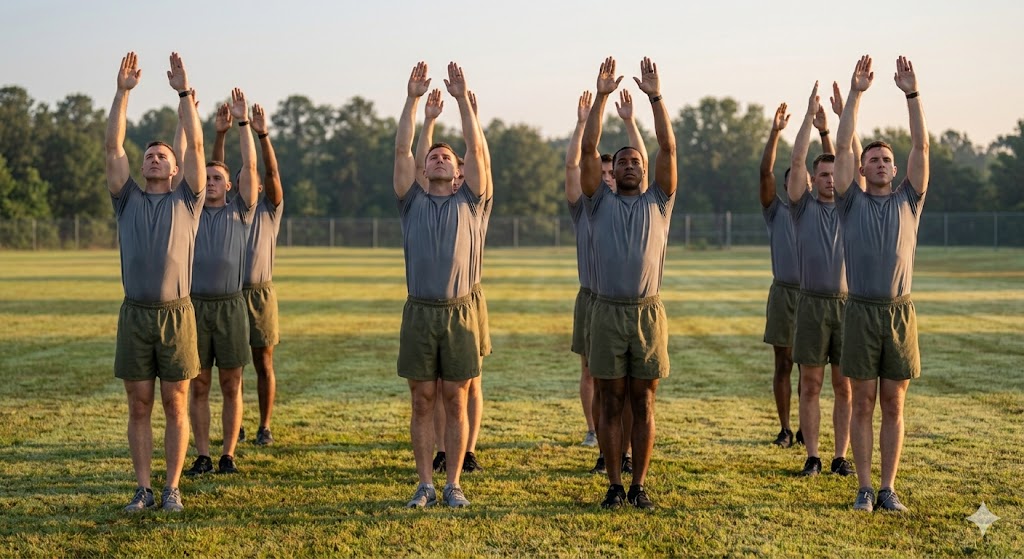
TL;DR — What Is Army PRT and What Are All Its Drills?
Army PRT (Physical Readiness Training) is the U.S. Army’s official fitness system, governed by FM 7-22 (October 2020) under the Holistic Health and Fitness (H2F) program. It runs through structured drills — Preparation, 4 for the Core, Hip Stability, Military Movement, Conditioning, Climbing, Strength/Endurance, and Recovery — and most can be done at home with no equipment.
Table of contents
What Is Army PRT?
Army PRT (Physical Readiness Training) is the U.S. Army’s standardized physical fitness program, governed by Field Manual FM 7-22 (October 2020) within the Holistic Health and Fitness (H2F) system. It develops strength, endurance, and mobility through structured drills performed in a set sequence, replacing earlier doctrine such as TC 3-22.20.
The shift to H2F matters. Older online plans still circulate under TC 3-22.20 or the long-retired FM 21-20, and the exercise order, names, and even the running doctrine have changed. If a plan tells you to run intervals without ever mentioning running skill, it predates the current manual. FM 7-22 folds physical training into a wider readiness model that also covers sleep, nutrition, and mental and spiritual fitness — but the part most people search for is the drill catalog, which is what this guide maps in full (Source: FM 7-22, 2020).
Current-doctrine callout: FM 7-22 (Oct 2020) is the authority. TC 3-22.20 and FM 21-20 are superseded — ignore any plan built on them.
For a complementary bodyweight foundation, see our military calisthenics workout guide.

PRT Drill Index (Quick-Reference Table)
Here is the full PRT drill catalog at a glance. Use it to navigate — every drill below gets its own breakdown. Rep ranges follow FM 7-22 and ATP 7-22.02; conditioning and movement drills are typically run for prescribed repetitions, distance, or intervals rather than a fixed count.
| Drill | Abbreviation | # Exercises | Purpose | Reps/Time |
|---|---|---|---|---|
| Preparation Drill | PD | 10 | Warm-up; primes joints and muscles | 5–10 reps each, slow/moderate |
| 4 for the Core | 4C | 4 | Trunk and core stability/endurance | Hold up to 60 sec each |
| Hip Stability Drill | HSD | 5 | Strengthens hip/pelvis stabilizers | 5–10 reps per leg, slow |
| Military Movement Drill 1 | MMD1 | 3 | Running posture, agility, coordination | By distance/interval |
| Military Movement Drill 2 | MMD2 | 3 | Plyometric power and speed | By distance/interval |
| Conditioning Drill 1 | CD1 | 5 | Foundational strength and endurance | 5–10 reps each |
| Conditioning Drill 2 | CD2 | 5 | Advanced strength and mobility | 5–10 reps each |
| Conditioning Drill 3 | CD3 | 10 | Athletic power, agility, plyometrics | Varies |
| Climbing Drill 1 | CL1 | 5 | Upper-body/grip strength (uses bar) | 5 reps each |
| Climbing Drill 2 | CL2 | 5 | Advanced climbing under load | 5 reps each |
| Guerrilla Drill | GD | 3 | Combat movement, falling, carrying | Varies |
| Recovery Drill | — | Stretches | Cooldown; restores ROM | Hold ~20–30 sec |
| Strength & Endurance | — | — | Running (incl. running skill), resistance | Varies |
Need session-ready layouts off this index? Our printable military workout PDF packages them up.
The Preparation Drill (PD)
The Preparation Drill is PRT’s standardized warm-up: 10 exercises performed in a fixed doctrinal order to prime the joints and muscles before any training session. You run it before conditioning, running, or strength work — every time. Do each exercise for 5 to 10 repetitions at the prescribed cadence, never rushing the slow-tempo movements (Source: FM 7-22, 2020).
The order is not negotiable. The drill walks the body from spine and hips down through the legs and finishes with upper-body work, so the sequence itself is the design. Don’t shuffle it.

The 10 Preparation Drill Exercises
- Bend and Reach — 5–10 reps, slow. Cue: keep the movement controlled on the way down; don’t bounce.
- Rear Lunge — 5–10 reps, slow. Cue: step straight back and lower the rear knee without letting the front knee drift past the toes.
- High Jumper — 5–10 reps, moderate. Cue: land soft, knees bent.
- Rower — 5–10 reps, slow. Cue: move torso and arms together; keep the lower back from rounding hard.
- Squat Bender — 5–10 reps, slow. Cue: heels flat; chest up.
- Windmill — 5–10 reps, slow. Cue: rotate from the hips, not the lower back; knees slightly bent.
- Forward Lunge — 5–10 reps, slow. Cue: control the descent; front knee tracks over the foot.
- Prone Row — 5–10 reps, slow. Cue: squeeze the shoulder blades; lift chest and arms.
- Bent-Leg Body Twist — 5–10 reps, slow. Cue: shoulders flat; only the legs rotate.
- Push-up — 5–10 reps, moderate. Cue: straight line head to heels; full range.
The most common mistake people make is treating the slow-cadence exercises like reps to grind through. They’re mobility work. Slow means slow.
4 for the Core (4C)
4 for the Core is a four-exercise drill that builds trunk stability and muscular endurance — the bracing strength that protects your spine under load. Several are timed holds, with the goal of sustaining each position for up to 60 seconds as you progress (Source: FM 7-22, 2020 / ATP 7-22.02).
- Bent-Leg Raise — controlled leg raises loading the lower abs; keep the lower back pressed down.
- Side Bridge — side plank in a straight line; stack shoulders and hips.
- Back Bridge — glute bridge hold; drive through the heels; don’t hyperextend.
- Quadraplex — opposite arm and leg extended from quadruped; move slowly, resist rotating the hips.
This drill pairs naturally with bodyweight core training — see our calisthenics core workout for progressions once 60-second holds feel easy.
What Is the Hip Stability Drill?
The Hip Stability Drill (HSD) is a five-exercise routine that strengthens the muscles stabilizing the hip and pelvis — the often-neglected glute and hip work that prevents knee pain and improves running mechanics. Perform each exercise for 5 to 10 controlled reps per leg at a slow cadence (Source: FM 7-22, 2020 / ATP 7-22.02).

Most civilian “Army workout” guides skip this drill entirely, which is a real gap — weak hip stabilizers are behind a large share of running and squatting injuries. The five exercises are:
- Lateral Leg Raise — side-lying, raise the top leg straight up; lead with the heel.
- Medial Leg Raise — top leg crossed forward, raise the bottom inner-thigh leg; keep it straight.
- Bent-Leg Lateral Raise — side-lying knee bent, “clamshell” pattern; hips stacked.
- Single-Leg Tuck — draw one knee to the chest under control.
- Single-Leg Over — on your back, rotate one leg across the body; both shoulders down.
Cue across all five: go slow and feel the working muscle. Speed defeats the purpose.
Military Movement Drills — MMD1 & MMD2
The Military Movement Drills are two three-exercise drills that train running posture, agility, coordination, and plyometric power. MMD1 builds the movement base; MMD2 adds explosive power. Always run MMD1 before MMD2, and never mix exercises between them (Source: FM 7-22, 2020).
MMD1 develops controlled, efficient movement:
- Verticals — high-knee running emphasizing posture and a tall torso.
- Laterals — side-to-side shuffling that trains lateral hip control.
- Shuttle Sprint — short accelerations with sharp directional changes.
MMD2 is plyometric and more demanding:
- Power Skip — explosive skipping for stride power.
- Crossovers — lateral crossover steps for hip mobility and coordination.
- Crouch Run — accelerating from a low, athletic position.
Coach’s note: both drills are run over a set distance, not a fixed rep count. Quality of movement beats quantity.
Conditioning Drills — CD1, CD2 & CD3
The Conditioning Drills are three progressive bodyweight circuits that build strength, muscular endurance, and athletic power. CD1 is the foundation, CD2 adds difficulty and mobility, and CD3 is the most advanced — explosive, plyometric, agility-heavy. Perform CD1 and CD2 exercises for roughly 5 to 10 reps each (Source: FM 7-22, 2020).

What Is CD1?
CD1 (Conditioning Drill 1) is the foundational conditioning circuit of PRT — five bodyweight exercises that build baseline strength and endurance and serve as the entry point before CD2 and CD3. It’s the closest thing PRT has to a “basic endurance drill”: simple, equipment-free, scalable.
CD1 (5 exercises): Power Jump, V-Up, Mountain Climber, Leg Tuck and Twist, Single-Leg Push-up.
CD2 (5 exercises): Turn and Lunge, Supine Bicycle, Half Jacks, Swimmer, 8-Count Push-up. Cue: keep the 8-count push-up rhythm clean rather than racing it.
CD3 (10 exercises): an advanced plyometric/agility set including the “Y” Squat, Single-Leg Deadlift, Tuck Jump, Straddle Run, Half-Squat Laterals, Frog Jumps, and Alternate Quarter-Turn Jump, among others. Warm up fully with the Preparation Drill first; land soft on every jump.
Climbing Drills — CL1 & CL2
The Climbing Drills (CL1 and CL2) build upper-body pulling and grip strength using a climbing bar. Each drill is five exercises, performed for about 5 reps each; CL1 is the base version, CL2 progresses the difficulty — in service performed under fighting load (Source: FM 7-22, 2020).
CL1 typically includes the Straight-Arm Pull, Heel Hook, Pull-up, Leg Tuck, and Alternating Grip Pull-up. CL2 swaps in the Flexed-Arm Hang for the opening movement and runs the remaining pulls under added load.
These are the only PRT drills that genuinely require equipment — a sturdy overhead bar. The at-home section covers how to replicate the pulling stimulus without one. Cue: full range on every rep.
Strength & Endurance Training (incl. Running / Pose Method)
Strength and endurance training in PRT covers sustained running, sprint-interval work, and resistance training that builds on the drills above. The headline change in FM 7-22 is running skill — the 2020 manual adopted the Pose Method of running technique, the most significant running-doctrine update in over a decade (Source: posetech.com; FM 7-22, 2020).

Running skill breaks technique into three teachable elements: the pose (a balanced, spring-loaded posture), the fall (using gravity to drive forward momentum), and the pull (lifting the foot from the ground rather than pushing off). The Army’s running drills in FM 7-22 Chapter 7 are credited to Dr. Nicholas Romanov’s Pose Method work. The point is injury-resistant, efficient running — not just logging miles.
For sustained training, PRT uses ability-group runs, release runs, and sprint/interval drills, scaled to the soldier’s level. The principle that carries over to any home program: train the skill of running, not only the volume.
Weighing equipment-based work against bodyweight drills? Our gym vs calisthenics breakdown helps you choose.
What Is the Recovery Drill?
The Recovery Drill is PRT’s standardized cooldown — a sequence of static stretches performed after every training session to restore range of motion and gradually return the body to a resting state. Hold each stretch in a controlled position, roughly 20 to 30 seconds, without bouncing (Source: FM 7-22, 2020 / ATP 7-22.02).
- Overhead Arm Pull — shoulders and arms.
- Rear Lunge — hips.
- Extend and Flex — spine.
- Thigh Stretch — quads.
- Single-Leg Over — rotational finish.
Each stretch has an easier modified variation if you need it — work through them top to bottom. Cue: recovery stretches are held, not pulsed. Skipping the cooldown is the single most common PRT shortcut — and the one that quietly costs you mobility over time.
Can Civilians Do Army PRT at Home?
Yes — most of Army PRT is bodyweight-only and translates directly to home training. The Preparation Drill, 4 for the Core, Hip Stability Drill, Conditioning Drills, Military Movement Drills, and Recovery Drill need zero equipment. Only the Climbing Drills require a bar, and those are easy to substitute.

Drills you can run as-is, no equipment:
- Preparation Drill, 4 for the Core, Hip Stability Drill, Recovery Drill — all pure bodyweight.
- CD1 and CD2 — bodyweight circuits; need only floor space. A mat helps for supine work.
- MMD1 and MMD2 — need about 25 meters of clear space.
Drills that need a swap:
- Climbing Drills (CL1/CL2) — the only true equipment drills. Replace the pulling stimulus with towel rows (loop a towel around a sturdy post), doorway rows (heels forward, grip the doorframe), table rows (lie under a solid table and pull your chest to the edge), or a doorway pull-up bar. Match ~5 controlled reps per set.
- CD3 plyometrics — doable at home, but land on a forgiving surface and regress jump height if new or over 50.
Sensible regressions:
- New to training: cut Preparation Drill reps to 5, hold 4 for the Core positions 15–20 sec instead of 60, skip CD3 until CD1/CD2 feel comfortable.
- Knees or joints complain on jumps: swap plyometric versions for moderate-cadence Preparation Drill equivalents.
For a structured progression, follow our 8-week military calisthenics plan, and if you’re training around age or joint considerations, see military calisthenics for men over 50 and our military calisthenics routines for women.
Get the Printable 5-Page PRT Cheat-Sheet (Free)
Want the whole system — every drill, reps, form cues, and a printable session tracker — on one clean 5-page PDF? Enter your email below and we’ll send it straight to your inbox. In a hurry? The quick-reference table is right underneath.
Pair it with our full printable military workout PDF for complete sessions.
| Drill | Do This |
|---|---|
| Preparation Drill (10) | Bend and Reach, Rear Lunge, High Jumper, Rower, Squat Bender, Windmill, Forward Lunge, Prone Row, Bent-Leg Body Twist, Push-up — 5–10 reps each |
| 4 for the Core (4) | Bent-Leg Raise, Side Bridge, Back Bridge, Quadraplex — hold up to 60 sec |
| Hip Stability (5) | Lateral Leg Raise, Medial Leg Raise, Bent-Leg Lateral Raise, Single-Leg Tuck, Single-Leg Over — 5–10 reps/leg |
| MMD1 (3) | Verticals, Laterals, Shuttle Sprint |
| MMD2 (3) | Power Skip, Crossovers, Crouch Run |
| CD1 (5) | Power Jump, V-Up, Mountain Climber, Leg Tuck and Twist, Single-Leg Push-up |
| Recovery | Overhead Arm Pull, Rear Lunge, Extend and Flex, Thigh Stretch, Single-Leg Over — hold 20–30 sec |
Army PRT FAQ
What does PRT stand for?
PRT stands for Physical Readiness Training — the U.S. Army’s standardized fitness program. It’s governed by FM 7-22 (October 2020) under the Holistic Health and Fitness (H2F) system, and it replaced earlier doctrine including TC 3-22.20 and FM 21-20.
How many exercises are in the Preparation Drill?
The Preparation Drill has 10 exercises, performed in a fixed order: Bend and Reach, Rear Lunge, High Jumper, Rower, Squat Bender, Windmill, Forward Lunge, Prone Row, Bent-Leg Body Twist, and Push-up. Each runs 5 to 10 reps at a slow or moderate cadence.
What’s the difference between PRT and the ACFT?
PRT is the Army’s training system — the drills soldiers do to get fit. The ACFT (Army Combat Fitness Test) is the six-event assessment that measures fitness. PRT is how you train; the ACFT is how you’re tested.
What is the Hip Stability Drill?
The Hip Stability Drill is a five-exercise PRT routine that strengthens the hip and pelvis stabilizers: Lateral Leg Raise, Medial Leg Raise, Bent-Leg Lateral Raise, Single-Leg Tuck, and Single-Leg Over. Done slowly for 5 to 10 reps per leg, it helps prevent knee and running injuries.
What is CD1?
CD1 is Conditioning Drill 1, the foundational bodyweight conditioning circuit in PRT. It has five exercises — Power Jump, V-Up, Mountain Climber, Leg Tuck and Twist, and Single-Leg Push-up — and builds baseline strength and endurance before CD2 and CD3.
What is MMD1?
MMD1 is Military Movement Drill 1, a three-exercise drill that develops running posture, agility, and coordination. Its exercises are Verticals, Laterals, and Shuttle Sprint. Always perform MMD1 before MMD2, and never mix exercises between the two.
What is the Recovery Drill?
The Recovery Drill is PRT’s cooldown — static stretches done after every session to restore range of motion. It includes the Overhead Arm Pull, Rear Lunge, Extend and Flex, Thigh Stretch, and Single-Leg Over, each held around 20 to 30 seconds without bouncing.
How long does the Preparation Drill take?
The Preparation Drill usually takes about 8 to 12 minutes. With 10 exercises at 5 to 10 controlled reps each plus brief transitions, it’s a complete warm-up. Don’t rush the slow-cadence movements — they’re mobility work.
Can civilians do Army PRT at home?
Yes. Most PRT drills — Preparation, 4 for the Core, Hip Stability, Conditioning Drills, Military Movement Drills, and Recovery — are bodyweight-only and need just floor space. Only the Climbing Drills require a bar, easily swapped for towel rows, doorway rows, or table rows.



Pingback: Army PT Uniform (APFU): Components, Rules and Prices