
Resistance Exercises for Older Adults: 12 Moves Scaled by Decade (40s to 80s)
Editorial persona: Claire Morgan
Last updated: November 7, 2026
Gymnase Tips is reader-supported. When you buy through links on our site, we may earn an affiliate commission at no extra cost to you.
This article provides general educational information and does not replace individual medical advice, diagnosis or treatment. Speak with a qualified healthcare professional about your symptoms and circumstances.
TL;DR — What Are the Best Resistance Exercises for Older Adults?
Resistance exercises for older adults should target all major muscle groups two to three times per week using bodyweight, bands, or light dumbbells. The 12 moves below, including squats, rows, and glute bridges, are scaled by decade from your 40s through your 80s, so you train at the right intensity for where your body is now.
Table of contents
Why Resistance Training Matters After 40
Adults lose 3-8% of their muscle mass per decade after age 30, and that rate accelerates sharply past 60 (Source: Volpi et al., 2004). The condition is called sarcopenia. A global meta-analysis of 58,404 older adults estimated its overall prevalence at about 10%, with rates climbing to 20% in certain populations depending on the diagnostic criteria used (Source: Shafiee et al., 2017).
The consequences go beyond appearance. Muscle loss drags down bone mineral density and slows walking speed. It makes a fall more likely and more dangerous. A Cochrane systematic review (Sherrington et al., 2019) found that structured exercise reduced the rate of falls by 23%.
Resistance training fights back. It rebuilds muscle, loads bones, and sharpens the balance and coordination you need to stay independent. The 2019 NSCA Position Statement and the updated 2026 ACSM Position Stand both recommend it as a primary intervention for older adults (Source: Fragala et al., 2019; Source: Currier et al., 2026). If you want a women-specific plan with a menopause and hormonal angle, see our strength training plan for women over 50.
Test Your Starting Level (Sit-to-Stand Self-Assessment)
The five-times sit-to-stand test tells you where to start before picking a program track. Sit in a sturdy, armless chair with your feet flat on the floor. Cross your arms over your chest. Stand up and sit back down five times as fast as you safely can. Time yourself.
Compare your time to these reference values from Bohannon’s meta-analysis of normative data (Source: Bohannon, 2006):
| Age Group | Reference Time |
|---|---|
| 60-69 | 11.4 seconds |
| 70-79 | 12.6 seconds |
| 80-89 | 14.8 seconds |
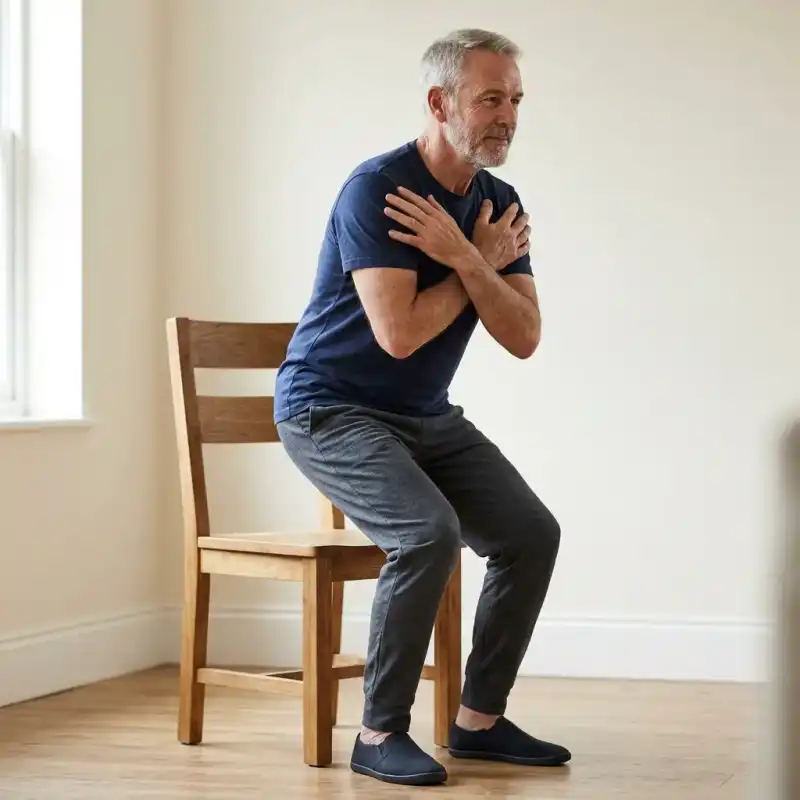
How to read your result: If your time is at or below the reference for your age group, start with the intermediate track in the 4-week program below. If you are slower, start with the beginner track. If you are under 60, aim for a brisk, controlled pace and use the beginner track if you feel unsteady.
This is a screening tool, not a diagnosis. If standing from a chair causes pain or dizziness, talk to your doctor before starting any resistance program.
12 Best Resistance Exercises for Older Adults
These 12 compound and isolation exercises cover every major muscle group and scale from loaded barbell work in your 40s to chair-supported movements in your 80s. Each entry includes a decade-scaling note so you can match the movement to your current ability.
Lower body
1. Goblet Squat / Chair Squat
Builds leg and glute strength for standing, climbing stairs, and getting out of a chair. Stand with feet shoulder-width apart, hold a dumbbell at your chest (goblet) or use no weight (chair squat). Lower your hips until thighs approach parallel, then drive up.
Do 2-3 sets of 8-12 reps. In your 40s, load with a 10-20 kg goblet squat. Drop to 5-12 kg in your 50s. By your 60s, switch to bodyweight squats with a chair tap at the bottom for depth control. In your 70s and 80s, this becomes a sit-to-stand from the chair itself, using the armrests if you need them.
2. Romanian Deadlift / Hip Hinge
Strengthens the posterior chain: hamstrings, glutes, and lower back. Hold dumbbells in front of your thighs. Push your hips back while keeping a slight knee bend, lowering the weights to mid-shin. Squeeze your glutes to return upright.
| Decade | Variant | Sets x Reps |
|---|---|---|
| 40s | Moderate dumbbells (12-20 kg each) | 2-3 x 8-10 |
| 50s | Lighter dumbbells (6-12 kg) | 2-3 x 8-10 |
| 60s | Bodyweight hip hinge, hands on thighs | 2-3 x 8-10 |
| 70s-80s | Standing hip hinge holding a countertop | 2 x 8-10 |
3. Step-Up / Assisted Step-Up
Improves balance and stair confidence. Place one foot on a sturdy step (15-20 cm). Press through that heel to step up, then lower back down with control. Alternate legs. For more leg exercises for seniors, see our dedicated guide.
Aim for 2 sets of 8 per leg. The movement scales through step height and load: 40s trainees use a higher step (20-30 cm) with dumbbells in hand, while those in their 50s stick to a standard 15-20 cm step with light weights. At 60, lose the weights and use a low step. Past 70, add handrail support for safety.
4. Wall Sit / Seated Leg Press
A low-impact quad builder. Lean your back against a wall and slide down until your thighs are roughly parallel to the floor. Hold. No wall available? A seated leg press machine at a gym works too.
Sets/reps: 2-3 sets, 15-30 second holds (wall sit) or 10-12 reps (leg press). Decade scaling: 40s: deep wall sit or moderate leg press; 50s: partial wall sit (45-degree knee bend); 60s: shallow wall sit, 15-second holds; 70s-80s: seated knee extensions with ankle weights or a resistance band.
5. Calf Raise / Seated Calf Raise
Supports ankle stability and balance. Stand on the edge of a step or flat floor, rise onto your toes, pause at the top, then lower slowly. Hold a wall or chair for balance.
Two to three sets of 12-15 reps works across all age groups. What changes is the difficulty. In your 40s, try single-leg calf raises with added weight. Your 50s call for double-leg raises with light dumbbells. At 60, bodyweight alone is enough. For those in their 70s and 80s, seated calf raises with feet flat and pressing through the toes keep the movement safe and effective.
Upper body
6. Seated or Bent-Over Row
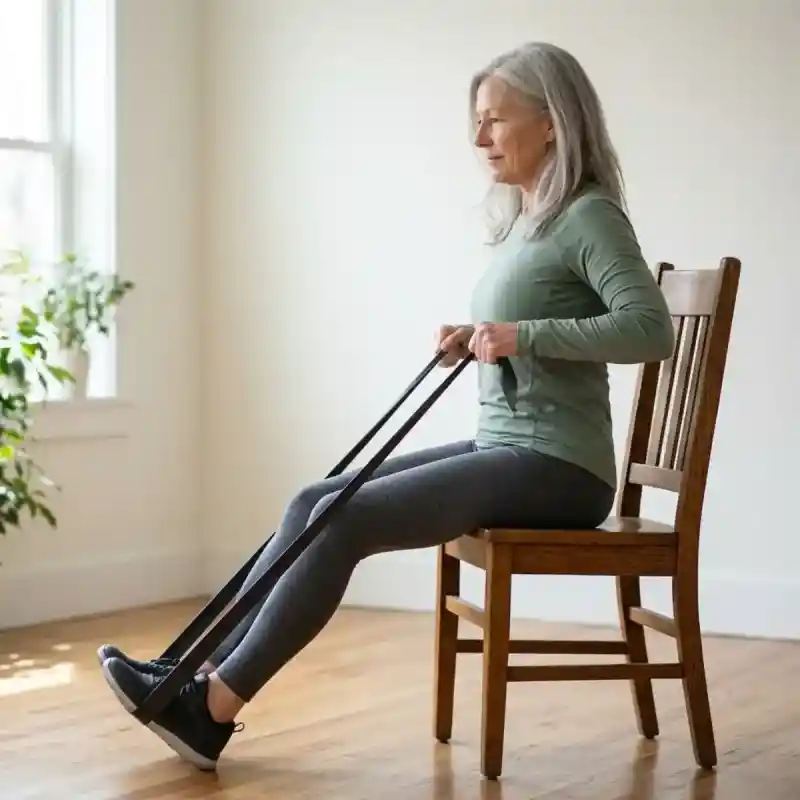
Counters rounded posture and strengthens the mid-back. Sit on a chair with a resistance band anchored at foot level, or bend at the hips holding dumbbells. Pull toward your waist, squeezing shoulder blades together. Lower with control.
Shoot for 2-3 sets of 10-12 reps. The progression looks like this: bent-over dumbbell rows at 8-15 kg in your 40s, lighter dumbbells or a heavy band in your 50s, a seated band row with medium resistance in your 60s, and the same seated row with light resistance in your 70s-80s.
7. Wall Push-Up to Full Push-Up
A scalable upper-body press that targets chest, shoulders, and triceps. Place hands on a wall (easiest), countertop (moderate), or floor (hardest). Lower your chest toward the surface, push back up. Keep your body in a straight line from head to heels. Do 2-3 sets of 8-12 reps regardless of which surface you use.
| Decade | Surface / Load |
|---|---|
| 40s | Floor push-ups, or incline with a weighted vest |
| 50s | Floor or elevated surface |
| 60s | Countertop |
| 70s-80s | Wall |
8. Overhead Press / Seated Press
Builds shoulder function for reaching shelves and lifting objects overhead. Sit or stand, press dumbbells from shoulder height to overhead. Lower under control.
Two sets of 8-10 reps is plenty. Stand and press moderate dumbbells (6-12 kg) in your 40s. Sit down and drop to 4-8 kg in your 50s. By your 60s, use very light weights (2-4 kg) or a band, still seated. Past 70, a seated band press or simple arm raises with no weight keeps the pattern alive without stressing the shoulder joint.
9. Bicep Curl / Band Curl
Grip and carrying strength. Curl dumbbells or a resistance band from full arm extension to shoulder height. Keep elbows pinned to your sides.
Sets/reps: 2 sets of 10-12 reps. Decade scaling: 40s: moderate dumbbells (6-10 kg); 50s: lighter dumbbells (4-6 kg); 60s: light dumbbells (2-4 kg) or medium band; 70s-80s: light band curls.
Core
10. Glute Bridge / Hip Thrust
Hip extension power for walking, standing, and climbing. Lie on your back, knees bent, feet flat. Press through your heels to lift your hips until your body forms a straight line from knees to shoulders. Squeeze at the top. Lower slowly.
Work up to 2-3 sets of 10-12 reps. Younger trainees in their 40s can load this hard with a barbell hip thrust or go single-leg. In your 50s, place a dumbbell across your hips for added resistance. Bodyweight alone is the right call for most people in their 60s. If you are in your 70s or 80s, keep both feet flat, hands at your sides for stability, and focus on a controlled squeeze at the top.
11. Dead Bug / Supported Dead Bug
Core stability without crunches. Lie on your back, arms pointing toward the ceiling, knees bent at 90 degrees. Slowly extend one arm overhead and the opposite leg straight, keeping your lower back pressed into the floor. Return and switch sides.
| Decade | Variant | Volume |
|---|---|---|
| 40s | Full dead bug, slow tempo | 2 x 6-8 per side |
| 50s | Full dead bug; arms only or legs only if coordination is tricky | 2 x 6-8 per side |
| 60s | Supported: lower one leg at a time, arms stay still | 2 x 6-8 per side |
| 70s-80s | Seated marching in a chair, lifting knees alternately | 2 x 6-8 per side |
12. Pallof Press / Seated Rotation
Anti-rotation training for fall prevention and trunk stability. Anchor a resistance band at chest height. Hold it at your sternum and press straight out, resisting the band’s pull to one side. Hold two seconds. Return.
Two sets of 8-10 reps per side. In your 40s, stand and use moderate band tension. Dial the tension back in your 50s but stay standing. Move to a seated Pallof press with a light band once you hit your 60s. For those in their 70s and 80s, swap to seated trunk rotations holding a light medicine ball or even a water bottle.
The Decade Progression Ladder: 40s Through 80s
Your age decade determines starting load, rep range, and rest period, not exercise selection. The movements stay the same. Only the intensity changes. The table below scales all 12 movements across four tiers.
| Parameter | 40s (Aggressive) | 50s (Moderate) | 60s (Conservative) | 70s-80s (Supported) |
|---|---|---|---|---|
| Load | 60-75% of estimated max; dumbbells 8-20 kg | 50-65% of estimated max; dumbbells 4-12 kg | Bodyweight or light dumbbells 2-6 kg | Bodyweight, light bands, or chair-assisted |
| Rep range | 8-10 reps | 10-12 reps | 10-15 reps | 12-15 reps (or timed holds) |
| Sets | 3 | 2-3 | 2 | 1-2 |
| Rest between sets | 60-90 seconds | 90-120 seconds | 120-180 seconds | 2-3 minutes or as needed |
| Squat variant | Goblet squat (loaded) | Goblet squat (light) | Bodyweight squat to chair | Sit-to-stand from chair |
| Push variant | Floor push-up | Incline push-up | Countertop push-up | Wall push-up |
| Row variant | Bent-over dumbbell row | Light dumbbell row | Seated band row (medium) | Seated band row (light) |
| Hinge variant | Romanian deadlift (moderate) | Romanian deadlift (light) | Standing hip hinge (bodyweight) | Counter-supported hip hinge |
| Core variant | Full dead bug + Pallof press | Dead bug + light Pallof | Supported dead bug + seated rotation | Seated marching + seated rotation |
| Session duration | 35-45 min | 30-40 min | 25-35 min | 20-30 min |

Use the table as a starting point. A fit 70-year-old might train at the 50s tier. A 45-year-old recovering from surgery might start at the 60s tier. Match the tier to your sit-to-stand test result and how your joints feel during the first week. Ability matters more than birth year.
Equipment You Need (and What You Can Skip)
You can start with zero equipment. Bodyweight and a sturdy chair handle 8 of the 12 exercises above. As you progress, bands and dumbbells open up more loading options.
| Equipment | Cost (as of November 2026) | Portability | Joint-Friendliness | Best For |
|---|---|---|---|---|
| Bodyweight | $0 | Go anywhere | High (self-limiting load) | Beginners, 70s-80s tier, travel |
| Resistance bands | $15-30 | Fit in a drawer | High (smooth, low-impact) | All ages; rows, curls, presses |
| Dumbbells (adjustable) | $50-150 | Moderate (stay at home) | Moderate (free-weight control needed) | 40s-60s tier; progressive overload |
| Gym machines | $30-60/month (membership) | Low | High (guided movement path) | Joint issues, post-rehab, supervised training |
A resistance band loop set and a pair of adjustable dumbbells cover every exercise in this article for roughly $65-180 total as of November 2026. Skip machines unless you have access to a gym and prefer the guided motion for joint comfort.
Bodyweight training alone can build real strength. If you want proof, see how calisthenics builds muscle at any age.
Resistance Band Exercises for Seniors: Substitutions
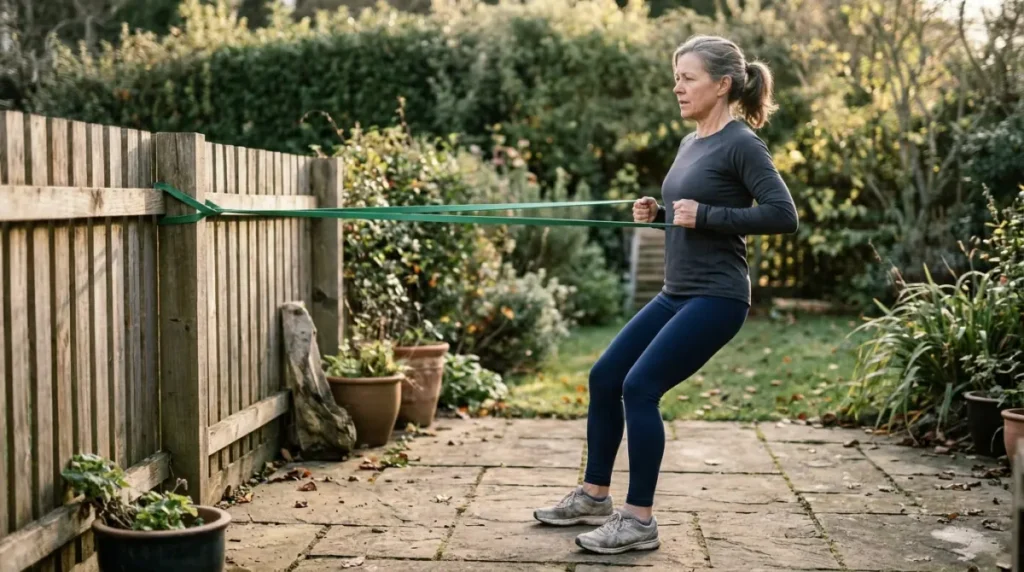
Resistance bands replicate 9 of the 12 exercises above and cost $15-30 as of November 2026. They are joint-friendly because the resistance curve is smooth: hardest at full stretch, lightest at the start of the movement where joints are most vulnerable.
Band substitutions for the 12 exercises:
- Squat: loop band above knees for resistance, or stand on band and hold handles for a front squat pattern
- Row: anchor at foot level, pull to waist (seated or standing)
- Overhead press: stand on band, press handles overhead
- Bicep curl: stand on band, curl handles up
- Calf raise: stand on band for added resistance
- Pallof press: anchor at chest height, press outward
- Hip hinge: stand on band, hinge forward, extend hips against resistance
- Glute bridge: loop band above knees for hip abduction during bridge
- Leg press alternative: seated band knee extension
The wall sit, step-up, and dead bug work well without any equipment at all.
For the full breakdown with form cues and band-weight progressions, see our full resistance band exercise library.
Your 4-Week Starter Program
Start with two sessions per week, 20-30 minutes each, using the beginner track below. Add a third session in week 3 if recovery allows. Pick the track that matches your sit-to-stand result.
Warm-up (every session, 5 minutes):
- Marching in place, 1 min
- Arm circles forward and back, 1 min
- Ankle rolls, 30 sec each foot
- Gentle bodyweight squats to half depth, 1 min
- Shoulder shrugs, 30 sec
Beginner Track (Bodyweight + Bands, 2x/Week)
| Week | Exercises | Sets x Reps | Rest | Notes |
|---|---|---|---|---|
| 1 | Chair squat, wall push-up, seated band row, glute bridge, calf raise, seated marching | 1 x 10 each | 2 min | Learn form; stop if sharp pain |
| 2 | Same 6 exercises | 2 x 10 each | 2 min | Add one set per exercise |
| 3 | Add: band curl, standing hip hinge, supported dead bug | 2 x 10 each | 90 sec | Add third session if you recover well |
| 4 | All 9 exercises; increase band resistance or range of motion | 2 x 12 each | 90 sec | Test sit-to-stand again; compare to week 1 |
Intermediate Track (Dumbbells + Bands, 2-3x/Week)
| Week | Exercises | Sets x Reps | Rest | Notes |
|---|---|---|---|---|
| 1 | Goblet squat, Romanian deadlift, incline push-up, bent-over row, glute bridge, dead bug | 2 x 8 each | 90 sec | Start light; establish form |
| 2 | Same 6 exercises + calf raise, band Pallof press | 2 x 10 each | 90 sec | Add two exercises |
| 3 | All 8 exercises + overhead press, step-up | 2-3 x 10 each | 60-90 sec | Add third session |
| 4 | All 10 exercises; increase dumbbell weight by 1-2 kg where form allows | 3 x 10 each | 60-90 sec | Re-test sit-to-stand |
Cool-down (every session, 3-5 minutes):
- Standing quad stretch, 30 sec per side
- Seated hamstring stretch, 30 sec per side
- Chest doorway stretch, 30 sec
- Cat-cow on all fours or seated spinal rotation, 1 min
Progressive overload matters more than any single exercise. Add one rep per set each week, or increase resistance by the smallest available increment when you can complete all sets with good form.
How Often and How Hard: Frequency and Intensity Guide
Train 2-3 days per week on non-consecutive days, aiming for 8-15 repetitions per set at an effort level where the last 2-3 reps feel hard but form stays clean. That is roughly RPE 6-7 on a 10-point scale.
Both the NSCA and the 2026 ACSM Position Stand agree on this range (Source: Fragala et al., 2019; Source: Currier et al., 2026). The NSCA recommends working toward 2-3 sets of 1-2 multi-joint exercises per major muscle group. The ACSM sets the evidence-based minimum at two sessions per week.
Rest at least 48 hours between sessions that work the same muscle groups. Recovery takes longer as you age. A 70-year-old typically needs more rest between sessions than a 45-year-old doing the same program. Respect it.
When to add load: If you finish all prescribed sets and reps two sessions in a row with good form and the last rep does not feel challenging, add the smallest weight increment available (0.5-1 kg for dumbbells, next band thickness for bands).
Safety and When to See a Doctor
Resistance training is safe for most older adults when loads start light and form is controlled. The NSCA Position Statement confirms that a properly designed program with appropriate supervision is safe for healthy older adults (Source: Fragala et al., 2019).
Check with your doctor first if you have uncontrolled blood pressure, a recent joint replacement, chest pain during exertion, or a diagnosed heart condition. Stop immediately if you feel sharp joint pain, dizziness, or chest tightness during a set.
Two practical rules: breathe out on the effort (never hold your breath through a full rep), and keep range of motion within a pain-free window. Some muscle soreness 24-48 hours after a session is normal. Joint pain that lingers beyond two days is a signal to reduce load or see a professional.
Frequently Asked Questions
What is the best resistance exercise for over 60?
The goblet squat (or chair squat) and the seated row are the two best starting points. The squat trains every lower-body muscle needed for standing and walking. The row strengthens the upper back and fights the forward-rounded posture that becomes more common with age. Both appear in the 12-exercise list above.
Can you build muscle after 60?
Yes. Fiatarone et al. demonstrated that nursing-home residents with a mean age of 87 increased muscle strength by 113% after 10 weeks of high-intensity resistance training (Source: Fiatarone et al., 1994). Peterson’s meta-analysis of 47 studies found strength gains of 24-33% in older adults using progressive resistance exercise (Source: Peterson et al., 2010). The Fiatarone data shows muscle adaptation is possible well into your late 80s given a sufficient training stimulus.
What equipment do older adults need for resistance training?
Nothing to start. Bodyweight and a sturdy chair cover most foundational exercises. A set of resistance bands ($15-30 as of November 2026) and adjustable dumbbells ($50-150 as of November 2026) open up the remaining movements. See the equipment decision matrix above for a full cost and suitability comparison.
How do you start strength training at 60 with no experience?
Take the sit-to-stand self-assessment, then follow the beginner track in the 4-week starter program. Two sessions a week, 20-30 minutes each, bodyweight and bands. That is enough to build a foundation.
Men looking for a higher-intensity bodyweight approach can also explore military calisthenics for men over 50.
This article provides general educational information and does not replace individual medical advice, diagnosis or treatment. Speak with a qualified healthcare professional about your symptoms and circumstances.
Sources
- Volpi, E. et al. “Muscle tissue changes with aging.” Current Opinion in Clinical Nutrition and Metabolic Care, 2004; 7(4):405-410. PubMed Central
- Shafiee, G. et al. “Prevalence of sarcopenia in the world: a systematic review and meta-analysis of general population studies.” Journal of Diabetes & Metabolic Disorders, 2017; 16:21. PubMed Central
- Sherrington, C. et al. “Exercise for preventing falls in older people living in the community.” Cochrane Database of Systematic Reviews, 2019; Issue 1. Cochrane Library
- Fragala, M.S. et al. “Resistance Training for Older Adults: Position Statement From the National Strength and Conditioning Association.” Journal of Strength and Conditioning Research, 2019; 33(8):2019-2052. NSCA guidelines
- Currier, B.S. et al. “ACSM Resistance Training Position Stand.” Medicine & Science in Sports & Exercise, 2026; 58(4):851-872. PubMed
- Bohannon, R.W. “Reference values for the five-repetition sit-to-stand test: a descriptive meta-analysis of data from elders.” Perceptual and Motor Skills, 2006; 103(1):215-222. PubMed
- Fiatarone, M.A. et al. “Exercise Training and Nutritional Supplementation for Physical Frailty in Very Elderly People.” New England Journal of Medicine, 1994; 330(25):1769-1775. NEJM
- Peterson, M.D. et al. “Resistance exercise for muscular strength in older adults: a meta-analysis.” Ageing Research Reviews, 2010; 9(3):226-237. PubMed
All studies cited inline. Full references listed above.