
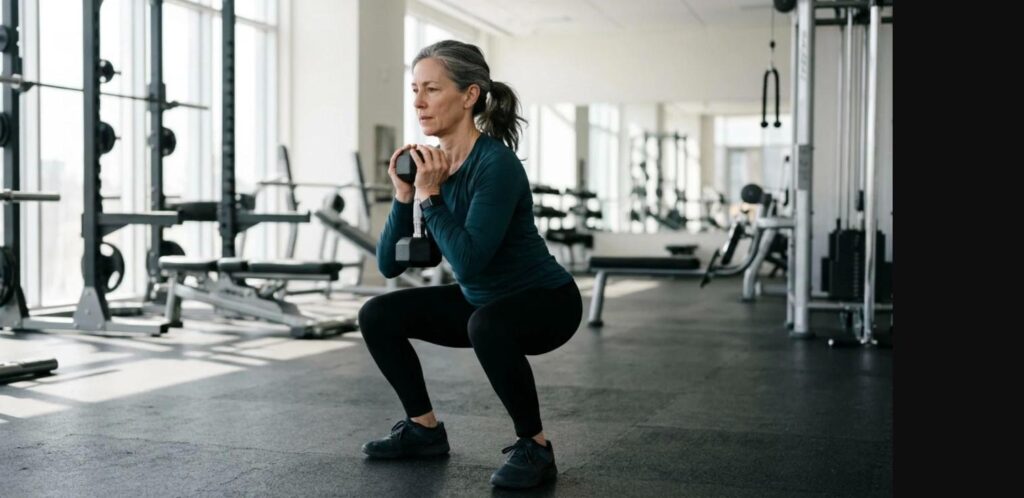
By Claire Morgan, Women’s Health Writer | Updated November 2026
This plan is for general fitness information. Consult your doctor before starting a new exercise program, especially if you have existing health conditions.
Gymnase Tips is reader-supported. When you buy through links on our site, we may earn a small commission at no extra cost to you.
TL;DR — What Does a Menopause Workout Plan Look Like?
A menopause workout plan includes 2–3 strength training sessions, 2 cardio sessions, and 1–2 flexibility or balance sessions per week. During perimenopause, prioritize heavier strength work. In menopause and postmenopause, add dedicated balance training and bone-loading exercises. Adjust intensity using RPE based on daily energy and recovery.
Table of contents
How to Use This Plan
Pick your stage — perimenopause, menopause, or postmenopause — and follow the matching weekly table below. Not sure where you fall? Our guide on perimenopause vs menopause stages breaks it down. Each table lists a specific exercise for every day, with both a gym option and a home option, so the plan works regardless of your setup.
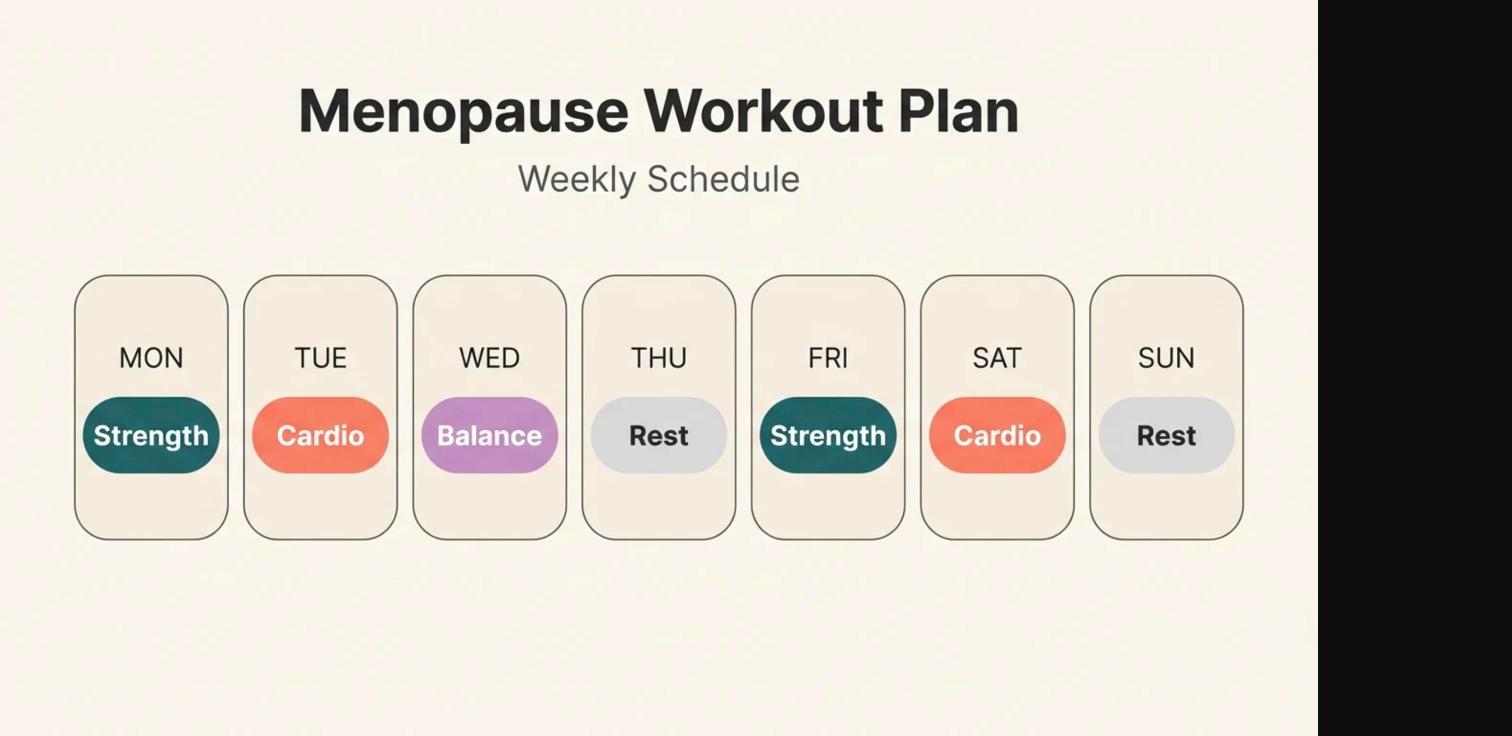
You need minimal equipment. A pair of adjustable dumbbells and a set of loop resistance bands cover the strength days. A yoga mat handles floor work and stretching. That is it.
Every exercise has an RPE (Rate of Perceived Exertion) number on a 1–10 scale. RPE 6 means you could talk in short sentences but not sing. RPE 8 means you finish the set with maybe one rep left. Use RPE to self-regulate — some days you will feel strong, others less so. Hormonal fluctuations make that normal during the menopause transition.
All three stage plans follow a shared 12-week progression (Foundation → Build → Perform), detailed further down. Start at Phase 1 regardless of your training history. Four weeks is not long. It protects your joints and builds the habit.
You can also pair this plan with natural menopause treatments for a broader symptom-management approach.
Perimenopause Workout Plan (Weekly Schedule)
Perimenopause training should center on heavy compound lifts three days per week to fight the accelerating muscle and bone loss that comes with declining estrogen. Add two moderate cardio sessions and one mobility day. Recovery needs change week to week because hormones fluctuate — use RPE to adjust load rather than chasing a fixed number every session.
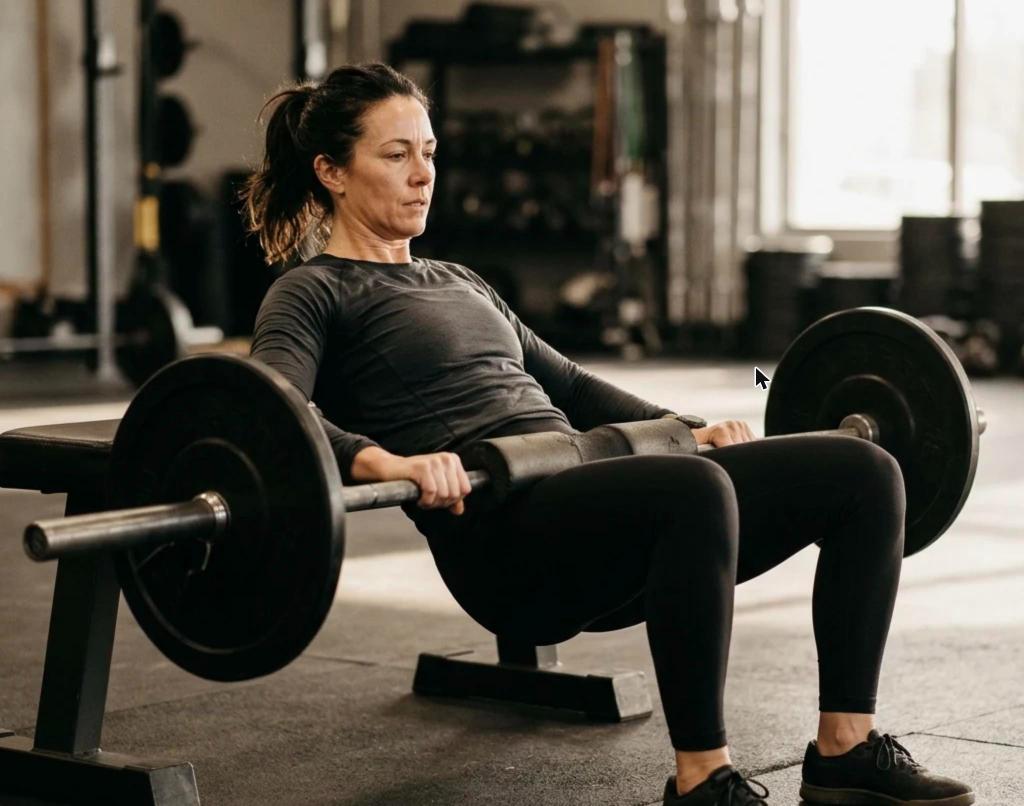
Why the strength emphasis? Muscle mass drops roughly 3–8% per decade after age 30 (Source: Current Opinion in Clinical Nutrition and Metabolic Care, 2010), and the rate speeds up around menopause as estrogen, progesterone, and testosterone all decline. Heavy resistance training is the single most effective countermeasure for both sarcopenia and bone density loss.
Weekly Schedule
| Day | Focus | Exercise | Sets x Reps | RPE | Gym Option | Home Option |
|---|---|---|---|---|---|---|
| Mon | Strength (Lower) | Goblet squat | 3 x 10 | 7 | Barbell back squat | Banded goblet squat |
| Romanian deadlift | 3 x 10 | 7 | Barbell RDL | Dumbbell RDL | ||
| Walking lunge | 3 x 12 each leg | 6 | Dumbbell lunge | Bodyweight lunge | ||
| Kegels + deep core | 3 x 10 holds (5 s each) | 4 | — | — | ||
| Tue | Cardio | Brisk walk 35 min | — | 5–6 | Incline treadmill | Outdoor walk |
| Wed | Strength (Upper) | Dumbbell bench press | 3 x 10 | 7 | Barbell bench press | Push-ups (knees if needed) |
| Bent-over row | 3 x 10 | 7 | Cable row | Resistance band row | ||
| Overhead press | 3 x 10 | 7 | Barbell OHP | Dumbbell or band press | ||
| Kegels + deep core | 3 x 10 holds (5 s each) | 4 | — | — | ||
| Thu | Rest or gentle walk | 20 min easy walk | — | 3 | — | — |
| Fri | Strength (Full Body) | Deadlift | 3 x 8 | 7–8 | Barbell deadlift | Dumbbell deadlift |
| Hip thrust | 3 x 12 | 6 | Barbell hip thrust | Glute bridge with band | ||
| Dumbbell curl to press | 3 x 10 | 6 | Cable curl to press | Band curl to press | ||
| Sat | Cardio (intervals) | Cycling intervals: 30 s hard / 90 s easy x 8 | — | 7–8 (peaks) | Stationary bike | Outdoor bike or stair repeats |
| Sun | Flexibility + Balance | Yoga flow 30 min | — | 4 | Studio class | YouTube follow-along |
HIIT: Keep It Short
Limit high-intensity interval work to one session per week — that Saturday cycling slot counts. Dr. Stacy Sims, a leading exercise physiologist researching women in midlife, recommends keeping HIIT sessions short and intense rather than relying on long moderate-intensity cardio for women going through the menopause transition (Source: Dr. Stacy Sims, 2024). The key word is short. Sprint hard for 20–30 seconds, recover fully, repeat 6–8 times, and stop. Long HIIT classes that keep you in a moderate-intensity zone for 45 minutes are a different animal — they pile stress onto a system already running hot from hormonal flux.
Skip the fasted training too. Eating a small meal with protein before your session supports energy and recovery.
For a full periodized strength program, see our 12-week strength training plan for women over 50.
Menopause Workout Plan (Weekly Schedule)
During menopause proper — 12 or more months without a period — the priority shifts to bone-loading exercises and joint-friendly cardio. Training volume drops slightly compared to perimenopause because recovery windows tend to lengthen. Reduce high-impact work, increase weight-bearing strength moves, and add dedicated balance training to counter the rising fall risk that comes with declining proprioception.
How does this differ from the peri plan? Fewer total sets, slightly lower RPE ceilings, and more emphasis on controlled, weight-bearing movements. Joints feel menopause. Collagen turnover slows, tendons stiffen, and shoulders or knees that were fine at 42 may protest at 52. Programming around that is not weakness — it is smart training.
The NICE menopause guideline (NG23, updated 2024) specifically recommends maintaining muscle mass and strength through physical activity during the menopause transition (Source: NICE, 2024). Resistance training is the most direct route.
Weekly Schedule
| Day | Focus | Exercise | Sets x Reps | RPE | Gym Option | Home Option |
|---|---|---|---|---|---|---|
| Mon | Strength (Full Body) | Goblet squat to box | 3 x 10 | 6–7 | Leg press | Bodyweight squat to chair |
| Dumbbell floor press | 3 x 10 | 6 | Chest press machine | Push-ups (elevated) | ||
| Seated cable row | 3 x 10 | 6 | Machine row | Resistance band row | ||
| Kegels + deep core | 3 x 10 holds (5 s each) | 4 | — | — | ||
| Tue | Cardio (low-impact) | Swimming or cycling 30 min | — | 5–6 | Pool / stationary bike | Outdoor cycling or brisk walk |
| Wed | Balance + Flexibility | Single-leg stance 3 x 30 s each leg | — | 4 | BOSU ball | Firm pillow on floor |
| Heel-to-toe walk 3 x 20 steps | — | 3 | — | — | ||
| Yoga flow 25 min | — | 4 | Studio class | Home video | ||
| Thu | Strength (Full Body) | Step-up with dumbbells | 3 x 10 each leg | 6 | Barbell step-up | Bodyweight step-up |
| Dumbbell overhead press | 3 x 10 | 6 | Machine shoulder press | Resistance band press | ||
| Dumbbell deadlift | 3 x 10 | 6–7 | Trap bar deadlift | Banded good mornings | ||
| Kegels + deep core | 3 x 10 holds (5 s each) | 4 | — | — | ||
| Fri | Cardio (low-impact) | Brisk walk 35 min | — | 5 | Treadmill incline walk | Outdoor walk |
| Sat | Balance + Mobility | Tai chi or balance circuit 25 min | — | 4 | Class | YouTube follow-along |
| Sun | Rest | Rest or gentle 20 min stroll | — | 2–3 | — | — |
A Note on HRT and Training
If you are on hormone replacement therapy, research suggests the combination of HRT and exercise may improve cardiovascular and metabolic markers (Source: Archives of Gerontology and Geriatrics, 2023). Some women on HRT report better training recovery and energy. This is a conversation between you and your doctor, not something to self-prescribe based on a workout plan.
Concerned about belly fat changes? Our menopause belly guide covers that specifically.
Postmenopause Workout Plan (Weekly Schedule)
Postmenopausal women can absolutely build muscle and improve bone density. A 2024 meta-analysis in Archives of Gerontology and Geriatrics found that resistance training produced measurable muscle hypertrophy in postmenopausal and older women, with higher training volumes yielding the strongest gains (Source: Archives of Gerontology and Geriatrics, 2024). The plan below emphasizes progressive resistance training 2–3 days per week, daily walking toward 7,000–12,500 steps, and dedicated balance work to prevent falls — the leading cause of injury-related death in adults over 65 (Source: CDC, 2026).
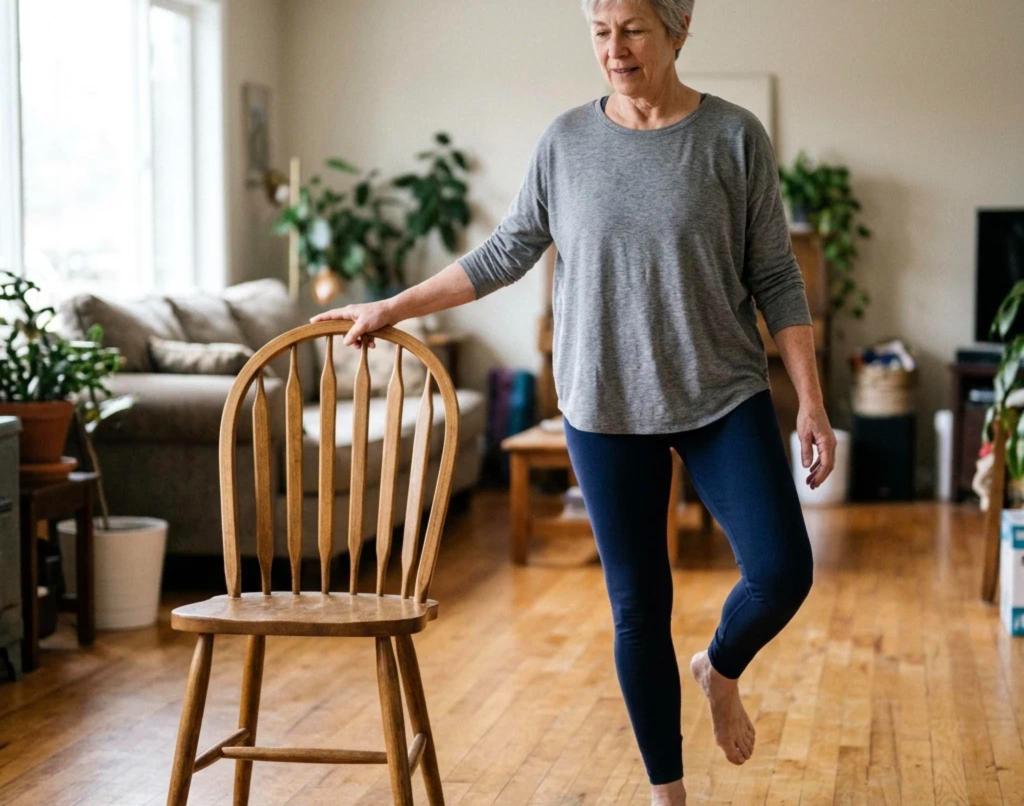
That fall stat matters. A 2019 Cochrane review of 108 trials — the most recent edition of this review — found that exercise programs incorporating balance and strength training reduced the rate of falls by 23% in community-dwelling older adults, a finding reaffirmed in a 2023 network meta-analysis (Source: Cochrane Database of Systematic Reviews, 2019; European Review of Aging and Physical Activity, 2023). Two balance sessions per week is not optional at this stage. It is the minimum.
Bone density can drop 1–2.5% per year after menopause, with the fastest loss in the first few years around the final menstrual period (Source: PMC, 2018). Weight-bearing exercise and progressive resistance training are the primary non-pharmaceutical tools to slow that loss. The U.S. Physical Activity Guidelines recommend muscle-strengthening activities at least two days per week for older adults, including exercises that target all major muscle groups (Source: HHS Physical Activity Guidelines, 2018).
Weekly Schedule
| Day | Focus | Exercise | Sets x Reps | RPE | Gym Option | Home Option |
|---|---|---|---|---|---|---|
| Mon | Strength (Full Body) | Goblet squat | 3 x 10 | 6 | Leg press | Chair squat with dumbbell |
| Lat pulldown | 3 x 10 | 6 | Machine lat pulldown | Resistance band pulldown | ||
| Dumbbell bench press | 3 x 10 | 6 | Chest press machine | Incline push-up | ||
| Kegels + deep core | 3 x 10 holds (5 s each) | 4 | — | — | ||
| Tue | Balance + Walk | Single-leg stance 3 x 30 s each | — | 4 | BOSU ball | Firm pillow |
| Heel raises 3 x 15 | — | 4 | Calf raise machine | Stair edge | ||
| Brisk walk 30 min | — | 5 | Treadmill | Outdoor | ||
| Wed | Cardio (low-impact) | Swimming or cycling 30 min | — | 5–6 | Pool / stationary bike | Outdoor cycling |
| Thu | Strength (Full Body) | Dumbbell deadlift | 3 x 10 | 6–7 | Trap bar deadlift | Banded deadlift |
| Seated dumbbell press | 3 x 10 | 6 | Machine shoulder press | Resistance band press | ||
| Stability ball wall squat | 3 x 12 | 5 | Smith machine squat | Stability ball wall squat | ||
| Kegels + deep core | 3 x 10 holds (5 s each) | 4 | — | — | ||
| Fri | Balance + Flexibility | Tai chi or balance circuit 25 min | — | 4 | Class | YouTube follow-along |
| Yoga or stretching 20 min | — | 3 | Studio | Home video | ||
| Sat | Walk | Brisk walk 35–45 min | — | 5 | Treadmill | Outdoor (aim for 8,000+ steps total today) |
| Sun | Rest | Rest or gentle movement | — | 2 | — | — |
Progressive Overload — Briefly
Progressive overload means gradually increasing the demand on your muscles over time. Add 1–2 kg when you can complete all reps at the prescribed RPE for two sessions in a row. Or add one rep per set. Small jumps compound over months. The 12-week progression below gives you the framework.
For a detailed breakdown of pairing training with nutrition after menopause, see our menopause weight loss guide. Active older adults who exercise benefit from at least 1.2 g of protein per kg of body weight per day to support muscle maintenance, with 1.0–1.2 g per kg as the baseline for healthy older adults (Source: PROT-AGE Study Group, 2013).
12-Week Progression: Foundation to Perform
Following the same routine at the same weight for months stalls progress. This 12-week progression moves through three 4-week phases — Foundation (learn movements, build the habit), Build (increase load and volume), and Perform (train near your working capacity). All three stage-specific plans above use this same phase structure. Start at Phase 1 even if you have trained before.
| Phase | Weeks | Training Goal | Sets x Reps | RPE Range | Cardio Change | Key Cue |
|---|---|---|---|---|---|---|
| Foundation | 1–4 | Movement quality, joint prep, habit | 2–3 x 12–15 | 5–6 | Steady-state, moderate pace | “Can I hold a conversation?” Yes = right zone |
| Build | 5–8 | Increase load, add volume | 3 x 8–12 | 6–7 | Add 5 min duration or one interval set | “Last 2 reps should feel challenging” |
| Perform | 9–12 | Train near capacity, peak loads | 3–4 x 6–10 | 7–8 | Maintain duration, increase pace or resistance | “Could I do one more rep? Barely.” |
Phase 1 is not wasted time. It teaches movement patterns under lighter load, lets connective tissue adapt (tendons adapt more slowly than muscles, so they need the ramp-up time), and prevents the early-program injuries that derail progress.
After completing Phase 3, either repeat the cycle at higher loads or take a deload week (half the volume, same movements, RPE 4–5) before restarting. Most people see visible strength gains by Week 6 and measurable improvements in balance and endurance by Week 10.
The progression applies across all three menopause stages. What changes between stages is exercise selection (the tables above), not the loading philosophy.
What to Skip — Exercises That Backfire During Menopause
Most exercises are safe during menopause. But three patterns tend to cause more problems than they solve.
Excessive HIIT. More than one or two high-intensity sessions per week stacks stress on an already-elevated cortisol baseline. Sleep disruption — already common in menopause — gets worse. One short interval session per week is plenty. If your sleep tanks after a HIIT class, that is your answer.
Behind-the-neck pressing and pulldowns. Collagen loss accelerates after menopause, and shoulder joint laxity increases. Behind-the-neck movements force the shoulder into extreme external rotation under load. Press and pull in front of your body instead. Same muscles, far less joint risk.
Long steady-state cardio without strength training. Running 45 minutes five days a week while skipping the weights is a recipe for accelerated muscle loss. Cardio alone does not preserve muscle mass or bone density. Pair it with resistance training, or the net effect on body composition may be negative.
Skip marathon training blocks unless you are already an experienced runner with a solid strength base. For most women in menopause, walking plus two to three strength sessions delivers a better return per hour invested.
FAQ
How often should you exercise during menopause?
Four to five days per week works for most women. Split that across 2–3 strength sessions, 2 cardio sessions (walking, cycling, or swimming), and 1–2 flexibility or balance sessions. The exact split depends on your stage and current fitness. Perimenopause can handle more intensity. Postmenopause needs more balance work. Start with three days if you are returning from a long break, and add a day every two weeks.
Is HIIT good for perimenopause?
Yes, in small doses. One session per week of short, true intervals — 20–30 seconds of all-out effort followed by full recovery — supports cardiovascular health and may help manage body composition. The problem starts when HIIT replaces strength training or becomes a daily habit. Long, moderate-intensity “HIIT” classes (the kind where you never fully recover between rounds) pile on unnecessary stress. Slot intervals into one cardio day and prioritize lifting for the rest.
Can you build muscle after menopause?
Yes. A 2024 meta-analysis found that postmenopausal women who performed resistance training achieved measurable muscle hypertrophy, with higher training volumes producing stronger results (Source: Archives of Gerontology and Geriatrics, 2024). The process is slower than at 30, partly due to anabolic resistance — your muscles need more stimulus and more protein to grow. But growth happens. Two to three sessions per week with progressive overload is the recipe. For a full strength program, see our strength training plan for women over 50.
What is the best workout split for menopause?
A full-body split two to three days per week is the most practical option for most menopausal women. It hits every muscle group with enough frequency to stimulate growth, fits around cardio and balance work, and does not require five gym days. An upper/lower split works too if you prefer four sessions. Avoid body-part splits (chest day, back day) unless you are training four or more days purely for strength — they spread volume too thin at lower frequencies.
Do I need different exercises during perimenopause vs postmenopause?
Yes, and the difference matters. During perimenopause, you can generally tolerate heavier loads and higher training volumes. That is the time to push compound lifts hard — squats, deadlifts, presses — and build the strength reserve you will draw from later. After menopause, balance and bone-loading exercises take priority. You still lift, but recovery takes longer, joint considerations increase, and dedicated fall-prevention work becomes non-negotiable. The stage-specific tables above reflect these differences in exercise selection and intensity.
Sources
- NICE NG23 — NICE, updated 2024
- U.S. Physical Activity Guidelines — HHS, 2018
- CDC falls data — CDC, 2026
- Cochrane review — Cochrane Database of Systematic Reviews, 2019
- Archives of Gerontology and Geriatrics — resistance training and muscle hypertrophy in postmenopausal women, 2024
Key sources shown. Every other study is named inline where it is cited.