
Last updated: June 2026 — written by the Gymnase Tips training team.
Holding a handstand longer comes down to three skills: hand-and-finger pressure control for micro-balancing, hollow-body alignment to keep your line straight, and accumulated practice volume — typically 5 to 15 minutes daily of total handstand work. Most consistent practitioners reach 30-second freestanding holds in 8 weeks and 60-second holds in 16 weeks. The key is daily short sessions, not occasional long ones.
This guide covers the prerequisites for handstand training, the 3 balance principles that matter most, the 8-week progression from wall holds to freestanding, the daily practice protocol, and the common errors that limit progress.
Prerequisites
- Shoulder mobility — full overhead range of motion without arching back
- Wrist conditioning — wrists tolerate weight-bearing without pain
- Core strength — 60-second hollow body hold
- Push-up endurance — at least 15 strict push-ups
- Wall walks — be able to walk feet up a wall to handstand position
3 balance principles for longer holds
1. Finger pressure control
Press into the floor with fingertips when falling forward; release pressure when falling backward. Like steering a tiny car with your hands.
2. Hollow body alignment
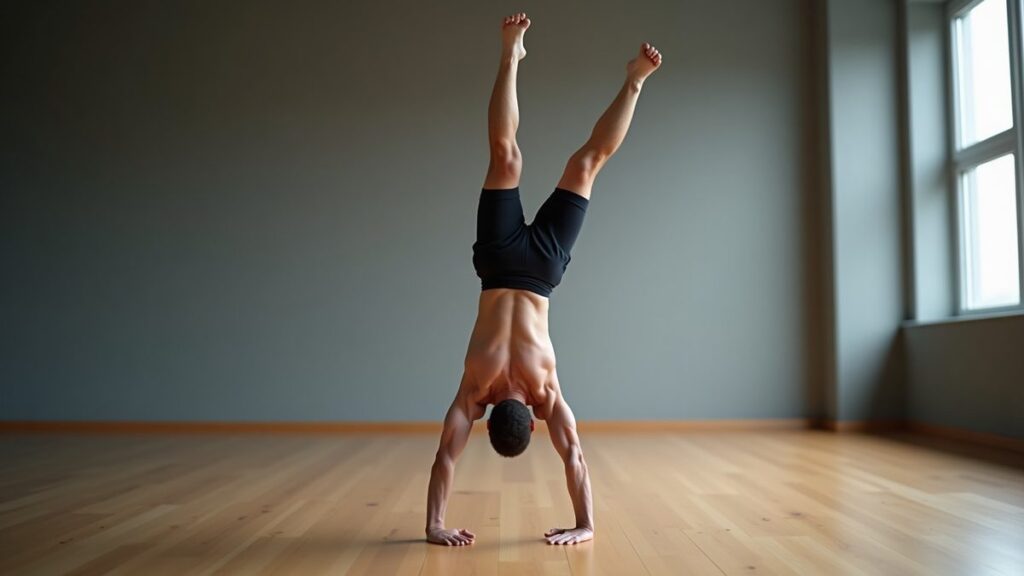
Squeeze glutes, ribs tucked, slight pelvic posterior tilt. A “banana” handstand (arched back) is unstable and tires fast.
3. Stacked alignment
Wrists, elbows, shoulders, hips, knees, ankles in a vertical line. Energy travels through bones rather than fighting muscles to stay up. The American College of Sports Medicine emphasizes proper alignment as the foundation of safe inverted training.
The 8-week progression
Weeks 1–2: Wall foundations
Daily 10 minutes:
- Wall plank (chest-to-wall) — 4 × 30 sec
- Wall handstand (back-to-wall) — 4 × 30 sec
- Hollow body hold — 4 × 45 sec
- Wrist mobility work — 5 min
Weeks 3–4: Belly-to-wall holds
Daily 12 minutes:
- Chest-to-wall handstand — 5 × 45 sec (work toward stacking shoulders directly over wrists)
- Heel pull-aways from wall — 4 × 5 reps (controlled balance practice)
- Wall walks — 3 × 3 reps
- Hollow body hold — 4 × 60 sec
Weeks 5–6: Freestanding kicks
Daily 15 minutes:
- Kick-up to handstand — 10 attempts (open space, fall safely if needed)
- Belly-to-wall handstand — 4 × 60 sec
- Heel pull-aways — 4 × 5 reps with longer holds at peak
- Hollow body hold — 4 × 60 sec
Weeks 7–8: Freestanding holds
Daily 15 minutes:
- Freestanding kick-ups — 12 attempts, hold each as long as possible
- Wall practice — 3 × 60 sec for endurance
- Total handstand time goal: 60+ seconds across all attempts
- Wrist conditioning + hollow body work
Daily practice protocol
- Practice daily, briefly — 10–15 min works better than 60 min twice a week
- Warm up wrists thoroughly — circles, stretches, weight-bearing prep
- Practice in the same spot — visual cues help balance
- Film yourself — alignment looks different than it feels
- Bail safely — practice cartwheel-out so you don’t fear falling
Common errors that limit progress
- Banana back — arched back, hips forward. Looks like a half-handstand.
- Bent arms — wastes energy, increases fatigue
- Shoulders not stacked — leaning forward instead of pressing up
- Looking forward (head out) — disrupts balance line
- Holding breath — limits hold time. Breathe shallowly throughout.
FAQ
How long does it take to hold a freestanding handstand?
Most beginners reach 5–10 second holds in 4–6 weeks of daily practice. 30-second holds: 12–16 weeks. 60-second holds: 16–24 weeks. Faster with gymnastics or yoga background.
Should I practice handstands every day?
Yes — daily short sessions are the fastest path. Wrist health matters: warm up thoroughly, and rest 1 day per week if discomfort develops.
Can I learn handstands as an adult?
Yes. Adults learn slower than kids but reach respectable levels with consistent practice. Plenty of 40+ year olds hold 60-second handstands.
Will handstands build muscle?
Handstand holds build mostly endurance. Handstand push-ups build serious shoulder and tricep strength. See our calisthenics chest exercises for related strength moves.
Do I need a coach?
Not strictly. Self-coaching with video review works for most. A few sessions with a calisthenics or gymnastics coach can shortcut form errors.
The bottom line: longer handstand holds come from daily, deliberate practice combining wall foundations, freestanding kick-ups, and hollow body conditioning. The 8-week plan above takes most beginners from zero to 30+ second holds. Practice daily, film yourself, and trust the slow accumulation. For broader bodyweight skill development, our street workout guide covers the full skill ladder.

Pingback: Yoga for Focus and Productivity: The 5-Min Routine