Updated November 2026
Gymnase Tips is reader-supported. When you buy through links on our site, we may earn an affiliate commission at no extra cost to you.
TL;DR — Do Squats Actually Build Thicker Thighs?
Squats for thicker thighs work when you pair progressive overload with a caloric surplus and adequate protein (at least 1.6 g/kg/day). This guide gives you a 3-day weekly routine with exact sets, reps, and rest periods, a double-progression loading model, and a 12-week timeline for visible thigh growth.
Table of contents
Can Squats Make Your Thighs Thicker?
Yes, squats can make your thighs thicker when performed with progressive overload and combined with a caloric surplus. Bodyweight squats alone build muscular endurance but not significant mass. Adding external load (barbell, dumbbells, or a leg press) and eating at least 1.6 g of protein per kilogram of bodyweight daily drives measurable hypertrophy within 8–12 weeks.
The outcome depends on your energy balance. Squatting in a caloric surplus sends the signal and the raw materials for muscle growth, so your thighs get thicker. Squatting in a deficit preserves muscle while you lose fat, so thighs look leaner and more defined but do not grow. At maintenance calories, you get slow body recomposition: marginal size gain over months rather than weeks. If your goal is toning rather than building, see our how to tone your legs guide.
The 2026 ACSM position stand confirms that hypertrophy occurs across a wide loading spectrum, from moderate to heavy loads, provided effort is sufficient (Source: ACSM, 2026). That means the barbell back squat is not the only path to thicker thighs, but it remains the most load-efficient one. The deciding factors are progressive overload, enough weekly volume, and nutrition.
Best Squat Variations for Thigh Size
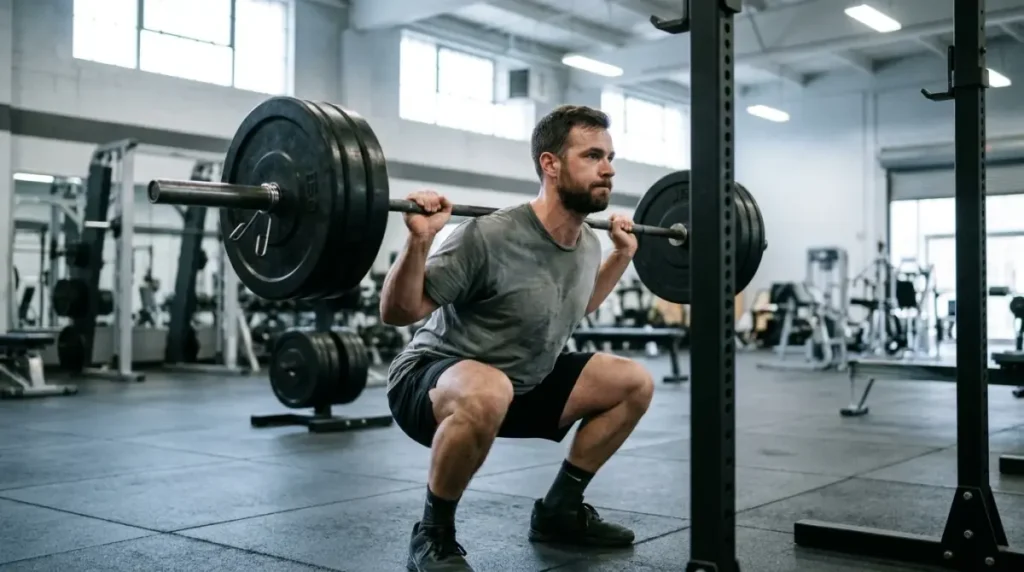
Back squats and front squats drive the most thigh growth, but variation selection depends on your weak points and equipment access. Here are six options ranked by hypertrophy stimulus, with the muscle emphasis that matters for thigh thickness.
| Variation | Primary Emphasis | Best For | Equipment |
|---|---|---|---|
| Barbell back squat | Quads, glutes, adductors | Overall thigh size | Barbell + rack |
| Front squat | Quads (vastus lateralis, vastus medialis) | Quad-dominant thickness | Barbell + rack |
| Heel-elevated goblet squat | Quads | Quad isolation with lighter loads | Dumbbell + wedge or plate |
| Sumo squat | Adductors, glutes, quads | Inner thigh thickness | Barbell or dumbbell |
| Bulgarian split squat | Quads, glutes (unilateral) | Fixing left-right imbalances | Dumbbells + bench |
| Leg press | Quads, glutes (bilateral) | High-volume overload without spinal load | Leg press machine |
Skip the Smith machine squat for thigh size. The fixed bar path reduces adductor and stabilizer recruitment, which limits how much total thigh musculature you stimulate per rep.
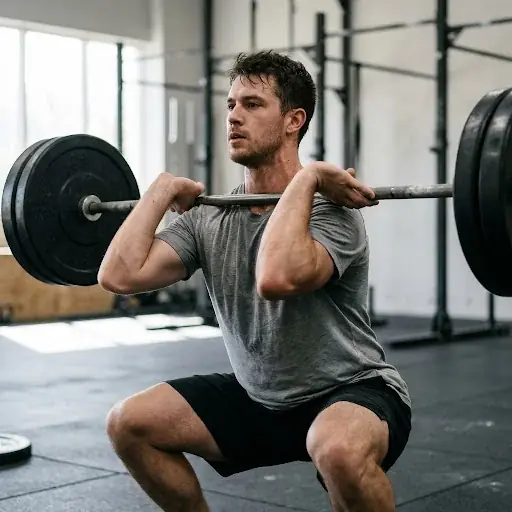
A few form points that matter. Use full range of motion on every variation. Drive your knees over your toes rather than restricting them. Control the eccentric (lowering) phase for 2–3 seconds; the 2026 ACSM position stand identifies eccentric overload as a variable that favors hypertrophy (Source: ACSM, 2026).
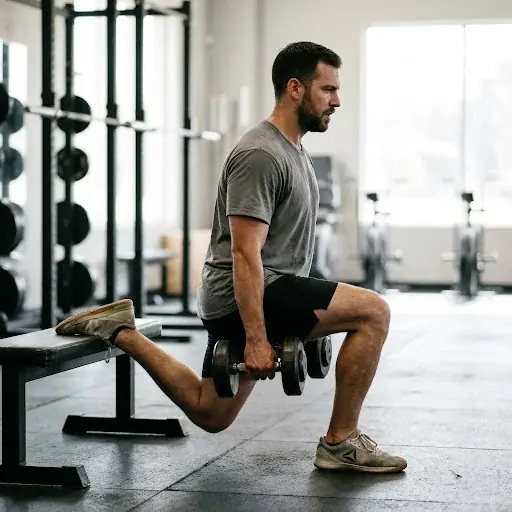
For dumbbell-only substitutions, see our dumbbell thigh exercises guide, and for machine-based alternatives check the leg machine exercises overview.
The 3-Day Squat Routine for Thicker Thighs
Train legs three days per week on non-consecutive days. Each session takes 40–50 minutes and targets a different emphasis: quads, posterior chain, then full leg. This structure gives each muscle group at least two direct exposures per week, which helps you accumulate enough volume. A 2019 meta-analysis found that training frequency does not meaningfully affect hypertrophy when total weekly volume is sufficient (Source: Schoenfeld et al., 2019). Aim for at least 10 hard sets per muscle group per week (Source: ACSM, 2026).
Day 1 — Quad Emphasis
| Exercise | Sets | Reps | Rest | RPE |
|---|---|---|---|---|
| Barbell back squat | 4 | 8–10 | 2–3 min | 7–8 |
| Front squat | 3 | 8–10 | 2 min | 7–8 |
| Heel-elevated goblet squat | 3 | 10–12 | 90 sec | 8 |
| Leg extension | 2 | 12–15 | 60 sec | 8–9 |
Day 2 — Posterior Chain + Glutes
| Exercise | Sets | Reps | Rest | RPE |
|---|---|---|---|---|
| Romanian deadlift | 4 | 8–10 | 2–3 min | 7–8 |
| Bulgarian split squat | 3 | 10–12 each leg | 90 sec | 8 |
| Leg curl | 3 | 10–12 | 60 sec | 8 |
| Hip thrust | 3 | 10–12 | 90 sec | 8 |
For more posterior chain work, see our glute exercises guide.
Day 3 — Full Leg
| Exercise | Sets | Reps | Rest | RPE |
|---|---|---|---|---|
| Sumo squat | 4 | 8–10 | 2–3 min | 7–8 |
| Leg press | 3 | 10–12 | 2 min | 8 |
| Walking lunge | 3 | 12 each leg | 90 sec | 7–8 |
| Standing calf raise | 3 | 12–15 | 60 sec | 8 |
Rest at least one day between sessions. A typical split: Monday / Wednesday / Friday, or Tuesday / Thursday / Saturday.
How to Warm Up Before Squatting
Spend five minutes preparing your joints and muscles before loading. Do 2 minutes on a bike or brisk walk, then 10 bodyweight squats, 10 leg swings per side, and 10 hip circles per side. Finish with one light set of your first working exercise at roughly 50% of your planned load. That is enough.
After your session, cool down with some thigh stretches for recovery.
How to Add Weight Over Time (Double Progression)
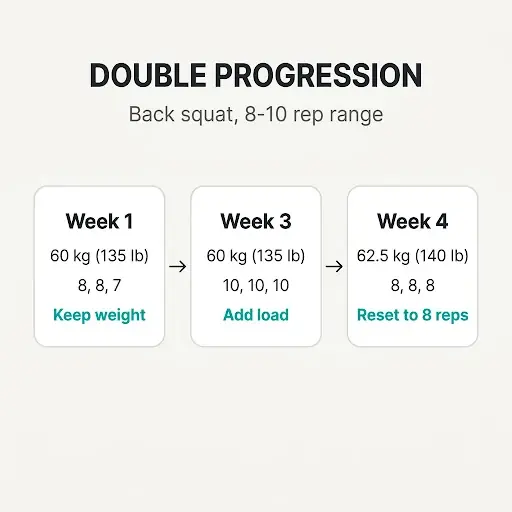
Use double progression: once you hit the top of your rep range on every set, add 2.5 kg (5 lb) next session and reset to the bottom of the range. This one rule removes guesswork from progressive overload.
Here is a concrete example for back squats in the 8–10 rep range:
- Week 1: 60 kg (135 lb) x 8, 8, 7. You did not hit 10 on all sets, so keep the weight.
- Week 3: 60 kg (135 lb) x 10, 10, 10. Top of range on every set. Time to add load.
- Week 4: 62.5 kg (140 lb) x 8, 8, 8. Reset to the bottom of the range and build back up.
Stay in the RPE 7–9 range. RPE 7 means you could do roughly three more reps; RPE 9 means one rep left. You should rarely hit actual failure. The 2026 ACSM position stand notes that training near failure (roughly 2–3 reps in reserve) produces the same hypertrophy outcomes as absolute failure (Source: ACSM, 2026).
If you stall (same weight and reps for two consecutive sessions), drop the weight by 10%, restart, and build past the plateau. Stalls are normal. They are not a signal that your program is broken.
When Will You See Results? A 12-Week Timeline
Most beginners see measurable thigh growth after 8–12 weeks of consistent training with progressive overload and adequate nutrition. The first four weeks are mostly neural adaptation; visible size changes start around week five.
Here is what the research suggests at each phase.
Weeks 1–4, neural adaptation. Your nervous system learns to recruit more motor units and fire them faster. Strength jumps quickly. Thigh measurements stay roughly the same. This phase frustrates people, but it is the foundation for the growth that follows.
Weeks 5–8, early hypertrophy. Muscle protein synthesis is consistently elevated. Quadriceps cross-sectional area increases at roughly 0.1% per day during progressive resistance training, according to a review (Source: Wernbom et al., 2007). You will start noticing your trousers fitting tighter around the thighs.
Weeks 9–12, visible thickening. If nutrition is on point, this is where other people start to notice.
The timeline assumes you train legs at least twice per week, eat in a surplus, and progress the load. Drop any of those three and the timeline stretches.
What to Eat for Thicker Legs
Thicker thighs require a modest calorie surplus and at least 1.6 g of protein per kilogram of bodyweight daily. A 2022 meta-analysis confirmed that younger adults consuming at least 1.6 g/kg/day during resistance training gained more lean body mass than those eating less (Source: Nunes et al., 2022). Without enough calories and protein, even the best squat program will not add measurable size.
Protein intakes beyond roughly 1.6 g/kg/day did not further increase lean mass gains (Source: Morton et al., 2018). So 1.6 g/kg is the floor.
Common Mistakes That Stall Thigh Growth
The most common reason squats fail to build thigh size is insufficient load. Bodyweight squats and high-rep daily challenges do not provide the mechanical tension needed for hypertrophy.
Going too light for too long. If you can do 20+ reps with ease, the weight is not driving growth. Hypertrophy demands loads that bring you close to failure within the 6–15 rep range. Doing 100 squats a day or “20 squats every morning” builds endurance and burns calories, but it will not make your thighs thicker.
Training to failure every session. The opposite extreme is equally counterproductive. Grinding to absolute failure on every set generates excessive fatigue that compromises your next session. Keep 1–2 reps in reserve on most sets. Save true max-effort sets for occasional test days.
Skipping the posterior chain. Your thighs are not just quadriceps. The hamstrings and adductors make up a large portion of thigh circumference. A quad-only approach leaves size on the table. That is why the routine above includes Romanian deadlifts, leg curls, and sumo squats.
Ignoring nutrition. Training provides the stimulus; food provides the building material. If you have been squatting hard for months and your thighs have not grown, check your calorie and protein intake before changing your program. For bodyweight-only training options, see our bodyweight leg workout guide.
Frequently Asked Questions
How long does it take to get thicker thighs?
Most beginners notice measurable changes after 8–12 weeks of consistent progressive resistance training with adequate nutrition. The first four weeks build neural efficiency rather than visible muscle. Detectable hypertrophy typically begins around weeks five through eight, with visible results by week twelve.
Do squats make your thighs bigger or smaller?
Both, depending on your diet. Squatting in a caloric surplus builds muscle and makes thighs thicker. Squatting in a deficit preserves muscle while you lose fat, making thighs look leaner and more defined. The exercise itself is the stimulus; your energy balance determines the outcome.
How many times a week should you train legs for size?
Two to three times per week. A 2019 meta-analysis concluded that training frequency does not meaningfully affect hypertrophy when total weekly volume is sufficient (Source: Schoenfeld et al., 2019). The practical advantage of splitting work across two or three sessions is that you can accumulate more total sets without each workout running excessively long.
Can you build bigger legs without weights?
Yes, to a point. Beginners will gain some thigh size from bodyweight squats, pistol squats, and lunge variations. But the ceiling is low. Without external load, progressive overload stalls quickly. For a full bodyweight approach, check our bodyweight leg workout guide. Expect slower and smaller results compared to loaded training.
What should you eat to get thicker legs?
Eat in a modest caloric surplus above maintenance and consume at least 1.6 g of protein per kilogram of bodyweight per day. Prioritize whole protein sources. See the nutrition section above for details.
Sources
- Currier BS, et al. “ACSM Position Stand: Resistance Training Prescription for Muscle Function, Hypertrophy, and Physical Performance in Healthy Adults.” Med Sci Sports Exerc. 2026;58(4):851–872. ACSM 2026 position stand
- Nunes EA, Colenso-Semple L, McKellar SR, et al. “Systematic review and meta-analysis of protein intake to support muscle mass and function in healthy adults.” J Cachexia Sarcopenia Muscle. 2022;13(2):795–810. Nunes et al. 2022
- Schoenfeld et al. 2019, training frequency and hypertrophy. Schoenfeld et al. 2019
- Wernbom et al. 2007, quadriceps cross-sectional area with resistance training. Wernbom et al. 2007
- Morton et al. 2018, protein intake and lean mass gains. Morton et al. 2018