

Gymnase Tips is reader-supported. Some links may be Amazon affiliate links; if you buy through them we may earn a small commission at no extra cost to you.
TL;DR — Is Walking with a Weighted Vest Worth It?
A weighted vest for walking increases calorie burn roughly in proportion to the added load. Expect about 10% more calories with a vest weighing 10% of your body weight. Start at 5% of body weight, walk 3 to 4 days per week, and build over 30 days. Below: calorie numbers by body weight, a 4-week plan, and a treadmill protocol.
Table of contents
Is Wearing a Weighted Vest Good for Walking?
Yes. A weighted vest for walking is one of the simplest ways to increase calorie burn and cardiovascular demand during a walk without changing your speed or route. Research shows the metabolic cost of walking rises roughly in proportion to total system mass, so adding 10% of your body weight burns about 10% more calories per session (Source: ACSM, Guidelines for Exercise Testing and Prescription, 11th ed., 2021).
Here is what a vest adds to your walk, specifically:
- A 160-lb person walking 3 mph for 30 minutes burns about 126 calories unloaded. Add a 16-lb vest (10% body weight) and that climbs to about 138 calories, roughly a 10% increase (138.3 versus 125.7 before rounding). Not dramatic per session, but it compounds over weeks.
- The extra load raises heart rate and oxygen demand at the same pace, which is useful if flat walking no longer challenges you.
- Your glutes, quads, and core muscles work harder to stabilize and propel the added weight with each step.
- Weight-bearing exercise supports bone health, though UCLA Health sports-medicine surgeon Dr. Sharon Hame notes that the extent to which a weighted vest improves bone density beyond regular walking is not yet established (Source: UCLA Health, 2025).
These are walking-specific benefits. For broader vest training applications, see weighted vest workouts.
Weighted Vest Walking vs Rucking
A weighted vest distributes load evenly around your torso, keeping your center of gravity close to your spine. A rucksack puts all the weight behind you, shifting posture forward and changing gait mechanics. If you want to walk with your normal stride and upright posture, a vest is the better tool. Rucking has its own protocols and progression, which are outside the scope of this guide.
How Heavy Should a Weighted Vest Be for Walking?
When choosing a weighted vest for walking, start with a vest weighing 5% of your body weight, roughly 8 lbs for a 160-lb person (Source: UCLA Health, 2025). UCLA Health recommends increasing weight gradually in small increments using an adjustable vest. We suggest adding 2 to 3 lbs every two weeks if you feel no joint pain at the current load.
You will find conflicting advice online: some retailers say 3 to 5%, others list flat numbers like “4 to 8 lbs” regardless of body size. The body-weight percentage approach is more reliable because an 8-lb vest is a very different stimulus for a 120-lb walker versus a 220-lb walker.
Our recommendation: 5% for healthy adults to start. If you have joint concerns or are recovering from an injury, begin lighter and consult your doctor on an appropriate load. We suggest capping vest weight at 10 to 15% of body weight for walking; beyond that, gait changes become more pronounced and injury risk rises.
For detailed vest fit and sizing guidance, see what size weighted vest should I get.
Body-Weight Percentage Quick-Reference
Use this table to find your starting and intermediate vest weight. Round to the nearest available plate increment on your vest.
| Your Body Weight | Beginner Vest (5% BW) | Intermediate Vest (10% BW) |
|---|---|---|
| 120 lbs | 6 lbs | 12 lbs |
| 140 lbs | 7 lbs | 14 lbs |
| 160 lbs | 8 lbs | 16 lbs |
| 180 lbs | 9 lbs | 18 lbs |
| 200 lbs | 10 lbs | 20 lbs |
| 220 lbs | 11 lbs | 22 lbs |
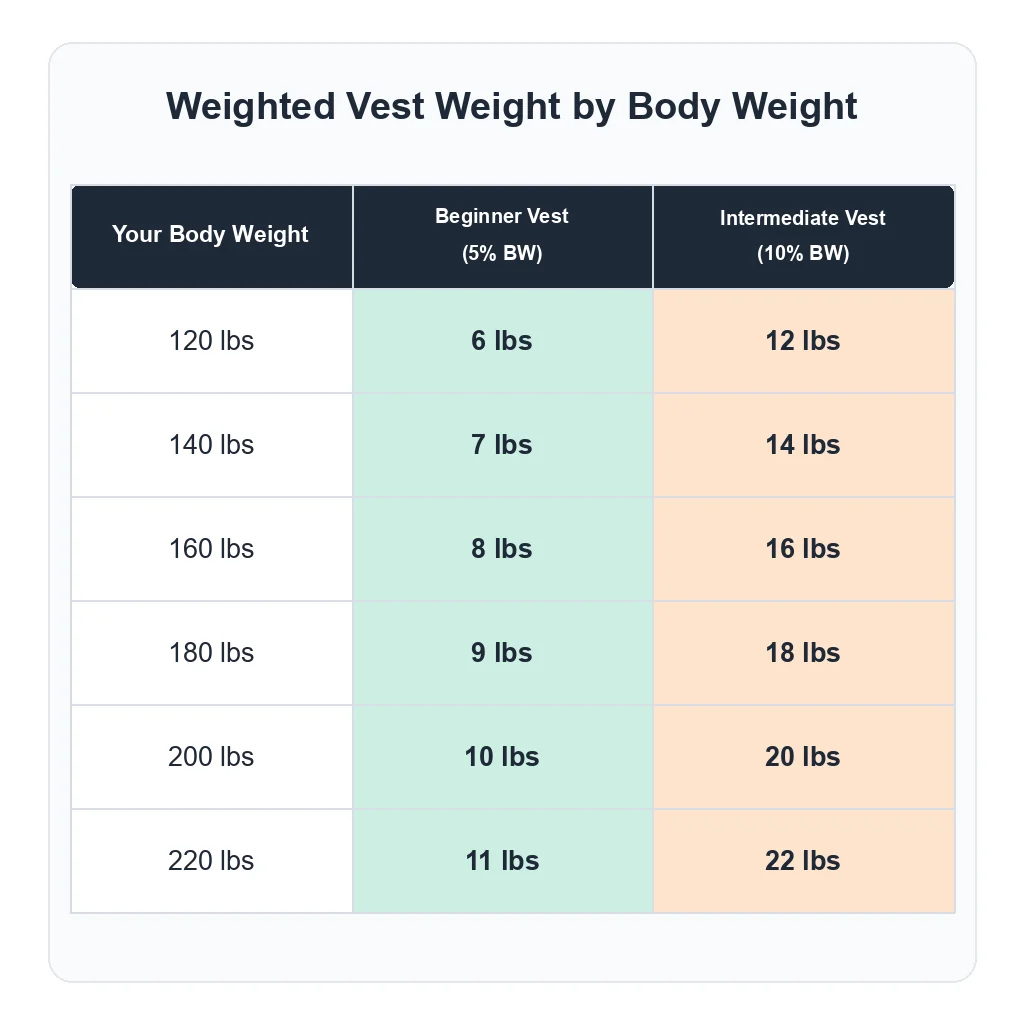
These numbers are simple math (body weight times 0.05 or 0.10). The practical takeaway: if you weigh 160 lbs, grab an adjustable weighted vest and load it to 8 lbs on day one.
Weighted Vest for Walking: Calorie Burn vs Regular Walking
A weighted vest for walking changes calorie burn in a predictable way. A 160-lb person walking at 3 mph burns roughly 126 calories in 30 minutes. Add a 16-lb vest (10% body weight) and that rises to about 138 calories, a 10% increase (138.3 versus 125.7 before rounding). The real calorie jump comes from adding incline: that same person walking at 3 mph on a 5% grade with a 10% vest burns approximately 225 calories, nearly double the flat unloaded walk.
These estimates use the ACSM walking metabolic equation, which calculates oxygen cost from speed, grade, and total mass carried (Source: ACSM, Guidelines for Exercise Testing and Prescription, 11th ed., 2021). All values are gross calories (they include resting metabolism) for a 30-minute session at 3 mph.
| Body Weight | Regular Walk (3 mph, flat) | 10% BW Vest (3 mph, flat) | 15% BW Vest (3 mph, flat) | 10% BW Vest + 5% Incline |
|---|---|---|---|---|
| 130 lbs | ~102 kcal | ~112 kcal | ~118 kcal | ~183 kcal |
| 160 lbs | ~126 kcal | ~138 kcal | ~145 kcal | ~225 kcal |
| 200 lbs | ~157 kcal | ~173 kcal | ~181 kcal | ~281 kcal |
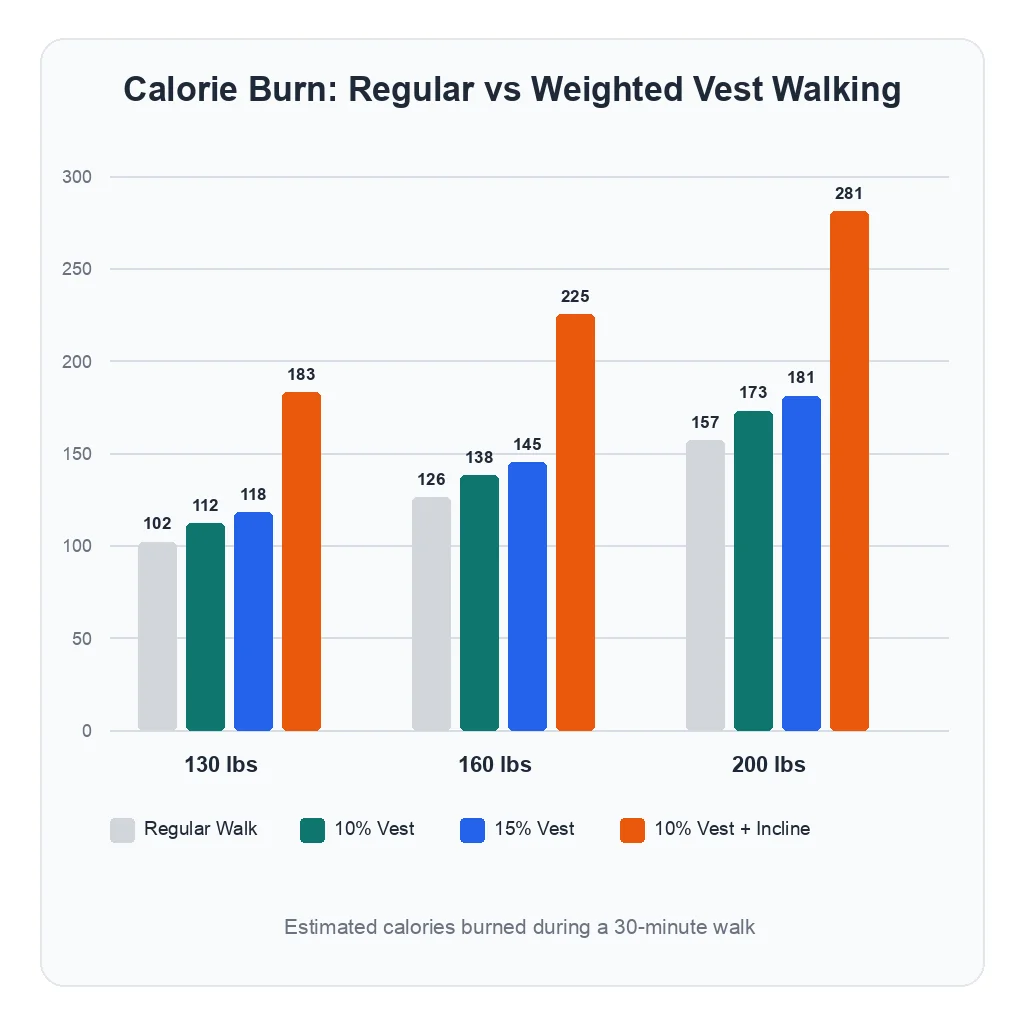
Calculation method: ACSM equation VO2 = (0.1 x speed in m/min) + (1.8 x speed x grade) + 3.5, multiplied by total system mass (body + vest). 3 mph = 80.47 m/min. Calories = VO2 x mass (kg) / 1000 x 5 x duration. Individual results vary with fitness level, walking surface, and stride efficiency.
Two things stand out in this table. First, the vest alone adds a modest 10 to 15% on flat ground. Real, but not dramatic. Second, incline is the multiplier.
If you want meaningfully higher calorie burn from your walks, combining a vest with a hill or treadmill incline delivers far more than the vest alone on flat ground.
30-Day Weighted Vest Walking Plan
This 4-week weighted vest for walking plan starts at 5% of your body weight for 15-minute walks and builds to 10% for 30 to 40 minutes. That is enough progressive overload to produce measurable fitness gains without overloading your joints. The structure follows standard progressive overload principles: increase one variable at a time (Source: ACSM, Guidelines for Exercise Testing and Prescription, 11th ed., 2021).
| Week | Vest Weight (% BW) | Walk Duration | Frequency | Notes |
|---|---|---|---|---|
| 1 | 5% | 15-20 min | 3x/week | Flat terrain. Focus on upright posture and normal stride length. |
| 2 | 5% | 25-30 min | 4x/week | Same weight, longer walks. Add one gentle hill if available. |
| 3 | 7-8% | 30 min | 4x/week | First weight increase. Keep distance steady. Monitor knees and lower back. |
| 4 | 10% | 30-40 min | 4-5x/week | Add incline sessions (treadmill or hills) on 2 of the 4 to 5 days. |
Rest days matter. Do not wear the vest every day, especially in weeks 3 and 4. Alternate weighted walks with unweighted walks or full rest days. Your joints, tendons, and lower back need recovery time to adapt to the new load. We suggest capping vest walks at 4 to 5 sessions per week and using off days for unweighted walks or complete rest.
Form cues to check each walk:
- Shoulders back, chest up. Do not lean forward to compensate for the weight.
- Take a shorter, more controlled stride than your normal walk. Over-striding with extra load stresses your knees.
- If your gait feels awkward or your lower back aches, the vest is too heavy. Drop back to the previous week’s weight.
After completing the 4-week base, you have two options: continue walking and progress to 12 to 15% body weight over the next month, or add weighted vest workouts to your routine for strength and conditioning.
Treadmill Weighted Vest Walking Protocol
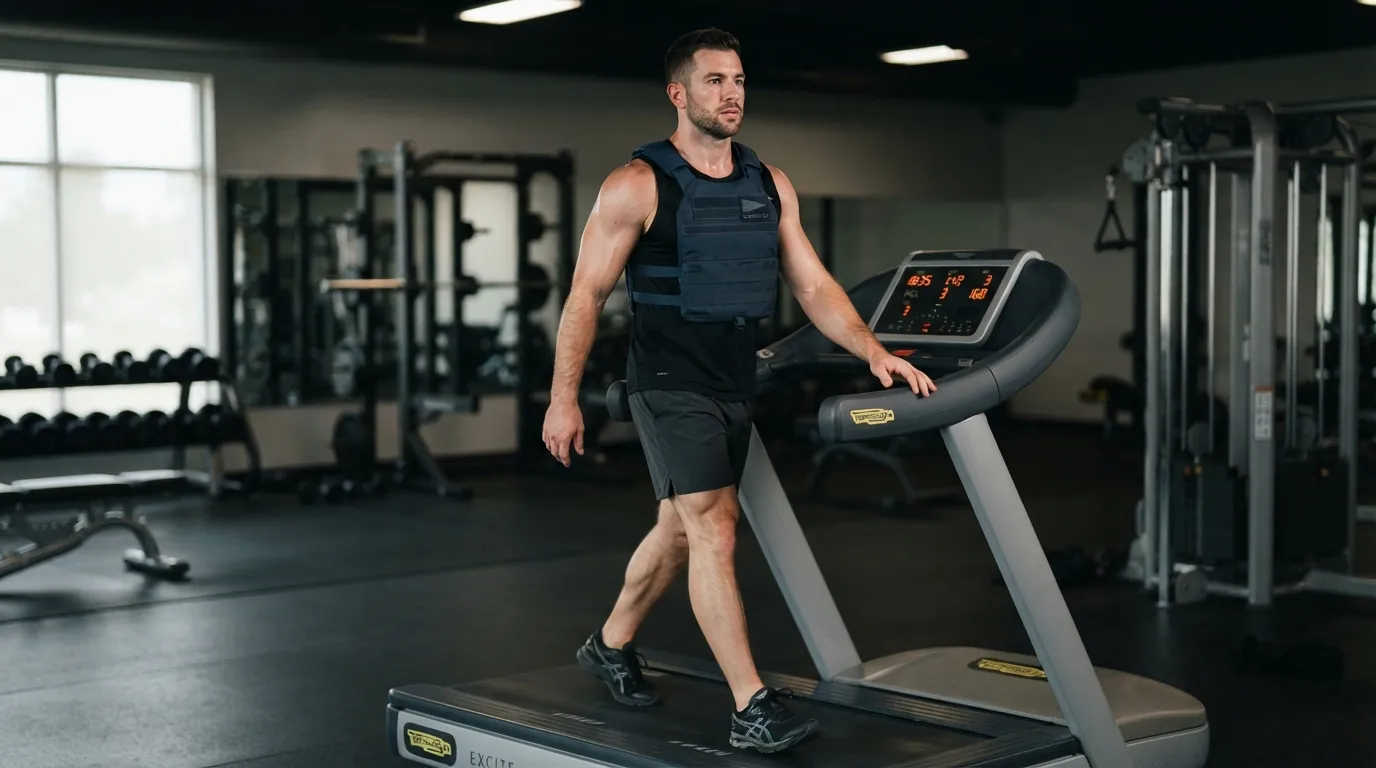
Set the treadmill to 2 to 3% incline to simulate outdoor resistance, walk at 3 mph, and use the same vest weight as your outdoor walks. The controlled, flat surface actually makes weighted walking easier on balance, not harder, so the treadmill is a good place to start if you are new to vest training.
Why treadmill walking with a vest works well: consistent speed (no slowing on hills without realizing it), adjustable incline in precise increments, and handrails available if you need to test your balance during the first session.
Sample 30-Minute Treadmill Session
| Minutes | Speed | Incline | Notes |
|---|---|---|---|
| 0-5 | 2.5 mph | 0% | Warm-up, no vest or vest worn loosely |
| 5-10 | 3.0 mph | 3% | Tighten vest. Settle into pace. |
| 10-15 | 3.0 mph | 5% | Higher incline interval. Shorter stride, drive through heels. |
| 15-20 | 3.0 mph | 3% | Recovery interval |
| 20-25 | 3.0 mph | 5% | Second high-incline interval |
| 25-30 | 2.5 mph | 0% | Cool-down, flat |
This session alternates between 3% and 5% incline. As you adapt, push the high intervals to 6 to 8% or extend them to 7-minute blocks. Keep speed at 3 mph. Walking faster with added weight increases joint stress, so speed should be the last variable you adjust.
If your gym has one, a walking-pad treadmill works fine for vest walks at these speeds. For a full treadmill walking plan without the vest, see our Japanese indoor walking treadmill plan.
Will Walking with a Weighted Vest Help Lose Belly Fat?
No. A weighted vest does not target belly fat specifically. Fat loss is systemic: your body draws energy from fat stores based on genetics and hormones, not based on which muscles you are working. ACSM’s guidelines describe localized fat reduction through targeted exercises as a misconception (Source: ACSM, Guidelines for Exercise Testing and Prescription, 11th ed., 2021). One study confirmed this directly, finding that 12 weeks of single-leg training did not preferentially reduce fat in the trained leg (Source: Ramirez-Campillo et al., Journal of Strength and Conditioning Research, 2013).
What a weighted vest for walking does is increase total calorie expenditure by roughly 10% per walk (with a 10% body-weight vest), which contributes to an overall calorie deficit.
Here is the honest math for a 160-lb person with a 10% vest:
- Extra calories per 30-minute walk: about 13 extra calories (138.3 versus 125.7 before rounding)
- Over 20 sessions in a month: ~260 extra kcal
- Fat equivalent: roughly 0.07 lbs (one pound of body fat stores approximately 3,500 kcal of energy)
That is a small number on its own. The vest is not a standalone fat-loss tool. Its value for body composition sits in the broader picture: it makes your walks harder, which builds fitness that lets you walk longer and faster over time, and it stacks with dietary changes to deepen a calorie deficit. If fat loss is your primary goal, your diet does the heavy lifting. The vest is a useful add-on, not a shortcut.
What Are the Downsides of Wearing Weighted Vests?
The main downsides are joint stress on knees and ankles if you start too heavy, posture compensation from the added load, and overtraining risk if you skip rest days. People with existing joint injuries should get medical clearance before adding vest walks to their routine (Source: UCLA Health, 2025).
Specific risks to know:
- Every pound on the vest adds force to your joints with every step. Starting above 10% of body weight, or jumping straight to a heavy vest without the progression plan above, is the most common mistake.
- If the vest is too heavy or poorly fitted, you will unconsciously lean forward, which loads your lumbar spine. An upright torso is non-negotiable. UCLA Health emphasizes maintaining upright posture throughout your walk (Source: UCLA Health, 2025).
- Extra weight shortens optimal stride length. If you try to maintain your normal long stride, you increase stress on your knees. Shorten your stride slightly.
- Walking with a vest every day without rest increases your risk of tendon irritation, especially in the Achilles and patellar tendons. We suggest limiting vest walks to 4 to 5 sessions per week, with unweighted walks or rest on the other days.
- UCLA Health specifically flags people with back or neck injuries, and notes that added loading may aggravate arthritis in the hips, knees, or ankles. If you have any of these conditions, talk to your doctor first (Source: UCLA Health, 2025).
None of these are reasons to avoid vest walking entirely. They are reasons to start light, progress slowly, and listen to your body.
Ready to pick the right size? Use our weighted vest sizing chart.
FAQ
Can I walk with a weighted vest every day?
We do not recommend it. Rest days give your joints and tendons time to adapt to the added load. Aim for 4 to 5 vest walks per week maximum, and fill the remaining days with unweighted walks or complete rest. Daily vest use without recovery increases your risk of overuse injuries in the knees, ankles, and lower back.
Is a 20-lb weighted vest too heavy for walking?
It depends on your body weight. A 20-lb vest is 10% of body weight for a 200-lb person, which is a reasonable intermediate load. But for a 120-lb person, that same vest is nearly 17% of body weight, well above our recommended ceiling for walking. Use the body-weight percentage table above: start at 5%, progress to 10%, and treat 15% as your upper limit.
Does walking with a weighted vest build muscle?
Walking with a vest increases muscular endurance in your legs and core, but it is unlikely to produce meaningful muscle growth. Walking loads are far below the thresholds used in resistance training, and the repetitive low-intensity nature of walking does not provide a strong hypertrophy stimulus. If strength and muscle size are your goals, you need resistance training. See our guide to weighted vest workouts for exercises that build muscle with a vest.
Should I walk faster or longer with a weighted vest?
Increase duration first, then add incline. Speed should be the last variable you change. Walking faster with extra weight increases joint stress and makes it harder to maintain good form. A safer progression is to extend your walks from 20 to 30 to 40 minutes at your normal pace, then add 2 to 3% treadmill incline or hillier routes. Only increase speed after you are comfortable at the longer duration and higher incline.
Sources
- UCLA Health — “Should you walk with a weighted vest?” (reviewed by Sharon Hame, MD) — uclahealth.org (Published: October 2025; Retrieved: October 2026)
- ACSM — Guidelines for Exercise Testing and Prescription, 11th ed. Wolters Kluwer, 2021. Walking metabolic equation, progressive overload principles, and spot-reduction misconception.
- Puthoff ML, et al. — “The effect of weighted vest walking on metabolic responses and ground reaction forces.” Medicine & Science in Sports & Exercise, 38(4):746-752, 2006. — pubmed.ncbi.nlm.nih.gov
- Ramirez-Campillo R, et al. — “Regional fat changes induced by localized muscle endurance resistance training.” Journal of Strength and Conditioning Research, 27(8):2219-2224, 2013. DOI: 10.1519/JSC.0b013e31827e8681