
Last updated: April 2026 — written by James Nolan, Gymnase Tips senior trainer.
Gymnase Tips is reader-supported. Some links below are Amazon affiliate links — if you buy through them we may earn a small commission at no extra cost to you. See our full disclosure.
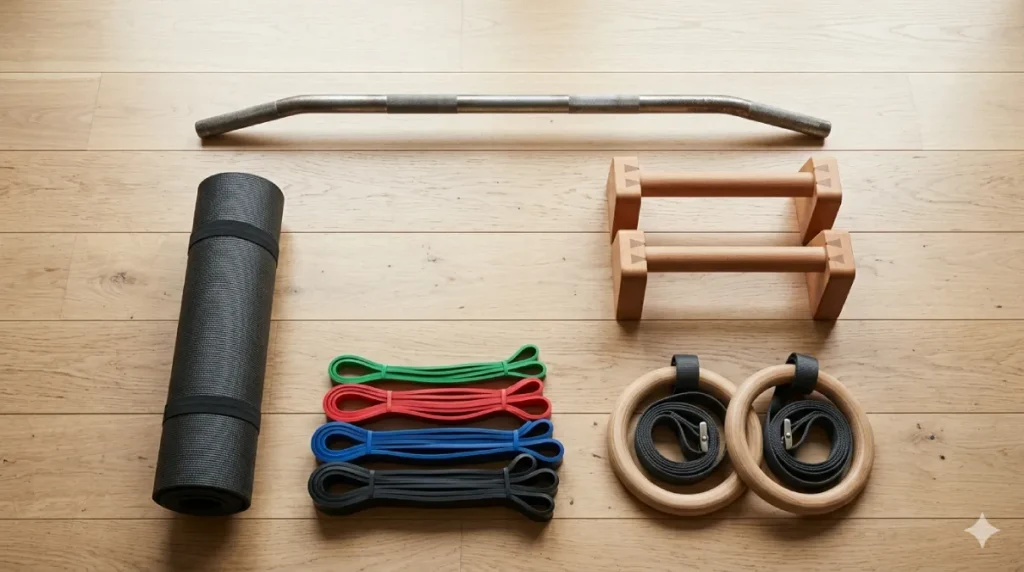
You can train calisthenics seriously with three pieces of equipment for under $100: a pull-up bar ($25-$50), a yoga mat ($15-$30), and a resistance band set ($20-$40). Everything else on the “essential calisthenics workout equipment” list is useful but optional — bought in strategic order as your training matures.
This guide ranks the 8 pieces of calisthenics equipment that actually matter, in priority order, with honest price ranges and what to skip entirely.
Quick Answer — Calisthenics Workout Equipment
- Minimum setup (under $100): Pull-up bar, yoga mat, resistance band set.
- First buy: Pull-up bar — without it, ~40% of calisthenics training is off the table.
- Month 3 additions: Parallettes ($30–60), dip station ($60–150).
- Month 6+: Weighted vest ($40–120), gymnastic rings ($25–40).
- Skip: Ab rollers, push-up boards, premium-branded gear with no mechanical advantage.
- Free alternative: A local calisthenics park or playground covers most of the list.
Table of Contents
- The Minimum Viable Setup
- The 8 Pieces Worth Owning
- Equipment Tier List
- What to Skip Entirely
- Budget by Training Level
- Calisthenics Parks vs. Home Setup
- FAQ
The Minimum Viable Calisthenics Workout Equipment Setup
Three pieces, total cost under $100:
- Pull-up bar ($25 to $50)
- Yoga mat ($15 to $30)
- Resistance band set ($20 to $40)
That is the entire starter kit. Everything else on this list is useful but optional, purchased in order of leverage as your training matures past the beginner stage.
The 8 Pieces of Calisthenics Equipment Worth Owning
1. Pull-Up Bar — $25 to $50 (Essential)
The single most important piece of calisthenics workout equipment. Without it, your back and biceps training collapses to inverted rows only, which plateau fast.
Options:
- Doorway bar ($25 to $40) — removable, no installation, weight limit ~300 pounds. Best for renters and apartments.
- Wall-mounted bar ($50 to $100) — permanent, zero wobble, handles weighted pull-ups and muscle-ups. Requires a stud wall.
- Free-standing tower ($120 to $250) — includes a dip station. Good for garages and dedicated training spaces.
2. Yoga Mat — $15 to $30
Floor work without a mat shreds your elbows, knees, and tailbone inside a month. A basic 6mm mat solves the problem. Skip the $80 premium mats unless you also practice yoga. For calisthenics, thickness matters more than aesthetics.
3. Resistance Bands — $20 to $40
Use cases that justify the purchase:
- Band-assisted pull-ups for beginners
- Banded push-ups and rows to add progressive tension
- Warm-up and shoulder prep
Buy a set with 3 to 5 different resistance levels. Bulk loop bands (often called “pull-up assistance bands”) are the most useful format.
4. Parallettes — $30 to $60
Short parallel bars, roughly 8 to 12 inches off the floor. Enable:
- L-sits and tuck holds (much easier than on the floor)
- Deep push-ups with a deeper range of motion
- Planche progressions
- Handstand push-up work with neutral wrist angle
Wooden parallettes with a grippy surface are the gold standard. Avoid plastic versions that flex under load.
5. Dip Station or Parallel Bars — $60 to $150
Dips are the chest press of calisthenics. Without parallel bars, your triceps and lower chest development gets capped by bench dips alone — a much inferior exercise.
Options:
- Bolt-on dip bars to an existing tower ($30 to $60)
- Standalone dip station ($80 to $150)
- Outdoor park equipment ($0) — search for a calisthenics park nearby
6. Weighted Vest — $40 to $120
Becomes useful around month 6 when bodyweight push-ups and pull-ups stop being challenging.
- Budget vest, 20 pounds ($40 to $60) — adequate for most home lifters for years
- Premium adjustable vest, 50 to 80 pounds ($100 to $200) — for serious weighted calisthenics athletes
Skip it for your first 6 months. Focus on mastering bodyweight progressions first.
7. Gymnastic Rings — $25 to $40
Two rings on adjustable straps, hung from a bar or outdoor structure. Unlock:
- Ring push-ups and rows (significantly harder than the bar versions due to instability)
- Muscle-up progressions
- Ring dips (more shoulder-friendly than bar dips for many)
Add these in month 6 to 12 once your foundational strength is established.
8. Pull-Up Bar Grips or Chalk — $10 to $20
Thick grips or gymnastics chalk extend grip endurance on high-rep pull-up sessions. Bar too slippery? Chalk. Grip the weakest link? Thick grips.
Calisthenics Workout Equipment Tier List
| Tier | Equipment | Priority |
|---|---|---|
| Tier 1 (day one) | Pull-up bar, yoga mat, resistance bands | Essential |
| Tier 2 (month 3+) | Parallettes, dip station | High value |
| Tier 3 (month 6+) | Weighted vest, gymnastic rings | Progression tools |
| Tier 4 (optional) | Grips, chalk | Nice-to-have |
What to Skip Entirely
Ab rollers, rotating push-up handles, and resistance push-up boards. These gimmick products promise unique stimulus they do not deliver. A wheel ab rollout is the same movement as a plank walkout. Skip them.
Suspension trainer clones of TRX. Rings do everything a suspension trainer does, usually better, for similar money.
Home gym “towers” with multiple stations. Usually under-built, with a wobble that makes serious pull-ups feel sketchy. A simple wall-mounted bar plus a dip station is more stable and half the cost.
Expensive branded gear. Calisthenics equipment is mechanically simple. A $200 pull-up bar is not meaningfully stronger than a $40 one from the same weight class.
How to Budget for a Full Calisthenics Home Setup
Three tiers, depending on seriousness:
- Starter ($60 to $100): Pull-up bar, yoga mat, resistance bands.
- Intermediate ($200 to $300): Add parallettes, dip station, chalk.
- Complete home gym ($400 to $600): Add gymnastic rings, weighted vest, thick-grip attachments.
For reference, 3 months of most gym memberships costs $100 to $150. A full home calisthenics setup pays for itself inside a year for most people.
Calisthenics Parks and Outdoor Setups
If you have a calisthenics park (or a kids’ playground) within walking distance, you essentially own everything on this list for free. Pull-up bars, dip stations, monkey bars, parallel bars — all public and free.
Check the FitWithBars, Calisthenics Parks, or World Calisthenics Organization maps to find a park near you. For many urban athletes, outdoor training replaces a home setup entirely.
Calisthenics Workout Equipment FAQ
What is the first piece of calisthenics equipment I should buy?
A pull-up bar. Without it, you cannot do pull-ups, chin-ups, hanging leg raises, or dead hangs — which cover 40 percent of calisthenics training. Doorway bars at $25 to $40 are the best entry-level option.
Is expensive calisthenics equipment worth it?
Rarely. Calisthenics gear is mechanically simple. A $40 pull-up bar and a $200 pull-up bar both hold your bodyweight. Premium versions mostly buy aesthetics or finish quality, not meaningful performance.
Do I need a weighted vest for calisthenics?
Not for the first 6 months. By month 6 to 12, most lifters can do enough clean bodyweight reps that added weight accelerates continued progress. Before that, exercise progressions (archer push-ups, one-arm work) provide enough overload.
How much space do I need for a home calisthenics setup?
A 6-by-8-foot area plus a doorway or wall for a pull-up bar. No dedicated room required for most of the training.
Can I train calisthenics with zero equipment?
Yes, but with limits. Without a pull-up bar, you lose all vertical pulling, which means no pull-ups, no chin-ups, no hanging leg raises. Inverted rows under a sturdy table fill the gap partially but are not equivalent.
What about gymnastic rings versus a pull-up bar?
Get a pull-up bar first. Rings are a powerful supplement once your foundational bar strength is in place, typically in month 6 to 12. Starting calisthenics on rings is possible but less efficient.
For a broader training context, see our complete calisthenics progression plan.
Related Gymnase Tips guides
- Home Gym Workouts: 12 Routines for Limited Equipment
- Dumbbell + Bodyweight Workout: 5-Day Hybrid Plan
- Hybrid Training: Mixing Dumbbells with Calisthenics
- 5-Day Home Workout Plan: Bodyweight-Only Split
- Gym vs Calisthenics: Which Is Right for Your Goals?
- How to Build Muscle Without Weights: 6-Month Bodyweight Plan


Pingback: Military Calisthenics for Women: 4-Week Plan (2026)
Pingback: 8-Week Military Calisthenics Plan: Free Printable PDF (2026)
Pingback: Military Calisthenics: Complete 2026 Guide + 4-Week Plan