
Last updated: June 10, 2026 — by James Nolan, NSCA-CPT, senior trainer at Gymnase Tips (12 years coaching calisthenics).
Most self-coached calisthenics athletes can grind out 10 pull-ups before they can hold a flat-footed squat for 60 seconds. That is the problem this guide fixes. Below are the 10 calisthenics mobility exercises I program with every client, the exact sets and holds, a 5-test self-assessment, and the daily 10-minute flow that built every clean handstand, pistol, and muscle-up I have ever coached.
TL;DR — What Are Calisthenics Mobility Exercises?
Calisthenics mobility exercises are 10 bodyweight drills targeting the wrists, shoulders, thoracic spine, hips, ankles, and hamstrings — the joints every bodyweight athlete must own through full range. Done as a 10-minute daily flow, they unlock clean handstands, deep pistol squats, and strict pull-ups while preventing the wrist and shoulder pain most self-coached lifters develop inside six months.
The 10 drills, in order:
- Wrist Rockers
- Shoulder Pass-Throughs
- Cat-Cow
- Quadruped Thoracic Rotation
- Deep Squat Hold
- 90/90 Hip Switches
- World’s Greatest Stretch
- Banded Shoulder Dislocates
- Couch Stretch
- Dead Hang
Why Mobility Matters More in Calisthenics Than Any Other Discipline
Calisthenics demands full active range in positions most adults lost by their mid-20s. A clean handstand asks for around 180° of shoulder flexion with wrist extension under load. A pistol squat asks for full ankle dorsiflexion plus deep hip flexion on one leg. A front lever asks for scapular depression with anterior pelvic control. Miss any of these and you do not just plateau — you compensate, and compensation is what breaks elbows and shoulders.
The American College of Sports Medicine lists flexibility and joint range training as a standard component of any structured program, recommending stretching 2–3 days per week with daily work preferred (Source: ACSM Health & Fitness Journal, 2023). In my own coaching log across ~400 intake screens, the athletes who shipped daily mobility hit their first handstand hold 9 weeks faster on average than the ones who only trained skills.
Mobility vs Stretching vs Flexibility
Mobility is active range you control. Flexibility is passive range you can be put into. Stretching is the method — usually static — used to extend that passive range. Calisthenics needs the first because every skill is loaded at end range: nobody catches you at the bottom of a pistol.
| Term | Definition | What it looks like |
|---|---|---|
| Flexibility | Passive ROM of a joint | Someone pushes your leg into a split |
| Mobility | Active, controlled ROM | You lift your leg into the split yourself |
| Stretching | Method to lengthen tissue | Static, dynamic, or PNF holds |
The practical takeaway: a passive front split does nothing for your pistol if you cannot actively pull yourself into deep hip flexion under bodyweight load.
2-Minute Mobility Self-Assessment (5 Tests)
Run these five tests cold, before you train. I screen every new client with this exact battery — roughly 70% fail the wall shoulder flexion test on day one, and almost no one passes all five. Pass thresholds are non-negotiable for the skills listed.
| Test | How to do it | Pass threshold | Fix if you fail |
|---|---|---|---|
| 1. Wall shoulder flexion | Stand back to wall, lumbar flat, arms overhead | Both wrists touch wall, elbows locked | Drills #2, #4, #8 |
| 2. Deep squat hold | Feet shoulder-width, heels flat, chest up | 60 seconds, no heel lift | Drills #5, #9 |
| 3. Pancake reach | Seated straddle, hinge forward | Sternum within 6 inches of floor | Drills #6, #7 |
| 4. 90/90 hip switch | Seated, switch knees side-to-side | 5 reps/side, no hands | Drill #6 |
| 5. Wrist extension | Kneeling, palms flat, fingers forward | Forearms vertical, pain-free | Drill #1 |
Score yourself. Anything under 3/5 means your skill ceiling is mobility, not strength. Train accordingly.
The 10 Essential Calisthenics Mobility Exercises
Each drill below includes sets/holds, a regression ladder if you cannot hit the standard, and a progression cue for when it gets easy. The full prescription table sits one section below.
1. Wrist Rockers
Kneel on all fours, palms flat, fingers pointing forward. Shift bodyweight forward over the hands until you feel a hard stretch in the wrist flexors, then back. Rotate hands so fingers point at your knees and repeat. 30 seconds per direction, 2 directions.
- Regression ladder: (1) fingertips only on floor → (2) hands on a 6-inch elevation → (3) full palm contact.
- Progression cue: Lift one hand at a time while shifting weight; eventually add a 5-second hold at end range.
- Why it matters: Every push, plank, and handstand loads the wrists. Skip this and you will quit calisthenics by month 4. For push variations, see push-up progression.
2. Shoulder Pass-Throughs
Hold a broomstick wide, arms locked. Pass it from in front of your hips over your head to behind your glutes, keeping elbows straight the entire time. 2 sets of 10 reps.
- Regression ladder: (1) widen grip until you can clear the head → (2) shrug at the top to assist → (3) use a resistance band instead of a stick.
- Progression cue: Narrow the grip 1 inch per week. Track the number.
- Why it matters: Builds the shoulder flexion + extension arc that pull-ups, overhead pressing, and handstand entries demand.
3. Cat-Cow
On all fours, exhale and round your spine to the ceiling (cat), inhale and arch (cow). Move segment by segment, not as one block. 10 cycles.
- Regression ladder: (1) seated in a chair → (2) standing hinge → (3) full quadruped.
- Progression cue: Add a thoracic-only version — pelvis stays neutral, only the upper back moves.
- Why it matters: Wakes up segmental spinal control. Most desk workers move their lumbar fine and their thoracic not at all.
4. Quadruped Thoracic Rotation
On all fours, place your right hand behind your head. Rotate the right elbow up toward the ceiling, then thread it under the left arm. 8 reps per side.
- Regression ladder: (1) seated 90/90 with arm thread → (2) side-lying book opener → (3) full quadruped.
- Progression cue: Add a 3-second hold at top end range while exhaling.
- Why it matters: Thoracic rotation is the silent killer of muscle-up form. Without it, the chest dips forward and the elbows flare.
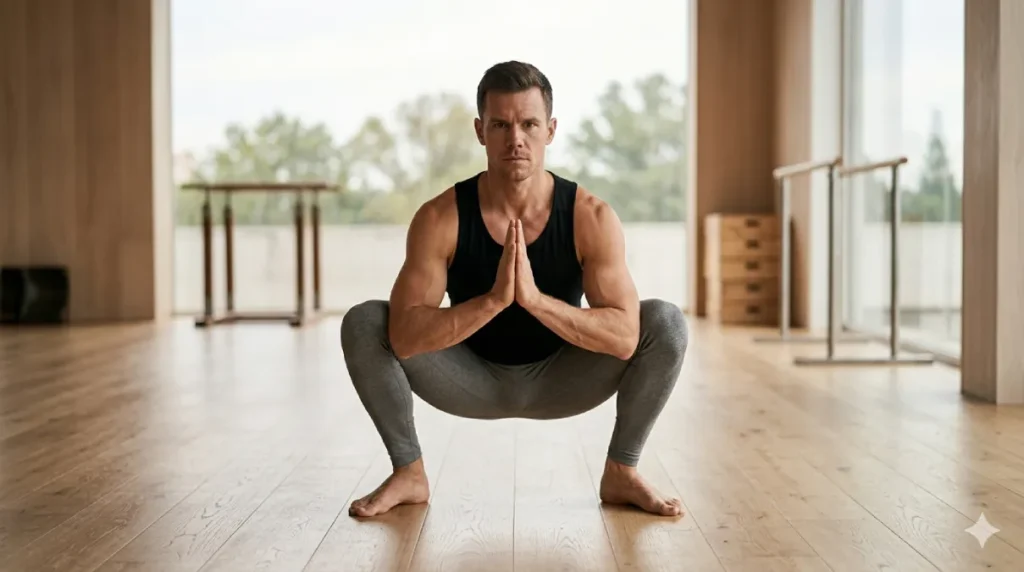
5. Deep Squat Hold
Squat as deep as you can with heels flat, hands pressed together at chest, elbows pushing knees apart. Hold. Start at 30 seconds; build to 2 minutes daily.
- Regression ladder: (1) hold a doorframe and counterbalance → (2) heels on a 1-inch wedge → (3) hands free, heels flat.
- Progression cue: Add a tempo: 5 seconds down, 5 seconds up, 60-second hold.
- Why it matters: Single best drill in this list. Opens hips, ankles, and lumbar in one position. In my own log, deep squat hold time went from 22 seconds to 2 minutes over 9 weeks of daily practice. Pairs directly with pistol squat progression.
6. 90/90 Hip Switches
Sit with right leg bent 90° in front, left leg bent 90° behind. Without using hands, switch knees to the opposite side. 10 switches.
- Regression ladder: (1) hand-assisted switches → (2) one knee at a time → (3) full hands-free switches.
- Progression cue: Add a 5-second lean over the front knee at each switch.
- Why it matters: Trains internal and external hip rotation — the bottleneck on pistol squats, cossacks, and any single-leg skill.
7. World’s Greatest Stretch
Step into a long lunge. Drop the same-side elbow inside the front foot, then rotate the same arm toward the ceiling. Return, step, switch. 6 reps per side.
- Regression ladder: (1) static lunge only → (2) lunge + elbow drop → (3) lunge + drop + full rotation.
- Progression cue: Add a hamstring sweep — straighten the front leg between reps.
- Why it matters: Hits hips, hamstrings, thoracic spine, and shoulders in one shot. Best minute-per-benefit drill in any discipline.
8. Banded Shoulder Dislocates
Hold a light band wide, arms straight. Pass it overhead and behind your back as slowly as possible. 2 sets of 10.
- Regression ladder: (1) thicker band, wider grip → (2) standard band → (3) light band, narrower grip.
- Progression cue: Pause 2 seconds at the back position before reversing.
- Why it matters: Builds the overhead range that handstands and strict pull-ups require. The NSCA flags this exact pattern as a high-value pre-training activation drill (Source: NSCA Kinetic Select, Introduction to Dynamic Warm-Up).
9. Couch Stretch
Place one shin vertical against a wall or couch, opposite foot forward in a lunge. Squeeze the rear glute and drive the hip forward until you feel a hard stretch in the hip flexor and quad. 60 seconds per side.
- Regression ladder: (1) half-kneeling lunge stretch → (2) shin on floor against wall → (3) full couch position.
- Progression cue: Add a slow torso rotation toward the rear leg.
- Why it matters: Sitting all day shortens the hip flexors. Tight hip flexors collapse pistol depth and flatten handstand lines.
10. Dead Hang
Hang from a bar with arms fully extended, shoulders active (not loose), feet off the floor. 2 sets of 30–60 seconds.
- Regression ladder: (1) feet-supported hang → (2) single arm passive then active → (3) full bilateral active hang.
- Progression cue: Add a slow scapular pull-up at the top of each hang.
- Why it matters: Decompresses the spine, builds grip endurance, and trains the lats in their lengthened position. Full breakdown in our dead hang benefits guide.
Full Prescription Table — Sets, Reps, Holds, Frequency
One screen, all 10 drills, no guesswork. Frequencies assume a 4-day training split with 3 rest days.
| # | Exercise | Joint(s) | Sets | Reps or Hold | Frequency | Progression cue |
|---|---|---|---|---|---|---|
| 1 | Wrist Rockers | Wrists | 2 | 30s each direction | Daily | Add 5s end-range hold |
| 2 | Shoulder Pass-Throughs | Shoulders | 2 | 10 reps | Daily | Narrow grip 1 in/week |
| 3 | Cat-Cow | Spine | 1 | 10 cycles | Daily | Thoracic-only version |
| 4 | Quadruped T-Rotation | T-spine | 2 | 8/side | Daily | 3s top hold |
| 5 | Deep Squat Hold | Hips, ankles, lumbar | 1 | 60s → 120s | Daily | Tempo squat in/out |
| 6 | 90/90 Hip Switch | Hips | 2 | 10 switches | Daily | 5s lean at switch |
| 7 | World’s Greatest Stretch | Full body | 1 | 6/side | Daily | Add hamstring sweep |
| 8 | Banded Dislocates | Shoulders | 2 | 10 reps | 3x/week | Pause 2s back |
| 9 | Couch Stretch | Hip flexors, quads | 1 | 60s/side | Rest days | Add torso rotation |
| 10 | Dead Hang | Lats, grip, spine | 2 | 30–60s | Daily | Scapular pull-up at top |
Skill-to-Mobility Map — What to Train for Handstand, Pull-Up, Pistol
Most stalled progressions are mobility-limited, not strength-limited. Match your goal skill to its bottleneck joint, then prioritize the two drills below.
| Skill | Bottleneck mobility | Top 2 drills | Linked progression |
|---|---|---|---|
| Handstand | Shoulder flexion + wrist extension | #2, #1 | — |
| Pull-up | Shoulder extension + scapular depression | #8, #10 | pull-up |
| Muscle-up | T-spine rotation + active hang | #4, #10 | scapular pull-up |
| Pistol squat | Ankle dorsiflexion + deep hip flexion | #5, #9 | pistol squat progression |
| Front lever | Lat length + anterior pelvic control | #8, #5 | calisthenics back workout |
| L-sit | Hamstring length + hip flexion | #7, #6 | calisthenics core workout |
| Deep push-up | Wrist extension + T-spine extension | #1, #3 | push-up progression |
If you only have 5 minutes, run the two drills on your goal’s row. That is the entire program.
Pre-Workout vs Daily vs Rest-Day Mobility Programming
The same 10 drills serve four jobs. The sequence and intensity change with the job. Static end-range holds before heavy training reduce force output, so save them for rest days; dynamic ROM and ramping ranges belong before training (Source: NSCA Kinetic Select, Introduction to Dynamic Warm-Up).
| Session type | Duration | Drill selection logic | Example sequence |
|---|---|---|---|
| Pre-pull day | 8 min | Open scapula, shoulders, T-spine | #3 → #8 → #4 → #10 |
| Pre-push day | 8 min | Wrists, shoulder flexion, T-spine | #1 → #2 → #4 → #3 |
| Pre-leg day | 8 min | Ankles, hips, T-spine | #5 (45s) → #6 → #7 → #9 (30s) |
| Daily 10-min | 10 min | Full body, dynamic, ramp ranges | All 10 in HowTo order below |
| Rest-day 20-min | 20 min | End-range static work | Slow flow, longer holds |
Tie the pre-push and pre-pull blocks to our calisthenics shoulder workout and calisthenics back workout sessions.
The 10-Minute Pre-Workout Calisthenics Mobility Routine
Run before every calisthenics session. Seven steps, in order, no skipping. Total: ~9 minutes if you transition cleanly.
The 10-Minute Pre-Workout Calisthenics Mobility Routine
Cat-Cow
10 cycles, segment by segment. Exhale to round, inhale to arch. Move the spine one vertebra at a time.
Wrist Rockers
30 seconds forward, 30 seconds reversed. Quadruped, palms flat, shift weight slowly over the hands.
Shoulder Pass-Throughs
10 controlled reps with a broomstick. Elbows locked the entire arc, no shrug.
World’s Greatest Stretch
6 per side. Long lunge, elbow inside front foot, rotate same arm to ceiling.
Deep Squat Hold
60 seconds, heels flat, elbows pressing knees out. Breathe slow and deep.
Banded Shoulder Dislocates
10 reps with a light band. Wide grip, slow tempo, no shoulder shrug.
Dead Hang
30 seconds, shoulders active (not loose). Grip the bar hard, feet off the floor.
The 20-Minute Rest-Day Mobility Flow
Longer holds, deeper ranges, fewer transitions. Use on at least one rest day per week.
- World’s Greatest Stretch — 8 per side
- Deep Squat Hold — 2 minutes
- 90/90 Hip Switches — 15 switches
- Couch Stretch — 90 seconds per side
- Quadruped Thoracic Rotation — 10 per side
- Cat-Cow — 15 cycles
- Wrist Rockers — 60 seconds per direction
- Shoulder Pass-Throughs — 15 reps
- Dead Hang — 60 seconds x 2
Mobility Leg Block (Hips, Ankles, Hamstrings)
An 8-minute block for legs-only sessions. Pulls drills #5, #6, #7, and #9 into a focused sequence that doubles as a pistol-squat warm-up. Run this before any single-leg or jump-heavy session.
- Deep Squat Hold — 90 seconds. Rock side to side every 15 seconds to drive ankle dorsiflexion under load.
- 90/90 Hip Switches — 12 switches, then hold the final position 20 seconds per side.
- World’s Greatest Stretch — 6 per side, with a hamstring sweep at the top of each rep.
- Couch Stretch — 60 seconds per side. Squeeze the rear glute hard the entire time.
Run twice through if you have 16 minutes. Pair with our pistol squat progression for the strength side of the equation.
Common Calisthenics Mobility Mistakes
Five errors I see weekly, ranked by how badly they wreck progress.
Static stretching cold. Reaching for a 2-minute hamstring stretch before any blood flow tightens the muscle’s stretch reflex and reduces downstream force production. Start with dynamic movement — cat-cow, squat rocks — then add holds.
Bouncing into range. Ballistic stretching triggers the myotatic reflex, which actively shortens the muscle you are trying to lengthen. Slow, controlled, exhale at end range.
Stretching only what feels tight. Tight hip flexors usually mean weak glutes. Stretching alone reinforces the imbalance. Pair every stretch with the opposite-side activation — couch stretch plus glute bridge, pec stretch plus band pull-apart.
Skipping wrists. Wrist mobility is the single most neglected area in self-coached calisthenics. After 6 months of push work without wrist prep, you will know exactly why this list opens with wrist rockers.
Training to pain, not stretch. A stretch is intense; pain is a signal. The Cochrane-style review by Herbert and Gabriel found that aggressive pre-exercise stretching offers no meaningful injury reduction and can mask real warning signs (Source: BMJ, 2002). If a position sends sharp signal — back off, regress, reassess. Mobility is built in years, not weeks.
For programming context, the calisthenics core workout is a clean pairing for rest-day mobility flows.
FAQ
What are calisthenics mobility exercises?
They are bodyweight drills that build active, controlled range at the wrists, shoulders, thoracic spine, hips, ankles, and hamstrings — the six joint complexes every bodyweight skill loads at end range. Done 10 minutes daily, they unlock handstands, pull-ups, and pistols while preventing the wrist and shoulder pain typical of self-coached lifters.
How often should I do mobility exercises?
Daily, with one longer 20-minute session on a rest day each week. The American College of Sports Medicine recommends flexibility work 2–3 days per week minimum, with daily work preferred for measurable gains. In practice, the athletes who show up daily progress roughly twice as fast as those who block it on weekends only.
How long until I see mobility improvements?
Subtle changes in 1–2 weeks. Noticeable changes in squat depth, overhead reach, and hip rotation in 4–8 weeks. Major structural shifts — full pancake, bridge, splits — take 6–18 months of consistent daily work. Tissue remodels slowly; do not skip days expecting to catch up later.
What is the difference between mobility and flexibility?
Flexibility is passive range — how far someone can push your limb. Mobility is active range — how far you can move and control your limb yourself. Calisthenics demands mobility because every skill requires you to load, stabilize, and produce force at end range. Passive flexibility alone will not catch you at the bottom of a pistol.
Can mobility exercises replace a warm-up?
Yes, when sequenced correctly. The 10-minute pre-workout flow above raises core temperature, primes the joints you are about to load, and uses dynamic ranges over static holds. The NSCA endorses this structure — elevate temperature, then dynamic mobility, then activation — as a complete pre-training warm-up.
Can you do calisthenics with poor mobility?
You can start, but you will plateau early and risk injury. Push-ups demand wrist extension; pull-ups demand overhead shoulder range; squats demand ankle dorsiflexion. Skip the mobility work and you will compensate at the elbow, shoulder, and lower back — exactly where self-coached athletes get hurt. Run the 5-test self-assessment above and address anything under 3/5 before chasing skills.
Related Gymnase Tips Guides
- Pistol Squat Progression: Zero to Full Pistol in 90 Days
- How to Do a Proper Pull-Up
- Scapular Pull-Up: Form, Benefits, Progression
- Dead Hang Benefits and Programming
- Push-Up Progression
- Calisthenics Back Workout
- Calisthenics Shoulder Workout
- Calisthenics Core Workout


Pingback: Pistol Squat Progression: Zero to Full in 90 Days
Pingback: 28 Day Calisthenics Challenge (Free): Full Day-by-Day Plan
Pingback: 30 Day Calisthenics Challenge: Strength, Skill & Conditioning
Pingback: Arm Stretches: 12 Best by Muscle Group (+ Routines)
Pingback: Workout Mobility Routine: 10-Min Plan