Last updated: May 2026 — written by James Nolan, Gymnase Tips senior trainer. Timelines based on observed progression in coached athletes meeting the prerequisites.
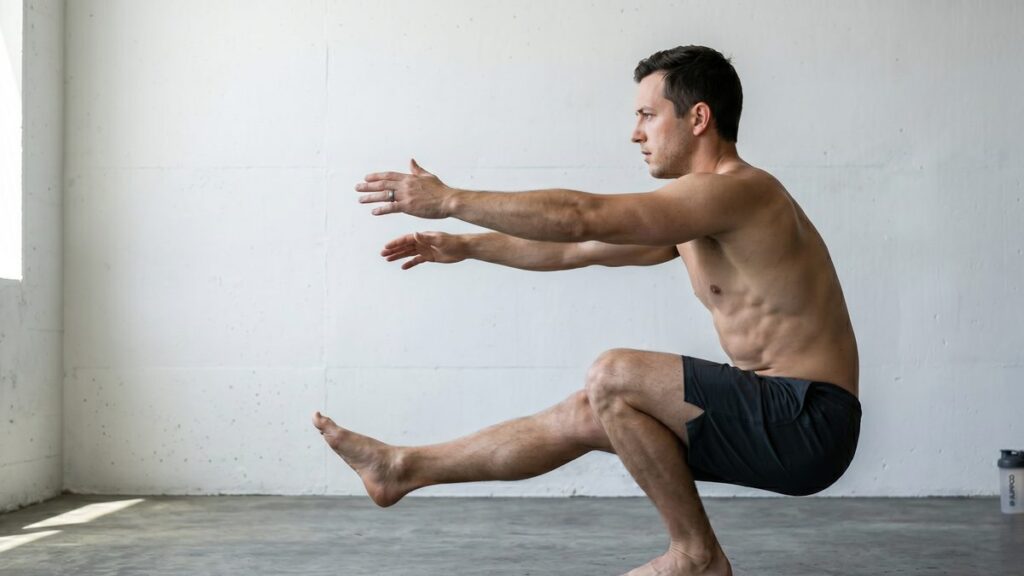
The fastest path from zero to a clean pistol squat is a 7-step progression spanning 60 to 120 days for most trainees with adequate ankle and hip mobility. The full pistol squat — a single-leg squat to depth with the non-working leg held parallel to the floor — requires three things: relative leg strength (roughly 1.5x bodyweight squat equivalent), ankle dorsiflexion of at least 30 degrees, and hip-flexor capacity to hold the front leg up under tension. Lacking any one of these blocks the movement entirely. This guide gives you the exact 7-step progression, the prerequisite check, weekly programming, mobility drills, and the troubleshooting checklist for the most common sticking points.
The pistol squat is the most-cited single-leg strength benchmark in calisthenics — and the move that exposes ankle and hip restrictions every desk worker carries. Train it correctly and you build unilateral leg strength comparable to heavy back squats. Train it wrong and you reinforce a knee-collapsing, heel-lifting compensation that won’t transfer to anything.
The 7 Stages at a Glance
| Step | Variation | Typical timeline | Graduation target |
|---|---|---|---|
| 1 | Box squat (high box, knee height+) | Weeks 1 to 2 | 8 strict reps per side |
| 2 | Box squat (low box, mid-shin) | Weeks 2 to 4 | 8 strict reps per side |
| 3 | Counter-balance pistol (5 to 10 kg) | Weeks 4 to 6 | 5 strict reps per side |
| 4 | Assisted pistol (anchor or doorframe) | Weeks 6 to 8 | 8 reps per side, minimal assist |
| 5 | Negative pistol (4 to 5 sec descent) | Weeks 8 to 10 | 5 controlled negatives per side |
| 6 | Half-pistol (from 30 cm box) | Weeks 10 to 12 | 5 reps per side |
| 7 | Full pistol squat | Week 12+ | 5 strict reps per side |
Timelines assume the prerequisites below are met and 3 sessions per week of structured practice. Trainees lacking ankle dorsiflexion or hip-flexor capacity should expect to add 1 to 3 months before starting step 1.
Pistol Squat Prerequisites
- 20 strict bodyweight squats with full depth (hips below knees), heels flat throughout
- 30 degrees of ankle dorsiflexion — kneel test: knee touches wall while toes sit 10 cm from the wall, heel stays flat
- Hip flexor capacity to hold a leg parallel to floor for 10 seconds while seated
- Single-leg balance for 30 seconds, eyes open, on each leg
If you fail any prerequisite, fix that first. Adding pistol squats to a body that can’t reach the bottom position only ingrains the wrong pattern. The mobility section below covers the drills that close each gap.
5-Minute Pre-Pistol Warm-Up
- 30 seconds jumping jacks or marching in place
- 10 ankle circles each direction, each foot
- 10 deep bodyweight squats with 2-second pause at bottom
- 10 walking lunges
- 30-second deep-squat hold to open hips and ankles
The 7-Step Pistol Squat Progression
Step 1: Box squat (one leg, high box)
Sit slowly to a box at knee-height or higher. Stand without pushing off the floor with the non-working leg. Graduate at 8 reps per side [90 sec rest between sides].
Step 2: Box squat (low box)
Lower the box to mid-shin height. The lower the box, the closer to a full pistol. Graduate at 8 reps per side [90 sec rest].
Step 3: Counter-balance pistol squat
Hold a 5 to 10 kg weight at chest level. The forward weight shift offsets the backward fall most beginners experience. Graduate at 5 reps per side [2 min rest].
Step 4: Assisted pistol (anchor or doorframe)
Hold a stable anchor, perform the full pistol motion using the anchor for balance — not strength. Pull yourself up with arms only when stuck. Graduate at 8 reps per side with minimal assistance [2 min rest].
Step 5: Negative pistol squat
Lower over 4 to 5 seconds to the bottom of the pistol position, sit, recover, repeat. The eccentric portion builds the strength needed for the concentric. Graduate at 5 controlled negatives per side [2 min rest — these are heavy].
Step 6: Half-pistol
Stand on a 30 cm box. Squat down with the non-working leg dropping below the box (not on the floor). This expands range without requiring the full bottom position yet. Graduate at 5 reps per side [2 min rest].
Step 7: Full pistol squat
Heel flat, non-working leg parallel to floor, hips below knee, controlled stand. Achieve 5 strict reps per side and you have a pistol.
Next progression: weighted pistols (holding 5 to 10 kg at chest), elevated-heel pistols (deeper range), or shrimp squat progression.
Weekly Programming for Each Step
- Day 1 (Strength): Mobility (ankle + hip flexor, 5 min) + current step — 4 sets of 5 to 8 reps per side [2 min rest]
- Day 3 (Eccentric): Negatives + balance work — 3 sets of 5 controlled negatives per side [2 min rest]
- Day 5 (Volume): Prior step (one level easier) — 3 to 4 sets of 8 to 12 reps [90 sec rest]
Always pair with posterior chain work. Pistols are heavily quad-dominant. Include glute bridges, hamstring curls or Nordic curls, and calf raises on the same days to balance the loading pattern. Without posterior work, hip and knee health suffer within 6 to 8 weeks of dedicated pistol training.
The Mobility Work That Unlocks the Pistol
- Wall ankle dorsiflexion drill: kneel facing wall, drive knee to wall without lifting heel. 3 sets of 10 per side, daily.
- Couch stretch: hip flexor opener. 90 seconds per side, daily.
- Deep squat hold: bottom of bodyweight squat, 60 to 120 seconds, daily.
- Active straight-leg raise: seated, lift one leg to parallel, hold 10 seconds. Builds the hip-flexor strength to keep the front leg up.
For the broader bodyweight leg routine, see our calisthenics leg workout. For mobility programming, see our beginning mobility exercises for calisthenics.
5 Common Pistol Squat Mistakes
- Heel coming off the ground. Indicates ankle restriction. Don’t grind through it — fix the mobility. Daily wall dorsiflexion drill resolves this for most trainees in 3 to 6 weeks.
- Knee caving in. Weak glute medius. Add side-lying clamshells and lateral band walks 2x per week. The fix is hip strength, not knee bracing.
- Front leg dropping during descent. Hip-flexor weakness. Add active straight-leg raises and L-sit progressions.
- Falling backward at the bottom. Counter with arms forward and a slightly forward torso lean. Counter-balance work (Step 3) fixes this within 2 to 4 weeks.
- Skipping prerequisites. The 90-day timeline assumes 20 strict bodyweight squats and 30° ankle mobility. Without that base, double the timeline — or build the base first.
If You’re Stuck at a Step
If 4 weeks pass without rep improvement on your current step, work through this checklist in order:
- Mobility regression check. Re-test the kneel dorsiflexion drill. Ankle mobility can lose ground if the daily drill stops. Restart the daily work.
- Form check. Film yourself from the side. Heels lifting, knee caving, or hips shifting all reduce the productive portion of each rep.
- Volume check. Are you running the full 3-session prescription, or skipping the negatives day? Negatives drive most of the strength gain at Steps 4 to 7.
- Recovery check. 7 to 9 hours of sleep and adequate protein (1.6 to 2.0 g per kg). Single-leg training is more recovery-demanding than it looks.
- Deload. Drop volume by 50% for one week, then return. Many stalls resolve after a single deload week.
Pistol Squat Progression FAQ
How long does it take to do a pistol squat?
For a trainee with adequate mobility and 20 strict bodyweight squats, the realistic timeline is 60 to 120 days following structured progression. Trainees lacking ankle dorsiflexion or hip-flexor capacity need to fix those first, which can extend the timeline by 1 to 3 months.
Are pistol squats bad for your knees?
No, when performed with proper progression. The knee tolerates loaded flexion well in healthy adults. Pistol squats become a problem when trainees skip prerequisites — particularly mobility — and grind through with knee-cave or heel-lift compensation. Prepare the joint, then progress.
Pistol squat or barbell squat — which is better?
Different tools. Heavy barbell squats are superior for raw bilateral strength and mass. Pistol squats are superior for unilateral strength, balance, and mobility under load. Most serious athletes train both. For bodyweight-only trainees, pistols deliver substantial leg development without equipment.
Can I train pistol squats every day?
No. Pistol squats are heavy single-leg loading and need 48 to 72 hours of recovery between hard sessions. The 3-day-per-week programming above is the sweet spot. Daily pistol training produces overuse stress at the knee and hip without faster progression.
Can I skip the box squat steps?
Only if you can already do counter-balance pistols (Step 3) with strict form. The box squat steps build the eccentric control most beginners lack — skipping them tends to extend the timeline by ingraining a faster, less-controlled pattern that breaks down at Step 5.
The bottom line: pistol squats reward patience over volume. Fix mobility, build through the 7-step progression, respect prerequisites, and pair with posterior chain work — the rest is consistency. For full programming, integrate pistols with the structure in our complete calisthenics workout plan.

Pingback: Bodyweight Leg Workouts: 12 Exercises Ranked