Last updated: June 2026 — written by James Nolan, Gymnase Tips senior trainer. Difficulty rankings calibrated against gymnastics strength standards.

TL;DR — Can You Really Build Legs With Bodyweight?
Yes — bodyweight leg workouts build real quad, glute, and hamstring size when you train near failure, progress to harder unilateral variations, and load the eccentric with slow tempo. Hypertrophy responds to mechanical tension and effective reps regardless of where the resistance comes from (Source: BuiltLean, 2024). Run 2–3 sessions per week, 48 hours apart, 25–35 minutes per session, and graduate the exercise variation — not just the rep count — every 4 weeks.
12 Bodyweight Leg Exercises Ranked (Easiest to Hardest)
The ranking below is calibrated against gymnastics strength standards: bilateral squat patterns sit at the bottom, unilateral hip-dominant work in the middle, and single-leg deficit and ROM-extreme squats at the top. Balance demand and ankle/knee mobility carry as much weight in the ranking as raw force.
The 12 best bodyweight leg exercises, easiest to hardest:
- Bodyweight squat
- Glute bridge
- Single-leg calf raise
- Reverse lunge
- Walking lunge
- Single-leg glute bridge
- Bulgarian split squat
- Cossack squat
- Step-up (high box)
- Nordic curl (assisted)
- Pistol squat
- Shrimp squat
| # | Exercise | Primary | Secondary | Sets × Reps | Regression | Progression |
|---|---|---|---|---|---|---|
| 1 | Bodyweight squat | Quads | Glutes | 3 × 20–30 | Box squat to chair | 3-sec eccentric, then 1.5 reps |
| 2 | Glute bridge | Glutes | Hamstrings | 3 × 15–20 | Shorter ROM, feet closer | Single-leg variation |
| 3 | Single-leg calf raise | Calves | Tib post | 3 × 15–25 / leg | Two-leg raise | Deficit off step, 3-sec lower |
| 4 | Reverse lunge | Quads | Glutes | 3 × 10–12 / side | Hand on wall | Deficit lunge off plate |
| 5 | Walking lunge | Quads, glutes | Adductors | 3 × 12 / leg | Stationary split squat | Add backpack load |
| 6 | Single-leg glute bridge | Glutes (unilateral) | Hamstrings | 3 × 10–12 / side | Foot elevated, both legs | Shoulders elevated on couch |
| 7 | Bulgarian split squat | Quads | Glutes | 3–4 × 8–12 / leg | Stationary split squat | 3-sec eccentric + pause |
| 8 | Cossack squat | Adductors | Quads | 3 × 8 / side | Lateral lunge | Hold bottom 2 sec |
| 9 | Step-up (high box) | Quads | Glutes | 3 × 10 / leg | Lower box, hand support | No push-off from trailing leg |
| 10 | Nordic curl (assisted) | Hamstrings | Glutes | 3 × 5–8 | Banded, partial ROM | Slow eccentric, no hands push |
| 11 | Pistol squat | Quads (unilateral) | Glutes | 3 × 5 / side | Box pistol | Deficit pistol off step |
| 12 | Shrimp squat | Quads (extreme unilateral) | Glutes | 3 × 3–5 / side | Hand-assisted shrimp | Elevated shrimp off plate |

How to Use This Ranking (Where to Start)
Pick your entry tier by current capacity, not optimism. Two honest self-tests beat any guesswork.
- Fewer than 20 strict bodyweight squats: start at tier 1–4. Build the bilateral base before adding unilateral load.
- 30+ strict squats and 8+ Bulgarian split squats per leg: jump straight to tier 5–9. You will outgrow tier 1–4 in a week and waste training stimulus there.
- Pistols and shrimps (tier 11–12): gated by progressions. Don’t attempt cold — use the pistol squat progression guide and pass each stage before the next.
Most lifters belong in tier 5–9 and stay there for 6–12 months. That’s where the bulk of bodyweight leg hypertrophy actually happens.
5-Minute Warm-Up (Every Session)
Skipping the warm-up is the most common reason bodyweight leg sessions feel flat — cold glutes don’t fire, and the quads carry work the hips should be doing.
- 30 seconds jumping jacks or jogging in place — raises core temperature
- 10 hip circles each direction — opens hip capsule
- 10 leg swings front-to-back per leg — primes hip flexors and hamstrings
- 10 bodyweight squats at slow tempo — grooves the pattern, opens ankles
- 10 glute bridges — wakes glute medius and max before loaded work
Five minutes. Every session. Non-negotiable if you want clean reps on Bulgarians.
Form Priorities for Each Major Exercise
Reps don’t count if the pattern is wrong. Below are the cues I drill with clients, plus the single most common mistake I correct on each move.

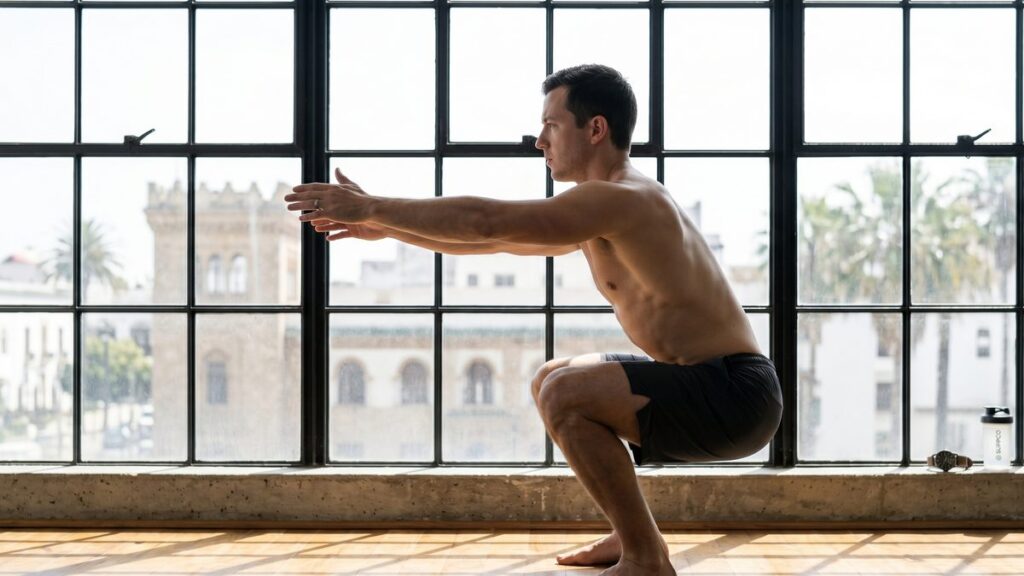
Bodyweight squat. Hips drop below knee level, heels stay flat, knees track in line with toes.
- Common mistake: knees caving inward (valgus collapse). Cue: “spread the floor” — actively press your feet outward as you descend. If heels lift, your ankles are the limiter; box-squat to a chair until mobility catches up.
Bulgarian split squat. Back foot on the chair, front foot far enough forward that the front knee tracks over the ankle at the bottom. Lower until the back knee almost touches the floor.
- Common mistake: hip drop on the working side. Cue: “level pelvis, ribs down” — imagine balancing a glass of water on your front hip bone the whole rep.
Glute bridge (and single-leg variant). Drive through the heel, squeeze the glute hard at the top, ribs stay down.
- Common mistake: lumbar over-extension at the top — people arch the back instead of extending the hip. Cue: “ribs down, posterior tilt before lift” — tuck the pelvis first, then push the floor away.
Reverse lunge. Step backward, lower until front thigh is parallel and back knee nearly touches the floor.
- Common mistake: front knee collapsing inward. Cue: “knee over second toe” — drive it out as you descend, don’t let the adductors win.
Cossack squat. Sit deep into one side with that foot flat; opposite leg straight, foot flexed. Knee tracks over the working foot.
- Common mistake: heel lift on the working side. Cue: “weight to the heel, toes light” — if the heel still lifts, narrow your stance and shorten the depth until ankle mobility opens.
Nordic curl (assisted). Hands ready to catch yourself; control as much of the lowering phase as possible, push back up with hands.
- Common mistake: hinging at the hips instead of the knees — the hips fold forward and the hamstrings barely load. Cue: “hips locked open, knees are the only hinge” — squeeze glutes the whole descent.
A 70% controlled negative on Nordics is still productive. Don’t expect full reps for 6–12 weeks.
How to Make Any Bodyweight Leg Exercise Harder (Without Weights)
The biggest myth in bodyweight training is that you eventually run out of stimulus. You don’t — you run out of imagination. Six levers add intensity without touching a dumbbell, and each one stacks on the others.
- Slow the eccentric. A 3-second descent doubles time-under-tension per rep. On a bodyweight squat, that turns a 30-rep set into a brutal 20-rep set with more mechanical tension per rep.
- Add a pause at depth. Hold the bottom of a Bulgarian split squat for 2 seconds before driving up. Removes the stretch reflex; the muscle has to start from a dead position.
- 1.5 reps. Go all the way down, come halfway up, go back down, then full rep. One “rep” becomes 1.5 reps of accumulated tension at the hardest range.
- Go unilateral. Single-leg work doubles load per limb without adding external weight. A bodyweight squat becomes a Bulgarian split squat becomes a pistol — same body, triple the demand.
- Train through deficit ROM. Stand on a plate or step so the bottom of the rep is deeper than the floor allows. Pistols off a 4-inch step are a different exercise.
- Add plyometrics. Jump squats and split jumps load the system explosively, which recruits high-threshold motor units the same way heavy load does.
Concrete stack on a bodyweight squat: 3-second descent, 2-second pause at the bottom, 1.5 rep at the bottom, drive up explosively. One “rep” now contains four distinct training stimuli. Twenty of those will humble most lifters.
4-Week Bodyweight Leg Routine
Run this twice per week, 48 hours apart, 25–35 minutes per session. Day A is bilateral-leaning and quad-dominant; Day B is unilateral-leaning and posterior-chain-leaning. Don’t swap days, don’t add cardio between them, and don’t skip the warm-up.
Day A (Monday)
| Exercise | Sets × Reps | Rest | Tempo cue |
|---|---|---|---|
| Bulgarian split squat | 4 × 8–12 / leg | 90 sec | 3-sec down, 1-sec pause |
| Bodyweight squat | 4 × 20–30 | 90 sec | 3-sec down, drive up fast |
| Single-leg glute bridge | 3 × 12 / side | 60 sec | 2-sec squeeze at top |
| Single-leg calf raise | 4 × 15–25 | 45 sec | 3-sec lower, full ROM |
| Hollow-body hold | 3 × 30–45 sec | 45 sec | Ribs down, lower back glued |
Day B (Thursday)
| Exercise | Sets × Reps | Rest | Tempo cue |
|---|---|---|---|
| Pistol squat progression (current step) | 4 × 5–8 / side | 2 min | 3-sec down, controlled up |
| Walking lunge | 3 × 12 / leg | 90 sec | Smooth, no bounce |
| Cossack squat | 3 × 8 / side | 75 sec | 2-sec pause at depth |
| Nordic curl (assisted) | 3 × 5–8 | 2 min | 4–5-sec eccentric, hands up |
| Side plank | 3 × 30 sec / side | 45 sec | Hip stacked, no sag |

For full-program context and how this slots into a wider plan, see our calisthenics leg workout breakdown.
Week-by-Week Progression Strategy
- Week 1 — Establish. Hit the lower end of every rep range. Lock form. Record every set.
- Week 2 — Add reps. Add 1–2 reps per set on anything you finished at the low end last week.
- Week 3 — Slow the eccentric. 3-second descent on every rep. Hit the top of every range.
- Week 4 — Add a set or graduate. Add a 5th set on the compound moves, or progress to the next variation (Bulgarian → pistol progression, walking lunge → backpack-loaded walking lunge).
Scaling Rules — If the Plan Is Too Hard or Too Easy
The decision rule: if you fail to hit the low end of the rep range two sessions in a row, swap to the regression for 2 weeks, then retest. Don’t grind broken reps; the form pattern erodes faster than strength builds.
Too hard — regress:
- Bulgarian split squats → stationary split squats with a hand on the wall
- Bodyweight squats → box squats lowering to a chair
- Nordic curls → banded Nordics, or eccentric-only at a shallow angle
- Cossack squats → lateral lunges (less depth, both feet flat)
- Pistols → box pistols to a chair, then progressively lower targets
Too easy — progress in this order: tempo first (slow the eccentric), then add a set, then change variation, then add external load (backpack with books works). If everything in this plan feels light by week 2, you’re past the bodyweight-only ceiling. The dumbbell + bodyweight hybrid plan is the natural next step.
What to Expect After 4 Weeks
Strength changes show up first; visible changes lag.
- Bulgarian split squat: +3 to 5 reps per leg on max set
- Bodyweight squat: +10 to 20 reps with slow tempo on max set
- Glute development: noticeable strength and firmness; visible shape change typically takes 8–12 weeks of consistent training
- Pistol progression: one stage advance for most trainees (box pistol → partial-depth pistol)
- DOMS: significant the first 2–3 weeks, then subsides as the muscle adapts
If you’re a month in and the lifts aren’t moving, the issue is one of three: under-eating, under-sleeping, or under-progressing. Bodyweight programs fail on those three before they fail on programming.
Bodyweight Leg Workouts FAQ
Can you build muscular legs with bodyweight alone?
Yes — for the first 12–24 months of training, bodyweight leg work builds substantial muscle if you progress to harder variations. ISSA’s coaching content notes that research shows bodyweight resistance produces comparable results to machine-based training when programmed with progression (Source: ISSA, 2024). Past the 2-year mark, serious mass gains usually require some form of external loading.
How often should I train legs with bodyweight?
Two sessions per week with 48 hours between is the sweet spot for hypertrophy. Bodyweight leg work is less neurally fatiguing than heavy barbell squatting, so some intermediate trainees tolerate three sessions per week split into one heavier day and one lighter day. More than three is rarely productive.
How long should a bodyweight leg workout be?
25–35 minutes including warm-up. Five exercises, 3–4 sets each, 45–120 seconds of rest. Past 40 minutes, junk volume creeps in and form decays — you stop building muscle and start practicing fatigue.
What’s the hardest bodyweight leg exercise?
The shrimp squat — a single-leg squat where you hold the non-working ankle behind you, descend until your knee touches the floor, and stand without using your arms. It demands strength, mobility, and balance simultaneously. The pistol squat is the most accessible advanced unilateral move.
Are bodyweight squats enough for legs?
For total beginners, yes — for the first 4–8 weeks. Once you can do 30+ strict squats, the bodyweight squat becomes a warm-up, not a stimulus. From that point, unilateral work (Bulgarians, pistol progressions, shrimp squats) drives continued growth.
How do I make bodyweight leg exercises harder without weights?
Six levers: slow the eccentric (3-second descent), pause at depth, use 1.5 reps, go unilateral, train through deficit range of motion, and add plyometrics. Stacking even two of these (slow eccentric + pause) turns a basic squat into a brutal set without touching external load.
Is a 4-week bodyweight leg routine enough to see results?
Enough to see strength changes (+3–5 reps per leg on Bulgarians, +10–20 reps on bodyweight squats) and feel firmer glutes — yes. Enough for visible shape change in the mirror — usually not. Visible glute and quad shape takes 8–12 weeks of consistent training for most people.
Bodyweight vs weighted leg training — which builds strength faster?
Weighted training builds maximal strength faster because you can dial in load precisely and progress in small increments. Bodyweight training builds relative strength, balance, and unilateral capacity faster. For pure 1RM gains, weights win. For functional leg strength inside a calisthenics program, bodyweight progression to pistols and shrimps is plenty.
The Bottom Line
Bodyweight leg training builds real muscle when programmed correctly — bilateral strength moves paired with unilateral hypertrophy work, twice per week, with progressive variation difficulty and slow eccentrics. Warm up properly, drill form cues before rep counts, graduate through the ranking at your own pace, and add the harder levers (tempo, pauses, deficit ROM) before reaching for weights. For the rest of the bodyweight system, see our complete calisthenics workout plan.
Sources
- BuiltLean — Build Muscle With Bodyweight Exercise. Source.
- ISSA — Best Bodyweight Exercises for Strong Legs. Source.