
TL;DR — Can You Mix a Pre-Workout Protein Shake?
Yes — a pre-workout protein shake is safe for most lifters, and mixing whey with your pre-workout does not blunt protein absorption. The one real limit is caffeine: keep your combined dose inside roughly 3–6 mg per kg of bodyweight (Source: ISSN, 2021) and under 400 mg total per day (Source: FDA, 2024). And remember: hitting your total daily protein matters far more than the exact minute you drink it.
Table of contents
Can you mix pre-workout with a protein shake?
Yes. You can stir a scoop of pre-workout into the same shaker as your whey and drink it 20–45 minutes before training. The caffeine and the protein do not cancel each other out, and no, combining them does not “kill” protein absorption — that claim is a gym myth with no mechanism behind it. The only thing you genuinely have to watch is your total caffeine load.
What you’ll notice is more about texture and taste than safety. Pre-workout powders are acidic and heavily flavored, so they can foam, clump, or clash with a creamy whey. None of that is dangerous. It’s a mixing problem, and it’s fixable.
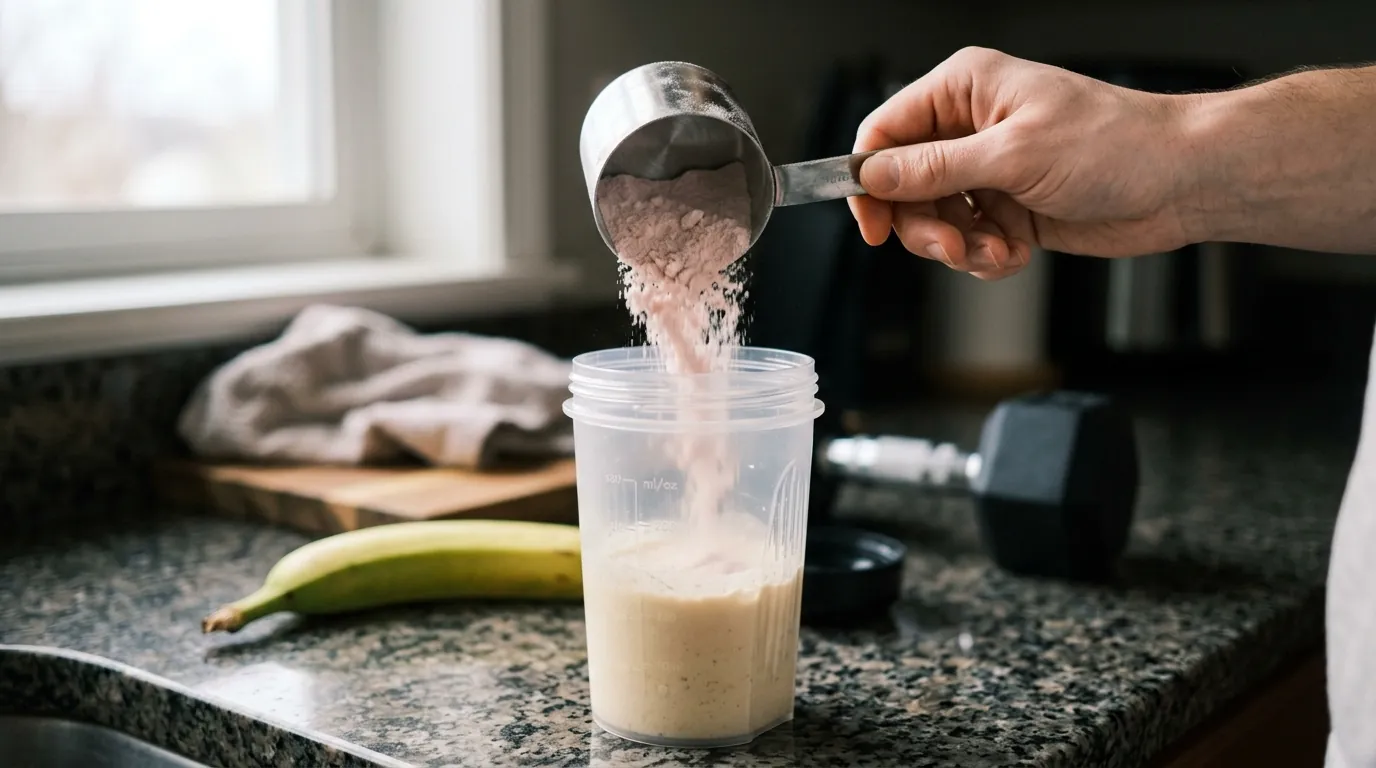
How to mix it:
- Add your powders to the shaker first — one scoop whey plus your pre-workout dose.
- Pour in cold liquid (water or milk), not warm.
- Shake hard for 15–20 seconds, or blend if you’re adding fruit or oats.
- Drink it 20–45 minutes before you train.
Watch the combined caffeine — do the math first
Run the numbers before you scoop. A typical pre-workout delivers 200–350 mg of caffeine per serving, and the evidence-backed ergogenic range sits at 3–6 mg per kilogram of bodyweight (Source: ISSN, 2021). Most plain whey powders add 0 mg — but mocha, coffee, and chocolate-coffee flavors can sneak in 50–100 mg, so read that label too. Across the whole day, the FDA flags 400 mg as the point where healthy adults start seeing downsides (Source: FDA, 2024).
Here’s the ergogenic range by bodyweight, so you can see where your pre-workout actually lands:
| Bodyweight | Low dose (3 mg/kg) | High dose (6 mg/kg) |
|---|---|---|
| 50 kg (110 lb) | 150 mg | 300 mg |
| 60 kg (130 lb) | 180 mg | 360 mg |
| 70 kg (155 lb) | 210 mg | 420 mg |
| 80 kg (175 lb) | 240 mg | 480 mg |
| 90 kg (200 lb) | 270 mg | 540 mg |
| 100 kg (220 lb) | 300 mg | 600 mg |
Worked example: an 80 kg (175 lb) lifter taking a 300 mg pre-workout sits comfortably inside their 240–480 mg ergogenic window, with 100 mg of headroom left before the 400 mg daily ceiling. That headroom is your coffee, your cola, your pre-bed allowance — spend it carefully. If you’re caffeine-sensitive or you train at night, anchor to the low end of the range instead of the high one. For the bigger picture on stacking stimulants, see our pre-workout energy drinks guide.
Can you put pre-workout IN the same shake? (taste, foaming, whey curdling)
You can, but expect some texture drama. Pre-workout formulas are acidic (citrulline malate and beta-alanine push the pH down), and acid plus whey protein is exactly the combination that foams up, clumps, and throws off the flavor. The result is a slightly gritty, fizzy, sour-sweet shake. It’s harmless, just not gourmet.
Three practical fixes: shake harder and longer to break up clumps, use ice-cold liquid (cold slows the foaming), or simply take your pre-workout separately in 250 ml (8 oz) of plain water and chase it with the protein shake. That last option sidesteps the curdling entirely. One more thing lifters notice — the beta-alanine “tingle” on the face and hands. That pins-and-needles feeling (paresthesia) is well-documented, transient, and harmless at normal doses (Source: ISSN, 2015).
Timing — when to drink it before training
Drink it 20–45 minutes before you train. That window gives caffeine time to climb toward peak blood levels while the protein starts digesting. For the muscle-building side, 20–40 g of high-quality protein around your session is the practical sweet spot for maximizing muscle protein synthesis (Source: ISSN/Schoenfeld & Aragon, 2018).
Don’t overthink the clock, though. The same body of research is blunt about priorities: your total daily protein intake outweighs precise timing for hypertrophy. A pre-workout shake is convenient and it covers a protein feeding — it isn’t a magic anabolic window. If you train fasted in the morning, it’s genuinely useful; if you ate a full meal two hours ago, it’s optional. For the deeper timing breakdown, see when to take pre-workout and should you eat before or after a workout.
Will mixing them upset your stomach?
For some people, yes — and usually it’s avoidable. The trouble comes from stacking several gut irritants at once: a punchy caffeine dose, concentrated whey, sugar alcohols in flavored powders, and the acids in pre-workout, all landing on an empty stomach. Lifters commonly report bloat, cramping, or a wave of nausea in the first 10 minutes. Tweak one variable at a time and most of it disappears.
Here’s how to troubleshoot the common complaints:
| Symptom | Likely cause | Fix |
|---|---|---|
| Bloating | Too much liquid volume or concentrate whey | Switch to whey isolate; cut the liquid by 100 ml |
| Cramps | Caffeine dose too high | Drop to a half scoop of pre-workout |
| Nausea | Empty stomach | Eat something light 30 min earlier, or dilute with more water |
If nausea is your recurring issue, a small carb-and-protein snack beforehand usually settles it — our pre-workout meal guide has easy options that won’t sit heavy.
Mix vs. separate — which is better for you?
Neither wins outright — it depends on your stomach, your schedule, and your caffeine tolerance. Mixing into one shake is faster and fine for most lifters. Taking them separately gives you precise control: you can dial the stim dose, dodge the curdling, and skip the caffeine entirely on days you’ve already eaten protein. Use the table to find your situation.
| Your scenario | Mix in one shake | Take separately | Why |
|---|---|---|---|
| Short on time | ✓ | One shaker, one cleanup | |
| Caffeine-sensitive | ✓ | Control the stim dose independently | |
| Fasted morning training | ✓ | Covers protein + energy in one go | |
| Pre-workout is coffee/mocha flavor | ✓ | Flavors clash badly with whey | |
| Whey curdles with your pre-workout | ✓ | Avoid the foaming and clumps | |
| Already ate a protein meal | ✓ | Take the stim only, skip extra whey | |
| Sensitive stomach | ✓ | Isolate one variable at a time |
Who benefits — and who should skip the combo
The combo earns its place for time-crunched lifters, fasted morning trainers, and hard-gainers who chronically under-eat protein — one shake solves energy and a protein feeding at once. Skip it (or split the two) if you’re caffeine-sensitive, you train in the evening and value your sleep, or you already ate a protein-rich meal within a couple of hours.
- Best fit: busy lifters, fasted AM trainers, under-eaters chasing a protein target.
- Separate or skip: caffeine-sensitive lifters, evening trainers, anyone already protein-fed.
Powder choice matters here too. Whey digests fast, which makes it the logical pick for a pre-workout shake — it’s available quickly around your session. Casein digests slowly and drip-feeds amino acids for hours, so it earns its keep post-workout or before bed, not 30 minutes before deadlifts. If you’re weighing what else belongs in your pre-workout slot, is creatine a good pre-workout is worth a read.
3 pre-workout protein shake recipes (with macros)
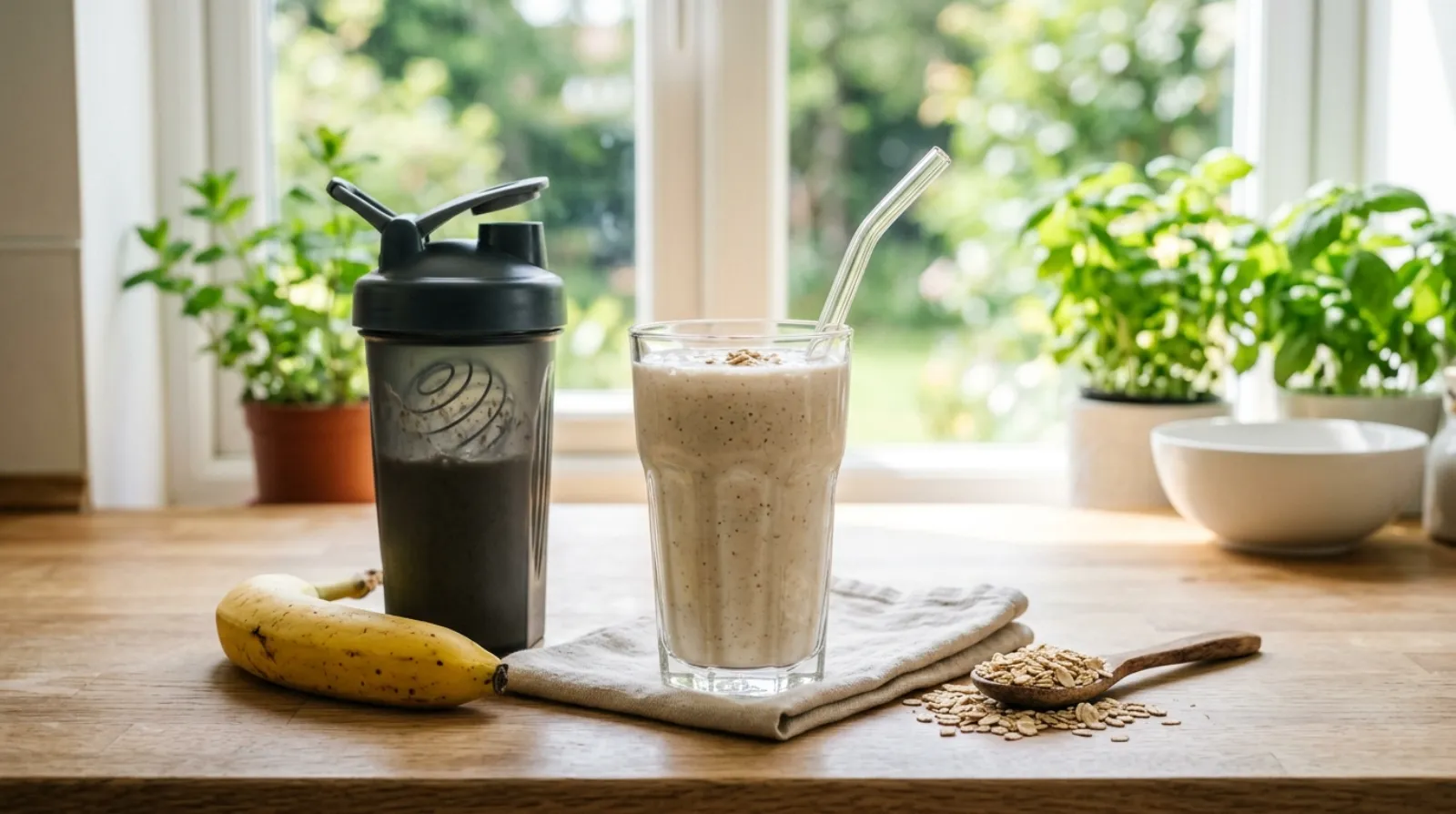
Three builds for three goals — scale the scoops to your own labels and recompute from there.
Performance Mix
- 1 scoop whey (~25 g protein)
- 1 scoop pre-workout (~200 mg caffeine)
- 1 banana
- 300 ml (10 oz) water or almond milk
- Ice, blended
Macros: ~28 g protein · ~200 mg caffeine · ~280 kcal
Endurance Fuel
- 1 scoop whey (~24 g protein)
- ½ scoop pre-workout (~100 mg caffeine)
- 40 g oats
- 200 ml (7 oz) milk
- 1 tsp honey
Macros: ~32 g protein · ~100 mg caffeine · ~420 kcal
Lean Cut
- 1 scoop whey isolate (~27 g protein)
- 1 scoop pre-workout (~200 mg caffeine)
- 200 ml (7 oz) water
- Ice, plus a 0-calorie flavoring
- Optional: thermogenic pre-workout for an extra metabolic nudge — see our thermogenic pre-workout breakdown first
Macros: ~27 g protein · ~200 mg caffeine · ~140 kcal
Always verify caffeine against YOUR pre-workout label, and recompute protein and calories for your specific powder. Scoop sizes and formulas vary widely.
For the Lean Cut especially, an unflavored whey isolate mixes cleanest with acidic pre-workout — fewer additives means less foaming and no flavor clash. A reliable option is NOW Sports Whey Protein Isolate, Unflavored (check current price on Amazon).
As an Amazon Associate, Gymnase Tips earns from qualifying purchases.
Frequently asked questions
Does mixing pre-workout with protein reduce absorption?
No. There’s no mechanism by which caffeine or pre-workout ingredients block whey digestion or amino acid uptake. This is a persistent myth. Your body absorbs the protein normally, and what actually drives results is your total daily protein intake, not the company it keeps in the shaker.
Is it bad to take pre-workout and protein at the same time?
It’s safe for most healthy adults, as long as your combined caffeine stays inside the 3–6 mg/kg ergogenic range and under 400 mg for the day (Source: FDA, 2024). The protein adds no extra risk — the only variable worth tracking is the stimulant load.
Should I drink it before or during my workout?
Before — ideally 20–45 minutes out, so caffeine peaks and protein starts digesting. Sipping during a workout is fine for long endurance sessions over 90 minutes, where extra fuel helps. For a standard 45–75 minute lifting session, drink it beforehand and you’re covered.
Can a protein shake replace pre-workout?
No. Protein is a building block, not a stimulant. A plain shake gives you no caffeine, no citrulline pump, and no acute performance lift (Source: Wax et al., 2015). It’ll feed your muscles, but it won’t sharpen focus or boost output the way a dosed pre-workout does.
Will a pre-workout protein shake break a fast?
Yes. A shake with whey and a banana carries real calories and protein, which ends any true fast — it triggers digestion and an insulin response. If you’re training fasted on purpose, take only a calorie-free, protein-free stimulant beforehand and save the shake for after.
Can mixing cause stomach cramps?
It can for sensitive users, usually from too much caffeine hitting an empty stomach. Drop to a half scoop of pre-workout, eat something light 30 minutes earlier, or dilute the shake with more water. Most cramping clears up once you cut the stim dose or add a little food.
The bottom line
A pre-workout protein shake is a legitimate time-saver, not a fallback. Get the caffeine math right, use cold liquid and an isolate if texture or your stomach gives you grief, and remember that nailing your daily protein target beats obsessing over timing. Build it around your goal, check the dose against your own label, and you’re set. If you want to round out that pre-session stack, our take on is creatine a good pre-workout is the logical next read.
Sources
- ISSN — Caffeine and exercise performance (Guest et al., 2021): jissn.biomedcentral.com
- ISSN — Protein timing & muscle protein synthesis (Schoenfeld & Aragon, 2018): jissn.biomedcentral.com
- ISSN — Beta-alanine position stand (Trexler et al., 2015): pubmed.ncbi.nlm.nih.gov
- Citrulline & performance (Wax et al., 2015): pubmed.ncbi.nlm.nih.gov
- FDA — How much caffeine is too much (2024): fda.gov


Pingback: Best Pre-Workout for Women (2026): 7 Picks, No Jitters