Last updated: July 2026 — written by the Gymnase Tips training team.
TL;DR — What’s in this dumbbell workout plan PDF?
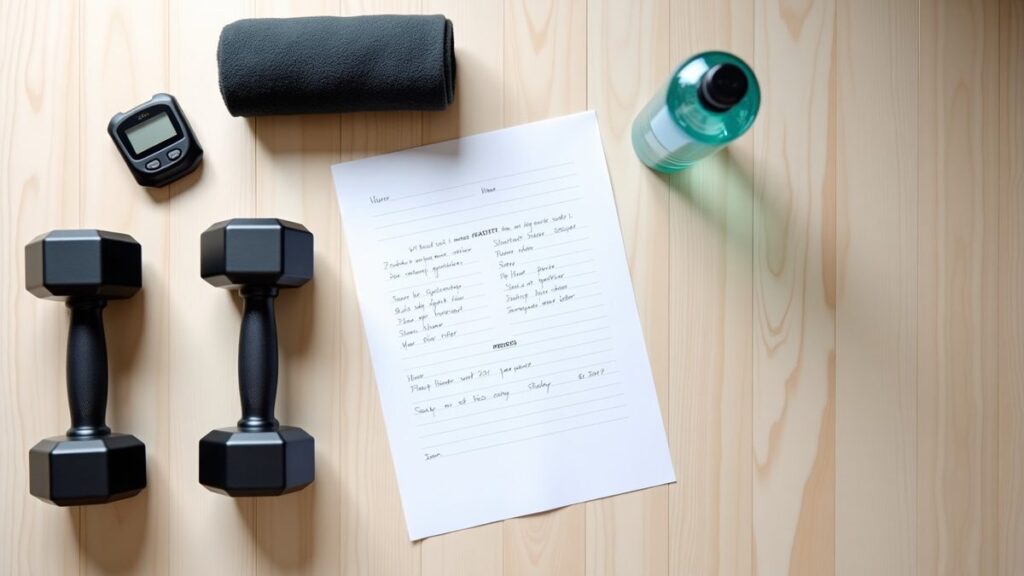
This free dumbbell workout plan PDF gives you a 4-week home routine using one pair of dumbbells: four ~40-minute strength days (upper, lower, push, pull) plus one cardio-core day. Download the printable PDF below, no email required. The file includes day-by-day tables, a starting-weight chart, and a blank 4-week tracking log.
| Spec | Details |
|---|---|
| Plan length | 4 weeks |
| Days per week | 4 strength + 1 cardio-core |
| Session time | ~40 min |
| Equipment | 1 pair of dumbbells (no bench needed) |
| Level | Beginner–intermediate |
| Download | Free PDF, no sign-up |
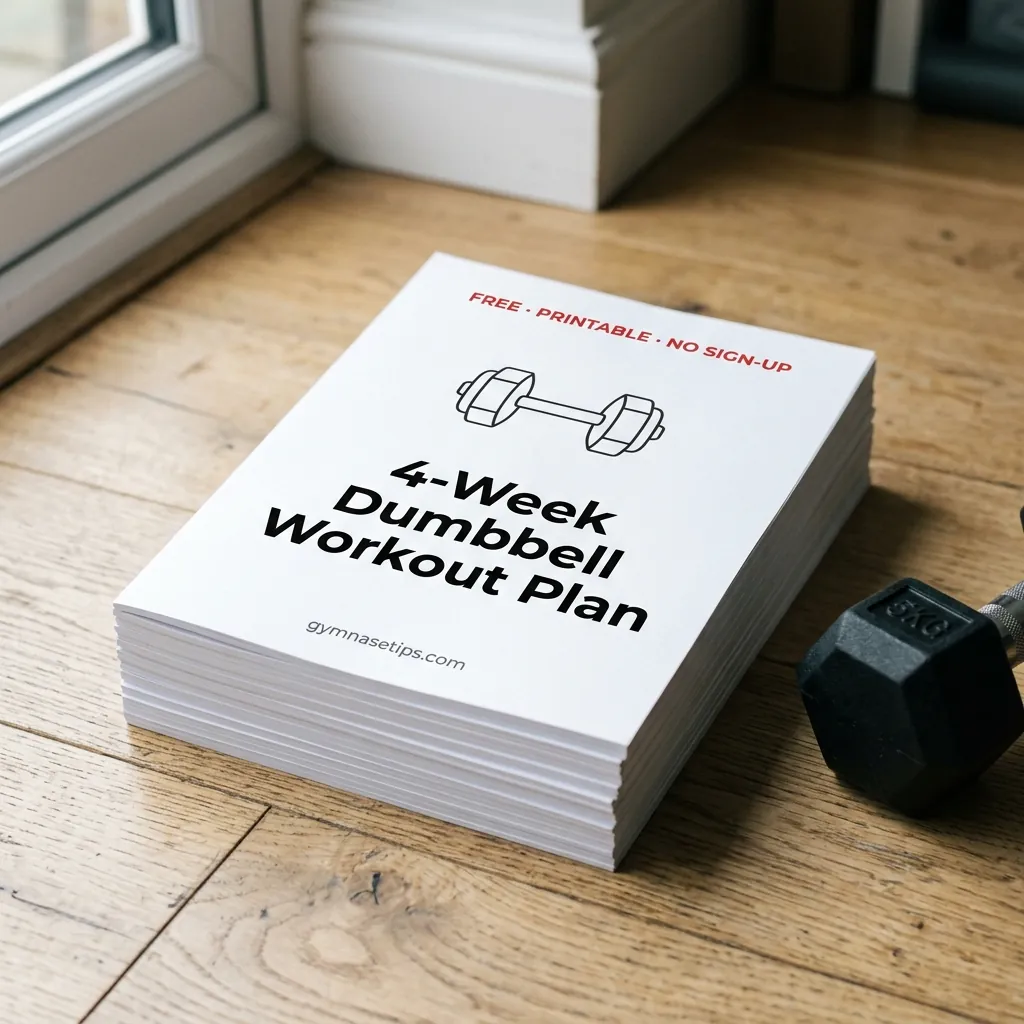
The full plan is also written out below in tables, so you can read every set and rep before you download anything.
Table of contents
What you need (spoiler: one pair of dumbbells)
One pair of dumbbells and enough floor space to lie down. That’s it. This is a dumbbell-only plan: no barbell, no machines, no bench, no pull-up bar required. If you’re choosing a pair, a light set runs 10–15 lb for most women and 15–25 lb for most men; a moderate set runs 20–30 lb and 30–45 lb respectively.
One adjustable pair covers both ranges and is the better buy if you plan to train past week 4. A mat helps for floor presses, glute bridges, and core work but a folded towel does the same job.
A bench is optional. Every bench movement in the plan lists a floor version, and an ottoman or sturdy step stands in for split squats. If you’re starting from zero equipment and zero training history, our beginner home workout plan is the gentler on-ramp.
Weekly schedule at a glance
You train five days out of seven: four strength sessions and one cardio-core day, with rest on Days 3 and 7. That layout clears the federal baseline of muscle-strengthening activity on 2 or more days per week (Source: HHS Physical Activity Guidelines, 2nd edition) with room to spare — only 22.5% of US adults met both the strength and aerobic guidelines in 2022 (Source: CDC MMWR, 2024).
| Day | Focus |
|---|---|
| Day 1 | Upper body |
| Day 2 | Lower body |
| Day 3 | Rest (optional walk) |
| Day 4 | Full-body push |
| Day 5 | Full-body pull |
| Day 6 | Cardio + core |
| Day 7 | Rest |
Only have three days? Run Days 1, 2, and 4 and keep everything else the same.
The 4-week dumbbell workout plan (day by day)
Each session below fits in about 40 minutes including rest. The Rest column follows one rule set: 90–120 seconds after compound lifts, 45–60 seconds after isolation work, 30 seconds between core and cardio sets. Treat those as floors, not races. In an 8-week trial, trained men resting 3 minutes between sets gained more strength and muscle than men resting 1 minute (Source: Schoenfeld et al., Journal of Strength and Conditioning Research, 2016), so if you have spare time, rest longer on the big lifts.
The last column solves the one-pair problem. When the weight is wrong for a given exercise, change the rep instead of the dumbbell: slow tempo (3 counts down, 1 pause, 3 up) or 1.5 reps when it’s too light, fewer reps or a single-arm version when it’s too heavy.
Day 1 — Upper body
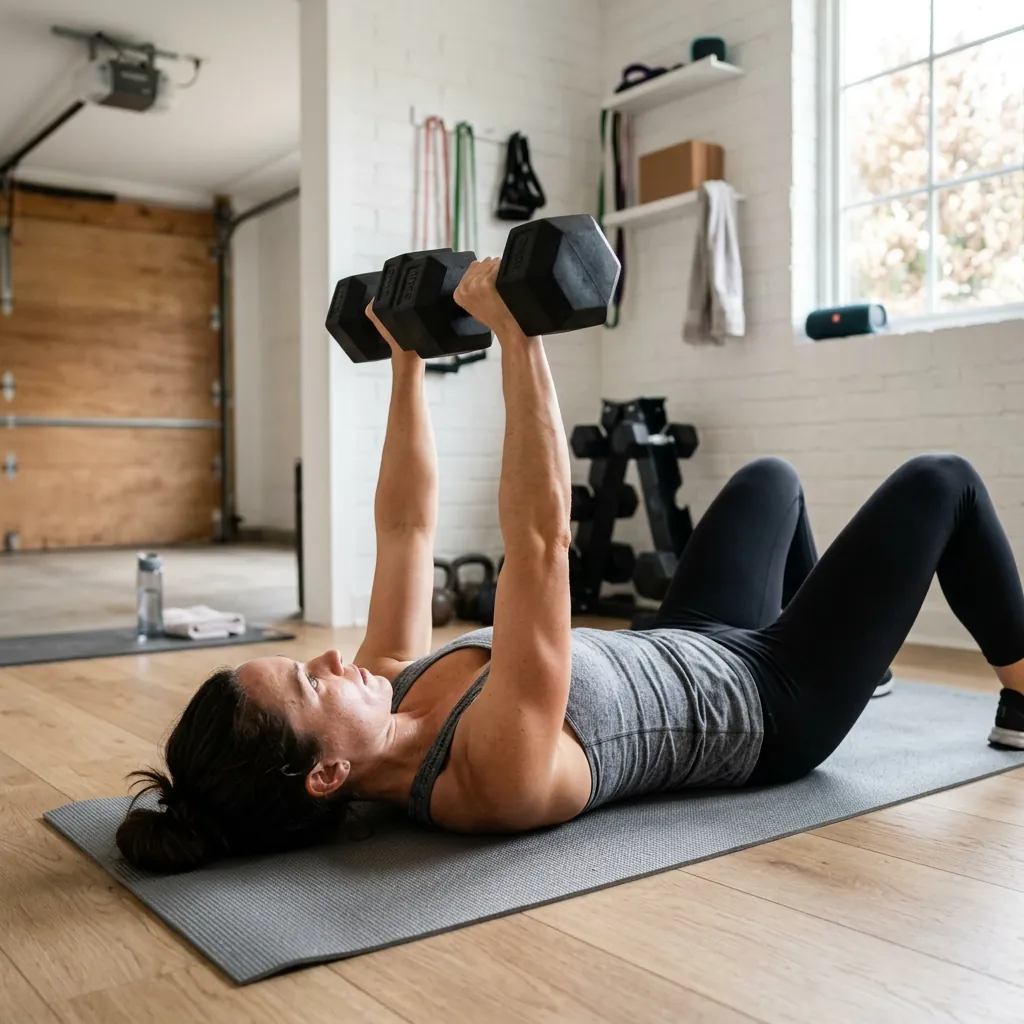
| Exercise | Sets × reps | Rest | One-pair-only substitution |
|---|---|---|---|
| Dumbbell bench press (floor press if no bench) | 4 × 10 | 90–120 s | Too light: 3-count lowering every rep |
| Bent-over row | 4 × 10 | 90–120 s | Too light: 1-second pause at the top |
| Overhead press | 3 × 12 | 90–120 s | Too heavy: press one arm at a time |
| One-arm row | 3 × 10 each side | 90 s | Too light: 2-second squeeze at the top |
| Biceps curl | 3 × 12 | 45–60 s | Too heavy: alternate arms |
| Triceps extension | 3 × 12 | 45–60 s | Too heavy: both hands on one dumbbell |
| Plank | 3 × 60 s | 30 s | Too easy: raise one foot |
Keep your shoulder blades pinned on presses. Pull the dumbbell to your hip, not your armpit, on rows.
Day 2 — Lower body
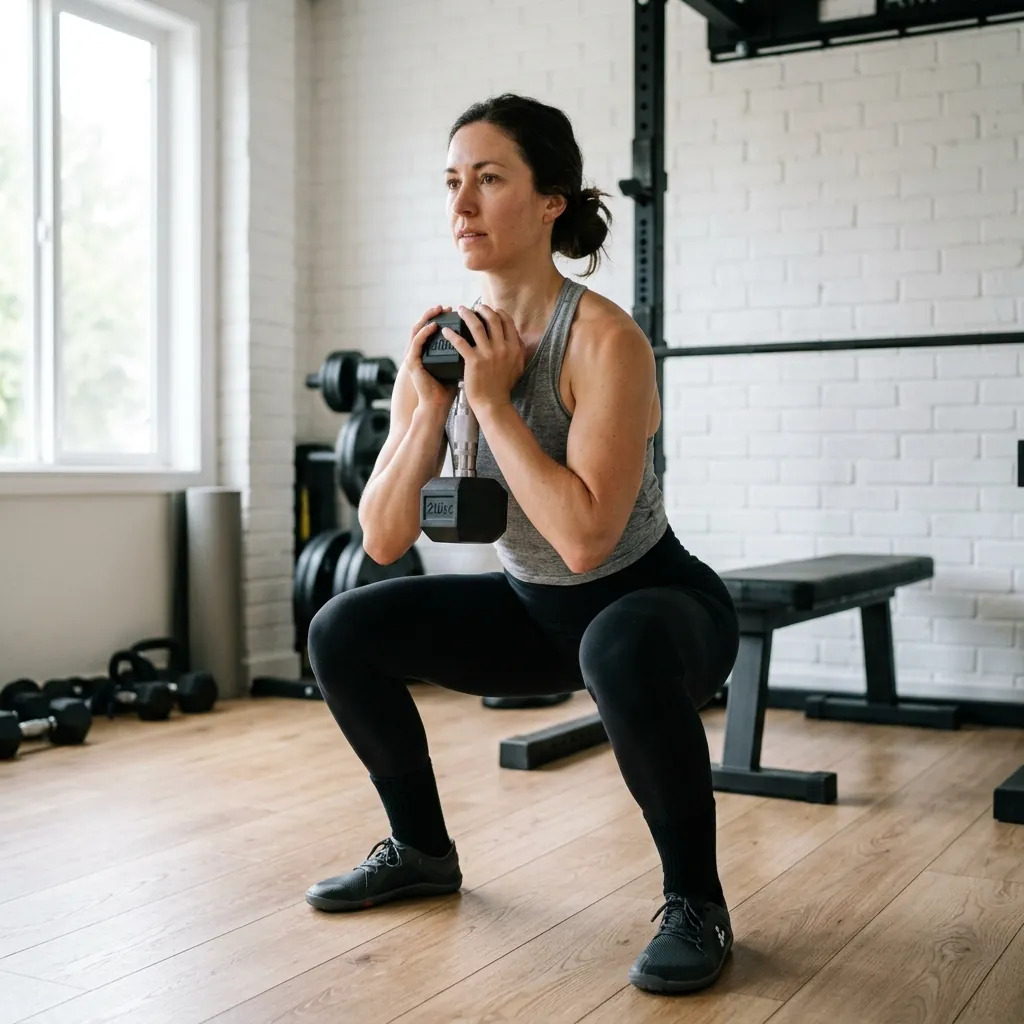
| Exercise | Sets × reps | Rest | One-pair-only substitution |
|---|---|---|---|
| Goblet squat | 4 × 12 | 90–120 s | Too light: 3-second descent, pause at the bottom |
| Romanian deadlift | 4 × 10 | 90–120 s | Too light: single-leg version |
| Bulgarian split squat | 3 × 10 each side | 90 s | No bench: reverse lunge |
| Walking lunges | 3 × 12 each side | 90 s | Too light: 2-count hold at the bottom |
| Weighted glute bridge | 3 × 15 | 45–60 s | Too light: single-leg bridge |
| Calf raises | 4 × 20 | 45–60 s | Too light: single-leg, slow lowering |
Sit back into the goblet squat like you’re reaching for a chair. For more lower-body options, see our guide to the best dumbbell exercises for thighs and glutes.
Day 4 — Full-body push
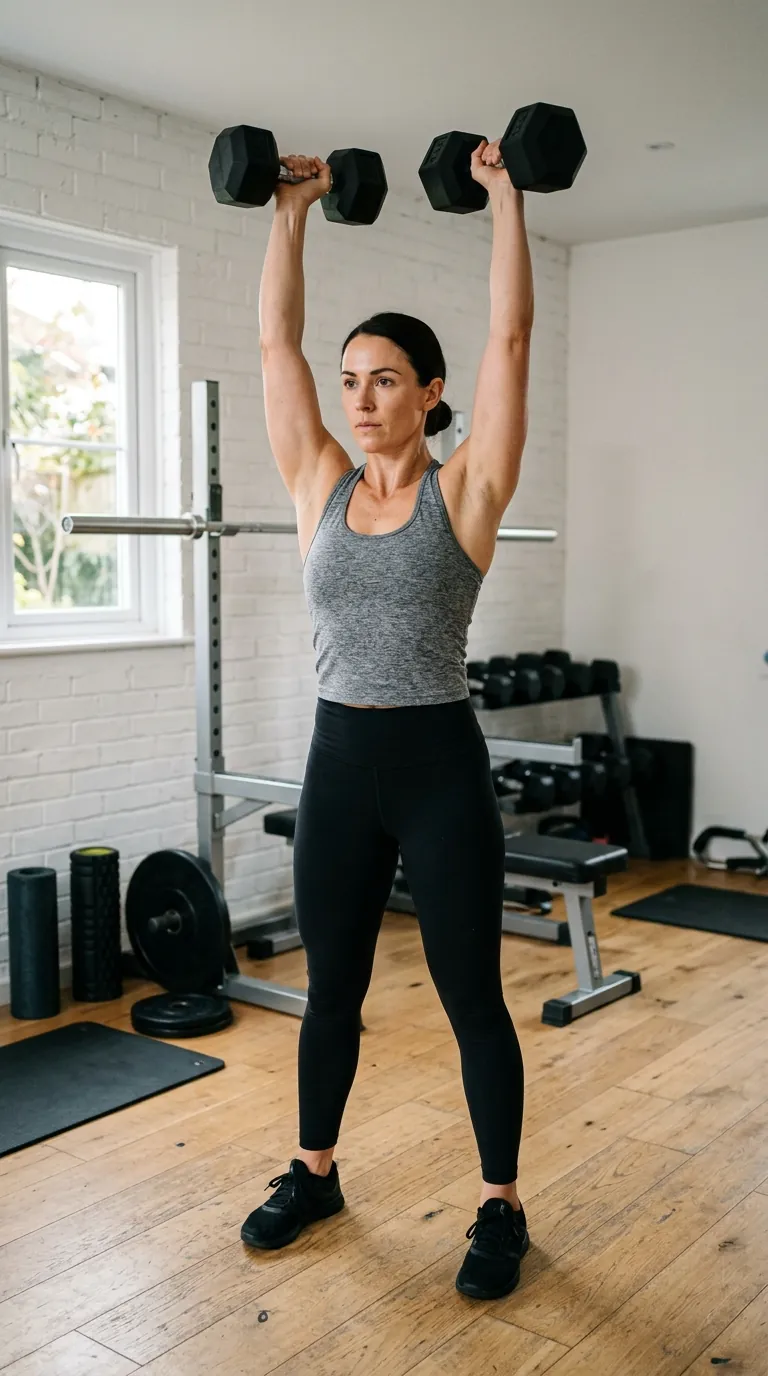
| Exercise | Sets × reps | Rest | One-pair-only substitution |
|---|---|---|---|
| Floor press | 4 × 10 | 90–120 s | Too light: 1.5 reps (repeat the bottom half) |
| Push press | 4 × 8 | 90–120 s | Too heavy: one arm at a time |
| Lateral raises | 3 × 15 | 45–60 s | Too heavy: bend elbows to 90° |
| Front raises | 3 × 12 | 45–60 s | Too heavy: alternate arms |
| Overhead triceps extension | 3 × 12 | 45–60 s | Too heavy: both hands on one dumbbell |
| Push-ups | 3 × max | 60 s | Too hard: drop to your knees |
Drive the push press with your legs, then punch the dumbbells overhead. Elbows stay soft at the top of raises.
Day 5 — Full-body pull
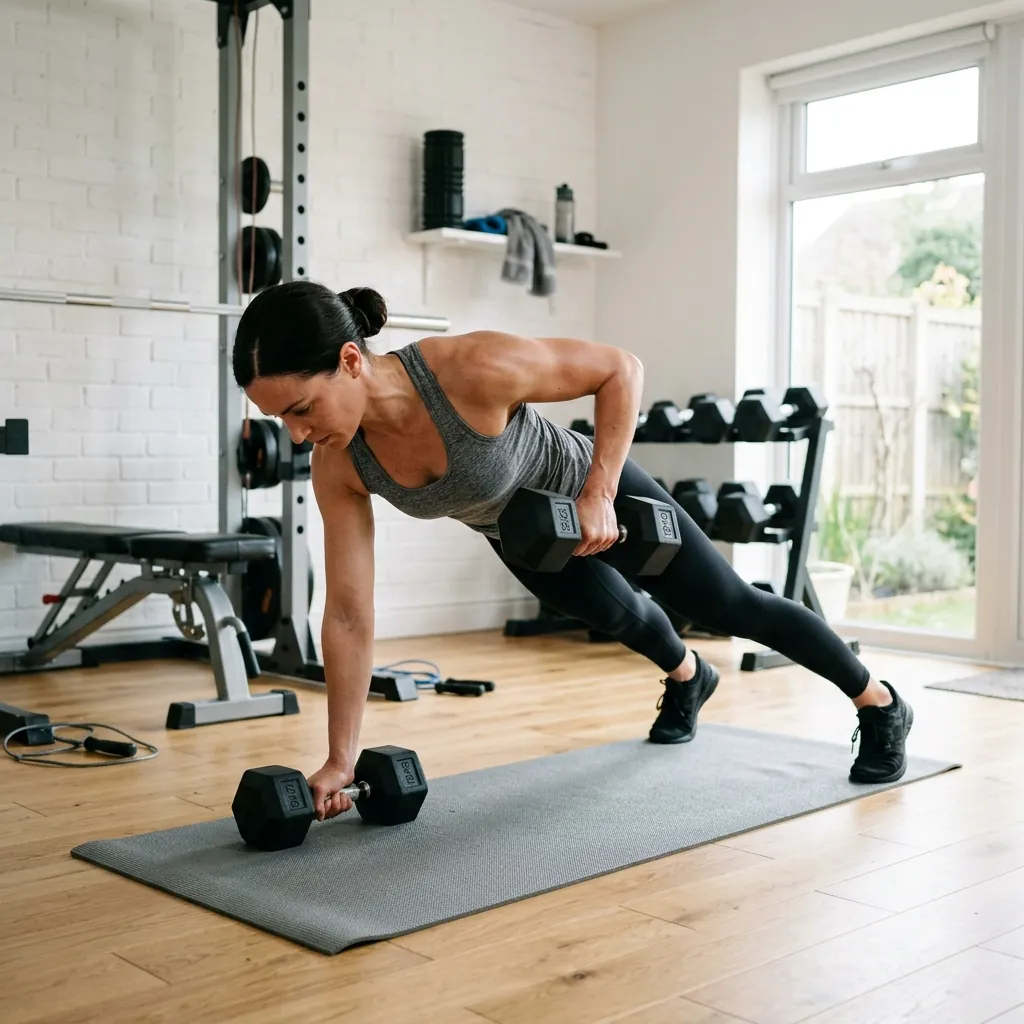
| Exercise | Sets × reps | Rest | One-pair-only substitution |
|---|---|---|---|
| Renegade row | 4 × 8 each side | 90–120 s | Too heavy: row from your knees |
| Dumbbell deadlift | 4 × 10 | 90–120 s | Too light: 3-1-3 tempo |
| Reverse fly | 3 × 12 | 45–60 s | Too heavy: bend elbows slightly more |
| Hammer curl | 3 × 12 | 45–60 s | Too light: 3-count lowering |
| Concentration curl | 3 × 10 each side | 45–60 s | Too heavy: assist up with the free hand, lower slow |
| Dead hang | 3 × 30 s | 60 s | No bar: farmer hold, 3 × 45 s |
Fight the hip twist on renegade rows. Feet wide, squeeze the floor.
Day 6 — Cardio + core
| Exercise | Sets × reps | Rest | One-pair-only substitution |
|---|---|---|---|
| Steady cardio (walk, jog, bike, rope) | 20 min | — | No machine: brisk walk or stair repeats |
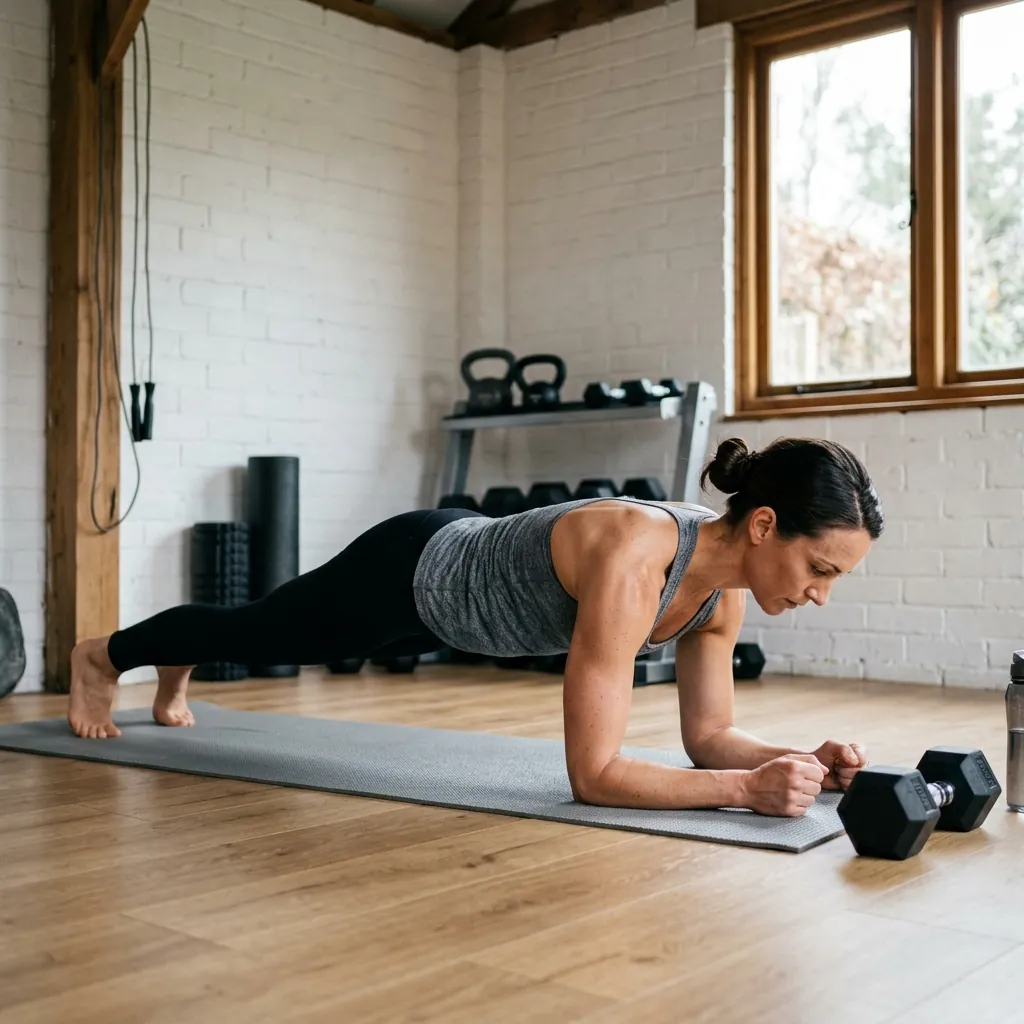
| Plank | 3 × 60 s | 30 s | Too easy: shoulder taps |
| Russian twists | 3 × 20 | 30 s | Too easy: hold one dumbbell |
| Knee raises | 3 × 12 | 30 s | Too easy: straight-leg raises |
| Side plank | 3 × 30 s each side | 30 s | Too hard: bottom knee down |
Cardio pace check: you should be able to talk, but not sing.
Prefer paper in front of you while you train? Download the free PDF (no email needed) — the same tables, plus the blank tracking log.
How heavy should your dumbbells be?
Heavy enough that the last two reps of every set feel hard while your form stays clean. That single rule beats any chart. As ballpark numbers, beginner women usually start around 8–15 lb on presses, 5–10 lb on isolation work, and 15–25 lb on squats and deadlifts; beginner men around 15–25 lb on presses and 25–40 lb on lower-body lifts.
| Lift type | Beginner women | Beginner men | Intermediate women | Intermediate men |
|---|---|---|---|---|
| Presses (floor/bench, overhead) | 8–15 lb (4–7 kg) | 15–25 lb (7–11 kg) | 15–25 lb (7–11 kg) | 25–40 lb (11–18 kg) |
| Rows and pulls | 10–15 lb (5–7 kg) | 20–30 lb (9–14 kg) | 20–30 lb (9–14 kg) | 35–50 lb (16–23 kg) |
| Squats, RDLs, lunges | 15–25 lb (7–11 kg) | 25–40 lb (11–18 kg) | 25–35 lb (11–16 kg) | 40–60 lb (18–27 kg) |
| Isolation (curls, raises, extensions) | 5–10 lb (2–5 kg) | 10–15 lb (5–7 kg) | 10–15 lb (5–7 kg) | 15–25 lb (7–11 kg) |
If a set of 12 ends and you could have done 18, the weight is too light: go up, or use the substitution column. The same chart is on page 6 of the PDF. Women following the plan at home can pair it with our workout plan for women at home for extra session variety.
4-week progression: how the plan is programmed
The plan applies progressive overload one variable at a time: week 1 is learning weight, week 2 adds a set, week 3 adds load, week 4 tests you. Never change two variables in the same week.
- Week 1: every exercise light, focus on form, leave 1–2 reps in reserve on each set.
- Week 2: add 1 set to the first two exercises of each day, still 1–2 reps in reserve.
- Week 3: drop 2 reps per set and add 5–10 lb where you can.
- Week 4: test week — keep week 3 loads and push the final set of each exercise to max clean reps.
Why it’s built this way: early strength gains come mostly from your nervous system learning to recruit muscle, with measurable force increases inside 4 weeks driven by motor-unit adaptations (Source: Del Vecchio et al., Journal of Physiology, 2019). So week 1 doesn’t need heavy weight to work. Volume matters too. The largest recent dose-response analysis, covering 67 studies, found muscle growth keeps rising with each added weekly set at a diminishing rate, while strength gets most of its benefit from the first few weekly sets, with far steeper diminishing returns after that (Source: Pelland et al., Sports Medicine, 2026). This plan lands most muscle groups at roughly 8–14 hard sets per week, squarely in the productive zone without wrecking recovery.
And why 4 weeks instead of 12? Adherence. Most page-one dumbbell programs run 12 weeks across 4–5 mandatory days, which is exactly the kind of commitment beginners abandon in week 3. Finish a 4-week block, bank the win, then decide what’s next. Skip the 12-week splits until you’ve completed at least one full block of something.
No bench? Do the plan anyway
You don’t need a bench for any day of this plan. Every bench-based movement has a floor or standing version programmed in, and the floor press is arguably safer for training alone at home since the floor catches your elbows. Don’t buy a bench for this program.
| Bench exercise | No-bench swap |
|---|---|
| Dumbbell bench press | Floor press |
| Incline press or incline fly | Standing overhead press work (already in Days 1 and 4) |
| Bulgarian split squat | Stairs or a sturdy chair, or reverse lunge |
What to do after week 4
Repeat the block. Run the same 4 weeks with heavier dumbbells, or keep the loads and add one set per exercise. Most people can repeat this plan two or three times before the progress slows enough to justify a new program.
When you’re ready to branch out, add a dedicated dumbbell leg day as a sixth session, blend in bodyweight work with our dumbbell and bodyweight hybrid, or move to hybrid training with dumbbells and calisthenics for a bigger movement menu.
FAQ
Short, self-contained answers below. If your real question is whether the equipment matters at all, we’ve covered whether you can build muscle without weights separately.
Can you build muscle with only dumbbells?
Yes. Muscle grows in response to progressive tension, and dumbbells deliver it as well as any barbell for beginner and intermediate lifters. Add weight, sets, or slower tempo over time and cover every major muscle group, which this 4-week plan does across five weekly sessions.
What weight dumbbells should a beginner start with?
Most beginner women start around 8 to 15 lb for presses, 5 to 10 lb for isolation work, and 15 to 25 lb for squats and deadlifts. Most beginner men start around 15 to 25 lb for presses and 25 to 40 lb for lower-body lifts. The last two reps of each set should feel hard with clean form.
Is 4 weeks enough to see results from dumbbell training?
Yes, for strength: most beginners lift noticeably heavier within 2 to 3 weeks, driven mainly by neural adaptation. Visible muscle changes usually take 6 to 8 weeks, so repeat the plan with heavier dumbbells after week 4 to keep the progress compounding.
How many days a week should I do this dumbbell plan?
The plan schedules five days: four strength sessions plus one cardio-core day, with two rest days. Four strength days is the target. Three days, using Days 1, 2, and 4, is a workable minimum for weeks when life gets in the way.
Do I need a bench for this dumbbell workout plan?
No. Every bench movement has a floor version built into the plan: the dumbbell bench press becomes a floor press, and incline work is replaced by standing overhead pressing. For Bulgarian split squats, use stairs or a sturdy chair, or swap in reverse lunges.
Can I do the whole plan with one pair of dumbbells?
Yes. Every day table includes a one-pair substitution column: slow the tempo or use 1.5 reps when the weight feels light, and shift to lower reps or single-arm versions when it feels heavy. An adjustable pair makes this easier but is not required.
Is this plan good for women and beginners?
Yes. The starting-weight chart and the week-1 form focus are built for people new to strength training, and every exercise scales by load rather than gender. Intermediate lifters should start heavier and add the optional extra sets from week 2 onward.
Bottom line
Four weeks, one pair of dumbbells, about 40 minutes a session. Follow the tables, respect the rest periods, and let the progression rules do the thinking for you. Print the tracker and write down every weight. Beat last week’s numbers by a little.
Sources
- HHS Physical Activity Guidelines for Americans, 2nd edition — muscle-strengthening 2+ days/week.
- CDC MMWR QuickStats (June 2024) — 22.5% of US adults met both guidelines in 2022.
- Del Vecchio et al., Journal of Physiology (2019) — strength increase after 4 weeks mediated by motor-unit recruitment and rate coding.
- Pelland et al., Sports Medicine (2026) — resistance training dose-response meta-regressions, weekly volume and frequency.
- Schoenfeld et al., Journal of Strength and Conditioning Research (2016) — longer inter-set rest enhanced strength and hypertrophy.