
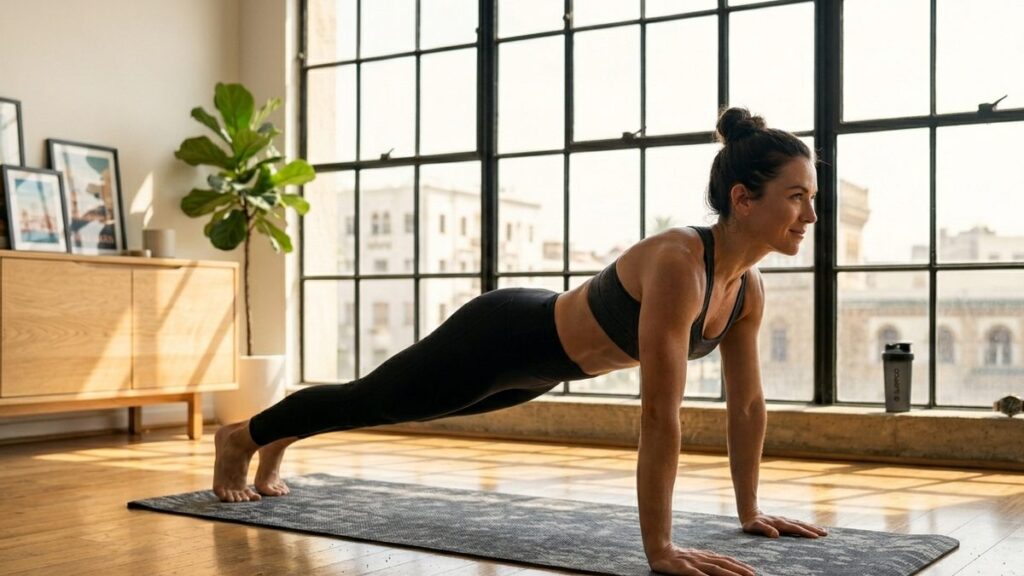
Workout Plan for Women at Home: 4-Week Bodyweight Plan
By James Nolan, NSCA-CPT (12 years coaching). Last updated June 2026.
A workout plan for women at home combines 3–4 bodyweight strength sessions per week — lower body, upper body, posterior chain, and full-body + core — with progressive reps over 4 weeks. No equipment is required. Expect noticeable strength gains in 2–3 weeks and visible muscle tone in 8–12 weeks.
This guide is built for women training at home with zero gear, from total beginners to lifters who lost their gym routine and need a structured restart. Every session fits in a corner of a living room. Every progression rule is testable. You get the same framework I use with online clients — adapted for a floor, a wall, and a sturdy chair.
TL;DR — What Is the Best Workout Plan for Women at Home?
The best workout plan for women at home is a 4-day bodyweight split — two lower-body sessions, one upper-body, one full-body + core — trained progressively for 4 weeks. Add a rep, shorten rest, or slow the eccentric each week. Train around your cycle when possible. Expect baseline strength gains by Week 3 and visible body-composition change between Weeks 8 and 12.
Weekly Schedule (At a Glance)
The four-day split below balances lower-body volume (where most women want strength and shape) with one focused upper-body day and a full-body finisher. Rest days are not optional — they are when adaptation happens.
| Day | Focus | Duration | Key Moves | Equipment |
|---|---|---|---|---|
| Monday | Lower Body — Glute/Quad | 35 min | Squat, reverse lunge, glute bridge (see our calisthenics leg workout for extra leg volume) | None |
| Tuesday | Upper Body — Push/Pull | 30 min | Push-up, pike push-up, doorway row | None (towel optional) |
| Wednesday | Active recovery | 20–30 min | Walk, mobility flow | None |
| Thursday | Lower Body — Posterior | 35 min | Single-leg hip thrust, RDL pattern, step-up | Sturdy chair |
| Friday | Full Body + Core | 35 min | Burpee, plank variations, dead bug | None |
| Saturday | Optional cardio or walk | 30–45 min | Brisk walk, dance, easy run | None |
| Sunday | Rest | — | — | — |
Two lower-body days are deliberate — glutes and hamstrings respond to higher weekly volume, and the posterior chain is the single biggest weak link in most desk-bound trainees. The upper day uses push-and-pull pairing to keep shoulders balanced. Friday’s full-body block builds conditioning without burning out the legs before the weekend.
Baseline Self-Test (60 Seconds)
Before Week 1, run three quick tests. The score decides your starting volume so you don’t undertrain or blow up your first session. Total time: under 5 minutes including rest.
The three tests:
- Max push-ups — knee or full, strict form, one set to technical failure.
- Bodyweight squats in 60 seconds — full depth (hip crease below knee), continuous.
- Plank hold — straight line from heel to head, hold until form breaks.
Match your worst score to the level — start there for all four sessions in Week 1.
| Level | Push-ups | Squats in 60 s | Plank | Week 1 starting volume |
|---|---|---|---|---|
| Beginner | 0–5 (or 0–10 knee) | <20 | <30 s | 2 sets × 6–8 reps, 60 s rest |
| Intermediate | 6–15 | 20–35 | 30–60 s | 3 sets × 8–12 reps, 45 s rest |
| Advanced | 16+ | 36+ | 60 s+ | 3 sets × 12–15 reps, 30 s rest |
Re-test in Week 4. Most women move up at least one tier on push-ups within a month — that single data point will tell you the plan is working long before the mirror does.
5-Minute Warm-Up
Do this before every session. Skip it and the first working set takes the hit.
- 30 s march in place + arm circles
- 10 cat-cows
- 10 bodyweight squats, slow
- 10 alternating reverse lunges
- 10 scapular push-ups (or wall slides)
The 4-Week Plan — Day-by-Day
Each session is five exercises. Use the sets/reps/rest from your tier in the Progression Matrix below. Form cue lives under each block — read it once, apply it every rep.
Monday — Lower Body (Glute/Quad)
- Bodyweight squat
- Reverse lunge (alternating)
- Glute bridge (feet flat)
- Wall sit
- Calf raise
Cue: drive through the mid-foot, knees track over the second toe. Keep ribs stacked over hips at lockout.
Tuesday — Upper Body (Push/Pull)
- Push-up (knee, incline, or full)
- Pike push-up
- Doorway row (towel anchored in closed door)
- Triceps dip (chair-supported)
- Superman hold
Cue: pull the shoulder blades down and back before the first rep — this protects the shoulder and turns on the lats.
Thursday — Lower Body (Posterior Chain)
- Single-leg hip thrust (shoulders on chair)
- Romanian-deadlift pattern (hinge with backpack)
- Step-up (sturdy chair)
- Bulgarian split squat (rear foot on chair)
- Side-lying clamshell
Cue: lead with the hips, not the knees. A good hinge looks like closing a car door with your butt.
Friday — Full Body + Core
- Burpee (step-back regression OK)
- Mountain climber
- Plank (forearm)
- Dead bug
- Hollow hold
Cue: brace the abs like you’re about to take a light punch — that’s the tension you keep through every rep. Pair this with our lower belly fat workout finisher if you want extra core volume.
Progression Matrix (Week 1–4)
Progressive overload on bodyweight comes from four levers: more reps, more sets, less rest, slower eccentrics. The matrix below stacks them across four weeks so adaptation never plateaus.
| Week | Sets | Rep range | Rest | Tempo (eccentric) | Target RPE | Focus |
|---|---|---|---|---|---|---|
| 1 | 2 | 8–10 | 60 s | 2 s down | 6/10 | Movement quality |
| 2 | 3 | 10–12 | 60 s | 2 s down | 7/10 | Add volume |
| 3 | 3 | 12–15 | 45 s | 3 s down | 8/10 | Density + control |
| 4 | 3–4 | 12–15 | 30 s | 3 s + 1 s pause | 8–9/10 | Strength peak |
Progression Matrix (Week 1-4)
Week 1 – Movement quality
2 sets of 8-10 reps, 60 s rest, 2-second eccentric, RPE 6. Focus on clean form on all five exercises per session before adding any volume.
Week 2 – Add volume
3 sets of 10-12 reps, 60 s rest, 2-second eccentric, RPE 7. Same exercises; the extra set is where most of the weekly progress comes from.
Week 3 – Density and control
3 sets of 12-15 reps, 45 s rest, 3-second eccentric, RPE 8. Shorter rest plus slower lowering builds time under tension without adding load.
Week 4 – Strength peak
3-4 sets of 12-15 reps, 30 s rest, 3-second eccentric with 1-second pause at the bottom, RPE 8-9. Re-test baselines at the end of the week.
How to use it: pick the row for the current week, apply those numbers to all five exercises in that day. If you cannot hit the bottom of the rep range with clean form, regress the exercise (knee push-up instead of full) and stay at the prescribed sets. RPE 6 means “could do 4 more reps.” RPE 9 means “could do 1 more.”
Household-Object Load Swaps
Once Week 4 reps feel like RPE 7 or below, add external load. A loaded backpack is the most underrated home tool in fitness — it scales linearly and rides cleanly during squats and hinges.
| Object | Approx load | Best swap-in exercise | Notes |
|---|---|---|---|
| Backpack + books | 5–25 lb | Squat, RDL, step-up, hip thrust | Cinch tight to the torso |
| 1-gallon water jug | ~8.3 lb | Single-arm row, suitcase carry | Handle is grip-friendly |
| 1.5 L water bottle | ~3.3 lb | Lateral raise, front raise | Beginner upper-body load |
| Full laundry detergent jug | ~10 lb | Goblet squat, farmer carry | Two-hand handle |
| Cast-iron skillet | 6–8 lb | Russian twist, halo, press | Watch the wrist |
| Sturdy chair | — | Bulgarian split squat, hip thrust bench | Test stability first |
A backpack jumps from 8 lb to 25 lb in one shopping trip — that’s a year of bodyweight progression compressed into an afternoon.
Cycle-Aware Training
Programming around your menstrual cycle is useful, not mandatory. The largest meta-analysis to date — McNulty et al., reviewing 78 studies — found that performance variation across cycle phases is statistically “trivial” and recommended a personalised approach rather than rigid phase-based rules (Sports Medicine, 2020). That’s the honest framing. What follows is what I program for clients who track and feel cycle effects clearly — roughly half of them.
Follicular (Day 1 of period to ovulation, ~14 days). Rising estrogen, lower perceived effort, best window for intensity. Push for PRs on push-ups, plank holds, and load increases. This is where the Week 3–4 RPE 8+ work lands cleanly if it aligns.
Luteal (ovulation to next period, ~14 days). Higher resting heart rate, hotter baseline temperature, slightly lower power output for some women. Hold sets steady, slow the tempo, focus on quality. Cardio sessions feel harder — that’s expected, not a regression.
Menstrual phase (Days 1–5). Train if you feel like it. Mayo Clinic notes regular moderate exercise can reduce cramps and PMS symptoms — there is no medical reason to skip workouts during your period unless symptoms are severe. Default to mobility, walking, and lighter sessions; deload if needed.
Tracking protocol. Log RPE per session in a notes app for two full cycles before deciding your pattern. The ACSM progression model emphasises individualised volume and intensity manipulation rather than universal templates — your data beats any phase chart.
Postpartum or pregnant: clear this plan with your clinician first. Diastasis recti and pelvic-floor screening change the exercise list.
Week-by-Week Milestone Chart
Specific milestones beat “results vary.” If you’re hitting the column-three marker each week, the plan is working.
| Week | Strength milestone | Stamina milestone | Visible/feel change | Tracking metric |
|---|---|---|---|---|
| 1 | Clean form on all 5 squat-day moves | Recover within 60 s between sets | Better sleep, mild DOMS | Push-up max (re-test) |
| 2 | +2–3 reps on push-up max | Hold plank 15 s longer | Posture feels taller | Plank PR |
| 3 | Hit RPE 8 without form breakdown | Finish Friday session unbroken | Waist + glutes feel firmer | Resting HR (lower) |
| 4 | +3–8 push-ups vs baseline | Squat 60 s test: +8–12 reps | Visible muscle tone (shoulders, glutes) | All 3 baseline re-tests |
Visible composition change typically lands between Weeks 8 and 12 — not Week 4. Anyone promising “transformation in 28 days” is selling, not coaching.
Scaling — Too Hard or Too Easy
Too hard — regress:
- Push-up → incline push-up (hands on chair) → knee push-up → wall push-up
- Squat → box squat to chair → assisted squat (hold doorframe)
- Plank → forearm plank on knees → incline plank on chair
- Bulgarian split squat → reverse lunge → static lunge
Too easy — progress:
- Add load via backpack (see swap table) — great for lower-body work; see how to tone legs for more leg-focused progressions
- Tempo: 3-second eccentric, 1-second pause at the bottom
- Single-limb variations (single-leg glute bridge, archer push-up)
- Cluster sets: same total reps, more sets, shorter rest
Myths to Discard
“Lifting makes women bulky.” Bodyweight and even moderate external load do not produce male-pattern hypertrophy in women — testosterone levels are roughly 10–15× lower. You get stronger and more defined, not “bulky.”
“Cardio is the fastest path to fat loss.” Resistance training preserves lean mass during a deficit. Cardio alone tends to drop muscle alongside fat, which lowers metabolic rate. Combine both.
“Bodyweight can’t build bone density.” Progressive resistance training — including bodyweight that loads the skeleton — is a first-line strategy for bone health in women. The ACSM position stand endorses progressive resistance training across the lifespan for musculoskeletal health.
“You need an hour a day.” The sessions in this plan are 30–35 minutes. Adherence over 12 weeks beats a perfect 60-minute program you skip every Thursday.
Nutrition + Recovery (The Non-Negotiables)
Strength work without enough protein is wasted work. The International Society of Sports Nutrition position on protein recommends 1.4–2.0 g per kg of bodyweight per day for individuals doing regular resistance training, with the upper end (around 2.2 g/kg) supporting lean-mass gain during energy restriction. For a 65 kg woman, that’s roughly 90–130 g of protein daily, spread across 3–4 meals.
Sleep 7–9 hours. Walk 7,000–10,000 steps on non-training days — it accelerates recovery and adds the calorie burn most people try to chase with extra HIIT. Skip the calorie obsession in Month 1; nail protein, sleep, and consistency first. For more on the activity side, see our fat loss exercises at home guide.
FAQ
How many days a week should a woman work out at home?
Three to four strength sessions per week is the sweet spot for at-home training. Four lets you split lower and upper body cleanly; three works if you go full-body each session. More than five days of intense training rarely outperforms four well-recovered ones for most women.
Can you build muscle at home with just bodyweight?
Yes – bodyweight builds real muscle when sets are taken close to failure and progressively overloaded. Hypertrophy depends on mechanical tension and total volume, not on barbells specifically. Beginners and intermediates gain noticeably for 12-18 months on bodyweight alone before plateauing.
How long until I see results from an at-home workout plan?
Strength gains appear in 2-3 weeks (neural adaptation). Visible muscle tone and body-composition change typically land between Weeks 8 and 12 with consistent training and adequate protein. Anyone promising a 4-week visual transformation is selling, not training you.
Is a 4-week bodyweight plan enough for beginners?
A 4-week plan is enough to build the habit, learn every movement pattern, and earn your first measurable PRs. It is not enough to finish – repeat the 4 weeks with added load or harder variations, or move to a longer hypertrophy block. Think of it as a foundation, not a finish line.
Should I work out during my period?
Yes, if you feel up to it. Regular moderate exercise can ease cramps and PMS symptoms, and there is no performance reason to skip training during menses (Mayo Clinic, 2023). Default to lighter sessions or mobility on heavy-flow days, and listen to your body.
Can women get toned with bodyweight only?
Yes. Toned is just visible muscle plus low enough body fat to see it. Bodyweight training builds the muscle; nutrition and overall activity manage the fat. The 4-week plan above hits both levers – progressive overload for muscle, plus walking and protein guidance for composition.
How can women build glutes at home without weights?
Use single-leg variations and slow eccentrics: single-leg hip thrust, Bulgarian split squat, step-up, glute bridge with 3-second lowering. Train glutes twice per week, push close to failure, and add backpack load once 15 reps feel easy. This plan’s Monday and Thursday sessions are built around exactly that.
Next Steps
Run the 4-week plan, re-test your baselines, then either repeat with added backpack load or move to a longer progression. For a slower on-ramp, see the home workout plan for beginners; if you’re ready to specialize, the beginner calisthenics routine is the natural next step.
Sources
- McNulty KL et al. The Effects of Menstrual Cycle Phase on Exercise Performance in Eumenorrheic Women: A Systematic Review and Meta-Analysis. Sports Medicine, 2020. pubmed.ncbi.nlm.nih.gov/32661839
- ACSM Position Stand. Progression Models in Resistance Training for Healthy Adults. Medicine & Science in Sports & Exercise, 2009. journals.lww.com
- Mayo Clinic. Menstrual cycle: What’s normal, what’s not. mayoclinic.org
- Jäger R et al. International Society of Sports Nutrition Position Stand: Protein and Exercise. JISSN, 2017. jissn.biomedcentral.com

Pingback: Best Calisthenics App 2026: 7 Workout Apps Ranked & Reviewed
Pingback: Toned Female Body: How to Get Lean Without Bulk
Pingback: Home Workout Plan for Beginners: 4-Week Starter
Pingback: Dumbbell Workout Plan PDF: Free 4-Week, No Sign-Up