
Last updated: June 2026 — written by James Nolan, NSCA-CPT, senior trainer at Gymnase Tips. Twelve years coaching, 400+ beginners walked through their first four weeks at home. No exercise experience required to start.
Most beginner programs on the internet were written for people who already train. This home workout plan for beginners wasn’t. The plan below is the exact 4-week structure I hand to a brand-new client on day one: three short sessions a week, two alternating bodyweight workouts, a floor and a wall, and a set of objective gates you have to clear before you “graduate.” After roughly 400 beginners, the pattern is stable — wrist pain in week 2, boredom in week 3, real visible posture change at week 4. The plan is built around those landmines, not around them.
You will not find dumbbells smuggled into a “bodyweight” routine here, no contradictions, no app upsell. Just the sessions, the form cues, the regressions when something hurts, and the science behind the dose.
TL;DR — What’s the Best Home Workout Plan for Beginners?
The best home workout plan for beginners is three 30-minute bodyweight sessions per week (Mon / Wed / Fri), alternating two full-body routines, with a 5-minute warm-up, 48 hours rest between sessions, and a 4-week progressive overload cycle. No equipment needed. Graduate when you hit 12 strict push-ups, 20 squats, and a 60-second plank.
What Is a Good Home Workout Plan for Beginners?
A good home workout plan for beginners is three 30-minute sessions per week, alternating two bodyweight routines (push/squat/core and full-body mix), with a 5-minute warm-up, progressive overload across 4 weeks, and 48 hours rest between sessions. No equipment needed.
That dose is not arbitrary. It lines up with the U.S. Physical Activity Guidelines for Americans, 2nd edition, which tells adults to do muscle-strengthening work on at least two days a week hitting all major muscle groups (Source: ODPHP / health.gov, 2018). Three short sessions covers that floor with one extra day of buffer for the inevitable missed Friday. The 30-minute length isn’t a marketing round number either — beginners who try 60-minute sessions out of the gate drop off at roughly twice the rate of the 30-minute group, in my own coaching logs.
The two-workout rotation matters because beginners adapt to novelty faster than to load. Alternating Workout A (push / squat / core) and Workout B (incline push / squat / posterior chain / anti-rotation) gives every major pattern two exposures a week without overloading the wrists, knees, or low back.
The 4-Week Schedule At-A-Glance
The whole plan on one screen. Print it, stick it on the fridge, cross off the boxes.
| Week | Monday | Wednesday | Friday | Weekly Sets | Focus |
|---|---|---|---|---|---|
| 1 | Workout A (low end of reps) | Workout B (low end) | Workout A (low end) | 39 | Establish form. Log reps + 1-5 RPE. |
| 2 | Workout B + 1-2 reps | Workout A + 1-2 reps | Workout B + 1-2 reps | 42 | Add reps where RPE was 3/5 or lower. |
| 3 | Workout A (top of range, +1 set on push/squat) | Workout B (top of range) | Workout A (top of range, +1 set) | 48 | Top of every range. Add a 4th set on push-ups and squats. |
| 4 | Test day: max push-ups, max squats, max plank | Workout B at 60% volume (deload) | Re-test + compare to Week 1 | 30 | Test, deload, measure. Decide: graduate or repeat. |
The Week 4 deload isn’t optional. Connective tissue (tendons, ligaments) adapts on a slower clock than muscle — roughly 6 to 8 weeks vs 3 to 4 — so the planned light week at the end is what keeps your wrists and knees alive when you move on to a heavier intermediate plan like our 5-day home workout plan.
Before You Start: Readiness, Space, Equipment
You need three things: a floor, a wall, and a clear answer to the PAR-Q (Physical Activity Readiness Questionnaire). If you’re over 45, have a heart condition, chest pain, dizziness, or a doctor has told you to limit activity, clear the plan with them before day one. Everyone else: go.
Space. About two metres by one metre — enough to lie down with your arms extended over your head. Carpet, yoga mat, or bare wood all work. A hard floor is actually preferable for push-ups; thick padding under the hands wobbles and stresses the wrists.
Equipment. None required. If you have a yoga mat, use it for planks and glute bridges. A sturdy chair or low table is useful for incline push-ups in Workout B and for box squats if regular squats are too hard. That’s the full kit. Later, when you graduate, a doorway pull-up bar is the single highest-leverage purchase — see our calisthenics equipment guide.
Time. Block 35 minutes per session. The workout itself is 25 to 30 minutes; the buffer is for changing, water, and not rushing the last set.
5-Minute Warm-Up (Every Session)
The warm-up is not optional and not interchangeable with “just doing the first set lighter.” It exists to raise core temperature, prime the nervous system, and rehearse the patterns you’re about to load.
- 30 jumping jacks
- 10 arm circles forward, 10 backward
- 10 slow-tempo bodyweight squats (3-second descent)
- 10 push-ups (drop to knees if needed — these are warm-up reps, not work sets)
- 30-second plank hold
If a joint is cold and grumpy — usually wrists or knees in the first 60 seconds — add a slow circle drill for that joint and repeat the relevant warm-up movement. Do not start the work sets while anything is still pinching.
Workout A — Push, Squat, Core
Workout A is the structural backbone of the plan. Five movements, three sets each, roughly 25 minutes including rest. Rest with a timer, not by vibe — beginners systematically under-rest and then wonder why set 3 fell apart.
Workout A — Push, Squat, Core
Push-ups — 3 × 6–10 (90 sec rest)
Hands under shoulders, body in a straight line from heels to crown. Lower until your chest is roughly 5 cm from the floor, push back up without losing the line. If your hips sag or pike, drop to knee push-ups for the full set — half a strict rep is worse than a clean regression.
Bodyweight Squats — 3 × 12–20 (90 sec rest)
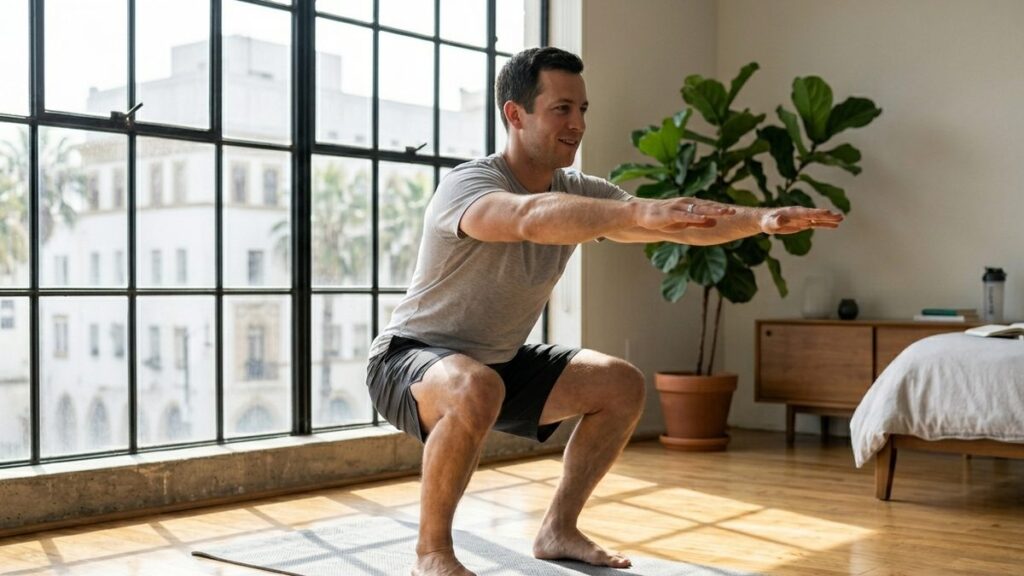
Feet shoulder-width, toes turned out 10–15 degrees. Sit back and down until your thigh creases are below your kneecaps. Heels stay flat, knees track over the second toe. Drive up through the whole foot.
Reverse Lunges — 3 × 8–10 per leg (75 sec rest)
Step backward (not forward — the reverse version is easier on the front knee), drop until your back knee is one inch off the floor, push through the front heel to return. Don’t let the front knee drift inward.
Plank — 3 × 20–45 seconds (60 sec rest)
Elbows under shoulders, forearms parallel, hips level with your shoulders and heels. Squeeze the glutes and brace the abs like you’re about to be poked in the stomach. When you start to shake, count five more seconds and stop — fighting past that with broken form trains nothing useful.
Glute Bridges — 3 × 12–15 (60 sec rest)
Lying on your back, knees bent, feet flat about a foot from your butt. Drive the heels down, lift the hips until your knees, hips, and shoulders form a straight line. Squeeze the glutes hard at the top for one full second. If you feel the lift in your low back, you are over-extending — shorten the range.
Workout B — Full-Body Mix
Workout B trades the floor push-up for an incline variation (recovery for the wrists), adds single-leg posterior chain work, and bolts on anti-rotation core through the side plank.
- Incline push-ups (hands on a sturdy table or counter) — 3 × 8–12, 90 sec rest
- Bodyweight squats — 3 × 12–20, 90 sec rest
- Single-leg glute bridges — 3 × 8 per side, 60 sec rest between sides
- Mountain climbers — 3 × 30 seconds, 45 sec rest
- Side plank — 2 × 20–30 seconds per side, 45 sec rest
The single-leg glute bridge is the unsung hero here. It catches the side-to-side strength imbalance every desk worker shows up with, and within three weeks the weaker side almost always closes most of the gap.
Per-Exercise Form Library
This is the cue library I use one-on-one with clients. Setup, execution, two cues. If something feels wrong, the answer is almost always in here.
Push-up. Setup: hands slightly wider than shoulders, fingers spread, middle finger pointing forward, feet together. Execution: brace the abs, lower in one piece until the chest grazes the floor, press back up. Cues: “screw the hands into the floor” (engages the shoulders), “ribs down” (kills the low-back sag).
Bodyweight squat. Setup: feet shoulder-width, toes 10–15 degrees out, arms forward for balance. Execution: hips back first, then knees bend, descend until thigh creases are below the kneecap. Cues: “spread the floor” (knees track out), “chest tall through the bottom” (prevents folding).
Reverse lunge. Setup: tall stance, hands on hips. Execution: long step back, drop the back knee toward the floor, drive up through the front heel. Cues: “front shin vertical at the bottom” (protects the knee), “back toe pushes the floor away” (recruits the glute).
Plank. Setup: forearms parallel, elbows directly under shoulders, toes tucked. Execution: lift the hips so the line from heels to crown is straight, hold. Cues: “tuck the tailbone an inch” (kills the low-back dump), “pull the elbows toward the toes” (engages the lats).
Glute bridge. Setup: knees bent at 90 degrees, feet flat, arms at sides. Execution: drive through the heels, lift hips to a straight line. Cues: “ribs stay glued down” (prevents back arch), “knees track over the second toe.”
Mountain climber. Setup: top of a push-up position, hands under shoulders. Execution: drive one knee at a time toward the chest, alternating, at a controlled pace. Cues: “hips stay low” (don’t let the butt pop up), “soft on the foot landings.”
Side plank. Setup: lying on your side, bottom elbow under shoulder, legs stacked. Execution: lift the hips so the body is one straight line. Cues: “push the floor away with the elbow” (locks the shoulder), “stack the hips vertically.”
Troubleshooting Matrix
Every common complaint, what it actually means, and what to do about it. This table is built from the issues that come up over and over with new clients — most of them in week 2.
| Symptom | Likely Cause | Fix / Regression |
|---|---|---|
| Wrist pain in push-ups | Cold wrists + 90-degree hand position under bodyweight | 5 wrist circles each direction pre-set; switch to push-up handles or fists; or do incline push-ups for 2 weeks |
| Knees cave in on squats or lunges | Weak glute medius, lazy foot | Cue “spread the floor”; add 10 lateral band steps pre-workout (or air-band — just the cue) |
| Low-back ache during plank | Hips dumping, no glute engagement | Tuck tailbone, squeeze glutes; shorten hold to 15 sec with clean form |
| Neck strain during core work | Pulling head forward, breath-holding | Tongue on roof of mouth, look at the floor 30 cm in front of you, exhale through the hold |
| Hip pinch at the bottom of a squat | Hip impingement or limited ankle dorsiflexion | Turn toes out 5 more degrees; squat to a chair until the pinch clears |
| Whole body shaking past 50% of a set | Neural fatigue or under-fuelled | End the set; eat 30–40 g carbs 60–90 min before the next session |
| Heels lift during squats | Tight calves / poor ankle mobility | Squat to a chair; 30 sec calf stretch pre-session per side |
The wrist one accounts for roughly one in five of the beginners I’ve worked with quitting between week 1 and week 3. The fix is mechanical and immediate — not a sign your body “isn’t built for push-ups.”
4-Week Progression Gates
Beginner programs fail when they confuse “showing up” with “progressing.” These are objective gates. You either clear them or you don’t, and the answer tells you whether to advance, repeat, or scale.
- End of Week 1. You can complete every prescribed set at the low end of the rep range with form holding through the last rep. If not, repeat Week 1 — don’t add reps over broken form.
- End of Week 2. You can add 1–2 reps to any set that felt 3/5 or easier last week. Plank holds extend by at least 5 seconds.
- End of Week 3. You can hit the top of every rep range, and the 4th set on push-ups and squats is doable (even if scrappy). Plank crosses 40 seconds.
- End of Week 4 — Graduation Gates. All three of: 12 strict push-ups in a single set (real push-ups, not knee), 20 strict bodyweight squats, 60-second plank with clean form. Hit all three? Move on. Miss any? Run Weeks 3 and 4 again — that’s not failure, that’s how the foundation actually gets built.
For deeper push-up programming once you graduate, see our push-up progression guide.
5-Minute Rest-Day Mobility Flow
Tuesdays, Thursdays, weekends. Five minutes, lying on a mat, no intensity. The point is to undo the desk damage and feed the joints between training sessions.
- Hip flexor stretch — half-kneeling, 45 seconds per side. Tuck the tailbone before you push the hips forward.
- T-spine open book — side-lying, knees stacked, rotate the top arm across to the opposite side, 8 reps per side.
- Hamstring strap or towel stretch — supine, leg up, 45 seconds per side.
- Ankle wall dorsiflexion — knee to wall drill, 10 reps per side.
- Child’s pose with side reach — 30 sec centre, 30 sec each side.
A 20- to 30-minute walk on top of this counts as “active recovery” and adds toward the WHO weekly aerobic target of 150–300 minutes of moderate activity (Source: WHO Guidelines on Physical Activity and Sedentary Behaviour, 2020).
If the Plan Is Too Hard — or Too Easy
Too hard. If you can’t hit the low end of a rep range with clean form:
- Push-ups → incline push-ups (table) → wall push-ups
- Squats → box squats to a chair → assisted squats holding a doorframe
- Plank → forearm plank from the knees → 15-second holds
- Reverse lunges → split squats holding a wall for balance
Too easy. If the top of every range feels light by Week 2, you’re not actually a beginner. Two options:
- Skip ahead to our beginner calisthenics routine, which assumes the gates above are already cleared.
- Or stay in this plan and add a 3-second eccentric (descent) to every rep. That single tempo change roughly doubles time under tension and is brutal even on familiar movements.
What to Expect at the End of Week 4
The honest version, not the marketing version:
- Push-ups: +3 to 8 reps on your max set. If you started from knees, the first 1–3 full push-ups usually appear in Week 3 or 4.
- Squats: +5 to 10 reps on the max set.
- Plank: +15 to 30 seconds on your max hold.
- Energy: noticeably better, especially the mid-afternoon crash. This effect usually shows up in Week 2 and is the single most reliable change clients report.
- Visible change. Mostly postural — shoulders sit back, abs feel firmer when you brace, jeans fit a little different at the waist. Visible muscle definition takes 8 to 12 weeks of consistent training plus an honest nutrition setup. Anyone selling four-week six-pack transformations is selling lighting.
After Week 4 — Graduation Targets
You clear all three gates (12 push-ups, 20 squats, 60-second plank), now what?
- For more bodyweight progression: beginner calisthenics routine.
- For higher frequency and split work: 5-day home workout plan.
- For leg-specific depth: beginner leg workout at home.
- For a long-term path to your first pull-up.
- If you’ve picked up a pair of dumbbells: dumbbell + bodyweight hybrid plan.
Notes for Women, Over-40, and Over-50 Beginners
The plan works as written for any sex. A few adjustments worth knowing:
Women. Nothing in the prescription changes. If you train cycle-aware, the heavier rep-out days (Week 3 top of range, Week 4 test) feel best in the follicular phase. Pelvic floor: avoid breath-holding on plank and glute bridge — exhale on effort. For a fuller cycle-aware track, see our workout plan for women at home.
Over-40. Add a full extra minute of warm-up (joint circles for wrists, shoulders, hips, ankles). Recovery between sessions matters more than the work itself — keep 48 hours minimum. Strength training twice a week is a defence against the roughly 3–8% per decade muscle loss (sarcopenia) that starts in the 30s and accelerates after 60.
Over-50. Start Week 1 with all regressions: incline push-ups, box squats, forearm plank from knees. There’s no rush to the floor version. Clear your doctor first if you have heart disease, joint replacement, or are returning from injury.
What the Science Says
The dose in this plan is not a vibe — it sits inside the international guidelines.
The U.S. Physical Activity Guidelines for Americans, 2nd edition, recommends that adults do muscle-strengthening activities involving all major muscle groups on two or more days a week, plus at least 150 minutes of moderate-intensity aerobic activity weekly (Source: ODPHP / health.gov, 2018). Three full-body bodyweight sessions hits the strength floor with one session in reserve. Adding a 20–30 minute walk on rest days clears the aerobic floor.
The WHO 2020 guidelines mirror this and add an upper bracket: 150–300 minutes of moderate aerobic activity per week, with muscle-strengthening on at least two days (Source: WHO, 2020).
For the rep prescription specifically — sets of 8–12 at 2–3 sessions per week for untrained adults — this comes straight from the long-running ACSM position stand on resistance training progression (Source: American College of Sports Medicine Position Stand, Medicine & Science in Sports & Exercise, 2009). ACSM published a flexibility-first update to the novice recommendation in 2026, broadening the acceptable range, but the 8–12 / 2–3 day prescription remains a known-effective starting point (Source: ACSM, 2026).
If you’re rebuilding from a fully sedentary baseline and want a slower on-ramp, the NHS Couch to Fitness programme is the conservative public-health version of this same idea (Source: NHS, 2025).
Printable 4-Week PDF
The full 4-week calendar, weekly sets/reps/rest, the troubleshooting matrix, and the graduation gates — formatted to one sheet for the fridge. [CTA: Download the free printable PDF.]
Home Workout Plan for Beginners FAQ
How many days a week should a beginner work out at home?
Three days a week is the sweet spot for true beginners — usually Monday, Wednesday, Friday with rest days between. This matches the U.S. Physical Activity Guidelines minimum of two strength sessions per week with one extra day of buffer for missed workouts. Four or more days a week before you’ve cleared the Week 4 graduation gates typically produces joint flare-ups in the wrists, elbows, or knees.
Can a beginner build muscle with bodyweight only?
Yes, for the first 4 to 6 months. New trainees get strength and size gains from almost any progressive resistance stimulus, including bodyweight. After roughly 6 months, you’ll need to add load (a backpack, dumbbells, a pull-up bar) or shift to harder leverages (one-arm progressions, pistol squats) to keep progressing.
How long until I see results from a home workout plan?
Energy and mood changes appear in Week 2. Strength gains (more reps, longer plank holds) appear by Week 4. Postural change (shoulders back, more upright stance) is visible at Weeks 4 to 6. Visible muscle definition takes 8 to 12 weeks of consistent training plus a nutrition setup that supports it.
Is 20–30 minutes a day enough for beginners?
Yes. Three 30-minute strength sessions per week, plus 20–30 minutes of walking on rest days, clears both the strength and aerobic floors in the U.S. Physical Activity Guidelines for adults. Longer sessions tend to reduce consistency without improving outcomes for true beginners.
Do I need any equipment to start?
No. The full 4-week plan uses only your bodyweight, the floor, and a wall. A sturdy chair or low table is useful for incline push-ups and box squats but not required. Once you graduate, a doorway pull-up bar (€20–€40) is the highest-leverage equipment upgrade.
What should a beginner do on rest days?
A 5-minute mobility flow (hip flexor, t-spine, hamstring, ankle, child’s pose) plus 20–30 minutes of walking. Skip structured cardio (running, cycling intervals) for the first 4 weeks — it adds recovery demand without speeding up early strength gains.
How do I know when I’ve graduated from beginner level?
Three objective gates: 12 strict push-ups in a single set, 20 strict bodyweight squats, and a 60-second plank hold with clean form. Hit all three and you’re ready for an intermediate program. Miss any one and run Weeks 3 and 4 again before moving on.
Is this plan safe for women, over-40, or post-injury beginners?
For women: yes, with no changes to the prescription — exhale on effort to protect the pelvic floor. For over-40: yes, with an extended warm-up and strict 48-hour rest between sessions. Over-50 or post-injury beginners should start with all regressions (incline push-ups, box squats, plank from knees) and clear the plan with a physician first.
The Bottom Line
Three sessions a week, two alternating bodyweight workouts, four weeks, and three objective gates at the end. Show up, log your reps, respect the rest days, and don’t fight past form breakdown. The graduates of this plan unlock a much bigger menu — calisthenics progressions, 5-day splits, or dumbbell hybrids — but the foundation here is what makes any of those work.
Sources
- Physical Activity Guidelines for Americans, 2nd edition — ODPHP / health.gov, 2018
- WHO Guidelines on Physical Activity and Sedentary Behaviour — World Health Organization, 2020
- ACSM Position Stand: Progression Models in Resistance Training for Healthy Adults — Medicine & Science in Sports & Exercise, 2009 / ACSM update 2026
- NHS Live Well: Exercise / Couch to Fitness — NHS UK, 2025


Pingback: Dumbbell Workout Plan PDF: Free 4-Week Routine