

Last updated: May 2026 — written by James Nolan, Gymnase Tips senior trainer.
Gymnase Tips is reader-supported. Some links in this guide are Amazon affiliate links — if you buy through them we may earn a small commission at no extra cost to you. See our full disclosure.
Military calisthenics for men over 50 uses the same proven exercise library — push-ups, pull-ups, sit-ups, squats, lunges — with critical modifications: training drops to 4 days per week (not 6), burpees are replaced with step-ups to protect knees, the warm-up extends to 10 minutes for joint preparation, and an extra 1-2 rest days are built in during the first month for connective tissue adaptation. Most men over 50 add 8-15 reps to their push-up max, drop 60-90 seconds from their 1-mile time, and lose 4-7 pounds of body fat across the 8-week modified program. The plan is designed for healthy men over 50 with no major joint issues — those with prior knee, shoulder, or back surgery should consult a physical therapist before starting.
This guide covers what changes in the over-50 protocol versus the standard plan, the 7 modified exercises with form cues, the complete 8-week schedule, the warm-up routine that prevents most over-50 injuries, scaling for joint-affected trainees, and how to continue past week 8.
Why the standard plan needs modification after 50
- Connective tissue adapts 30-50% slower after 50. Tendons and ligaments heal slower than muscle at any age — and the gap widens with age. Standard 6-day military rotations cause overuse injuries within 4-6 weeks for most men over 50.
- Joint compression sensitivity increases. Burpees, jump squats, and high-impact movements that 25-year-olds tolerate fine produce knee, ankle, and lower back issues for many over-50 trainees within 2-3 weeks.
- Warm-up requirements grow. Cold joints under load injure easily after 50. The 5-minute warm-up that suffices for younger lifters needs to extend to 10 minutes minimum.
- Recovery between sessions stretches. Muscle protein synthesis after training stays elevated for 48-72 hours after 50 (vs 24-48 hours for younger trainees). More rest days produce better gains, not worse.
- Pull-up bar grip becomes a limiter. Grip strength declines roughly 1% per year after 35. Pull-up volume needs to start lower and ramp slower.
Key modifications
- 4 days per week (not 6) — Mon, Wed, Fri training + Sat long walk
- Burpees → step-ups on a sturdy chair or bench (12-18 inch height)
- Jump squats → bodyweight squats only — no impact
- Mountain climbers → bird dogs for core work
- Sit-ups → dead bugs or modified crunches if lower back is sensitive
- Standard pull-ups → assisted or band pull-ups for the first 8 weeks
- 10-minute warm-up (vs 5 min) before every session
- Extra rest day after week 4 if soreness persists
The 10-minute over-50 warm-up
- 0-2 min: Easy walking in place or around the room
- 2-4 min: Arm circles (large, both directions), shoulder rolls, neck rotations
- 4-6 min: Hip circles, leg swings (front-back, side-side), ankle rotations
- 6-8 min: 10 bodyweight squats (slow, full ROM), 10 wall push-ups, 10 cat-camel
- 8-10 min: 10 hip bridges, 10 bird dogs, 5 deep breaths
This warm-up is non-negotiable. Most over-50 training injuries happen in the first 5 minutes of the working sets when joints aren’t fully prepped.

The 7 modified exercises
1. Push-up (or knee push-up)
Standard form. If standard push-ups fail before 8 reps, use knee push-ups for the first 4 weeks, then transition. Form cue: if shoulders ache during push-ups, narrow your hand position to shoulder-width — wider hand placement irritates the shoulder capsule for many over-50 trainees.
2. Assisted pull-up (band or jump-assist)
Use a thick resistance band looped over the bar and under one foot for assistance. Or jump up to chin-over-bar position and lower under control (negative pull-up). Build to strict pull-ups gradually over 12-16 weeks.
3. Bodyweight squat
Hip crease at or just below knee level (not deeper). Feet shoulder-width, knees tracking over toes. Over-50 cue: if knees pop or grind in deep squats, stop just above parallel — the marginal benefit of deeper depth isn’t worth joint damage.
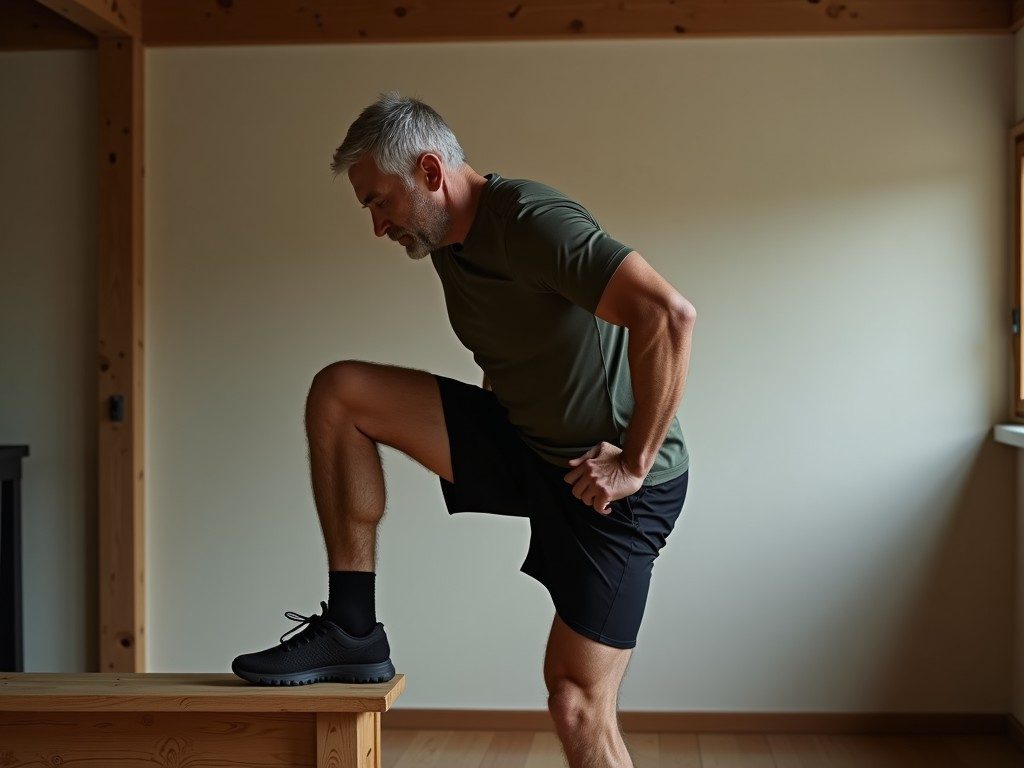
4. Step-up (replaces burpee)
Use a sturdy chair, bench, or step (12-18 inch height). Step up with one leg, drive through the heel to stand fully, lower under control. Alternate legs. Why it replaces burpees: step-ups deliver similar conditioning stimulus without the impact of jumping or rapid floor-to-standing transitions.
5. Reverse lunge
Step backward into lunge (gentler on knees than forward lunge). Front knee over ankle, back knee almost touches floor. Drive through front heel to return. Alternate legs.
6. Dead bug (replaces sit-up)
Lying on back, arms extended toward ceiling, knees bent at 90 degrees. Slowly lower opposite arm and leg toward the floor while keeping lower back pressed to the floor. Why it replaces sit-ups: dead bugs train deep core stability without lumbar spine flexion that aggravates lower back issues common after 50. For the full progression ladder and back-pain protocol, see our dead bug exercise guide.
7. Plank
Forearm plank, body rigid head-to-heels, hips neither sagging nor piking. Builds isometric core strength without spine compression. Hold 30-60 seconds depending on level.
The 8-week modified schedule
Week 1-2 — Baseline
- Mon (Strength): 3 rounds — 10 push-ups, 5 assisted pull-ups, 15 bodyweight squats, 10 dead bugs (each side), 30s plank, 90s rest between rounds
- Wed (Conditioning): 20-min walk + 4 rounds of 10 step-ups per leg, 75s rest between rounds
- Fri (Strength): 3 rounds — 10 push-ups, 5 assisted pull-ups, 12 reverse lunges per leg, 10 dead bugs, 30s plank, 90s rest
- Sat (Walk): 30-60 minute walk at conversational pace
Week 3-4 — Volume
- Same circuits, add 1 round (4 rounds total)
- Push-ups → 12 reps; assisted pull-ups → 6 reps; squats → 18 reps; plank → 40s
- Wednesday step-up rounds → 12 reps per leg
- Saturday walk → 45-75 minutes
Week 5-6 — Density
- Back to 3 rounds, but cut rest to 60 seconds
- Push-ups → 14 reps; pull-ups → first attempts at strict (1-3 reps) with assisted rounds after; squats → 20 reps
- Wednesday step-ups → 15 reps per leg
- Add 5 wall push-ups at end of strength sessions
Week 7 — Peak
- 4 rounds: 16 push-ups, 8 pull-ups (assisted or strict), 22 squats, 12 reverse lunges, 50s plank, 45s rest
- Wednesday: 25-min walk + 5 rounds of 15 step-ups per leg
- Saturday: 60-90 minute walk + 5 rounds of 10 push-ups
Week 8 — Test + Deload
- Mon: Active recovery — 30-min walk + 10 min mobility
- Tue: 2-min max push-ups, max strict pull-ups, 1-mile timed walk-jog (record times)
- Wed: Rest
- Thu: 60-minute walk + 30s plank x 5
- Fri: Rest
- Sat: Week 1 strength circuit at 2 rounds (deload)
What to expect
- End of week 2: Initial neural strength gains. Push-up max +3-5 reps. Joint stiffness in mornings reduces noticeably.
- End of week 4: Push-up max +5-10 reps. Walking pace improves. Better posture and balance.
- End of week 6: First strict pull-up achievable for many. Visible muscle definition in shoulders and chest. 2-4 lb body composition change.
- End of week 8: Push-up max +8-15 reps. 1-mile time -60-90 seconds. 4-7 lb body composition change. Joints feel more stable, mobility noticeably better, sleep quality improved.
When to back off
Listen to your body. Stop the working session and add an extra rest day if you experience:
- Sharp joint pain (vs muscle soreness — soreness is fine)
- Persistent fatigue lasting more than 48 hours
- Trouble sleeping after evening sessions (try moving training to morning)
- Elevated resting heart rate for 3+ consecutive days
- Any swelling in joints (knees, elbows, shoulders)
The over-50 plan is conservative by design — pushing harder doesn’t accelerate gains, it accelerates injuries.
How to continue past week 8
- Cycle 2 (weeks 9-16): Repeat the 8-week plan with new starting reps based on week-8 test numbers. Add 10% volume.
- Add a 5th day only after cycle 2 if recovery feels easy. Tuesday becomes a light circuit day.
- Add light weights after cycle 2 — 5-10 lb adjustable dumbbells for goblet squats, 8-12 lb for shoulder press.
- Focus on weak link. If pull-ups stayed assisted through week 8, dedicate cycle 2 to pull-up specialization.
Military Calisthenics for Men Over 50 FAQ
Is it too late to start at 60+?
No. Strength gains are achievable at any age. Research consistently shows even men in their 70s and 80s gain measurable strength and muscle from structured bodyweight training within 12 weeks. Start at 50% of prescribed volume, ramp gradually, and consult your doctor if you have known cardiovascular conditions.
What if I have knee or back issues?
Consult a physical therapist before starting. Most knee and back issues respond well to modified bodyweight work — wall sits instead of squats, dead bugs instead of sit-ups, walking instead of step-ups. The exercise library is flexible enough to accommodate most physical limitations.
Can I still build muscle after 50?
Yes. Muscle protein synthesis declines but doesn’t stop. Most untrained men over 50 gain 3-6 lb of lean muscle in their first 12 weeks of structured calisthenics. Past month 3, gains slow and require progressive overload (weighted vest, harder variations) to continue.
Should I take supplements?
A quality creatine monohydrate (3-5g daily) has the strongest evidence for older trainees — improves strength gains, supports cognitive function, well-tolerated. Adequate protein intake (0.8-1g per lb of bodyweight) matters more than any supplement. See our muscle-building nutrition fundamentals.
How much weight will I lose?
4-7 lb of body composition change in 8 weeks is typical with the plan plus a moderate caloric deficit (300-400 kcal/day). The training drives the muscle preservation; the deficit drives the fat loss.
Can I add running to this plan?
Yes — light running (under 30 min, conversational pace) on Wednesday or Saturday. Avoid hard runs on strength days. Many men over 50 do better with brisk walking + occasional 1-2 minute jog intervals than with continuous jogging.
Is there a printable version of this plan?
Yes — the schedule tables above are designed to be screenshot-printed. For other printable formats see our military workout PDF and 8-week printable plan.
The bottom line: military calisthenics for men over 50 uses the same proven exercise library with smart modifications — 4 days/week instead of 6, step-ups instead of burpees, dead bugs instead of sit-ups, 10-minute warm-up. Most men over 50 add 8-15 reps to push-up max, drop 60-90 seconds from 1-mile time, lose 4-7 lb in 8 weeks. The plan respects what changes after 50 (slower connective tissue adaptation, joint sensitivity, longer recovery) without abandoning what works (compound bodyweight movements, periodization, structure). For more options see our military calisthenics complete guide, leg strengthening for seniors, and printable military workout PDF.



Pingback: 8-Week Military Calisthenics Plan: Free Printable PDF (2026)
Pingback: Military Workout PDF: Free 4-Week Printable Plan (2026)
Pingback: Military Calisthenics: Complete 2026 Guide + 4-Week Plan